2Stage Elite 9 (dual rear shock) bike test
by Simon Paton
Feb 25, 2009
"I'll have an "E" please Bob", was a famous quip on Blockbusters quiz show that ran for ages here in the U.K. Basically the challenge was two contestants pitted against one, was two heads better than one? Maybe... Our question today is are two shocks better than one?
2Stage Bikes of New Zealand is asking that question today...
Photos: Ryan Corbyn
www.ryancorbyn.com
Location: Kinver Edge
Words: Si Paton
New Zealander and design engineer Roland is the brains behind this design and the 2Stage twin air shock technology. Word is in the middle of the night he awoke, jumped out of bed and started fiddling with his sons Lego Technics set. Three years later and plenty of track side research and development and numerous trips back to the drawing board to create an active stable platform technology where the threshold was delivered by the rider input, rather than the course you were descending down.
A full and further five whole years later from that first prototype and the 2Stage team have two bikes in full production. The Elite 9 as featured here for Downhill and the Zed 8 for "Free Ride". All Mountaineers don't fret, there is a bike currently in development for you.
Were any of you riding around Europe in 2007? You might of bumped into their top New Zealand Pro Glenn Haden at the Megavalanche winning the Sprint DH race? Or did you see him win the Italian National Championship Series? Race proven? The facts are there, he is also current 2008 New Zealand Downhill National Champion.
Glenn Haden 2Stage Bikes in Action:
In summary:
Primarily you are looking for a frame-set that has all the right angles and dimensions for riding and racing Downhill on. Many a bike company can tick that box, I mean all you need is a set square, protractor and half an "O" Level in welding don't you?
Suspension set-up, that's the key isn't it to making sure, 100% your back tyre sticks to the floor like sh1t sticks to a blanket. More traction time means faster acceleration when you are stomping on those flat pedals, better handling in corners and smoothing out the lumps and bumps we encounter over those three minutes, 22 seconds.
Axle paths? The first axle path is almost vert, following small bumps. The second axle path moves rearward following the trajectory of those big square rocks you keep hitting.
There are plenty of great shock companies out there that for years have been delivering the above, Fox, RockShox, Marzocchi, Manitou, Millyard etc. Then if you are really fussy then getting them tuned up by a professional is your next advancement up the ladder.
All the above happened with single pivot bikes, was the next step linkages? Yes linkages! Lawhill worked and felt so nice, I loved my Schwinn Straight 8, then it was all about pedaling as well, VPP, DW Link and some others.
What is next? Well anybody remember Scott dabbling with two shocks on their bikes a decade ago? I am not even going to mention that huge 8ft long seat that bolted onto the top tube. I think they got that idea from Skyway's BMX bolt on Freestyle Platform. Heath Robinson to say the least.
Well let's go down this two shocks road, surely there is some mileage down there. Especially now we are all talking about Air Shocks and their coming of age. Can I just say now my 1996 Foes DH Mono came with a Fox Air Shock, OK it lasted about two minutes but Airs have been about for a long, long time.
Many still condemn air forks and shocks that deliver more than 6 inches of travel. Will that be different here?
As the 2Stage system shares its 9inches of travel between both shocks, the first stage (top shock) uses five inches of travel. The second stage (bottom shock) uses four inches of travel. Therefore sharing the work load nicely and keeping all you air shock doubters more than happy.
On a 2Stage the first shock works at low pressure which takes care of all the small fast bumps. The second shock kicks in at the end of the first shock's stroke and is set at a higher pressure – this takes care of the big stuff.
Floating brake arms in simple terms that I can understand: This uncouples the braking from the suspension, in many bikes this locks the suspension out and it feels like your riding down steps. You can now brake later, even in those braking bumps and save those fractions of seconds whilst keeping hold of your false teeth.
Glenn Haden confirms this suspension system works and I agree with him. The 2Stage story is not over yet though, more tricks up their sleeve! They have got the suspension dialed but what about your pedaling, you don't want this to behave like a pedalo on Benidorm beach do you? Let me introduce the "Idle Cog", not a new invention but certainly tried and tested as seen on the likes of Canfields, Balfa, Appalache and even Trek. What benefits does this Idle Cog give you then? This routes the chain between the two pivot points keeping the suspension active on small hits with zero pedal feedback. It also cleverly locks out the second stage shock during accelerating. Chain tension here provides that lockout function and limits the travel of the bike by half. The first stage shock is still active whilst you pedal, in fact the harder you pedal the firmer the pedaling platform is.
Pivot Points? With suspension bikes your pivots are usually the problem come maintenance time. How many pivots here? There are two main pivot points so not as complicated as it looks. The lower pivot is for those small hits and delivers a short chain stay, good for those tight spots such as Inners, Bringewood and Caersws. The top pivot point is for those big wallops, that happen deeper in the stroke meaning a longer wheelbase for stability at high speeds, Fort William, Sun Peaks and Praloup etc.
To wrap this up I've ridden and raced plenty of the top bikes out there, all with single shocks that worked brilliantly. This two shock system performed just as well as any of my previous test rigs and in many cases pedaled even better. My answer for Bob (Blockbusters) is two better than one? Yes, coupled with an idler cog, frame design, linkages, pedal factor and reliability I know 2Stage are onto a winner.
There will be a lot of doubters out there as I'm sure we will see in the posts below. That's what it's there for so go fill your boots and comment to your hearts content. It will be really interesting to see what you guys think.
In the UK, Team Fenwicks are a four man strong team and signed up to race the 2Stage Bikes under the direction of John Smith in 2009 so keep em peeled! 2Stage also run a team of young guns who race for them in their “2Stage Academy” at UK National level. 2009 will be a big year for 2Stage as they have registered as a trade team to race in UCI World Cups. “2Stage Factory” will be making an announcement about their 2009 team in the coming weeks.
UK Dealers:
With an increasing list of accredited dealers around the UK it’s pretty easy to find a 2Stage bike to demo. A list of 2Stage dealers is up on the 2Stage website. www.2stagebikes.com.
Stay Unclipped.
Si Paton.
www.Descent-Gear.com
Track side and Online.
www.ryancorbyn.com
Location: Kinver Edge
Words: Si Paton
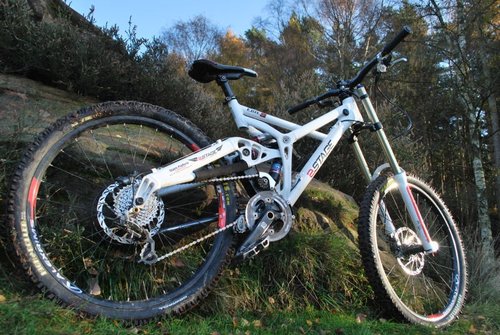
New Zealander and design engineer Roland is the brains behind this design and the 2Stage twin air shock technology. Word is in the middle of the night he awoke, jumped out of bed and started fiddling with his sons Lego Technics set. Three years later and plenty of track side research and development and numerous trips back to the drawing board to create an active stable platform technology where the threshold was delivered by the rider input, rather than the course you were descending down.
A full and further five whole years later from that first prototype and the 2Stage team have two bikes in full production. The Elite 9 as featured here for Downhill and the Zed 8 for "Free Ride". All Mountaineers don't fret, there is a bike currently in development for you.
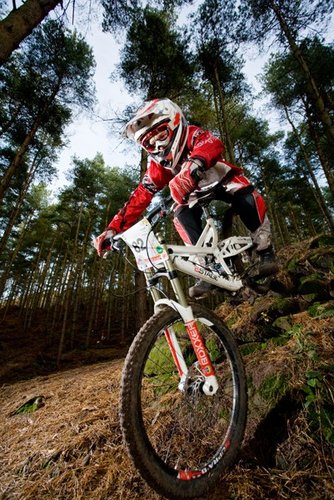
Were any of you riding around Europe in 2007? You might of bumped into their top New Zealand Pro Glenn Haden at the Megavalanche winning the Sprint DH race? Or did you see him win the Italian National Championship Series? Race proven? The facts are there, he is also current 2008 New Zealand Downhill National Champion.
In summary:
Primarily you are looking for a frame-set that has all the right angles and dimensions for riding and racing Downhill on. Many a bike company can tick that box, I mean all you need is a set square, protractor and half an "O" Level in welding don't you?
Suspension set-up, that's the key isn't it to making sure, 100% your back tyre sticks to the floor like sh1t sticks to a blanket. More traction time means faster acceleration when you are stomping on those flat pedals, better handling in corners and smoothing out the lumps and bumps we encounter over those three minutes, 22 seconds.
Axle paths? The first axle path is almost vert, following small bumps. The second axle path moves rearward following the trajectory of those big square rocks you keep hitting.
There are plenty of great shock companies out there that for years have been delivering the above, Fox, RockShox, Marzocchi, Manitou, Millyard etc. Then if you are really fussy then getting them tuned up by a professional is your next advancement up the ladder.
All the above happened with single pivot bikes, was the next step linkages? Yes linkages! Lawhill worked and felt so nice, I loved my Schwinn Straight 8, then it was all about pedaling as well, VPP, DW Link and some others.
What is next? Well anybody remember Scott dabbling with two shocks on their bikes a decade ago? I am not even going to mention that huge 8ft long seat that bolted onto the top tube. I think they got that idea from Skyway's BMX bolt on Freestyle Platform. Heath Robinson to say the least.
Well let's go down this two shocks road, surely there is some mileage down there. Especially now we are all talking about Air Shocks and their coming of age. Can I just say now my 1996 Foes DH Mono came with a Fox Air Shock, OK it lasted about two minutes but Airs have been about for a long, long time.
Many still condemn air forks and shocks that deliver more than 6 inches of travel. Will that be different here?
As the 2Stage system shares its 9inches of travel between both shocks, the first stage (top shock) uses five inches of travel. The second stage (bottom shock) uses four inches of travel. Therefore sharing the work load nicely and keeping all you air shock doubters more than happy.
On a 2Stage the first shock works at low pressure which takes care of all the small fast bumps. The second shock kicks in at the end of the first shock's stroke and is set at a higher pressure – this takes care of the big stuff.
Floating Brake Arm, recommended with. Though it is easily taken off if you wish to use the regular mounting set up.
Floating brake arms in simple terms that I can understand: This uncouples the braking from the suspension, in many bikes this locks the suspension out and it feels like your riding down steps. You can now brake later, even in those braking bumps and save those fractions of seconds whilst keeping hold of your false teeth.
Glenn Haden confirms this suspension system works and I agree with him. The 2Stage story is not over yet though, more tricks up their sleeve! They have got the suspension dialed but what about your pedaling, you don't want this to behave like a pedalo on Benidorm beach do you? Let me introduce the "Idle Cog", not a new invention but certainly tried and tested as seen on the likes of Canfields, Balfa, Appalache and even Trek. What benefits does this Idle Cog give you then? This routes the chain between the two pivot points keeping the suspension active on small hits with zero pedal feedback. It also cleverly locks out the second stage shock during accelerating. Chain tension here provides that lockout function and limits the travel of the bike by half. The first stage shock is still active whilst you pedal, in fact the harder you pedal the firmer the pedaling platform is.
Pivot Points? With suspension bikes your pivots are usually the problem come maintenance time. How many pivots here? There are two main pivot points so not as complicated as it looks. The lower pivot is for those small hits and delivers a short chain stay, good for those tight spots such as Inners, Bringewood and Caersws. The top pivot point is for those big wallops, that happen deeper in the stroke meaning a longer wheelbase for stability at high speeds, Fort William, Sun Peaks and Praloup etc.
To wrap this up I've ridden and raced plenty of the top bikes out there, all with single shocks that worked brilliantly. This two shock system performed just as well as any of my previous test rigs and in many cases pedaled even better. My answer for Bob (Blockbusters) is two better than one? Yes, coupled with an idler cog, frame design, linkages, pedal factor and reliability I know 2Stage are onto a winner.
There will be a lot of doubters out there as I'm sure we will see in the posts below. That's what it's there for so go fill your boots and comment to your hearts content. It will be really interesting to see what you guys think.
In the UK, Team Fenwicks are a four man strong team and signed up to race the 2Stage Bikes under the direction of John Smith in 2009 so keep em peeled! 2Stage also run a team of young guns who race for them in their “2Stage Academy” at UK National level. 2009 will be a big year for 2Stage as they have registered as a trade team to race in UCI World Cups. “2Stage Factory” will be making an announcement about their 2009 team in the coming weeks.
UK Dealers:
With an increasing list of accredited dealers around the UK it’s pretty easy to find a 2Stage bike to demo. A list of 2Stage dealers is up on the 2Stage website. www.2stagebikes.com.
Stay Unclipped.
Si Paton.
www.Descent-Gear.com
Track side and Online.
Must Read This Week
- 1. Brian Bartlett - Left Side Inc. 30492 reads
- 2. World Speed Record - Richard "Gaspi" Gasperotti 24160 reads
- 3. STUND Episode 5 - Watch Now! 23280 reads
- 4. Custom Specialized S-Works Enduro Carbon - Preview 19403 reads
- 5. Andrew Taylor - Bike Check 15776 reads
- 6. Brett Rheeder Web Edit 15505 reads
- 7. Tyler McCaul - Bike Check 15448 reads
- 8. Joyride 150 - Markham Ontario 14714 reads
128 Comments
Actually, its the Karpiel Apocalypse, My bike. Its made for extremely tech DH, and Freeriding. It actually completely different, this one and the corsair are both blow off shocks, they are only activated after the full travel of one shock has been blown through. On the apocalypse, it works 1/3 of the way, which makes a smoother transition than these. But The two stage bikes are really nice
Not really, it just depends on what pressure your shock is set at, you can make it so the first shock is soft, then the second just a little stiffer, then in that way the 2nd shock can begin is travel whenever you like, you could have it at the same time, 1/4, 1/2, 3/4,or all the way. it really up to you. The trick is not to have the second one over the end pressure of the first one, because is that happend, then the first one would finnish its travel, then there would be no travel, then finally the 2nd one would begin its stroke.
idk...crappy suspension and looks super heavy, stick with a dw link bike. who needs more than 8-10 inches anyways
don't forget the original c-dale gemini. they were one of the first to use two shocks from what i can recall.
i totally disagree with suicidedh - no disrespect intended. the apocalypse hasn't really changed much since it was developed. the whole reason the second shock was added was because bender was blowing through the travel so fast that a blow off shock was needed. there were many articles written about this very thing. 2stage is currently the only bike that i am aware of that uses both shocks in conjunction of one another for the entire usable travel, not as a blow off. it is two shocks working as one suspension unit, not two shocks performing separate jobs.
talhaslam, have you been eating retard sandwiches?
i totally disagree with suicidedh - no disrespect intended. the apocalypse hasn't really changed much since it was developed. the whole reason the second shock was added was because bender was blowing through the travel so fast that a blow off shock was needed. there were many articles written about this very thing. 2stage is currently the only bike that i am aware of that uses both shocks in conjunction of one another for the entire usable travel, not as a blow off. it is two shocks working as one suspension unit, not two shocks performing separate jobs.
talhaslam, have you been eating retard sandwiches?
In my opinion... take a look at motocross. Moto bikes have it all figured out, and mountain bikes are essentially a motocross bike without an engine. They went to the single shock way back in the early 80's and haven't gone back to dual shocks yet... Sure, it is set up differently, but same principle in theory. I say, the more simple you can keep a setup, the better it will work. Stop reverting to old technology and "improving" it. Just my two cents...
my question is, why would you ever need a duel rear shock? I mean freeriders for example robbie bourdon and Greg Minaar, they go big and are only using one rear shock.
why the negitive props? I just don't understand why you would need another one, especially for downhill. The goal is to have the lightest bike, and adding another shock doesn't exactly help.
you have neg props because you've missed the point; its not a primary shock and then a blow-off. think of it as one system with independant low and high speed compression (one shock for low, one for high) with independant wheel paths better suited to the low and high individually, its a big improvment as far as tracking etc is concerned.
andres629, the motocross dual shocks were in parallel, and were only used because a single one was not strong enough to handle the lateral load... it is NOT the same principle in theory at all.
i just think things are getting far too complicated, everyone claims they have the new and best suspension, with better features than others.
it could just be me but i think riders should try to improve more.
aye, but a cushy platform is always nice
those who want simplicity buy 224's, those who want high tech mechanics buy things like this. I dont think whether riders want to improve or not is particularly relevant as people that bothered about learning with basics generally train on hardtails, and race on cushy bikes which work through innovation such as the subject matter here.
Ok well for all you who are saying a single shock is better/lighter etc...
Air shocks are by far lighter than a coil shock, so having two is not much of a drawback
The reason for having two shocks is not for strength, or extra travel, It is there to help each pedal stroke you push to make you go further and faster (your suspension is no longer sucking up your pedal strokes) this is because of the separate shocks and their location/geometry, first one (on top) this one is for small bumps, single track, w/e (anything besides large drops, jumps etc..) so by having the first shock there it allows you to pedal hard, and have all your pedal power going to the rear wheel rather than being soaked up by your suspension like on a regular single shock bike where the travel is unrestricted as of to how far it compresses when you pedal. When you are pedaling, it dosent matter how hard you pedal because theforce your applying is not all going down on the bottom bracket, alot of it is in pulling the chain. So when you hit a big drop and you are not crankin on your cranks you land with all the weight resting on your bottom bracket. This is when the second shock comes into play, once you apply enough weight to the bottom bracket it transfers to the second stage where it uses the last 4 inches of it's suspension. Also the inverted axle plays a large role in the 1st. stage of compression when you are pedaling and rollin over small rocks, drops, mounds, jumps. And the path of travel your wheel takes with this vertical axle and double suspension helps your tire stay on the ground more, unlike on a single shock bike where the wheel takes the same path of travel throughout it's entire compression. As where with this shock the first stage soaks up the bumps and keeps your tire glued to the trail (keeping all your weight on it the entire time) unlike the single shock where it could pop up off the ground, or have less traction due to your body weight being somewhere else than the pedals (So when your entire body weight is resting on the pedals you have mximum traction).
Air shocks are by far lighter than a coil shock, so having two is not much of a drawback
The reason for having two shocks is not for strength, or extra travel, It is there to help each pedal stroke you push to make you go further and faster (your suspension is no longer sucking up your pedal strokes) this is because of the separate shocks and their location/geometry, first one (on top) this one is for small bumps, single track, w/e (anything besides large drops, jumps etc..) so by having the first shock there it allows you to pedal hard, and have all your pedal power going to the rear wheel rather than being soaked up by your suspension like on a regular single shock bike where the travel is unrestricted as of to how far it compresses when you pedal. When you are pedaling, it dosent matter how hard you pedal because theforce your applying is not all going down on the bottom bracket, alot of it is in pulling the chain. So when you hit a big drop and you are not crankin on your cranks you land with all the weight resting on your bottom bracket. This is when the second shock comes into play, once you apply enough weight to the bottom bracket it transfers to the second stage where it uses the last 4 inches of it's suspension. Also the inverted axle plays a large role in the 1st. stage of compression when you are pedaling and rollin over small rocks, drops, mounds, jumps. And the path of travel your wheel takes with this vertical axle and double suspension helps your tire stay on the ground more, unlike on a single shock bike where the wheel takes the same path of travel throughout it's entire compression. As where with this shock the first stage soaks up the bumps and keeps your tire glued to the trail (keeping all your weight on it the entire time) unlike the single shock where it could pop up off the ground, or have less traction due to your body weight being somewhere else than the pedals (So when your entire body weight is resting on the pedals you have mximum traction).
seems like a good idea, but all in all too complicated for something that could essentially be done using one shock with progressive spring (first half of the stroke is softer, second is stiffer) like the Foes bikes. pair that up with a Maestro or DW link, and you've got the ideal suspension set-up, minus the weight and expense of an extra shock.
You still are not getting the same hook up and traction as you do with this design
The progressive spring is a good idea but idk if it can still compete with this dual shock design, i wouldn't know.
not ure what your saying, but you get better traction because the suspension responds better to small jumps, mounds, drops, stumps, rocks w/e and it keeps your tire on the ground more, and with more weight on it so you are recaiving better traction while crankin through these rough sections
i've read this whole thing and people say that the second shock is used as a "backup" or somthing like that but the system of this bike uses both shocks in the way that (timhorton) had said wich makes it a waaay smoother ride, landing etc. But amazing bike.
The article says that in the "fully active" 1st stage of travel, the harder you pedal, the stiffer the "pedal platform" becomes. Unfortunately, that statement is 100% contradictory. The term "fully active" means the suspension is not effected by braking or pedaling at all.
The reason the 2 stage design stiffens when you pedal harder is because chain tension limits the activity of the suspension. This is something most designers try to avoid like the plague because limiting travel/activity reduces traction, and the accompanying pedal feedback can ruin drivetrains and cause further performance issues.
So anyway, bumps will feel bigger and rob more traction on a bike that stiffens while pedaling than they would on a fully active bike, that is just simple logic. Not trying to be a neg. nancy here, and I'm not knocking the entire 2 stage design, but after reading this article I know almost nothing more than I could've learned from looking at the pictures. mainly just non-credible and random opinions with plenty of misinformation.
The reason the 2 stage design stiffens when you pedal harder is because chain tension limits the activity of the suspension. This is something most designers try to avoid like the plague because limiting travel/activity reduces traction, and the accompanying pedal feedback can ruin drivetrains and cause further performance issues.
So anyway, bumps will feel bigger and rob more traction on a bike that stiffens while pedaling than they would on a fully active bike, that is just simple logic. Not trying to be a neg. nancy here, and I'm not knocking the entire 2 stage design, but after reading this article I know almost nothing more than I could've learned from looking at the pictures. mainly just non-credible and random opinions with plenty of misinformation.
yep except for the wheels path of travel makes for good combo of suspension/pedal power and traction
[Reply]
gotta be pretty heavy though, right? not like that's all that matters, but still... i mean, two the weight of an extra shock that isnt really making anything stronger?
200 to 400 grams for an air shock so on a 35 lbs (~ 17KG) bike thats an extra weight on about 2 percent. I'm sure some of the extra frame design weighs in too, but to put it into perspective, if the performance is awesome maybe it's worth 2% extra weight.
[Reply]
rode my mates bike last week and they are real nice ,track amazingly and yet still jump well. as for weight i think his was 39lb -40lb so light.
finally! a reveiw of this bike, now all i have to do is try it... looks amazing, and that suspension design is genious! the benefits from a balfa and linked design
they not to bad actually. here in NZ you can pick u fully built (and high spec) on for under 6 grand nz
Someone was riding one of these at the FoD Mini-DH on Sunday. One of the ProAm but can't see make out number board to see who:
http://www.pinkbike.com/photo/3050494/
Too right mate. I'm loving it!
I'd recommend everyone 'Get off their lazy arse and ride' and go demo one from your nearest dealer to see what all the hype is about.
Well something's working for you mate, congrats on the win at the weekend! Would love to demo one of these when I'm riding again, look lovely.
I tried one at fort william last year, along with 3 of my mates. We were all blown away with the performance, it honestly pedalled like a hardtail. Don't judge until you have tried one.
[Reply]
[Reply]
you can easily defeat the need for 2 shocks with a system like foes has... where you have 2 springs stacked on one shock with different ratings.
one 450 for small bumps, and then a 600 for the big stuff...
w/e, it's a neat looking bike
one 450 for small bumps, and then a 600 for the big stuff...
w/e, it's a neat looking bike
a 2:1 mono dhs with ti springs. they're dual rate, the same technology is used in offroad racing on sand rails and trophy trucks
zach-f-yea exactly, except OHV's use dual rate gas shocks as well.
Slackface-this is true, but if the second one is only for big hits then I fail to see how it's super beneficial to have a completely different axle path. I personally would rather ride something simpler, like the Foes DHS 2:1 Mono w/ dual rate Ti Spring.
Hell, even saying the full name of the bike makes it sound awesome.
Slackface-this is true, but if the second one is only for big hits then I fail to see how it's super beneficial to have a completely different axle path. I personally would rather ride something simpler, like the Foes DHS 2:1 Mono w/ dual rate Ti Spring.
Hell, even saying the full name of the bike makes it sound awesome.
has anyone actually compared a dual rate spring with a regular one? According to my physics courses, if you put two springs in a series so they only push against each other, you get the same reactions as one spring with a different spring constant. Check this link:
http://scienceworld.wolfram.com/physics/SpringsTwoSpringsinSeries.html
I have a hunch its just marketing nonsense.
http://scienceworld.wolfram.com/physics/SpringsTwoSpringsinSeries.html
I have a hunch its just marketing nonsense.
That's a very valid point. I think the article you pointed out comes down to the net force needed to fully compress springs of varying rates. Someone would have to test this, but I believe that until the necessary force is applied to compress the stiffer of the two springs, there could be a better range of "suppleness". For example: with a dual rate shock of say 400 and 600 lbs, on small bumps or soft hits, you could be left with a spring rate of barely more than 400, but on bottom out, you would be left with a shock rate of 500.
The same may or may not apply to this particular design. The photos don't make it the easiest to see exactly how things function, but I think it would be very difficult to achieve a true "blow off" type system as many of you were talking about.
[Reply]
does anyone kno how much these bikes are brand new in a New Zealand store..becasue i am moving there soon and i really want to find out where is the best place in NZ to get one from and how much they are in NZ dollars?
you can proabably call Karpiel and have them make you one.its called the karpiel apocalyps or sumthing, those are probably cheaper but are the same thing.
They are totally different from a Karpiel.
2stage are pretty pricey in NZ,but if you are going there with British pounds spend up large!
He says "does anyone know how much THESE BIKES are"...THESE BIKES refers to the bikes discussed in the article...the 2stage...dumbass
they go for around 6-7 grand built up new but iv seen them go for under 4500 on trade me (NZ ebay) bike hq are the dealer
http://www.bikehq.co.nz/index.cfm/Home
The 2 springs are just a helper spring set up. All it does is allow for a varied spring rate. This is completely isolating one shock from another so the stroke dampening can be adjusted independently from each other. That is a very important and useful feature. I can only imagine how long it would take to dial in.
Very clever. I bet it rides as good as it looks.
I'm having trouble seeing how this completely isolates anything? Aren't you just getting two shocks set up differently (as in different air pressures and whatnot) functioning on two different leverage ratios?
[Reply]
I've had a quick ride on one but not enough to say how good it was.
the advantage of running two shocks is having two different rebound speeds, 1st stage is fast for small hi speed stuff and the 2nd stage is slow for big hits and g-outs, because they both rebound independently to each other you wont have it pack down or kick up.... well in theory??
[Reply]
[Reply]
i had a simmaller idea.... but it involved a set of forks in the rearand 3 rear shocks
expensive idea but i think the idea would work... ima try to build one of them this summer but who knows might only take forks and 1 rear shock it would have a massive stance on it.....lol but this is a sweet ride... if i could afford a new bike this would be it 
That bike looks super sick! I was expecting more review from the vid, the amazing riding was, well amazing. I wish i had a chance on one of these....
It also looks like the rear end is sprung weight, not unsprung. Always a good thing, basically lightening up the bike. Wat is the leverage ratio on this bike? or dual leverage ratios? lol
It is a great bike. We need inovation.
But I don't know if the desired effect can't be take with just one shock.
Cannondale Moto leave the shock linear until close the full travel, but I can't botoom out a simple Fox Float with 150 lb of pressure. It is just an example.
Other ask, why the main pivot is so high? That demanded an extra axle for the chain line.
Well, the bike is different. I'm tired of the same VPP, etc.
But I don't know if the desired effect can't be take with just one shock.
Cannondale Moto leave the shock linear until close the full travel, but I can't botoom out a simple Fox Float with 150 lb of pressure. It is just an example.
Other ask, why the main pivot is so high? That demanded an extra axle for the chain line.
Well, the bike is different. I'm tired of the same VPP, etc.
What I'm wondering is why? I have never heard any people complaining that they only have one shock in the back. It would seem to just add weight. I am not denouncing it, because it is cool idea, I am just curious as to the reasoning behind it. Perhaps they suffer from the notorious Top Gear syndrome; fix something that works in order to answer a question that nobody was asking! JK
If nobody ever suffered from the "Top Gear Syndrome", then we'd still be hunting our food with rocks and sharpened sticks. They worked fine then, why bother changing anything?
I know you're not denouncing it, but the idea isn't to add a second shock because people are bored of just one... it's to add a second axle path, for two different levels of hits. People criticized adding rear suspension to a hard tail in the beginning as well, because what is an inch or two of crappy shock absorption going to do for your race time anyway? Well, it paved the way for what we have today.
It sounds cool in theory,but the proof will be in the pudding! Lets see if the teams can rack up any decent race results and if the Brand can Snag any top name riders to maybe put a 2stage on the podium,Sam Hill would have been a great ambassador for them,seeing as he is from that hemisphere and it would be a better move than going to spesh,lol.
But all i can say is Commencal will take some beating to prove any bikes out there are better,i mean cmon 2 world cup champs on the same team in the same year!! and a clean sweep at andorra on home soil!!! that is just blinding!!!! awsome!!! and they also have the biggest legend to ever ride a bike on the Factory team...CG!
Glenn Haden would probaly be a top 20 standard rider on the world stage, considering he won the national champs last year and has been ranked second in NZ for a couple of years.
The main reason you won't see any on world cup standard podiums is funding as they are a tiny buisness and can't afford people like sam Hill or the Anthertons.
ps. your'e a real doosh
The main reason you won't see any on world cup standard podiums is funding as they are a tiny buisness and can't afford people like sam Hill or the Anthertons.
ps. your'e a real doosh
I have the Zed 8 frame and I have nothing bad to say about these bikes.My build on our office shipping scale comes in just under 42lbs and that's using a RCX2 fork. Being able to dial in the rear is the best thing on this ride. It sticks like glue and will allow you to blast through the washboard trails. Prob the last bike i will ever own......until i get the Elite 9 LOL!
[Reply]
probably one of the mose aesthetically disappointing bikes on the market...but I really want to ride one to see just how great the ride is
i'm fine with one wheel path, and not using chain tension to lock-out 1/2 of the travel. pedal force is keeping the chain tensioned, what's efficient about that? and you would be losing traction because the suspension is less active.. sounds like it could make for harsh pedaling over chunder, considering you're already sagged almost 1/3 into the travel.
pedal induced lock-out can only happen if the suspension is affected by pedaling. and if that was a good thing this design wouldn't use an idler pulley to redirect the chain to the pivot area.
Yes that is what was explained in the article chain tension locks out 1 of the shocks. The "Big Hit" shock if I understand it. That will leave the other shock to absorb hits while you pedal. Hence the whole 2 shock idea.
Hating on the idler is strange cause all DH bikes have a chain guide isn't this the same thing in reality?
I'm not hating on anything, but idlers are way different than chainguides. A chainguide just keeps the chain from falling off the front ring. no torque transfer. An idler cog alters the path of the tensioned portion of the chain, so it needs to transfer a lot of torque, hopefully with low drag. Idler cogs change the angle the chain "pulls" the rear wheel from in order to keep chain tension from effecting the suspension's movement. Designs effected by chain-torque need idler cogs to pedal well.
So I don't understand how chain-tension partially locking-out this design is a good thing, because they've employed an idler cog to actually reduce the effects of chain-torque on the suspension.. I don't get it. Remember the stinky 9? That design, along with other high pivot and vpp designs today, was effected by chain torque and it wasn't a good thing. Chain-torque problems are the only reason why some designs, including this one, need and idler cog to pedal well.
I thought the explanation of the design was more anecdotal than factual, no offense but explaining a new suspension system shouldn't require reference to other bikes unless it's completely factual and accurate. Maybe with some visual aid, rather than just writing that he and his buddy like how it rides and have decided it's a winner because it has linkages and an idler cog to balance out the controversial air shocks.
In fact, the article states that one of the idler's functions in this frame design is locking-out the 2nd stage while pedaling, but removing the idler would result in way more chain tension for the upper pivot. moving the idler up towards the upper pivot should make it pedal more neutral in the 2nd stage.
I'm also wondering if someone can explain how pedaling harder in the "fully active" 1st phase of travel (with "zero pedal feedback") will provide a stiffer platform? If it's truly fully active, pedaling as hard as you want shouldn't effect the suspension at all. what the hell?
So I don't understand how chain-tension partially locking-out this design is a good thing, because they've employed an idler cog to actually reduce the effects of chain-torque on the suspension.. I don't get it. Remember the stinky 9? That design, along with other high pivot and vpp designs today, was effected by chain torque and it wasn't a good thing. Chain-torque problems are the only reason why some designs, including this one, need and idler cog to pedal well.
I thought the explanation of the design was more anecdotal than factual, no offense but explaining a new suspension system shouldn't require reference to other bikes unless it's completely factual and accurate. Maybe with some visual aid, rather than just writing that he and his buddy like how it rides and have decided it's a winner because it has linkages and an idler cog to balance out the controversial air shocks.
In fact, the article states that one of the idler's functions in this frame design is locking-out the 2nd stage while pedaling, but removing the idler would result in way more chain tension for the upper pivot. moving the idler up towards the upper pivot should make it pedal more neutral in the 2nd stage.
I'm also wondering if someone can explain how pedaling harder in the "fully active" 1st phase of travel (with "zero pedal feedback") will provide a stiffer platform? If it's truly fully active, pedaling as hard as you want shouldn't effect the suspension at all. what the hell?
one thing about it is usually when your pedalin it isnt gonna be through a really rough section where your using your suspension more. So by rollin through the rough sections it uses more travel because your not pedaling, when your pedaling it isnt gonna be as rough f an are and you still have travel while pedaling. It is not completely locked out from chain tension obviously that would snap the chain. My thought is that when a force hits the whel it will react, but when your simply pushing down on the Bottom Bracket it will not. Now i know that sounds like bullshit because your weight is always on the BB and when you land a drop all your weight falls on it. But you also are not pedaling when you land a jump, drop etc...
However i do not know if this is right.. so dont hold me to it.
Jakeami, its not that difficult to understand...
"...an idler pulley to redirect the chain to the pivot area." If you looked carefully, it doesn't do this. There is a low pivot near the BB and a high pivot at the top. The idler cog sits in the middle locking out ONE of the shocks which brings me onto my next point.
"...you would be losing traction because the suspension is less active" Well if you think you need 9" travel to keep traction, I want to know what you're pedalling over! The idler cog only locks out ONE of the shocks leaving you with half the travel to keep traction when pedalling - more than enough!
"...If it's truly fully active, pedaling as hard as you want shouldn't effect the suspension at all." OK if you want to be pedantic, its fully active all the time except when your pedalling when its 50% active"
"...controversial air shocks." Don't be so afraid of change. Yes its controversial but I've been riding the bike loads and haven't had any problems yet... Remeber its a 2:1 leverage ratio (same as Foes) so the shocks are put through much less force than usual.
"...an idler pulley to redirect the chain to the pivot area." If you looked carefully, it doesn't do this. There is a low pivot near the BB and a high pivot at the top. The idler cog sits in the middle locking out ONE of the shocks which brings me onto my next point.
"...you would be losing traction because the suspension is less active" Well if you think you need 9" travel to keep traction, I want to know what you're pedalling over! The idler cog only locks out ONE of the shocks leaving you with half the travel to keep traction when pedalling - more than enough!
"...If it's truly fully active, pedaling as hard as you want shouldn't effect the suspension at all." OK if you want to be pedantic, its fully active all the time except when your pedalling when its 50% active"
"...controversial air shocks." Don't be so afraid of change. Yes its controversial but I've been riding the bike loads and haven't had any problems yet... Remeber its a 2:1 leverage ratio (same as Foes) so the shocks are put through much less force than usual.
This is what I understand: pedal induced lock-out is only welcomed by designs that pedal like crap. If your suspension isn't effected by pedaling, you won't have the pedal lock-out issue because the bike is fully active. And the idler most definitely re-directs the chain to the pivot area, look how far away it would be without it. if the chain wasn't placed between the pivots it would pedal horribly and have tons (more) chain growth as the suspension cycled.
losing traction is never more efficient, doesn't matter what spin you put on it. why have 9" if it isn't going to be a plush, efficient 9"?
pedantic? more like accurate. Fully active means NOT effected by pedaling. Fully active except for when you're pedaling? So is every other design out there, einstein. Some of us don't think it's cool when pedaling locks out 50% of the travel, call us crazy.
and the controversial air shocks comment was just sarcasm. I thought it was funny that it was such a focus in the article (rather than anything technical). Kind of a red herring fallacy, diverting attention from issues that actually require knowledgeable explanation.
losing traction is never more efficient, doesn't matter what spin you put on it. why have 9" if it isn't going to be a plush, efficient 9"?
pedantic? more like accurate. Fully active means NOT effected by pedaling. Fully active except for when you're pedaling? So is every other design out there, einstein. Some of us don't think it's cool when pedaling locks out 50% of the travel, call us crazy.
and the controversial air shocks comment was just sarcasm. I thought it was funny that it was such a focus in the article (rather than anything technical). Kind of a red herring fallacy, diverting attention from issues that actually require knowledgeable explanation.
I dont quite understand what you're trying to say. Obviously it would pedal like crap with the idler removed (duh) thats why the idler was part of the original design and comes as standard on the frame.
Of course losing traction isn't more efficient, but pedal bob isn't efficient either. Unless youre pedalling over 9" high square edged rock slabs then you don't actually need 9" travel while you're pedalling, 4" is more than enough! Unless you regularly lose traction on every XC or 4X bike ever made?
Yes, its fully active except when you're pedalling. Its 50% active when you're pedalling, I've been over this more than enough times, its not a difficult concept.
You're hilarious yes.
Of course losing traction isn't more efficient, but pedal bob isn't efficient either. Unless youre pedalling over 9" high square edged rock slabs then you don't actually need 9" travel while you're pedalling, 4" is more than enough! Unless you regularly lose traction on every XC or 4X bike ever made?
Yes, its fully active except when you're pedalling. Its 50% active when you're pedalling, I've been over this more than enough times, its not a difficult concept.
You're hilarious yes.
Yes, I am a kick in the pants.. But you're just saying the suspension won't react to pedal strokes until you're pedaling, right? And that actually means it isn't fully active. And you will still have chain-tension feedback even when you aren't pedaling.
All axle paths (other than bb concentric) require chain growth to cycle, and they have feedback as the chain tension varies. Especially with rearward axlepaths, the chain will be pulled tighter as the suspension cycles just as pulling the chain tighter (with pedaling) keeps it from cycling.
Again, not knocking the 2 stage, maybe it's a great design for DH but unfortunately it is bound to physical law like everything else. For every action, there is an equal and opposite reaction, right?
All axle paths (other than bb concentric) require chain growth to cycle, and they have feedback as the chain tension varies. Especially with rearward axlepaths, the chain will be pulled tighter as the suspension cycles just as pulling the chain tighter (with pedaling) keeps it from cycling.
Again, not knocking the 2 stage, maybe it's a great design for DH but unfortunately it is bound to physical law like everything else. For every action, there is an equal and opposite reaction, right?
The way this bike keep the rear wheel on the ground is because the chain is working against the pivot.(the chain is pulling the rear swingarm downward) BUT the bike does still have a deraileur, so if you are riding forward(which you probably would be) then the cassete has the opportunity to spin and make the deraileur take up some chain slack. So..... while you are pedaling, the suspension is being limited by your pedaling, but the bike is still able to use suspension during the process by expanding the rear der. This helps your bike stay low in the travel waiting till you stop pedaling and hit the rough stuff. Good design, I like it.
But the axle path won't slacken the chain after the 1st stage.. the 2nd stage has a rearward axle path so the distance from the cassette to idler will increase as the rear axle travels above the height of the idler. And I agree, the upper section of chain isn't slack so pedalling or not, the chain will be torqued as the rear wheel moves away and requires more chain length.
I was also curious about how laterally stiff the rear end is with the long, single swingarm driving 2 shocks.. its only structural connection to the frame is a single linkage. I know a lot of rear-ends are connected to the frame with links nowadays but most seem to be triangulated with at least two links or pivots. I know single pivots can be laterally stiff, but structurally this is design is essentially a single pivot swingarm connection to a link that's connected to the frame..
Rear end feels very stiff to me. It runs on 2 fat bearings and steel top hats at the top and 4 bearings at the bottom.
It flex's alot less than a sunday if you grab the back wheel and yank it from side to side. ALso the rear end is super short so you wouldn't feel much flex even on the less beefy AM8.
As for all this chain feedback rubbish. You would have to be bunny-hopping whilst stationary in the highest gear known to man to even feel a hint of pedal feedback - WHY does it matter???
It flex's alot less than a sunday if you grab the back wheel and yank it from side to side. ALso the rear end is super short so you wouldn't feel much flex even on the less beefy AM8.
As for all this chain feedback rubbish. You would have to be bunny-hopping whilst stationary in the highest gear known to man to even feel a hint of pedal feedback - WHY does it matter???
would it even have to be "very rough" to feel pedal feedback? if the chain tension is locking out the suspension you will have pedal feedback. neg prop all you want..
The whole point is its preventing the 2nd shock from moving because of your pedalling force. But instead of moving the cranks, the cranks are preventing you moving the shock.
Sorry I can't be any clearer. But trust me, its not an issue when you ride it. It just works...
I understand, but you need to realize that if pedaling effects the suspension the suspension will effect the pedaling as well. think about it. pedal tension locks it out because the design has chain growth. The top of the chain is tight, no der. cage to flex, so how does the chain "grow" so the suspension can cycle? a rhetorical question, just think about it.
If you hit a massive boulder that bottoms out all 9" travel whilst you are pedalling as hard as you can, then yes there will be some pedal feedback. But I really don't think this is going to be a problem is it!
Instead of spending all day on forums discussing why it won't work, just book a demo with one of the dealers listed on the 2Stage. I think your comments would be 100% more useful if you had actually ridden one.
Nope. You don't have to be pedaling or bottomed out, the chain will be pulled tighter as the suspension cycles. And if the first stage stiffens as you pedal, you will also have pedal feedback. You can't have your cake and eat it too. I don't need to ride the bike to know that.
Again, I'm not saying the bike doesn't ride well. I'm just pointing out some fairly obvious inconsistencies in the article. Almost every bike has some pedal feedback, and designs that noticeably stifffen (or lock-out) as you pedal will have more. Just a fact.
[Reply]
This is probably one of the coolest bikes I've ever seen, I really like the main part of the frame w/ the double top tube, and from what the article says this bike isn't something that will only last a yaer or two it looks like it's here to stay. Props to 2Stage.
I'd rather see a progressive spring, ( small spring, collar, large spring) like on my elka suspension on the back of my quad. PLUSH!
This is not a new concept, KESTREL designed a 2 stage about 12-15 years ago and it did not fly. I think the phrase "Keep it simple stupid" applies here.
Post A New Comment
Why was a comment deleted?
1. add additional on topic info to the article that other users will find useful
2. add props and support/encouragement for the video/photo/article/product/story
3. add and explain constructive criticism for the video/photo/article/product/story
1. add additional on topic info to the article that other users will find useful
2. add props and support/encouragement for the video/photo/article/product/story
3. add and explain constructive criticism for the video/photo/article/product/story
RSS
Hahah i love this quote!