Pinkbike Product Picks
DT Swiss XM 1550 Tricon Wheels
Tricon Wheels are hand built, high-quality and decidedly different in many ways when compared to existing tubeless XC/Trail wheels. The rims are welded and have no internal spoke holes, so tires can be mounted directly without special sealing rim tape or such. The bladed spokes are straight-pull with threaded ends on both sides. The rim-side of the spokes thread into special aluminum plugs that fit into oval holes in the inside surface. The hub-side spoke ends have plugs that thread into machined rim flanges. Tricon hubs use separate spoke flanges so that high spoke tension will not expand the hub and cause the bearings to loosen. To accomplish this small feat, the hub flanges are glued and seat screwed to the hub in a final operation during the building process. Tricon XM 1550 wheels weigh 1586 grams a pair in QR 135/10-rear and 15/QR front configuration and are also available in standard quick release, 142/12mm rear and with DT Swiss' 135/10mm QR through-axle rear hub like our test wheels. You can also choose from Centerlock or bolt-on brake rotor mounts. Price is about $1300 USD. DT Swiss
![multi image]()
Pinkbike's Take:
Giro Feature Helmet
Many helmet makers have attempted to blend the skate-inspired freestyle helmet with the comfort, protection and adjustable features of an XC type lid, but the Giro Feature comes closest. The Feature is intended for 'all-mountain, trail and Super-D' and it looks the part. Its visor is adjustable with a hidden thumbscrew and there is a roller head retention device in the rear. Plenty of vents are crafted into the molded poly-carbonate shell without giving the Feature the cruise ship look that XC helmets suffer from. Colors are red, charcoal, yellow and teal . Sizes run a little small, so order upwards if your melon is in between normal sizes (Sm, Med and Large). Price is $75 USD. Giro
![Multi]()
Pinkbike's Take:
MRP Lopes SL Chainguide
Brian Lopes' signature chainguide by MRP is about as basic as you can get. It fits ISCG-05 bottom bracket tabs and works with a single chainring. The boomerang is laser etched with graduations that allow users to set up the upper and lower guides for each available chainring size. This takes the guess work out of mounting up the system. Long and short bolts, and a number of washers are included so your guide will fit any bike and MRP's instructions are clear and concise. MRP's Lopes SL chainguide costs around $135 USD. MRP
![Multi]()
Pinkbike's Take:
Tricon Wheels are hand built, high-quality and decidedly different in many ways when compared to existing tubeless XC/Trail wheels. The rims are welded and have no internal spoke holes, so tires can be mounted directly without special sealing rim tape or such. The bladed spokes are straight-pull with threaded ends on both sides. The rim-side of the spokes thread into special aluminum plugs that fit into oval holes in the inside surface. The hub-side spoke ends have plugs that thread into machined rim flanges. Tricon hubs use separate spoke flanges so that high spoke tension will not expand the hub and cause the bearings to loosen. To accomplish this small feat, the hub flanges are glued and seat screwed to the hub in a final operation during the building process. Tricon XM 1550 wheels weigh 1586 grams a pair in QR 135/10-rear and 15/QR front configuration and are also available in standard quick release, 142/12mm rear and with DT Swiss' 135/10mm QR through-axle rear hub like our test wheels. You can also choose from Centerlock or bolt-on brake rotor mounts. Price is about $1300 USD. DT Swiss
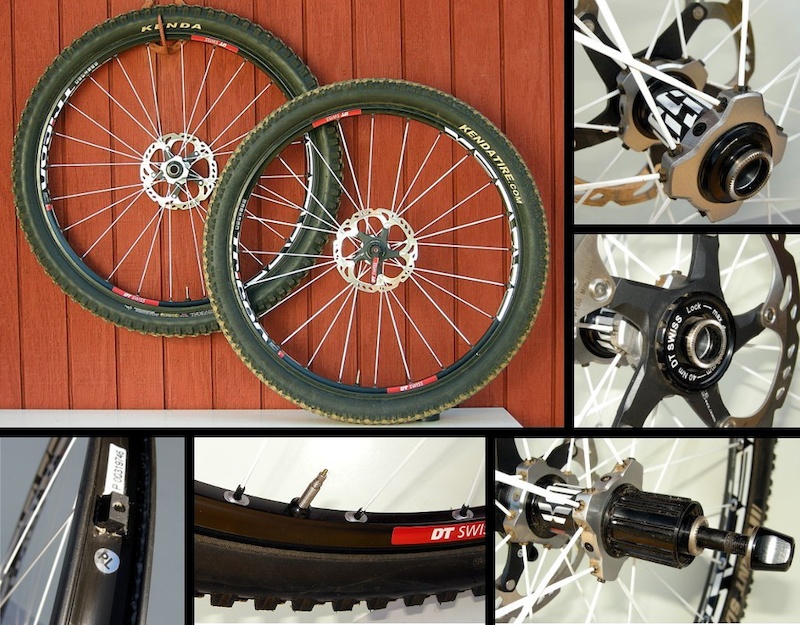
(clockwise) DT Swiss keeps the Tricon XM 1550 wheels looking fast with white-accent spokes and strong graphics - the Tricon hub flanges are screwed and glued in place and feature straight-pull spokes for maximum tension - Our wheelset had the Shimano Centerlock brake rotor option - A closeup look at the DT Swiss 10-millimeter through axle arrangement - Small oval plugs allow the spokes to be fed through the inside of the rim to make the Tricon wheel a sealed tubeless design - A look over the top of the welded rim reveals that it has no spoke holes.
Pinkbike's Take:
 | We have put some seriously tough miles on the Tricon wheels and they remain unphased by the punishment. Mounting them tubeless is a relatively easy seven out of ten (ten being an easy floor-pump inflation with almost any tubeless rated tire). Gobs of spoke tension gives the relatively narrow 20mm ID rim profile a very stiff feel in corners and technical situations that heap on lateral loads. We especially liked the 10-millimeter through-axle quick release that gave a normal rear-dropout bike a noticeable boost in stiffness and steering precision. DT Swiss hubs can be serviced without tools, which is a big plus because it encourages owners to check and lube the internals of the rear hub every once and a while. The downside is the price tag. $1300 is a lot for XC/trail wheels, but if you are searching for lightweight and strength in a 26-millimeter OD rim wheelset, the DT Swiss Tricon XM 1550 sets the standard. - RC |
Giro Feature Helmet
Many helmet makers have attempted to blend the skate-inspired freestyle helmet with the comfort, protection and adjustable features of an XC type lid, but the Giro Feature comes closest. The Feature is intended for 'all-mountain, trail and Super-D' and it looks the part. Its visor is adjustable with a hidden thumbscrew and there is a roller head retention device in the rear. Plenty of vents are crafted into the molded poly-carbonate shell without giving the Feature the cruise ship look that XC helmets suffer from. Colors are red, charcoal, yellow and teal . Sizes run a little small, so order upwards if your melon is in between normal sizes (Sm, Med and Large). Price is $75 USD. Giro

Giro's Feature helmet is refreshingly good looking from the front and the back. The roller retention adjustment in the rear ensures a good fit.
Pinkbike's Take:
| As helmets go. the Feature is one of the better looking we've seen. Its design is on the oval side, so if you have a round head, you may try one on to ensure a good fit. The single chin strap is functional, but after using bi-directional adjustment straps, I find that the Feature is a bit arbitrary. No worries, though, because the adjustable visor makes up for any angular change you may need to keep it functional on fast descents. Lids with non-adjustable visors must be set perfectly on the head to blend fit and function. Giro's Feature should make a lot of friends among the AM/trail crowd. - RC |
MRP Lopes SL Chainguide
Brian Lopes' signature chainguide by MRP is about as basic as you can get. It fits ISCG-05 bottom bracket tabs and works with a single chainring. The boomerang is laser etched with graduations that allow users to set up the upper and lower guides for each available chainring size. This takes the guess work out of mounting up the system. Long and short bolts, and a number of washers are included so your guide will fit any bike and MRP's instructions are clear and concise. MRP's Lopes SL chainguide costs around $135 USD. MRP

As simple as it gets, the MRP Lopes SL chainguide is easily assembled using guide references for various chainring sizes. The finished product is strong enough for hard driving downhills as long as you are willing to run without a bash ring to protect your sprocket. Lightweight and simple is what the Lopes SL guide is about.
Pinkbike's Take:
| If there was ever a no-worries single-ring chainguide, this is the one. The MRP Lopes guide does not have a bash guard, as it is intended for Super-D and aggressive trail applications where a rider may want the simplicity of a single chainring without the worry of derailing a chain. In this respect, the MRP guide does a wonderful job. Its lower guide employs a sprocket-type roller, which will make noise in the extreme right or left cassette gears, but it is acceptably quiet for XC/trail applications and doesn't feel draggy like many roller guides do. If you like simple and durable, MRP's single-ring Lopes chainguide will do just fine. - RC |
Author Info:
Must Read This Week
Sign Up for the Pinkbike Newsletter - All the Biggest, Most Interesting Stories in your Inbox
PB Newsletter Signup
www.pinkbike.com/photo/7560958
I got Easton Haven carbon wheels and there was absolutely nothing included in the package (which is a shame for a 2000+ dollar wheelset). Their after sale customer service is very good though (which is to be expected when spending 2000+ dollar on a wheelset).
Thats a little harsher then I wanted to be, but you can't fault DT swiss for only making a good wheel, and not making cheap parts to service their wheel. $100 spoke wrench sound like a shop part. I mean are you also angry that cane creek didn't give you a press with your headset?
Many people wouldn't even know how to use one, true. But then those people shouldn't buy a wheelset that expensive, or keep the wheels true by their LBS (and only then perhaps the tool becomes useless).
Props though for thinking outside the box. The concept of removing the nipple holes to provide a better tubeless set up is great (unless you've already heard of those nifty tubless wheelsets that come with a sealed liner). I think this is much like the gearbox concept. A great idea, but not yet practical for the layman. A for effort though.
Where I ride most would call aggressive XC or trail. But a normal helmet wouldn't do..
We have a SH*TON of rocks. All the other helmets look alright but I feel like the Feature has a lot more protection.
Definitely going to suck in the 100+ summers because of the little vents. But I'd already be sweating a bunch already.
My 2 cents
I was torn between the enduromatic and the feature. Ended up trying both. The feature fits perfectly and is very light and looked like it breathes a lot better. When I tried the enduromatic, even with a lot of playing around with the paddings/sizes, the deepest (top) portion of the helmet felt too tight on my skull while the lower portion felt too slack. Very weird fit, I guess it's great if your head has more of an egg shape but it's not my case. Since the enduromatic is adjusted by different size removable pads, I'd be worried that the fit changes over time as the pads thin due to long term use, as they do in most padded helmet.
Needless to say, I've bought the feature. The "knob" design adjustment felt spot on for the fit. And one of the nicest thing about it is that it's pretty much the narrowest helmet I've found (with the enduromatic). All other helmets looks like you're wearing a large soup bowl on your head (especially the poc trabec) while this one is pretty slick. I've had quite a bunch of rides with it so far and it's by far the best helmet I've ever owned. I tend to sweat a lot and I don't know if it's the venting that keeps my head cool or if it's due to some special wizardry but I never get sweat to drip in my eyes and the ultra-thin padding inside stays relatively dry as it doesn't get saturated with sweat, even during long rides on very hot days. It breathes even better than my much more expensive roadbike helmet that has the padding spewing rivers of sweat if I press it against my forehead.
Haven't gotten to test it in a crash yet but I'd say that if the feature fits you well, don't even bother looking at other helmets, this one has all someone could hope for. Oh and personally I went for the matte grey one as I'm not a big fan of flashy colors but the colored ones have a shiny gloss to them that looks amazing.
There current carbon snowboard helmets really are Sweet.
www.sweetprotection.com/snow/helmets-protection/?p=rooster&pid=252
Some say it's still cheap compared to the options we had 10 years ago, but come on, $100 for a CNC aluminium alloy plate and 2 plastic thingies...
www.google.com/search?q=lopes+sl+mrp&tbm=shop&hl=en&aq=f
I have an MRP G2 mini steel guide (cost me about £55, which i think is a good price, and it is a great guide). But I don't understand why a guide that has less features (no taco) and is made from alloy rather than steel (something which probably costs MRP a few pennies more to produce) costs £70 more. Any chance of explaining that to me?
Then there is all those things which always occur - heating the building, lights so the workers can see and so on. But what can be a big effect is probably that they are selling the cheaper models which do the same job, but the Lopes guide is a "high-end" product from MRP and thereby they want a bit more cash for it.
Hope this sheds some light over the mysteries of business:-)
Material costs, well see previous sentence. Aluminium & plastic are not premium materials and there's not even much of it there anyway! Machine costs? You think MRP don't already have CNC machines or can outsource some plastic moulding? Yes labour and fixed costs and all that crap have a part to play.
Well guess what, all that applys to the likes of superstar and their equivalent is well under half the RRP on this. But anyway, the point you made at the end is spot on - this is priced as a premium product (even if it isn't really) and the reason it's $135 is because that's round about what E13 & Straitline charge. And we're the mugs who buy into all this bullshit rather than just buying a superstar one!
you mean one of these?
If you're talking about the pictured adapter - that one is solely for Pivot bikes. Available from Pivot.