Tuf Rack Review
Tuf Rack: While many other racks approach the challenge of bike transportation with an array of ratcheting arms, sliding clamps or vertical hooks, the Tuf Rack goes in the opposite direction with a straightforward tray style setup. Their tray and tie-down design very much reminds us of a rack that would be used to carry a motocross bike - you simply place the bike in the tray, secure the ratcheting tie-down and you're off. Tuf Rack manufactures four different models to best suit the type of bikes that you'll be carrying, along with three different receiver height options that offer more or less ground clearance depending on your needs (there is even a 6'' lift receiver for 4x4 use). The entire system is modular, allowing you to transport up to five bikes. Prices range from $169.99 to $199.99 USD for the trays, with receivers costing between $49.99 and $89.99 USD.
![Tuf Rack]()
The details: The Tuf Rack consists of three main pieces: the steel tray that the bike slots into, a sturdy receiver and the supplied ratcheting tie-down straps. The trays come in different lengths and widths that can accomodate anything from a bike with a 49" wheelbase and 2.7" wide tires, to a 37.5" length intended for BMX bikes. One end of the tray features taller supports that wraps around more of the wheel, along with a welded in support that follows its lower circumference as well. Steel anchor points for the straps are bolted to each side and are adjustable fore and aft for better positioning to suit your bike. The tray is held in place with a steel hitch pin that is run through both the receiver bar and the underside of the tray, and the play is taken out by snugging down a large grub screw.
![Tuf Rack]()
Tuf Rack's receivers come in three different height options - straight, 3" rise and 6" rise - and four lengths depending on if you want to carry two, three, four, or five bikes (the straight three bike bar is 23'' long, while the 6" rise five bike bar is a whopping 53"). They are built from thick, zinc plated 1/8'' steel for outright strength. While there are loads of receiver options to choose from, there isn't one that would allow the rack to tilt up and clear a garage door, a fact that could be an issue for those who have to deal with space constraints. Vehicles that are equipped with, or only rated for, the smaller 1 1/4'' hitch can use Tuf Rack's hitch adapter ($44.00 USD) in order to install the rack.
Holding each bike in place is a burly, ratcheting tie-down strap that hooks on to the anchor points bolted to the tray. The ratcheting mechanism allows you to cinch down the strap tightly after you've taken out all of the slack by pulling it through the buckle. It has been rated for 500lb of tension, more than enough to keep your bike in place regardless of how rough the road is. The straps are completely separate from the rack itself and are taken off when not holding down a bike.
![Tuf Rack]()
Setup: There isn't a lot to do as far as assembly goes. Start by sliding the receiver bar into your vehicle's hitch (a sticker tells you which end to put in) and securing it with the supplied hitch pin. Next, slide the first tray onto the receiver bar and install the hitch pin to hold it in place. The last step is to tighten down the 5/32'' grub screw that removes any play between the tray and receiver bar. Repeat the process for your remaining trays, remembering to alternate their orientation as you go, and you'll be done within just a few minutes. Tuf Rack includes the only tool that you'll need to get the job done, a single 5/32'' hex key, and short of the rack coming preassembled, it couldn't really get an easier.
Performance: Loading a bike onto the Tuf Rack is quite easy, with the deep trays holding the bike upright and hands-free while you attach the tie-down. Bikes can be positioned in either direction, but we had the best results with the rear wheel at the taller end of the tray ( the metal tie-down buckle rests on the crank arm when facing the opposite way). If you have a long cage rear derailleur you'll want to shift into a gear that keeps the derailleur's cage from making contact with the tray's tall sides. The ratcheting tie-down takes a few minutes to figure out if you've never used one before, but it's dead easy once you've done it a few times. The whole process quick, easy and comparable time-wise to a more traditional rack that uses a ratcheting arm to hold the bike upright.
![Tuf Rack]()
Once the tie-down has been tightened the bike can't possibly go anywhere, and it also refuses to even rattle in the slightest - snug would be an understatement. While there will be some movement between the hitch and the rack's receiver (as with nearly any rack that doesn't employ a threaded hitch pin), all worry about losing a bike on a rough road went out the window with the Tuf Rack. We fit a number of different types of bikes, from skinny tired 29'ers to long wheelbase downhill bikes with massive rubber, and all fit into the rack just fine. Tuf Rack manufactures a number of different length trays, but we'd recommend just getting the long 49'' tray, as it can also carry shorter bikes without issue.
If you've ever had a rack who's ratcheting arm became useless after a few seasons of use, or who's folding mechanism developed enough play to have you worried about a short trip across town, you'll be a fan of the Tuf Rack's utter simplicity. Short of the tie downs wearing out in the long run, which are easy and relatively inexpensive to replace, there isn't much that can go wrong. The lack of a folding mechanism and its use of tie-downs to secure bikes will mean that it won't be for everyone, but the Tuf Rack will make sense for riders who spend their time shuttling up rough roads or live in Winter environments where road salt and grime will quickly take a toll on designs that use moving pieces or are bolted together.
![Tuf Rack]()
Issues: The Tuf Rack's straightforward layout will be ideal for many people, but there are a few hiccups to the design as well. Our major point of contention has to do with how close the trays are to each other, meaning that the bar and seat post on the opposing bikes come in contact. While this is something that nearly all tray style racks suffer from, and is a result of not wanting the rack to extend too far from the hitch, it would be the one trait that we would eliminate if we were designing a rack. Having to drop, or even remove, the post isn't the proper solution to the problem, but it is what we had to do nearly every time that we used the rack. A simple solution would be to to have more hitch pin holes on the receiver bar, allowing the user to choose the tray position that works best for them.
The straps that come with the rack come in different lengths depending on the tray choice. For instance, the DJ trays come with shorter straps because the bikes are lower. This makes for less slack to have to take up, but does sometimes present an issue of you want to transport another kind of bike on the rack. This is especially true for 29'ers and large sized bikes. It was usually easy enough to run the strap through another part of the bike, but it did pose a problem with some frame designs. The straps also marred the paint where they were repeatedly draped over the frame, leaving a dull strip after a few months of use. Despite initially doubting the convenience of using ratcheting straps to secure the bikes, the system proved to be quick and easy.
Each tray on our test rack uses a single grub screw to keep it from rattling around on the receiver bar, but we had them come loose on more than one occasion. Thankfully the grub screws don't keep the tray in place (the burly hitch pin does that job), but it was annoying to have to retighten them regardless. Tuf Rack is aware of the issue and has now upgraded the system to use a 5/16'' x 3/8'' bolt with a lock washer that should eliminate the problem. And speaking of play, Tuf Rack has also converted their receiver bars to incorporate an anti-rattle hitch pin to take care of the wiggle that is present on our early review sample.
![Tuf Rack]()
Pinkbike's take:
www.tufrack.com
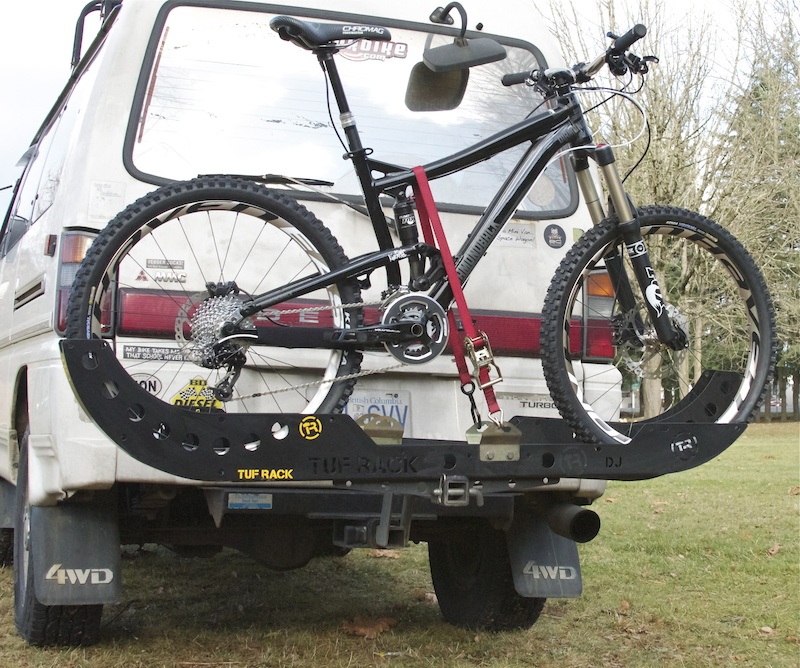
The bike sits within the Tuf Rack's steel tray and is held firmly in place with a ratcheting tie-down strap.
Tuf Racks details:
- Tray style hitch rack
- Laser cut 16-gauge steel trays
- Adjustable position 1/8'' plate strap brackets
- Industrial grade ratcheting tie-downs (rated to 500lbs)
- Receiver: zinc plated 1/8'' 2 x 2 rectangular HSS tubing
- Modular design
- Powder coated black or yellow trays
- MSRP: $169.99 - $199.99 USD (rack), $49.99 - $89.99 USD (receiver)
Tuf Racks details:
- Tray style hitch rack
- Laser cut 16-gauge steel trays
- Adjustable position 1/8'' plate strap brackets
- Industrial grade ratcheting tie-downs (rated to 500lbs)
- Receiver: zinc plated 1/8'' 2 x 2 rectangular HSS tubing
- Modular design
- Powder coated black or yellow trays
- MSRP: $169.99 - $199.99 USD (rack), $49.99 - $89.99 USD (receiver)
The details: The Tuf Rack consists of three main pieces: the steel tray that the bike slots into, a sturdy receiver and the supplied ratcheting tie-down straps. The trays come in different lengths and widths that can accomodate anything from a bike with a 49" wheelbase and 2.7" wide tires, to a 37.5" length intended for BMX bikes. One end of the tray features taller supports that wraps around more of the wheel, along with a welded in support that follows its lower circumference as well. Steel anchor points for the straps are bolted to each side and are adjustable fore and aft for better positioning to suit your bike. The tray is held in place with a steel hitch pin that is run through both the receiver bar and the underside of the tray, and the play is taken out by snugging down a large grub screw.
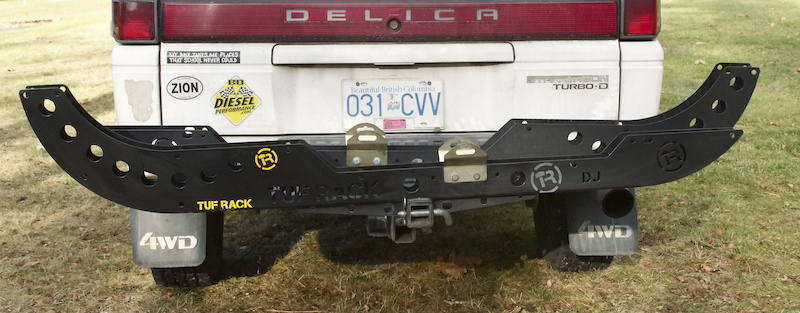
You won't find any pivoting arms to hold the bike up or rubber straps to hold down the rear wheel on the Tuf Rack. Simplicity is the name of the game.
Tuf Rack's receivers come in three different height options - straight, 3" rise and 6" rise - and four lengths depending on if you want to carry two, three, four, or five bikes (the straight three bike bar is 23'' long, while the 6" rise five bike bar is a whopping 53"). They are built from thick, zinc plated 1/8'' steel for outright strength. While there are loads of receiver options to choose from, there isn't one that would allow the rack to tilt up and clear a garage door, a fact that could be an issue for those who have to deal with space constraints. Vehicles that are equipped with, or only rated for, the smaller 1 1/4'' hitch can use Tuf Rack's hitch adapter ($44.00 USD) in order to install the rack.
Holding each bike in place is a burly, ratcheting tie-down strap that hooks on to the anchor points bolted to the tray. The ratcheting mechanism allows you to cinch down the strap tightly after you've taken out all of the slack by pulling it through the buckle. It has been rated for 500lb of tension, more than enough to keep your bike in place regardless of how rough the road is. The straps are completely separate from the rack itself and are taken off when not holding down a bike.
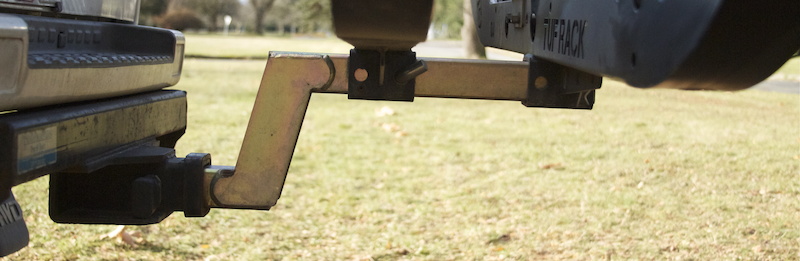
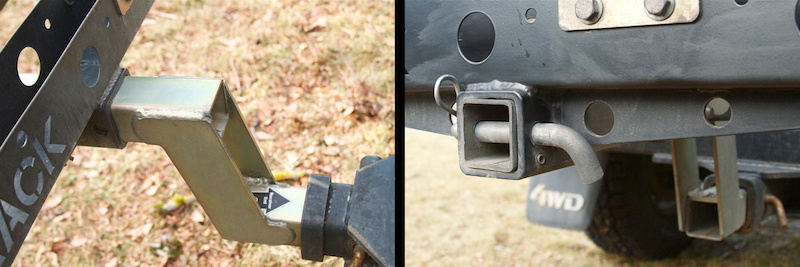
Receiver bars come in three different heights, with our test rack using the 4x4 friendly 6'' rise version.
Setup: There isn't a lot to do as far as assembly goes. Start by sliding the receiver bar into your vehicle's hitch (a sticker tells you which end to put in) and securing it with the supplied hitch pin. Next, slide the first tray onto the receiver bar and install the hitch pin to hold it in place. The last step is to tighten down the 5/32'' grub screw that removes any play between the tray and receiver bar. Repeat the process for your remaining trays, remembering to alternate their orientation as you go, and you'll be done within just a few minutes. Tuf Rack includes the only tool that you'll need to get the job done, a single 5/32'' hex key, and short of the rack coming preassembled, it couldn't really get an easier.
Performance: Loading a bike onto the Tuf Rack is quite easy, with the deep trays holding the bike upright and hands-free while you attach the tie-down. Bikes can be positioned in either direction, but we had the best results with the rear wheel at the taller end of the tray ( the metal tie-down buckle rests on the crank arm when facing the opposite way). If you have a long cage rear derailleur you'll want to shift into a gear that keeps the derailleur's cage from making contact with the tray's tall sides. The ratcheting tie-down takes a few minutes to figure out if you've never used one before, but it's dead easy once you've done it a few times. The whole process quick, easy and comparable time-wise to a more traditional rack that uses a ratcheting arm to hold the bike upright.
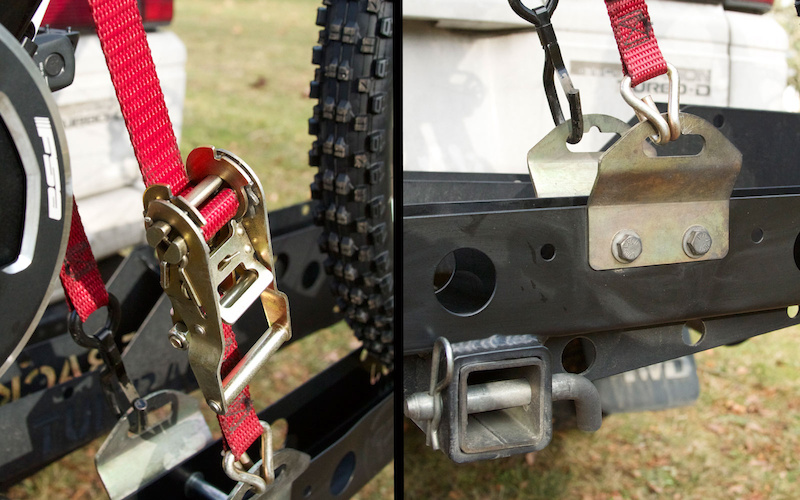
The ratcheting tie-down straps (left) are quick and easy to work with. Steel anchor points (right) are bolted to the trays and are adjustable to better accomodate different frame designs.
Once the tie-down has been tightened the bike can't possibly go anywhere, and it also refuses to even rattle in the slightest - snug would be an understatement. While there will be some movement between the hitch and the rack's receiver (as with nearly any rack that doesn't employ a threaded hitch pin), all worry about losing a bike on a rough road went out the window with the Tuf Rack. We fit a number of different types of bikes, from skinny tired 29'ers to long wheelbase downhill bikes with massive rubber, and all fit into the rack just fine. Tuf Rack manufactures a number of different length trays, but we'd recommend just getting the long 49'' tray, as it can also carry shorter bikes without issue.
If you've ever had a rack who's ratcheting arm became useless after a few seasons of use, or who's folding mechanism developed enough play to have you worried about a short trip across town, you'll be a fan of the Tuf Rack's utter simplicity. Short of the tie downs wearing out in the long run, which are easy and relatively inexpensive to replace, there isn't much that can go wrong. The lack of a folding mechanism and its use of tie-downs to secure bikes will mean that it won't be for everyone, but the Tuf Rack will make sense for riders who spend their time shuttling up rough roads or live in Winter environments where road salt and grime will quickly take a toll on designs that use moving pieces or are bolted together.
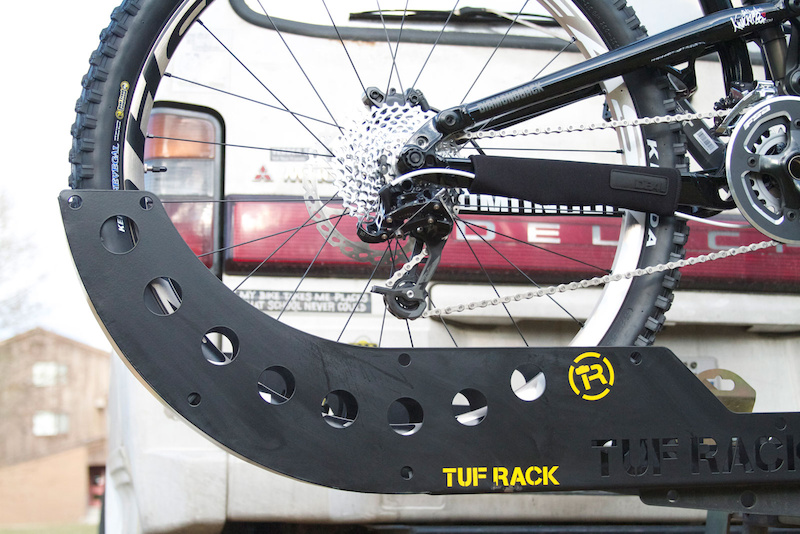
We had the best results when positioning the rear wheel at the taller end of the tray, but you have to be sure that the rear derailleur cage clears the tray's tall sides.
Issues: The Tuf Rack's straightforward layout will be ideal for many people, but there are a few hiccups to the design as well. Our major point of contention has to do with how close the trays are to each other, meaning that the bar and seat post on the opposing bikes come in contact. While this is something that nearly all tray style racks suffer from, and is a result of not wanting the rack to extend too far from the hitch, it would be the one trait that we would eliminate if we were designing a rack. Having to drop, or even remove, the post isn't the proper solution to the problem, but it is what we had to do nearly every time that we used the rack. A simple solution would be to to have more hitch pin holes on the receiver bar, allowing the user to choose the tray position that works best for them.
The straps that come with the rack come in different lengths depending on the tray choice. For instance, the DJ trays come with shorter straps because the bikes are lower. This makes for less slack to have to take up, but does sometimes present an issue of you want to transport another kind of bike on the rack. This is especially true for 29'ers and large sized bikes. It was usually easy enough to run the strap through another part of the bike, but it did pose a problem with some frame designs. The straps also marred the paint where they were repeatedly draped over the frame, leaving a dull strip after a few months of use. Despite initially doubting the convenience of using ratcheting straps to secure the bikes, the system proved to be quick and easy.
Each tray on our test rack uses a single grub screw to keep it from rattling around on the receiver bar, but we had them come loose on more than one occasion. Thankfully the grub screws don't keep the tray in place (the burly hitch pin does that job), but it was annoying to have to retighten them regardless. Tuf Rack is aware of the issue and has now upgraded the system to use a 5/16'' x 3/8'' bolt with a lock washer that should eliminate the problem. And speaking of play, Tuf Rack has also converted their receiver bars to incorporate an anti-rattle hitch pin to take care of the wiggle that is present on our early review sample.
Using burly steel components all around, the Tuf Rack is all about simplicity and sturdiness.
Pinkbike's take:
 | The Tuf Rack may be simple, but there is a lot to like about it, especially if you've dealt with more complicated racks in the past. Having to strap the bike down doesn't really take any longer once you've got a handle on the ratcheting tie-downs, and there is very little to go wrong with the Tuf Rack in the long run. We'd like to see a few changes made before we'd consider it the best of the bunch, but it makes a lot of sense for anyone who is hard on their gear or is looking for a rack that they can put on and forget about.- Mike levy |
www.tufrack.com
Author Info:

Must Read This Week
Sign Up for the Pinkbike Newsletter - All the Biggest, Most Interesting Stories in your Inbox
PB Newsletter Signup
Want to know the best part?!! TUFRACK stepped up and took over the organizing and promotion of the 2012 Ontario Cup race series! THANK YOU TUFRACK!
1) Not all of our racks are the same length, we make racks from BMX up to DH. We also have an MTB rack that will happily carry anything you ride.
2) For Europeans, we have a flange mount system for your towbars and an optional taillight/plate holder.
3) Everyone at Tuf Rack is a rider, from BMX to DH. We actually sponsor 3 teams as well as our own DH race team. We are also the Ontario Cup race series organizers for 2012. Point being that we know our way around bikes and how to carry them.
4) This company was started to give some of the younger members on our race team a place to work after school and on weekends, and to build a rack that is simple and yet tough enough to take off road abuse. At this point in time 100% of all profits from Tuf Rack have been put back into sponsoring riders, events and putting on our own events.
5) I believe we are one of only a few rack companies that warranty our product for off road use.
6) As far as speed recommendations, they can happily handle your local speed limits whatever they may be.
1.bp.blogspot.com/-doHPMIus-I4/TbOBrCS7qmI/AAAAAAAAACQ/dcBOcIG5lfg/s1600/P4230494.JPG
Also, as you ratchet down the strap you can compress the fork which will shorten the wheelbase slightly. I don't know that it would be enough but it is possible.
www.pinkbike.com/photo/5650321
This is a much better alternative. ratracks.com
The rack only comes in contact with the tires and you can carry a lot more bikes in the same space, and on top of that you can access any bike at any time...
If they skimped on such a strong point of how to retain the BICYCLE to the bicycle RACK...what else got skimped on or shortcut?
And sorry, but I think the rack is absolutely hideous anyway. Why get your groceries with a shopping cart when you can push a tank around the store?
Expensive DH rig's, super custom XC fly weights, Dirt Jumpers and BMX bikes. I put them all on this rack.
I would not risk carrying my balued and precious two wheeled cargo on anything else!!
For me, there is not a better bicycle rack on the market. The strength, simplicity and ease of use make it the perfect carrier for me. I can set my bikes in the carrier and and do a million other things while they sit perfectly balanced, ready to get strapped down.
*Plus.... it looks so badass on any vehicle.
When transporting your bike why not use the best and the strongest carrier that has ever been made!!
www.pinkbike.com/photo/5216008
www.pinkbike.com/photo/5403819
Being one that likes my bikes clean I understand the concern some may have over the paint rubbed or marred on the top tube. A simple fix for this is some of the thinner clear shields that you find from RockDemon and CrankSkins. You can barley notice the thinner versions and it does the job reducing marred paint….most hanging racks will leave more damage to the paint due to their usual rubber pads than this strap does.
Another note, this rack wasn't made to be fancy or frilly with gadgets and gizmos. I also own a Kuat NV that is heavliy laden with such toys (which I love also) that is super sexy and has many useful features for a hitch rack. The TufRack was built to be dead simple and sturdy. We have the "PreGrubScrew" model, and that for us is one thing for us that we would have appreciated to help reduce sway on hard turns and heavily undulated terrain. Our simple fix was drilled a hole into the hitch beam and run a 3/8 bold with nut and lock washers…no more play (but it looks like they fixed that). I dont mind the movement at the hitch as much as I did the trays, especially when more than one bike was mounted.
Weight…really the way it was designed, its so fast to disassemble and reassemble, that its easier to install one piece at a time if you must…plus when you remove the rack this way it takes up less room in the garage or storage as individual pieces. Plus our 4 bike Kuat is HEAVY and akward to move around the shop. I only wish I had the 4 bike of the TufRack (JON).
About the biggest thing that could be improved on (that Mike Levy also said) was bike spacing …. having more holes to choose from would have helped this with most bikes and contacting each other….
Ian
really nice bit of kit ! i work in a diamondback stockist in the uk and cant wait to see one of these in our store
Sticking with my Yakima. No frame contact.
Then I will still have to buy all the bar/rise configurations (presume-ably from 1-5 as the cops wont really let you drive around with your bike mounted on the back and a 4' pole sticking out of the back and mounting on the farthest back would lead to a lot of leverage)
Mike could we see a shot of the top tube of the bike? I have a customer who has been using a similar style tray rack from a manufacturer who just switched distributors. Their rack came up for warranty right as the switch occurred so the replacement was slow. The interim decision was to use a ratchet strap to hold the bike down however over bumps the suspension of the bike loaded and unloaded this lead to the strap (and whatever small bits of dirt, rocks, sand or whatever else you picked up off the road) to rub and scratch the heck out of the top tube (needless to say not happy when his Nomad rawed itself). I'd like to know if this issue is pertinent with the "Tuf Rack" as it relies on the ratchet strap.
So all of that and I still can't carry mom's road bike for family vacations. And there's no built in lock or acceptance for locks. And I can't open the hatch with it on.
It looks very "neat" but I need to know A LOT more before I go spending $1000 on anything
- While the strap certainly doesn't "raw" the top tube, it will leave a mark after a few months of use. I'd call it more of a dulled section of paint than anything else, but still not great.
- The rack will carry a road bike. And you could always use a locking hitch pin (there's one on mine now) and run a cable lock through the holes in the rack itself.
My intention was not to be an ass about this I just want to find the flaws maybe its just who I am or maybe there's just so few good racks out there that its hard to know what the highs and lows are on them.
As far as the strap goes... I don't really see a few months as a good test (again not trying to discredit you or anyone involved I realize that reviews need to be done in a timely fashion and testing for years simply isn't an option) I want this thing to carry my bikes year after year and I don't want my bikes to show wear from transport. "Shuttle scars" are inevitable in a lot of ways but minimizing them can go a long way to preserving your bike's look, value and eventually integrity. Not trying to say that you were wandering around a bigger issue or anything just that that's sort of where I stand. If people didn't care about wear from transport there would be no hesitations when it comes to Dakine Pads as they are another culprit of the same effect not only on your bike but also your tailgate.
Of course you can route a lock through any rack but then it sort of becomes one more cost where as with some of the other racks you are getting a lock built in. "Extras" I find is sort of where the shortcomings in the boutique racks (North Shore Tuf and Arbutus to name a few) really shine through.
But you might wanna reconsider point 6 for the german Autobahn
6) As far as speed recommendations, they can happily handle your local speed limits whatever they may be
That rack (although butt ugly) works well for cars and uses a wheel tray system like yours. The difference is, it folds up and can also pivot down for hatchbacks. Cool product though, just not for my little car.
I like your design, I like how easy it is to load a bike and take the bike off - I just wish I could move it out of the way when I'm not using it. Anyway, congratulations on thinking outside the box. It looks bullet proof.
most of us have to remove the rack after use. some racks are not bad and some can be near 100 pounds
Because it widdens the cars size, and that would be illegal. The car takes more space than then one specified on the registration (length x width).
Got hit by a semi truck at night. "Obstructed tail lights"
4 bikes. $20,000 in damages.
WE got the ticket. OUR fault. NO money compensation.
www.pinkbike.com/photo/6798677
I say UEBLER X21 NANO!