Diamondback Mason FS - Interbike 2012


Backcountry Handyman
Diamondback's 4.5" travel Sortie 29er has been well received, if flying a bit under the radar, but the guys at Diamondback knew that they also wanted a longer legged 29er platform that would give aggressive riders the confidence on gnarly terrain that only more travel can provide. Their Knuckle Box bell-crank rear suspension layout was modified to provide the Mason with a full 5.5" of travel but, more importantly, a relaxed philosophy was applied to the Mason when penning its geometry - the bike has a 68° head angle a 13.5'' bottom bracket height that should make it easy going when things get tricky. The result, Diamondback says, isn't just a 'trail bike', but more of a Swiss army knife-esque steed that is at home on more terrain than either a full-on all-mountain bike or a svelte trail bike.
The Mason (the FS model shown here, as well as the AM hardtail) was to be called Dixon originally, but with that moniker already taken, Diamondback went with Mason, a play on the Mason-Dixon Line that separated the pre-Civil War American South. Regardless of its name, Diamondback's resident

shredder, Eric Porter, says that he now spends most of his saddle time aboard the 5.5" travel 29er, only switching out to his downhill bike when riding the lifts or shuttling, or to his hardtail when at the dirt jumps. After a full year's worth of testing under Porter, it looks like Diamondback is getting close to releasing the Mason FS, although an exact date has yet to be decided upon.
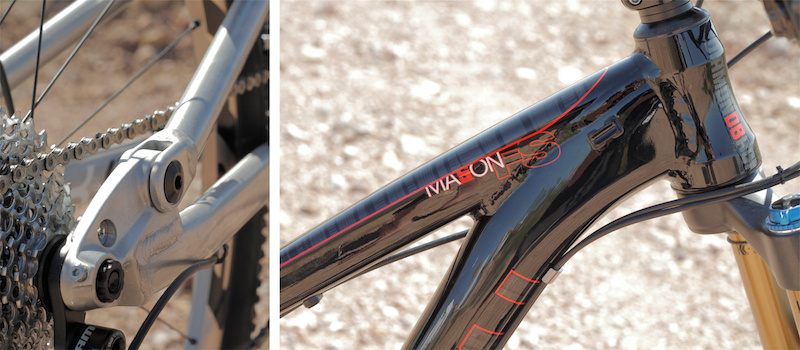
The updates to the Knuckle Box system focus on the bell crank itself, with it now being mounted directly to the down tube instead of above the tube on a welded-on extension, as seen on other models. The bell crank's aluminum main pivot axle passes directly through the down tube and, just like elsewhere on the bike, aluminum hardware holds it in place. The change in location has allowed Diamondback to widen the bell crank as well, a change that, along with a new seat stay bridge, should add even more lateral stiffness to the rear of the bike.
Knuckle Box
Diamondback's bell crank rear suspension layout is used throughout their high-end full suspension lineup, with it also utilized on the Mason FS, albeit in a evolved form. The basic design remains the same, with the bike's seat stays driving the bell crank, which then rotates to compress the shock. The system offers a low leverage ratio that Diamondback says greatly improves small bump sensitivity, a fact that we can vouch for after spending time on their 6" travel Mission Pro, but the layout also centralizes the bike's heaviest suspension components - the shock and the rocker link.
Diamondback's bell crank rear suspension layout is used throughout their high-end full suspension lineup, with it also utilized on the Mason FS, albeit in a evolved form. The basic design remains the same, with the bike's seat stays driving the bell crank, which then rotates to compress the shock. The system offers a low leverage ratio that Diamondback says greatly improves small bump sensitivity, a fact that we can vouch for after spending time on their 6" travel Mission Pro, but the layout also centralizes the bike's heaviest suspension components - the shock and the rocker link.
The updates to the Knuckle Box system focus on the bell crank itself, with it now being mounted directly to the down tube instead of above the tube on a welded-on extension, as seen on other models. The bell crank's aluminum main pivot axle passes directly through the down tube and, just like elsewhere on the bike, aluminum hardware holds it in place. The change in location has allowed Diamondback to widen the bell crank as well, a change that, along with a new seat stay bridge, should add even more lateral stiffness to the rear of the bike.

The Right Tools
Given the bike's versatile intentions, it comes as no surprise that Diamondback has equipped it with all of the ingredients required to handle whatever task may come its way. Dropper post cable routing is taken care of via subtle guides on the underside of the down tube, and ISCG-05 tabs are present around the bottom bracket. If a chain guide isn't required, but two or three chain rings are, a low/direct front derailleur mount has been incorporated onto the swingarm. A 12 x 142mm E-Thru axle out back ties the rear end together.
Diamondback hasn't decided on the bike's component spec at this point, meaning that its price is also up in the air, but the high-end Mason FS will likely make use of FOX's top tier, Kashima-coated suspension, as well as Race Face's SIXC carbon cranks. We've put the Mason FS on the short list of test bikes to spend time on, so expect a feature on the bike when it becomes available.
www.diamondback.com

Author Info:

 Member since Oct 18, 2005
Must Read This Week
Sign Up for the Pinkbike Newsletter - All the Biggest, Most Interesting Stories in your Inbox
PB Newsletter Signup
All my DH buddies are shredding the downhill trails here in Utah on their dirt jumpers, and leaving their DH bikes at home. You just can't pop and flow as well on a long travel hog.
To me, the 650B bikes I've ridden have been a GREAT split between the 29r that feels like a GIANT wheel to ccelerate and to manual etc. and a 26 that clearly has a disadvantage when roling over objects. I know it's not exactly the same, but when I went from 31" to 33" tires on my truck it was a HUGE revelation in terms of ride quality because the bigger tires just don't "drop into" holes and stuff... 650B feels more like a 29r in ride, but it handles like a 26" wheel so to me it's a GREAT idea. Your needs may varry.
Get a short-travel fult though and I'd bet you'll be keeping up with your buddies and smilling the whole way...
EDIT: wait, you've got a Jamis Parker??? Seems like that thing would be GREAT... maybe a little heavy, but fun to ride. Is it just a matter of not liking the specific bike or???
"Nice to meet you Mr. Mason. See you never."
I can speak for FL freeriders who can't pedal their tanks around our trails...
They go to 29" wheels and 140mm or more to satisfy the need, if they have the coin.
Otherwise, maybe a long-toothed 29er hardtail, but that's usually reserved for XC guys.
I'm in WV now, and I'd love to have this bike here, to try all my new trails on!
FSR, VPP, DW etc etc - Yes I know these are all licensed suspension platforms but they work and work well.
Knucklebox... please... just stop with this shit. Same goes for Scott and Cannondale. Just give it a break.
Jeeze, I wonder why soviet cars were such crap . . .
Everyone who has ever tried these bikes has liked them. They aren't going to revolutionize the world, just do something well. Kinda like most people who ride. I have a mission with a bell crank. It slays. I like it better than the Nomad and the Enduro, both of which have proven designs and huge market shares. Everytime DB comes up on PB it gets a good review and some tool has to knock them for not being giant or trek, or for having a link design similar to commencal. get a valid point or shut up.
You mention new ideas... this certainly isn't one. You better ideas... again, this is not one of them. This is LESS of a product than many other main stream brand puts out. I'm not knocking them for not being Giant or Trek or anyone - I am knocking them because they've created a medium product regardless of the name attached to it.
My whole bike is perfect for a guy like me: I can maintain it easily, it performs on the high end (though it doesn't have a special axle path to make climbing easier, but I've never missed that since it climbs well as the reviewers will tell you) and I can blast trails or park with it and love it the whole time.
Sorry I was way harsh earlier, but you knocked my bike without realizing what you were talking about. I'm protective of my baby.