hay i'v built a big booter its ten feet long and 5'6 high (ill have pic's soon)...its a pirfict artch for launching ... i was wondering iff ennyone knows the formula for distance iff i have velocity im m/s and time in m/s. i was hoping to be able to predict my (almost) exact distance traviling at a given speed.... can ennyone help?
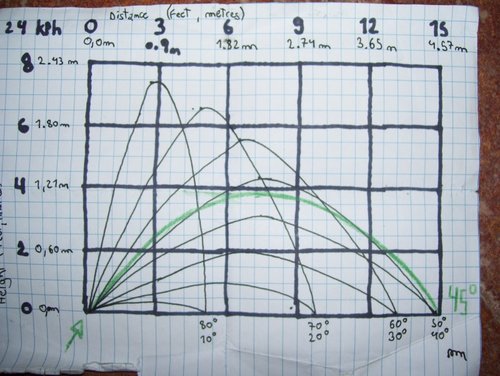
it doesn't matter how long the ramp is, or the height really. you are going to be on an arc. the more speed, the greater the diameter of the arc. you need the angle of the lip, that will be more helpful for you to determine the distance you can travel. i don't have a formula, there would be one for motion like this, but since the suspension is involved, it wont be perfect. look up pendulums, and think about it inversely. or just hit it.
thanks ill do that ... um the angle of the lip is 67.5 degres i think and id be going about 30km/h or 8.34 m/s
it doesn't matter how long the ramp is, or the height really. you are going to be on an arc. the more speed, the greater the diameter of the arc. you need the angle of the lip, that will be more helpful for you to determine the distance you can travel. i don't have a formula, there would be one for motion like this, but since the suspension is involved, it wont be perfect. look up pendulums, and think about it inversely. or just hit it.
thanks ill do that ... um the angle of the lip is 67.5 degres i think and id be going about 30km/h or 8.34 m/s
and thats gust an average gess on speed rolling in ... it might be more it might be less ill find out soon when i put my spedo into on my bike
To calculate the range of a projectile, including you on a bike jumping a ramp, it's like this. The range of the projectile is directly proportional to the square of your velocity. In other words, D=kVsquared..
Let's say you're jumping, oh a 5'6 feet ramp lol at 30km. Using this equation, 5'6=k(30)squared, or 5'6=k1225. Dividing both sides by 1225 gives you .0045714=k.
To calculate how far you'll jump at 35km, it's D=k35squared, or D=(.0045714)1225. The answer is that you'd fly APPROXIMATELY 5.599965 feet at 3O-35km.
I don't know where you got that formula D=kV^2, but that is certainly not what you need. You also equated D = height of ramp, and then followed with D = distance. wtf? If you have a highschool physics textbook, look up "projectile motion" for the proper equation. You need to account for the angle of take off, and calculate both the vertical and horizontal velocity vectors separately to find out where you would ideally land without air friction.
To calculate the range of a projectile, including you on a bike jumping a ramp, it's like this. The range of the projectile is directly proportional to the square of your velocity. In other words, D=kVsquared..
Let's say you're jumping, oh a 5'6 feet ramp lol at 30km. Using this equation, 5'6=k(30)squared, or 5'6=k1225. Dividing both sides by 1225 gives you .0045714=k.
To calculate how far you'll jump at 35km, it's D=k35squared, or D=(.0045714)1225. The answer is that you'd fly APPROXIMATELY 5.599965 feet at 3O-35km.
To calculate the range of a projectile, including you on a bike jumping a ramp, it's like this. The range of the projectile is directly proportional to the square of your velocity. In other words, D=kVsquared..
Let's say you're jumping, oh a 5'6 feet ramp lol at 30km. Using this equation, 5'6=k(30)squared, or 5'6=k1225. Dividing both sides by 1225 gives you .0045714=k.
To calculate how far you'll jump at 35km, it's D=k35squared, or D=(.0045714)1225. The answer is that you'd fly APPROXIMATELY 5.599965 feet at 3O-35km.
That doesn't seem right to me, surely you need to factor in gravity at some point, also you need to convert all your units in to SI units to stand some kind of chance of getting the right answer.