Get ready for the season - TIPS
doesn't always win. This is because at the higher levels of competition
most competitors have about the same skill. Winning races is a mental
war and often a more prepared, focus and confident competitor will
beat someone with slightly more "skill".
I have a few friends who are amazing bike handlers, definitely
better bike handers than I, but I usually manage to beat them on
race day. The key to winning any competition is being able to have
a "peak" performance during competition. Consistently performing
at your peak is easier said than done. One way to improve your consistency
is to imagine or "visualize" you runs. Imagining is a very important
skill and just like any other skill the more you practice it the
better you get. If you haven't imagined before or your imaging needs
some improvement work on the information below.
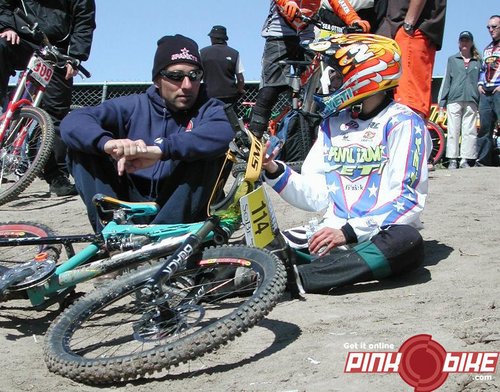
What To Imagine
1. How you feel mentally in the starting gate, during the run,
as you cross the finish line and when the run is over: excited,
strong, confident, fast , etc.
2. How you feel physically in the starting gate, during the run,
as you cross the finish line and when the run is over: muscles relaxed,
your breathing, lactic burn in legs, steering and balance movements,
absorbing shocks, etc.
3. What your eyes are focusing on when you are in the starting
gate, during the run, as you cross the finish line and when the
run is over: looking ahead, reference points, course conditions,
etc.
4. What you hear in the starting gate, during the run, as you cross
the finish line and when the run is over: wind rushing by, crowd
noise, bike noise, announcer screaming that you have just taken
over the lead! (Myles Rockwell actually does that), etc.
How To Imagine
1. Imagine from 1st person, you are actually racing down the course.
2. Imagine from 3rd person, you are watching yourself.
3. Imagine flawless runs, if you make a mistake back up and correct
it.
4. Imagine in slow motion to learn new skills or master a difficult
section.
5. Always imagine positive performances, feelings and thoughts.
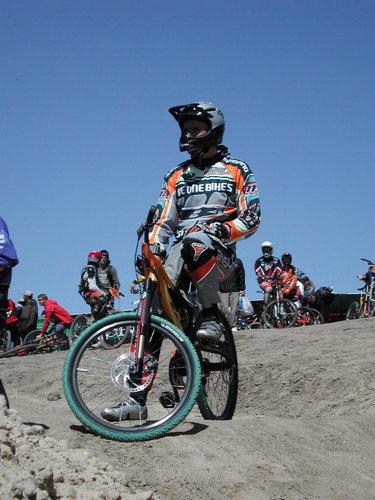
How To Get Started
1. Imagine riding the 1st "section" (the 1st fourth or fifth of
the trail, start new sections at major changes in terrain) of your
favorite trail. Practice until your experience everything you experience
on an actual run.
2. Start adding sections until you can imagine an entire 5-6 minute
run.
3. Time your imaging runs and compare their times to actual ones.
If your imaging runs are faster than real ones you may being using
to few reference points (physical feature such as big rocks, stumps,
ruts, or trees that you use to keep your bearing on the course (more
on the use of reference points later)) and skipping parts of the
course or you might not be imaging all the steps it takes (braking,
shifting, pedaling, jumping gaps) to get down the course. If your
imaging runs are slower than real runs you either have too many
reference points and your getting bogged down on details that you
don't notice when racing or you don't have enough RPs and are getting
lost on the way down.
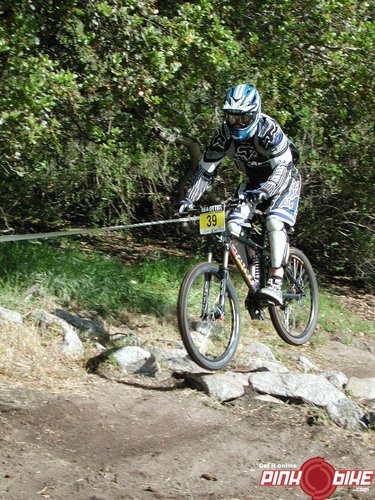
Gene Hamilton is pro downhill racer and level 2 USSCA Snowboard Coach. Over the last seven years he has had several top 30 NCS finishes as a privateer and finished third at the 1999 UCI World Masters championships. At the ripe old age of 36 Gene has decided to take sometime off from racing and use his snowboard and mountain bike coaching experience to start BetterRide/Rocky Mountain Downhill, a downhill mountain bike coaching service. For more information on Rocky Mountain Downhill’s coaching, camps, and clinics please check out his website or e-mail Gene at [email protected] .
Also check out www.betterride.net