Powered by Outside

Spokes need to be tightened after every ride?

PB Forum :: All Mountain, Enduro & Cross-Country
Spokes need to be tightened after every ride?

Author Message
O+
Posted: Oct 20, 2017 at 12:41 Quote
I have a set of Stan's Flow MK3s on DT Swiss 350 with whatever their strongest spokes are...and my rear wheel requires attention after every single ride. Roughly 5-8 spokes are completely floppy and loose. I tighten them up, make sure it roughly spins true, and the end of my next ride I have to do it all over again. So I've tried to tighten them up a bit more than I would normally do, and they're not as loose afterwards but still requires to be tightened with a spoke wrench.

My wheel has a *slight* wobble at one part, but I've true'd it up pretty good and I'm too lazy to do a full teardown and retension everything.

The wheels on my old bike, cheap Easton Haven's I bought online with 24 spokes, lasted for over two years and never had to take a spoke wrench to them once.

So I'm wondering what's going on here. Are these spokes shot and I should replace them? Should I just bite the bullet and take it to a shop to be retensioned and true'd properly?

Posted: Oct 21, 2017 at 3:56 Quote
I'd start with a proper tension and true. Guessing your spokes are twisted and unwinding when you ride.

You might use a marker or some paint to mark the nipple and spoke then ride and check whether they are coming lose from the nipple unscrewing or from the spoke stretching/wheel bending. My guess is you've a ton of spoke wind up that's unwinding when you ride.

Posted: Oct 21, 2017 at 10:53 Quote
The problem probably started with insufficient and/or unequal spoke tension in the initial build, with spoke prep (or lack thereof) being a possible contributing factor also. As BikePilotOne mentioned, spoke windup could also be a problem depending on how you are handling retensioning and whether or not you're using any kind of anti-windup tool as you wrench.

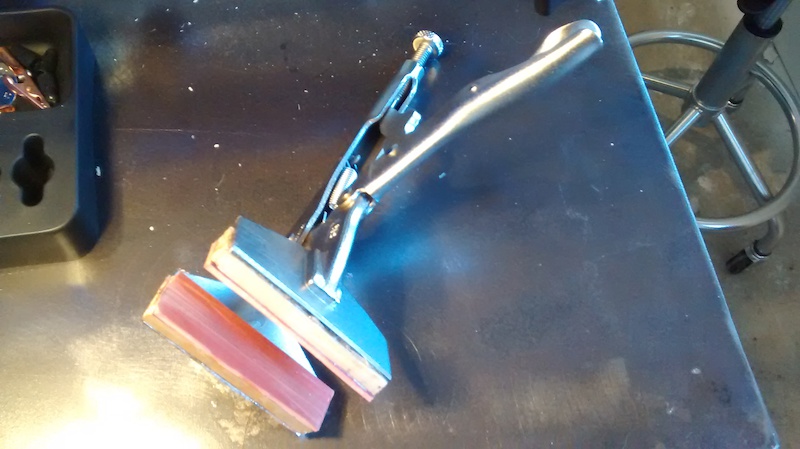
Maybe there s already a commercially available tool just like this and I m late to the party as usual but this thing is worth it s weight in gold for building wheels with round straight pull spokes. Basically a welding clamp with wood blocks to make the jaws meet parallel and rubber gasket material to grip the spokes so they don t spin as you tighten the nipples. Speeds up the build by quite a bit and leaves my fingers feeling good enough at the end of the day to grip other things...

Insufficient spoke tension can cause spokes to momentarily detension completely when a spoke reaches the 6 o'clock position in a wheel's rotation when under load or landing impact. If there is any windup tension in the spoke, it will release at that moment and possibly allow the nipple to spin relative to the spoke or vice versa. Now bearing this in mind, also consider your nipple threads. If you've been screwing your nipples back and forth a lot retensioning your wheels you may have worn and distorted the threads in the nipples to the point where they've become a sloppy fit with the spoke threads. Spokes, after all, are stainless steel and a lot harder than alloy or brass nipples, so in a pinch the spoke threads win every time. If that's the case, then that will also contribute to a wheel that won't stay tensioned.

Another possible cause of detensioning could be whether or not the wheels were built with locking nipples or some kind of spoke prep, and what was used. It all works, but it doesn't all work the same way.

The old standard Wheelsmith spoke prep DOES work, but it turns to powder after a few days inside the nipple/spoke interface. As long as the spoke was reasonably tensioned in the first place that powder adds friction between the threads and the spoke prep does it's job, but if you detension that spoke completely the spoke prep will fail completely and allow you to unscrew the nipples with your fingers. If you don't believe me, prep a spoke, screw a nipple on it, wait a week, then try it. You'll see what I mean.

Boiled linseed oil is an old school spoke prep that either works incredibly well or almost not at all depending on whether or not you let it dry on the spoke threads for a couple days before building. Build right away and it'll take forever for the linseed to harden because it can't get any air. Paint the threads and wait three days before building and you'll have a gluey, sticky, buttery feel that lasts a looong time and will NEVER completely fail even on a spoke with no tension at all.

Some manufacturers also make locking nipples of various kinds. They work better than Wheelsmith spoke prep in my personal experience, but you can wear out the locking features in them eventually if you twist 'em back and forth a helluva lot. Good for people who just ride, but bad for people who just can't leave shit alone.

At the end of the day, if I were in your position I would rebuild with either brand new high quality locking nipples or brand new non-locking nipples with linseed oil painted on the spoke threads and dried for a few days. In addition to that I'd build with a tensiometer and make sure that spoke tensions are averaging around 100-120 kgf on the tighter side of the wheels. If you build using a tensiometer and some kind of spoke prep or locking nipples and STILL have problems, then I'd start from scratch and rebuild with new spokes and nipples (and spoke prep, etc...).

Posted: Oct 21, 2017 at 12:19 Quote
I am by no means any sort of wheel building expert so this is the amateur opinion/idea.
On the one and only so far wheels I built myself (also stans flow mk3 rims) that did the same thing.
I backed the niples of quarter a turn after re tensioning and they have been spot on ever since no re tension needed since touch wood.
Hope it's as simple a fix for you to

  • Previous Page
  • Next Page


Copyright © 2000 - 2026. Pinkbike.com. All rights reserved.
dv56 0.014476
Mobile Version of Website