Pinkbike.com
Powered by Outside

Ride886
- Member since Jun 18, 2026
- 47
-
 Bellingham , Washington
 - 0 Followers
- 0 Trailforks Points
Recent
Ride886 edspratt's article
Sep 13, 2026 at 3:08
2 days
Aaron Gwin & Gloria Scarsi Win the 2026 US Open Downhill
Gwin back on top and Sam Hill full time moto dad, off the couch and still in the mix. More of this please!
Ride886 edspratt's article
Aug 25, 2026 at 7:19
Aug 25, 2026
2026 Val di Sole DH World Championships Preview: Rider List, How to Watch & Race Favorites
The UCI Youtube channel doesn't show any of the events for me in the US, but switching the VPN to Taiwan and they all appear to be available.
Ride886 Ride886's article
Jun 25, 2026 at 12:43
Jun 25, 2026
Ride 886 Releases TopHat Dual-Stage Air Spring System
@DaveRobinson81: definitely not easy, but when a few more pieces fall into place we’re planning a sub $200 price for US customers. International prices unfortunately are harder to bring down until we can better work around the relatively huge minimum administrative fees charged by the shipping companies.
Ride886 Ride886's article
Jun 25, 2026 at 12:24
Jun 25, 2026
Ride 886 Releases TopHat Dual-Stage Air Spring System
@englertracing: Good question, we contemplated going that route initially. The downside is primarily one of QC, as we can’t predict or control how the original manufacturer handles the upper inner surface to the stanchion. Finish quality, tapering, etc isn’t something we can control so it just makes sense from that perspective. Aside from that, having a sleeve is easier to install without the need to press a sealed piston in, lubrication is pre installed and doesn’t leak, it’s easier to handle, is sealed from contamination and so on. I’m still exploring that option for a future update as it would allow us to significantly lower the cost too. Excluding finishing, assembly, and packaging that tube is 25% of the manufacturing cost.
Ride886 Ride886's article
Jun 24, 2026 at 7:22
Jun 24, 2026
Ride 886 Releases TopHat Dual-Stage Air Spring System
I'd love to be able to be able to sell these for $150, but that would only be achievable if we sold them in person right out the front door of the factory. Even if you can get the cost of goods low enough by finding the cheapest possible supplier and stripping away as many features as possible you'd quickly be confronted by the realities of the real cost of getting the product to your customers. Credit card processing fees will take $4-7, if your customer pays in a foreign currency add another $3. Shipping is where it gets tricky, as you can certainly scale down the cost through bulk shipping and warehousing, those will add overhead. If you are a small company based in the US or EU it will be difficult to have a physical presence and maintain a business in a foreign market too. Let's imaging you are a US company and you want to send a single order to the EU. With a decently negotiated contract with UPS you might get an 80% discount off standard rates, but you'll still hit all sorts of minimum that don't scale in your favor. Let's imagine an incredibly optimistic $20 base shipping charge. On top of that there's a fuel surcharge that changes weekly, currently it's about 50%, so real shipping cost is now $30. It's cheaper for your customer if you send the package DPP (delivery duty paid) so your customer doesn't get hit with even higher VAT, import, and brokerage fees. So that's another $28 in VAT plus any flat import fee that may be charged. UPS will pay that on your behalf and invoice your account at a fee of %2 of VAT/Tariff total, which seems fair except the minimum is $15-20. On top of that they may charge you a fee for converting the invoice from the foreign currency to your own currency, also at a flat fee of around $15. These fees may be more easily absorbed in hi-cost or bulk shipments, but for a $150 product they are crushing to your margins. That $20 shipping cost effectively becomes $60 or more. If your the delivery address is considered 'out of area' or rural there's anotfher fee. Shipping domestically in the US this may be about $5 but on an international label order it's $30, and that $30 is used to recalculate the fuel cost multiplier, making the additional charge more like $50. Your total real delivery cost isn't $20, it's now $90-100 even with your huge contract discount. But it doesn't stop there, if the customer makes an error when entering their address in any way that requires UPS to verify or update it's another $25 fee. Add all that together, plus your cost of goods from the supplier and you're already in debt. Sure you could pass the shipping and import cost off to your customer, but then your $150 product will come with massive bill, or you can raise the price to reflect these costs and suddenly you're right back in the $230 - $250 range. Using your Runt example at $225, the international shipping is free, but the import charges are not. Making the real cost outside the US $268 after VAT plus all the brokerage fees incurred during customs processing being charged to the customer, pushing the real delivered cost very likely to the $300+ range. TLDR: if you are a small, low volume MTB business shipping small volume or single packages at relatively low price points you can get crushed by the real cost of delivery. For a company doing business both locally and internationally you'll most likely raise your domestic retail price to help balance out the higher costs so your RRP remains competitive in all markets. Hope that at least helps explain what often feels like a disconnect between what the perceived cost of a product might be versus what may feel like a grossly inflated retail price.
Ride886 Ride886's article
Jun 23, 2026 at 14:16
Jun 23, 2026
Ride 886 Releases TopHat Dual-Stage Air Spring System
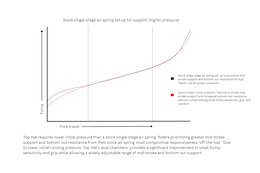
Lee from Ride 886 here. A primary goal when designing the TopHat was to address what we felt were limitations with the products currently available aftermarket. Namely, reducing unnecessary internal volume as much as possible, adding additional tuning option that are decoupled from the pressure ratio, purposely not designing around a predetermined ratio or theoretical spring curve, creating a modular design that can be adapted cheaply to a new fork purchase whenever possible, adding value for customers by manufacturing and including a quality installation/removal tool, including replacement seals and publishing all other o-ring specs, building a robust website with easy to follow tuning advice, offering free replacement of small small parts should you lose something, a lifetime warranty, improved aesthetics, stable stock levels, and a price that is accessible to a worldwide market rather than a regional one. Ultimately, adding a second option to what is otherwise a single product market in either the US or Europe gives consumers more choice and presents other manufacturers a reason to update and refine their own products. My personal take on the latter is there seems to be more effort spent arguing with each other about who supposedly came up with a fairly obvious idea first, as if it's a performance metric, rather than trying to innovate or differentiate.
Not everyone will find the same value, or agree that a TopHat offers the improvement we promise. That's okay, it's not going to appeal to everyone. But I'll stand by the claim that TopHat offers better value, range of performance, support and ease of use than other legacy aftermarket options.
Added 1 video
Jun 18, 2026 at 21:27
Jun 18, 2026
1 comment –
Add comment