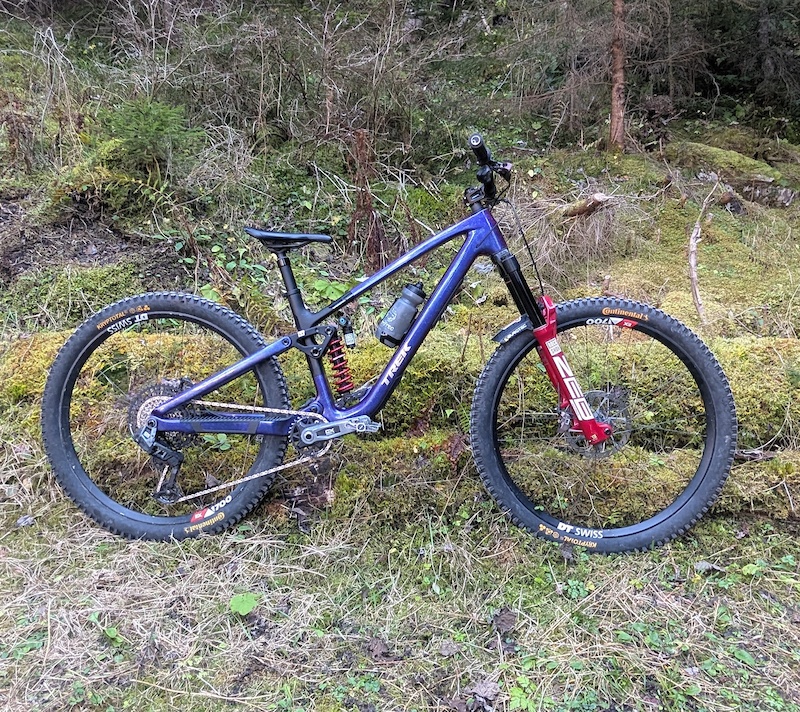
I know the Fuel LX has just been released but it is a potential contender for a next bike. I like the idea of a "Slash without all the high pivot" complication. I've owned a high pivot bike before and didn't love the drivetrain noise. Has anyone had a chance to ride both the Slash and Fuel LX to compare? Is the reported "plushness" of the Slash suspension worth the high pivot complication?
In my opinion, “plushness” isn’t the main difference between these two bikes—it’s more about how the rear center reacts to impacts. If you’re racing, the Slash is the better choice thanks to the characteristics of its high-pivot design—the rear wheel gets out of the way more easily, making it easier to maintain speed. The LX is more of a jack-of-all-trades long-travel bike. You can race it, ride your local trails, or hit the bike park, and it’ll likely feel a bit more nimble than the Slash.
I know the Fuel LX has just been released but it is a potential contender for a next bike. I like the idea of a "Slash without all the high pivot" complication. I've owned a high pivot bike before and didn't love the drivetrain noise. Has anyone had a chance to ride both the Slash and Fuel LX to compare? Is the reported "plushness" of the Slash suspension worth the high pivot complication?
In my opinion, “plushness” isn’t the main difference between these two bikes—it’s more about how the rear center reacts to impacts. If you’re racing, the Slash is the better choice thanks to the characteristics of its high-pivot design—the rear wheel gets out of the way more easily, making it easier to maintain speed. The LX is more of a jack-of-all-trades long-travel bike. You can race it, ride your local trails, or hit the bike park, and it’ll likely feel a bit more nimble than the Slash.
Agree with the plushness! I especially doubt the supposed advantage of the Slash in racing. Why? You win enduro races in corners and with maneuverability, not on flat-out straights. I wouldn’t be surprised if we’ll only see Fuel LX or MX bikes in World Cups next season instead of the Slash.
I know the Fuel LX has just been released but it is a potential contender for a next bike. I like the idea of a "Slash without all the high pivot" complication. I've owned a high pivot bike before and didn't love the drivetrain noise. Has anyone had a chance to ride both the Slash and Fuel LX to compare? Is the reported "plushness" of the Slash suspension worth the high pivot complication?
Haven’t ridden both back-to-back but I’ve tried each and they’ve got pretty different feels. The Slash is definitely plusher and more planted, you really notice it in rough stuff, but yeah the high pivot adds a bit more noise and complexity. The Fuel LX feels simpler and quieter, climbs nicer, and is still plenty capable if you’re not constantly smashing bike park laps. Just depends if you want that extra downhill cush or prefer a more straightforward setup.
I know the Fuel LX has just been released but it is a potential contender for a next bike. I like the idea of a "Slash without all the high pivot" complication. I've owned a high pivot bike before and didn't love the drivetrain noise. Has anyone had a chance to ride both the Slash and Fuel LX to compare? Is the reported "plushness" of the Slash suspension worth the high pivot complication?
In my opinion, “plushness” isn’t the main difference between these two bikes—it’s more about how the rear center reacts to impacts. If you’re racing, the Slash is the better choice thanks to the characteristics of its high-pivot design—the rear wheel gets out of the way more easily, making it easier to maintain speed. The LX is more of a jack-of-all-trades long-travel bike. You can race it, ride your local trails, or hit the bike park, and it’ll likely feel a bit more nimble than the Slash.
Agree with the plushness! I especially doubt the supposed advantage of the Slash in racing. Why? You win enduro races in corners and with maneuverability, not on flat-out straights. I wouldn’t be surprised if we’ll only see Fuel LX or MX bikes in World Cups next season instead of the Slash.
You could run the Slash as a mullet for quicker turning while still getting better straight-line performance over rough terrain than the LX. Since the LX shares the same geometry as the EX—higher bottom bracket and shorter wheelbase—the Slash will likely corner in a more intuitive and stable way. Add in the high-pivot design, which provides strong anti-squat without compromising suspension performance on descents, and the Slash comes out as the technically stronger choice for racing or pushing hard.
Out of curiosity, I compared the LX to my RAAW Madonna v2.2 while thinking about my next bike. I’ve always considered the Madonna more of a long-legged trail bike than a pure enduro brute, so the comparison felt fair. What stood out was that the LX really does share the EX’s geo, and I’m not interested in a 160mm bike built on the bones of a 145mm platform.
All this to say - I think the LX is an awesome bike but it's not a Slash, nor does it fit the traditional mold of a 160mm travel enduro bike (race bike?).
I think we see a mix of usage between the LX and Slash for racing, depending on the course.
In my opinion, “plushness” isn’t the main difference between these two bikes—it’s more about how the rear center reacts to impacts. If you’re racing, the Slash is the better choice thanks to the characteristics of its high-pivot design—the rear wheel gets out of the way more easily, making it easier to maintain speed. The LX is more of a jack-of-all-trades long-travel bike. You can race it, ride your local trails, or hit the bike park, and it’ll likely feel a bit more nimble than the Slash.
Agree with the plushness! I especially doubt the supposed advantage of the Slash in racing. Why? You win enduro races in corners and with maneuverability, not on flat-out straights. I wouldn’t be surprised if we’ll only see Fuel LX or MX bikes in World Cups next season instead of the Slash.
You could run the Slash as a mullet for quicker turning while still getting better straight-line performance over rough terrain than the LX. Since the LX shares the same geometry as the EX—higher bottom bracket and shorter wheelbase—the Slash will likely corner in a more intuitive and stable way. Add in the high-pivot design, which provides strong anti-squat without compromising suspension performance on descents, and the Slash comes out as the technically stronger choice for racing or pushing hard.
Out of curiosity, I compared the LX to my RAAW Madonna v2.2 while thinking about my next bike. I’ve always considered the Madonna more of a long-legged trail bike than a pure enduro brute, so the comparison felt fair. What stood out was that the LX really does share the EX’s geo, and I’m not interested in a 160mm bike built on the bones of a 145mm platform.
All this to say - I think the LX is an awesome bike but it's not a Slash, nor does it fit the traditional mold of a 160mm travel enduro bike (race bike?).
I think we see a mix of usage between the LX and Slash for racing, depending on the course.
Perfect, you pretty much convinced me, the fuel will be the better choice. Thanks mate!
In my opinion, “plushness” isn’t the main difference between these two bikes—it’s more about how the rear center reacts to impacts. If you’re racing, the Slash is the better choice thanks to the characteristics of its high-pivot design—the rear wheel gets out of the way more easily, making it easier to maintain speed. The LX is more of a jack-of-all-trades long-travel bike. You can race it, ride your local trails, or hit the bike park, and it’ll likely feel a bit more nimble than the Slash.
Agree with the plushness! I especially doubt the supposed advantage of the Slash in racing. Why? You win enduro races in corners and with maneuverability, not on flat-out straights. I wouldn’t be surprised if we’ll only see Fuel LX or MX bikes in World Cups next season instead of the Slash.
Yeah that lines up with how I see it too. The Slash just feels more like a true enduro race bike, while the LX leans more trail-y even with the extra travel. Both solid bikes but if you’re pushing hard or racing, the Slash makes more sense.
You could run the Slash as a mullet for quicker turning while still getting better straight-line performance over rough terrain than the LX. Since the LX shares the same geometry as the EX—higher bottom bracket and shorter wheelbase—the Slash will likely corner in a more intuitive and stable way. Add in the high-pivot design, which provides strong anti-squat without compromising suspension performance on descents, and the Slash comes out as the technically stronger choice for racing or pushing hard.
Out of curiosity, I compared the LX to my RAAW Madonna v2.2 while thinking about my next bike. I’ve always considered the Madonna more of a long-legged trail bike than a pure enduro brute, so the comparison felt fair. What stood out was that the LX really does share the EX’s geo, and I’m not interested in a 160mm bike built on the bones of a 145mm platform.
All this to say - I think the LX is an awesome bike but it's not a Slash, nor does it fit the traditional mold of a 160mm travel enduro bike (race bike?).
I think we see a mix of usage between the LX and Slash for racing, depending on the course.
I’ve ridden Slash and Fuel LX back-to-back, and honestly you feel the difference. The Slash is way plusher on descents, more confidence in rough, steep stuff. But man, the high-pivot adds complexity and some drivetrain noise. The Fuel LX is simpler, lighter, climbs better, quieter, and is more fun for mixed trails. If I were picking, I’d only go Slash if I was doing a lot of downhill / bike-park runs / rough lines, otherwise Fuel LX is totally legit and easier to live with.
Trek Slash + Soaks up every hit and bump + Holds straight lines with ease + confidence super boost + Climbs okay
– Less efficient – Needs more input when cornering
Trek Fuel EX + Feels super efficient (both straight and in turns) + Great adjustability (though I’d keep it mostly stock, just add a 0.5° steeper angleset. tossed in the +1 on the slash too) + Shock feels more supportive + Pedals more than okay!
– Needs more correction, as fast rear hits don’t get absorbed as smoothly
In general, the Slash is a big-hit bike that almost never feels unbalanced. With the Fuel, on the other hand, you do notice the rear kicks when hitting at high speed. That doesn’t mean you get bucked, but you need to put in more work to keep the bike balanced. On slower or deeper hits, however, the Fuel generated more speed and carried momentum forward, whereas the Slash absorbed everything — sometimes even losing speed in the process (if that makes sense somehow?).
The big differences are efficiency, cornering, and speed generation. With the Fuel, I had the feeling that corners were over quicker compared to the Slash. In other words: same input, better output — or less input, same output. The amount of speed the Fuel carried through corners was impressive. The Slash is definitely no slouch in cornering, especially compared to other bikes, but the Fuel does it in a noticeably more efficient way.
I could feel that the Fuel would be more fatiguing than the Slash when wrestling the bike around for a whole day. however the less weight (tested the carbon fuel, owe the alu slash) makes up for some of that.
I really liked the higher stack and never felt the need to adjust to the shorter reach. The “kick forward” sensation might actually be related to that shorter reach? – honestly, no idea.
Conclusion: I’ll definitely order the Fuel, as it suits my riding style and terrain much better. I would keep the Slash if I were riding more bike parks, but since I mainly ride trails and enduro races and somewhat 10-15 bikeparkdays, the Fuel is simply the better choice for me.
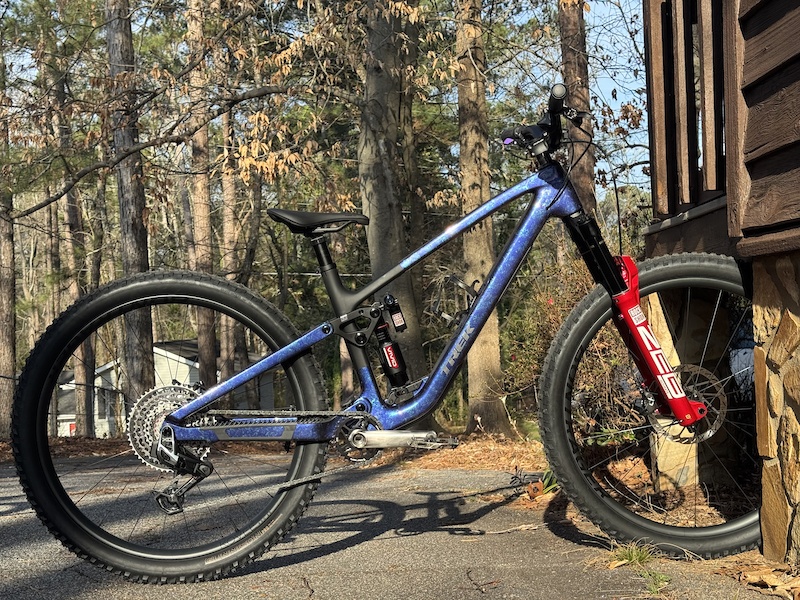
Finally built it up and swapped pretty much all parts over from the slash. Got the WRP zero drag hub internals. May be its purely mind games but the kicking forward sensation is definately less noticable. Thing is super quick, more my type of bike. And looks ace (at least in my opinion. )
Looks like this is the Fuel LX setup. How does the seat angle feel? On paper it looks a little slack for the XL size.
It is the LX. This is size large. Seat angle could be steeper but doesn't need to be, totally fine. Yet i still slammed the saddle all the way forward, because i could. Would be fine if this wasn't an option.
Definately nowhere near the old slash seatangle where you had the saddle in line with the last third of the chainstay.
Has anyone compared a mullet LX? I'm currently on a Gen 5 9.9 and trying to decide between the Slash and Fuel LX. I like the idea of changing the LX to mullet and swapping the shock mount to suit.
Pinkbike's video comparing the EX/LX/MX lap times on the front page inspired me to post up here. Here's a wall of text that will include some thoughts about these bikes, some philosophy, and some vitriol about how terrible climbing is and how you should feel bad if you like it.
TLDR about the comparison between a Slash and a Fuel LX in the middle, because some men just want to watch the world burn.
Last year I had a 2025 Slash that I built up with XTR, some eeWings and Rockshox Zeb/Vivid ultimate (it was a fancy build) that I tested and rode in a wide variety of trails, in both mullet at full 29, and this year I just got an even fancier Fuel that I'm playing around with an even larger variety of setups. I know these bikes at their best and worst.
Here's my background/riding style, and opinion on the which bike question.
Climbing is a necessary evil part of riding bikes, but it's not something I give a shit about or take joy in. I get my riding thrills purely from the most rowdy parts of the descent. The rest of the ride is just filler to me. I come from a DH background. If I could build a chairlift on the 150 foot climb part of my local XC loop, I would.
My favorite trails are mellow fire road climbs followed by DH trails. In an ideal world, I'd be on a DH bike and be shuttling all of them, but sadly, the world is not ideal, and a lot of times I have to pedal my bike to the top.
Which bike is best? It depends on where you live, what trails you have access to, and what you generally ride.
If your riding is exclusively the "mellow fire roads followed by a DH trail, and straight up shuttling and bike parks" types, the Slash is unquestionably better and you should get it. It is (by a lot) the most capable enduro/freeride bike I've ever ridden on the descents. I've ridden some actual DH trails at bike parks that don't require any pedaling faster on my Slash than I did on my DH bike. It's an amazing bike, it descends incredibly well. It manages to be poppy and jumps terrifically. Line changes are quick and natural. Riding in the pocket feels stable and easy. It manages to plow through the chundery stuff with ease, handles off camber like a champ, and is one of (if not the) most quiet descending bike I've ever ridden. Mullet was better all around - the 29 didn't bring enough to the table in climbing to justify. It was 90-95% as good as a DH bike at doing DH things, and for mellow climbs up fireroads it was 100% fine. If I still lived in the PNW, or any number of places in California, I'd have kept it. It was 90-95% as good at being a DH bike as a pure modern DH bike, except that it could pedal (kind of. I'll get to that).
But, If your riding has some (really any amount) of rolling single track, climbing single track, or descents that don't require a DH bike, you should get the Fuel. The LX is a very good descender. I feel comfortable doing big features on it that I would do on my slash, and going fast. I have bike park trips planned, and based on my current rides, have no doubt they're gonna be awesome. It pedals, climbs, and holds speed on the mellower sections of trail so much better than the Slash that I can get to the top without hating life, hating myself, hating everybody else, and wanting to murder all living things, and I never have the urge to go buy a Surron while riding it.
The Slash on the other hand was an absolute chore to drag up the hill. It felt like I was dragging a 50lb log behind the bike. It felt like every pedal stroke pushed the bike into the hill, rather than up the hill. It was heavy as hell. The extra chain-drag was noticeable. It was loud. Even on mellow descents it felt like it was effort to keep it going. It was very much not a "can do a bit of everything" type bike that made a few compromises to excel in certain areas; it was a "This bike is a DH bike that can kinda pedal but isn't quite as good at DH things as a true DH bike." It came stock in 170/170, but the geometry made the most sense and fit the most naturally in 170/180, and 170/190 would not have been even slightly crazy (I never tested that).
TLDR: if you ride exclusively shuttled DH trails, bike parks, and DH trails you have to pedal up a fire road to get to, the Slash is the play. If you ride any amount of single track that involves mellow descents or needing to go uphill in addition to the rowdy DH stuff, the Fuel is orders of magnitude better. The Fuel LX is an excellent do everything bike that is a blast to rip on, but can do a bit of everything from XC to DH. The Slash is a DH bike you can kind of pedal when the climbs are mellow and smooth.
More specific to the Fuel, and less relevant to the Slash: If you get the Gen 7 Fuel EX, you have an EX. But if you get the LX, it's just an extra 250 bucks and an hour of elbow grease, you can also have an LX and an EX. I've been swapping mine back and forth testing out various setups.
So far my favorite setup that I've landed on / recommend to somebody buying a Gen 7 Fuel is: get the LX, ideally selling the stock coil shock (even though it's a perfectly good shock) and getting your favorite flavor of 205x65 air shock to replace it (I'm running a vivid ultimate air, but I played around with the stock Fox Coil shock too).
While you can technically use the stock coil shock with a travel spacer and change in spring to make it an EX, I recommend an air shock; in addition to the weight savings that become relevant if you're pedaling or running EX mode, the fine tuning you need to do to change the bikes attitude between EX/LX is better suited to an airspring, where you can change just a few PSI, rather than be faced with deciding between two 50lb increments. A 205x65 air shock technically gives you extra travel in EX mode, but if you tune the sag/compression/rebound settings around running 25% sag in EX mode and 30% in LX mode, the extra travel becomes largely irrelevant because it only ever comes into play occasionally on big hits.
Then, simply by swapping the link to an EX link and the air shaft to 150, it becomes a general all purpose trail bike - and swapping back is easy as can be. I'm a fairly competent but very ADHD and easily distracted mechanic and it takes me about 45 minutes. I imagine somebody with any focus at all could do a complete swap in closer to 25-30 minutes without breaking a sweat.
The EX is very capable on the general all purpose trails that feature a mix of up down left and right, and is probably going to end up being where my bike spends the majority of it's time, but the LX manages to be fairly nimble and spritely, without ever holding me back save the high front end on the really steep stuff. And it's super butter on the descents.
I think this is EX mode with my Trail wheelset on it it came out to 30.3lbs