Kathmandu, Nepal With Sacred Rides
The woman was angry, really getting her gut into whatever it was she was screaming in Nepali. Mountain bikers are used to airborne abuse. It's part of sharing trails with dog walkers, dirtbikers and hikers (especially the ones with trekking poles). But we weren’t sharing a trail with the woman, we were sharing her front yard. And here’s where it gets interesting. She wasn’t yelling at us, she was yelling at her dog. She was just fine with the ten riders who burst out of the narrow gulley uphill from her house and occupied, briefly but totally, the dirt walkway just off her front step. She was mad at her dog for barking at them. Such is mountain biking in Nepal, where dirt trails are everywhere, and everyone is welcome to them.
![Heavy load through Kathmandu. Photo by Patrice Halley]()
Our Sacred Rides group hit Nepal the first week of November - nine riders and a guide from Canada, the U.S. and New Zealand. Sacred Rides does trips all over North and South America and even Europe, but this was their first trip to Nepal. To negotiate the physical and human geography of the Himalaya they’ve enlisted local rider and guide Mandil Pradhan for a week of riding around chaotic Kathmandu and the austere Lower Mustang Valley. It was on the third day that the dog barked. We were on our way down from Chisapani toward Bhaktapur (in tourist terms, we were descending from a place where you can see Mount Everest to the walled medieval city that’s a UNESCO heritage site).
![Photo by Ian Merringer]()
Leaving Chisipani we followed rock-impregnated doubletrack that rose and fell along the rough contours of one of the larger hills ringing Kathmandu. I call them hills because the distant Himalayan peaks set the bar pretty high for geographic terms, but for three days these hills at roughly 1,200 metres in elevation were punching above their weight in acclimatizing us. The previous two days we followed traffic-free roads and trails in and out of dense forest on semi-populated hillsides, climbing an accumulated 2,000 vertical metres. Today was our downhill day, one that still included almost 800 metres of climbing.
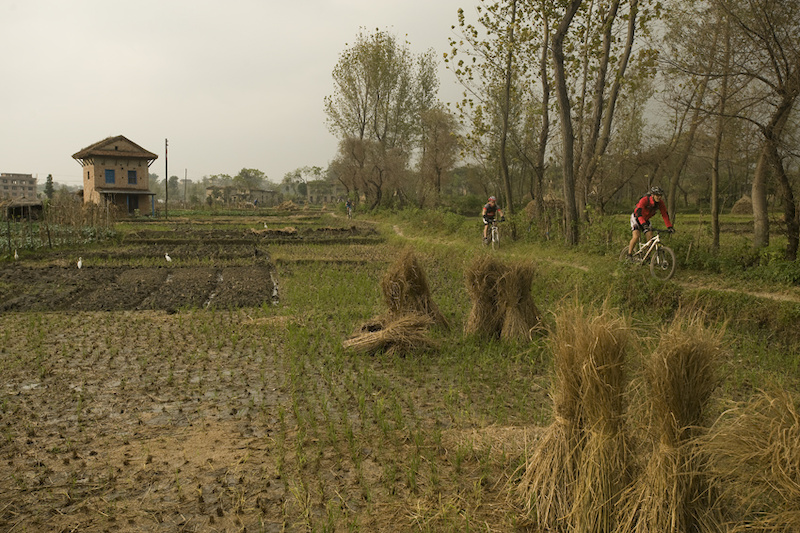
![Photo by Patrice Halley Riding the ridges separating rice paddies coming into Bhaktapur outside Kathmandu.]()
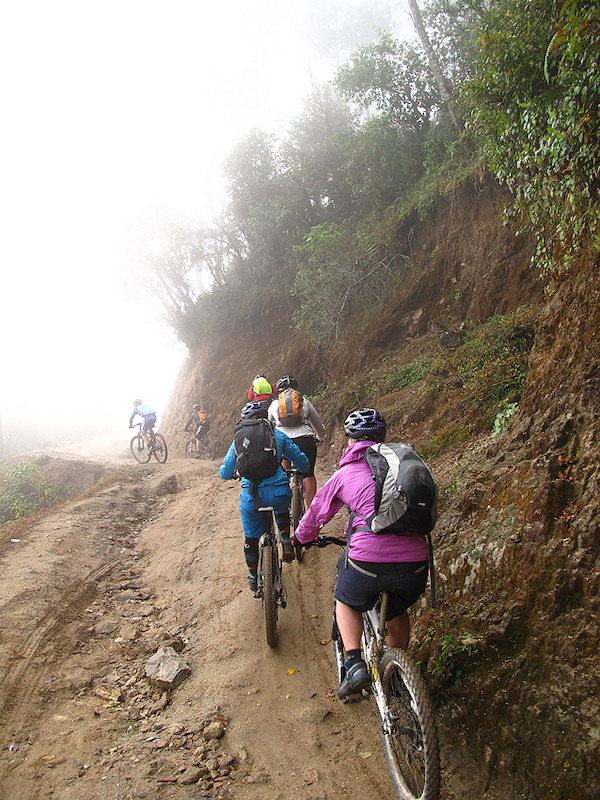
Pradhan stopped us at a concrete and steel hut with corrugated metal roofing, no doubt built to shelter the Western trekkers that feed a steady stream of rupees into the economy. “Lower your seats,” Pradhan said, before dropping into a gully leading straight downhill. This fall-line trail had known no erosion-abatement efforts. Rocks and ruts kept my attention focused pretty close off the front of my tire until it started rolling over intermittent stone steps and I realized our ride had become a semi-urban adventure.
![Kathmandu Photo by Patrice Halley]()
![Riding from Chisapani to Khatmandu Photo by Patrice Halley]()
![Hillside trails around Kathmandu. Photo by Patrice Halley]()
Paving stones and short staircases alternated with stretches of packed dirt and loose rock on this singletrack footpath that was the only means of getting to or from these houses. The trail hadn’t been built with flow in mind. It hadn’t been built at all, just worn by people coming and going from houses, the terraced paddy fields all around and the road somewhere below. With its direct route and frequent switches from rural to urban, the trail called for equal parts cross country, downhill and stunt park skills. What it didn’t call for was diplomacy. On the first day, after realizing that biking in Nepal meant biking among Nepalis, I had asked Pradhan how to say “excuse me”. “We don’t,” he replied. “We say, ‘Get out of the way.'” I didn’t ask for a translation.
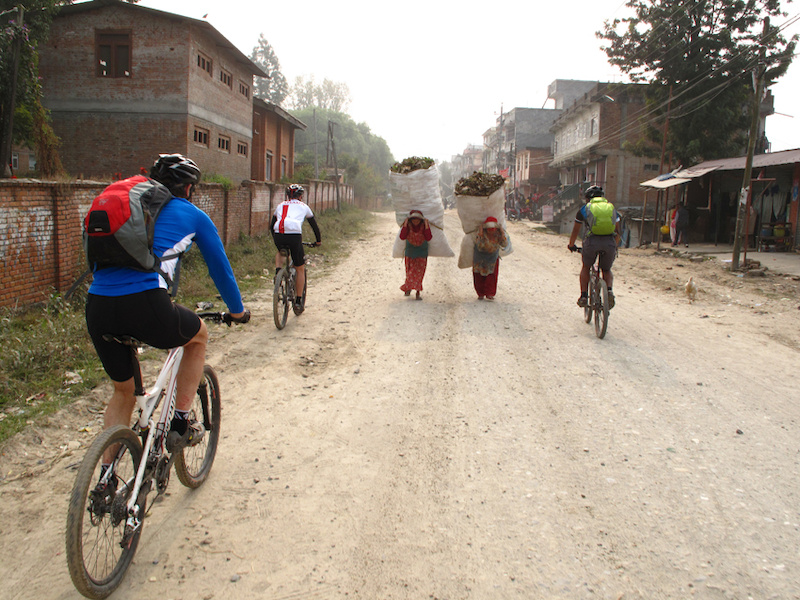
Our Sacred Rides group hit Nepal the first week of November - nine riders and a guide from Canada, the U.S. and New Zealand. Sacred Rides does trips all over North and South America and even Europe, but this was their first trip to Nepal. To negotiate the physical and human geography of the Himalaya they’ve enlisted local rider and guide Mandil Pradhan for a week of riding around chaotic Kathmandu and the austere Lower Mustang Valley. It was on the third day that the dog barked. We were on our way down from Chisapani toward Bhaktapur (in tourist terms, we were descending from a place where you can see Mount Everest to the walled medieval city that’s a UNESCO heritage site).
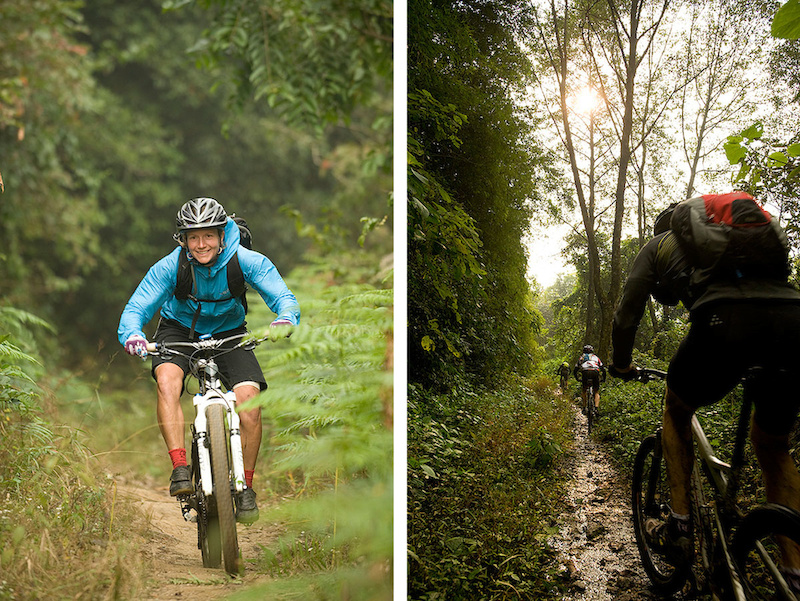
Leaving Chisipani we followed rock-impregnated doubletrack that rose and fell along the rough contours of one of the larger hills ringing Kathmandu. I call them hills because the distant Himalayan peaks set the bar pretty high for geographic terms, but for three days these hills at roughly 1,200 metres in elevation were punching above their weight in acclimatizing us. The previous two days we followed traffic-free roads and trails in and out of dense forest on semi-populated hillsides, climbing an accumulated 2,000 vertical metres. Today was our downhill day, one that still included almost 800 metres of climbing.
Pradhan stopped us at a concrete and steel hut with corrugated metal roofing, no doubt built to shelter the Western trekkers that feed a steady stream of rupees into the economy. “Lower your seats,” Pradhan said, before dropping into a gully leading straight downhill. This fall-line trail had known no erosion-abatement efforts. Rocks and ruts kept my attention focused pretty close off the front of my tire until it started rolling over intermittent stone steps and I realized our ride had become a semi-urban adventure.
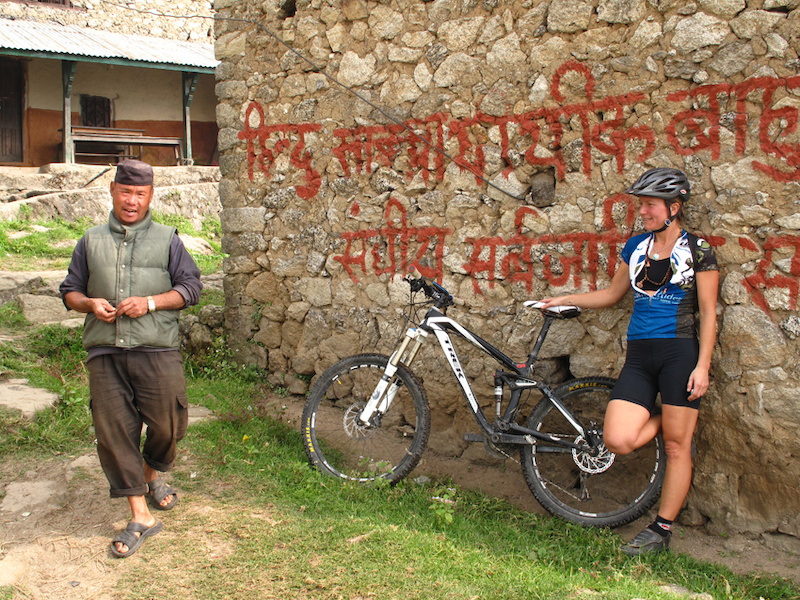
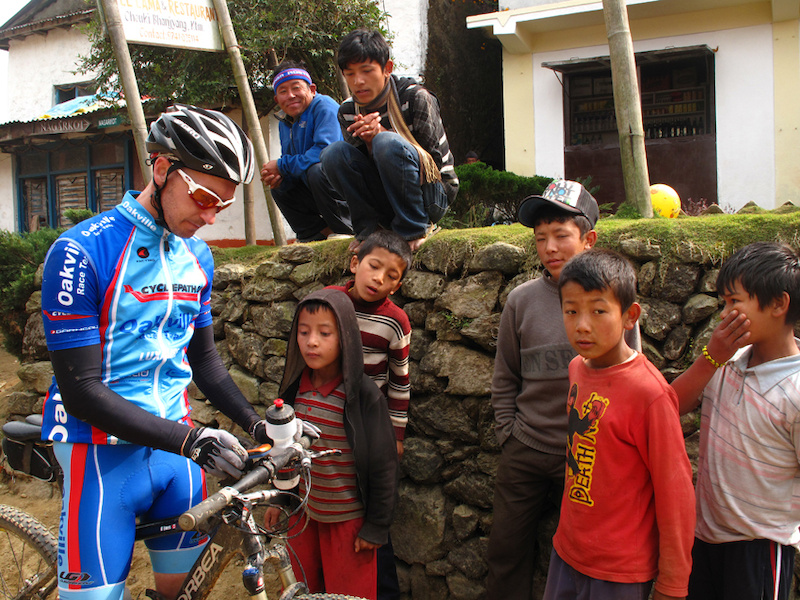
 | One storey houses started blurring past on either side. Various goats, chickens and an occasional water buffalo tethered by ropes through the nostrils populated most front yards. People doing laundry by hand and bundling millet, threshing rice or pounding chilis smiled and waved as we threatened to run over their livestock. Children in school uniforms screamed ''namaste'' and assorted mangled English phrases. |
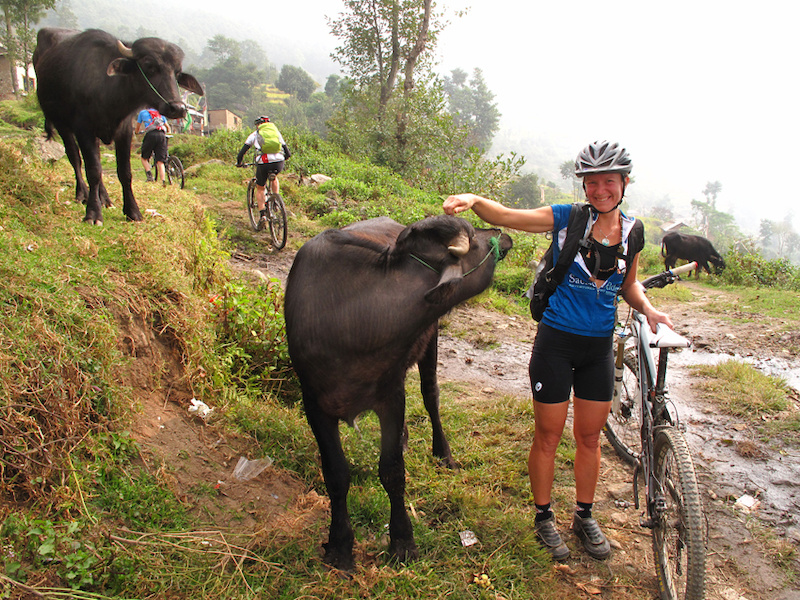
Paving stones and short staircases alternated with stretches of packed dirt and loose rock on this singletrack footpath that was the only means of getting to or from these houses. The trail hadn’t been built with flow in mind. It hadn’t been built at all, just worn by people coming and going from houses, the terraced paddy fields all around and the road somewhere below. With its direct route and frequent switches from rural to urban, the trail called for equal parts cross country, downhill and stunt park skills. What it didn’t call for was diplomacy. On the first day, after realizing that biking in Nepal meant biking among Nepalis, I had asked Pradhan how to say “excuse me”. “We don’t,” he replied. “We say, ‘Get out of the way.'” I didn’t ask for a translation.
This trail cut through yards, became one with sets of front steps and threaded through alleyways just a metre wide, and no one along the way took issue with us ripping down it. Except the dog. But he got told. After almost an hour it fed us out onto a single-lane paved road and we hung a right, through more semi-urban streetscape. Similar trails dumped out from uphill every hundred metres or so while we followed Pradhan, who was keeping track of the downhill trails leading off to our left before stopping at his favourite one for more of the same. “There must be about a million miles of trails in Nepal,” said Harvey, an amateur cross country racer from Montreal. Yes, he was exaggerating. No, not by much. In a country of thirty million people with the fewest roads per capita of anywhere on earth, these trails are everywhere. Down every gulley, up every valley, across every ridge. With all of them being open to riding, the world’s network of mountain bike trails stands to get a big boost as Nepal is fully discovered.
Photos by Patrice Halley
Next up: Himalayan highs in the Lower Mustang Valley
Sacred Ride runs Nepal trips in March and November.
Photos by Patrice Halley
Sacred Ride runs Nepal trips in March and November.
Author Info:
 Toronto, ON, Canada
Must Read This Week
Edit: but I agree, I was picking out lines the whole walk
They could care less about bicycles. They've got bicycles, but its all they can afford. Bicycles are good personal transportation but don't really get your family around, nor are they good in developing countries for hauling large quantities of materials.
As such, when you ride an expensive bike in a developing country, they 1) don't know how much its worth 2) would laugh if you said it was worth more than a $100 (USD) car.
The developing world has fascination with what they see as the developed world's "freedoms", like cars, computers, hospitals in every town and political/cultural security.
They want cars, motorcycles, houses, electricity, sewers, TV and internet.
All the thing we tend to "escape" by getting on a $4,000 bike.
We tend to consider ourselves happy by getting things, by affordind more and more. Then we are very arrogant to think that this is what would make people in the third world happy as well, we actualt force poor nations to join this "free" way of life. Unfortunately our way is, in many cases, the reason why they are "not developed" by exploiting their work force and resources. Are we developed? Maybe, but are we mature?
By "development" detached from nature, from anythimg that's sacred, from our loved ones, finally from ourselves. We live further and further from our bodies contemplating mistakes of the past, planning new challenges, to travel further, jump higher, to get faster, stronger, better, making up new needs, following ever present new impulses, desires. Not sure if they are after that...
You are pointing out a disturbing disproportion, but at the same time don't be so keen on pitying them too much, as it might be them pitying us. You never know who is happier with what he has and where he is.
Cheers!
To be honest, I don't feel like shit when someone drives past me with a 300000$ car and I don't think the nepali people feel like that either when someone passes by them with a 3000$ bike.
And speaking of hapiness, there is a study done in the US if I remember correctly, showing that people who earn less than 20k$ a year are getting happier the closer they get to the 20k$ mark, and then the farther they get away over that 20k$ mark, the less happy they become. They explained it saying that the closer you get to be able to afford the basic needs, the less of a burden money becomes, but the more money you get after that, the more you create yourself artificial needs you have to satisfy, so earning money becomes a burden once again...
Sometimes happiness isn't always where you believe it to be.
I would love to tour a developing world on my bike - a rocky mountain slayer - I wouldn't take a bike I didn't enjoy riding for the sake that someone might be offended. What a great way to really see a country. Also, to be correct, the "financial benchmark" for happiness was pegged at $75,000. Unfortunately, I then, am not happy.
But then again we're getting off topic...
We can put as many FB likes under "Free Tibet" actions, we can take a very active part, but as soon as we buy stuff made in China, we are doing the total opposite, because we are supporting regime that enslaved this peaceful country.
Cheers!
Interesting discussion anyway.