Stories posted under Pinkbike Community blogs are not edited, vetted, or approved by the Pinkbike editorial team. These are stories from Pinkbike users.
If a blog post is offensive or violates the Terms of Services, please report the blog to Community moderators.
Damping Curves - Digressive, Linear, Progressive
I was asked via private message to explain damping curves, so here's the reply for anyone else who may be curious.
A damping curve is the way a damper responds to different speeds (referring to the speed of the damper shaft, not necessarily the wheel or the rider). Think of moving your hand through water: if you do it very slowly, you barely feel the resistance; if you move quickly, there can be lot of force. It's the same for dampers, though they're more complex, with valves that open, close, or partially open at various levels of force to tune the force vs. speed relationship. Most discussions focus on the compression damping, rather than the rebound, but the same principles apply to both.
You will often hear three terms to describe the force vs. speed relationship, but keep in mind they're not distinct curves; the range of relationships is a continuum and almost any amount of fine-tuning is possible:
• Digressive: Starting from zero shaft speed, the force increases quickly at first, then begins to level off. For an extreme example, imagine a flap with a small hole. The flap is held down with a spring. Oil flows through the tiny hole, which quickly creates a lot of resistance. At a certain speed, the pressure is great enough to overcome the spring and the flap opens, creating an enormous opening for the oil to flow. Additional shaft speed doesn't create much more force because the opening is so large. This curve is steep at first, then nearly flat once it reaches that threshold.
• Linear: The curve is a fairly straight line. Multiply the shaft speed by a factor of X and the force also changes by about the same factor of X. This factor can be small or large, meaning the rate of increase can be mild or steep; the distinctive property is the relationship is close to linear.
• Progressive: The force increases more rapidly than a linear system. This does not necessarily mean the force becomes greater, only that in increases faster.
Simplified examples are shown below.
![Damping curve example showing representative progressive linear and digressive compression and rebound tunes of the high-speed circuits. These are idealized curves for example purposes and may not reflect actual damper curves. Source Shocks for Drivers by Ross Bentley via www . speedsecrets . com]()
Image from "Shocks for Drivers" by Ross Bentley, via www.speedsecrets.com
Curves such as these represent a single damping circuit, and a shock may contain multiple circuits that become active at different shaft speeds and/or shaft positions. If we consider the total damping curve for a shock, instead of looking at circuits in isolation, the combined curve will always be digressive for part or all of the curve due to the high rate of the low-speed compression damping circuit. The low-speed compression damping circuit blows open (i.e. allows access to the high-speed circuit) at fairly low shaft speed, since the resistance would be too high to respond to faster inputs if the damping continued to increase at the low-speed rate.
A damping curve is the way a damper responds to different speeds (referring to the speed of the damper shaft, not necessarily the wheel or the rider). Think of moving your hand through water: if you do it very slowly, you barely feel the resistance; if you move quickly, there can be lot of force. It's the same for dampers, though they're more complex, with valves that open, close, or partially open at various levels of force to tune the force vs. speed relationship. Most discussions focus on the compression damping, rather than the rebound, but the same principles apply to both.
You will often hear three terms to describe the force vs. speed relationship, but keep in mind they're not distinct curves; the range of relationships is a continuum and almost any amount of fine-tuning is possible:
• Digressive: Starting from zero shaft speed, the force increases quickly at first, then begins to level off. For an extreme example, imagine a flap with a small hole. The flap is held down with a spring. Oil flows through the tiny hole, which quickly creates a lot of resistance. At a certain speed, the pressure is great enough to overcome the spring and the flap opens, creating an enormous opening for the oil to flow. Additional shaft speed doesn't create much more force because the opening is so large. This curve is steep at first, then nearly flat once it reaches that threshold.
• Linear: The curve is a fairly straight line. Multiply the shaft speed by a factor of X and the force also changes by about the same factor of X. This factor can be small or large, meaning the rate of increase can be mild or steep; the distinctive property is the relationship is close to linear.
• Progressive: The force increases more rapidly than a linear system. This does not necessarily mean the force becomes greater, only that in increases faster.
Simplified examples are shown below.
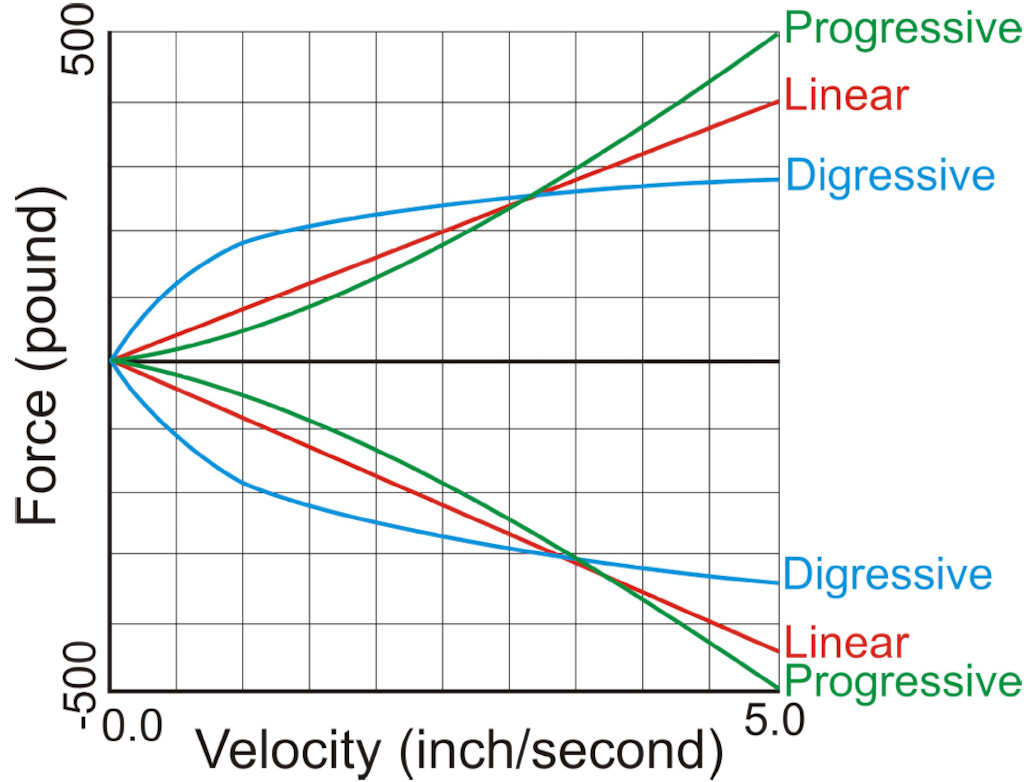
Image from "Shocks for Drivers" by Ross Bentley, via www.speedsecrets.com
Curves such as these represent a single damping circuit, and a shock may contain multiple circuits that become active at different shaft speeds and/or shaft positions. If we consider the total damping curve for a shock, instead of looking at circuits in isolation, the combined curve will always be digressive for part or all of the curve due to the high rate of the low-speed compression damping circuit. The low-speed compression damping circuit blows open (i.e. allows access to the high-speed circuit) at fairly low shaft speed, since the resistance would be too high to respond to faster inputs if the damping continued to increase at the low-speed rate.
Author Info:

 Calgary, AB, Canada
Must Read This Week
4 Comments
- 60
hmstuna
(Feb 15, 2021 at 13:43)
Super cool that you are doing all these blog posts. Its great that people will be able to have a reference for some of the more obscure questions by someone who actually knows what they are talking about.
- 30
R-M-R
(Feb 15, 2021 at 14:32)
Thank you. Yeah, I figured I'm already responding to several questions per week privately, so might as well provide the information as a public resource.
- 20
notsosikmik
FL (Feb 15, 2021 at 13:45)
As always great right up! Appreciate you taking the time to share the responses publicly.
- 30
R-M-R
(Feb 15, 2021 at 14:33)
Thanks! Nice to know folks are finding value in it.
Login or Sign Up