Ibis Bikes
It all began as a search for the next trail bike to build and after reading and hearing enough good things about the Mojo from Ibis, it was decided to see what the hype was all about.
Initial Build up Article
How to clean a dirty Ibis feature
Final review of the Ibis Mojo
As you can see the results were favorable and the bike stood out in my mind as one of my top rides ever and that is a tough list to get on to. Along the way I had the good fortune of getting to meet a few of the owners of Ibis, an engineer and their world renowned athlete Brian Lopes. Ibis has made a name and brand for themselves by not wanting to be the biggest, most bad ass company out there, but rather a company that makes high quality bikes that the end users (you and I) will love to ride on our local trails and beyond. The fact that the owners themselves are very approachable meant that I was able to ask them questions and tell biking stories too, with out feeling like I was being a grom. Heck I even learned that Scot can fly a plane and lived in Alaska for a while - frick that adds personality to a company.
Enough about thoughts and feelings, let's talk about their bikes now for a bit. The Mojo put them back on the map for high end, high quality rides, let's hear about the Mojo HD and the Tranny.
Scot talks about Ibis, the Mojo HD and working with Brian Lopes and Lopes talks about the Tranny:
Brian and the Tranny:
![photo]()
![photo]()
![photo]()
![photo]()
![photo]()
![photo]()
![photo]()
![photo]()
![photo]()
![photo]()
![photo]()
![photo]()
Learn more about the Tranny here.
Lopes talks about the Mojo SL, the Mojo HD as well as working with Ibis:
Brian's Mojo SL:
![photo]()
![photo]()
![photo]()
![photo]()
![photo]()
![photo]()
![photo]()
Learn more about the Mojo SL here.
Now for the real reason you've read this far, you want to know more about the all new Mojo HD. At 160mm of rear travel via the DW Link suspension platform, the HD is a whole new level of AM bike. Listen to Colin and learn.
Colin talks about the Mojo HD:
Prototype Ibis Mojo HD:
![photo]()
![photo]()
![photo]()
![photo]()
![photo]()
![photo]()
![photo]()
![photo]()
![photo]()
![photo]()
![photo]()
Additional Mojo HD Prototype Specs:
•Price and delivery date are both to be decided.
•26" Wheels.
•Target weight for the frame and shock: 6.2-6.5 lbs.
•Chain stay length: 17.125".
•Top tube lengths are the same as regular Mojos.
•Max rear tire sizing - 2.35"-2.5" depending on brand and height of the side knobs.
•The bottom bracket height is 13.8"-14" depending on tires.
•The graphics on the production models will be different than that which is pictured above.
Learn more about the Mojo HD here.
As you can see there are some exciting things happening over at Ibis Bicycles right now and moving forward. You can be sure that we'll be getting our greasy paws on a Mojo HD in the new year, so stay tuned to see where we take it!
-Tyler "Brule" Maine
How to clean a dirty Ibis feature
Final review of the Ibis Mojo
As you can see the results were favorable and the bike stood out in my mind as one of my top rides ever and that is a tough list to get on to. Along the way I had the good fortune of getting to meet a few of the owners of Ibis, an engineer and their world renowned athlete Brian Lopes. Ibis has made a name and brand for themselves by not wanting to be the biggest, most bad ass company out there, but rather a company that makes high quality bikes that the end users (you and I) will love to ride on our local trails and beyond. The fact that the owners themselves are very approachable meant that I was able to ask them questions and tell biking stories too, with out feeling like I was being a grom. Heck I even learned that Scot can fly a plane and lived in Alaska for a while - frick that adds personality to a company.
Enough about thoughts and feelings, let's talk about their bikes now for a bit. The Mojo put them back on the map for high end, high quality rides, let's hear about the Mojo HD and the Tranny.

Brian and the Tranny:


Ambrose filming a Tranny
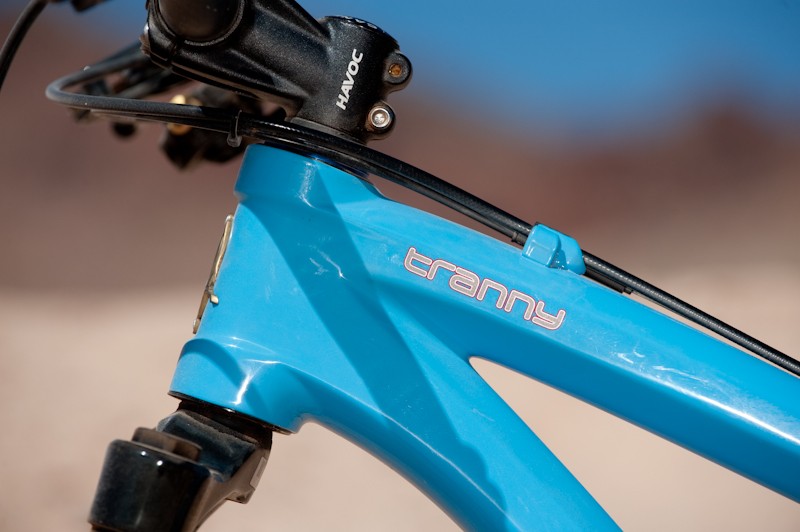



Brian riding a Tranny
Learn more about the Tranny here.
Brian's Mojo SL:


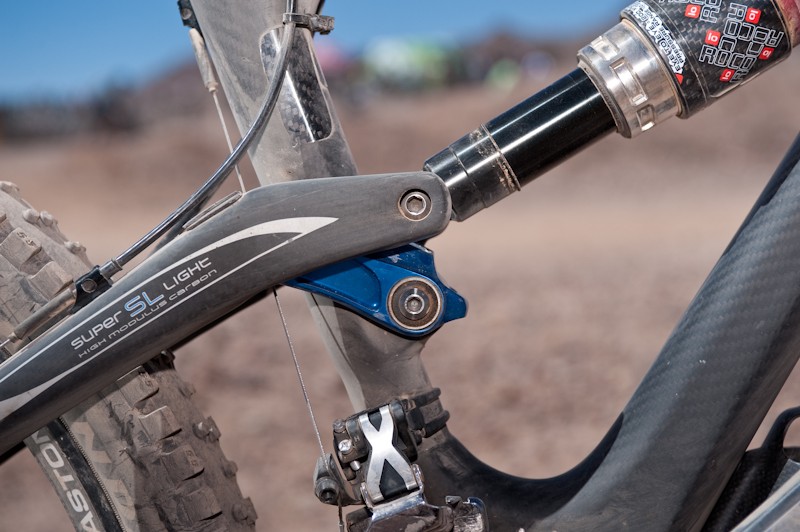
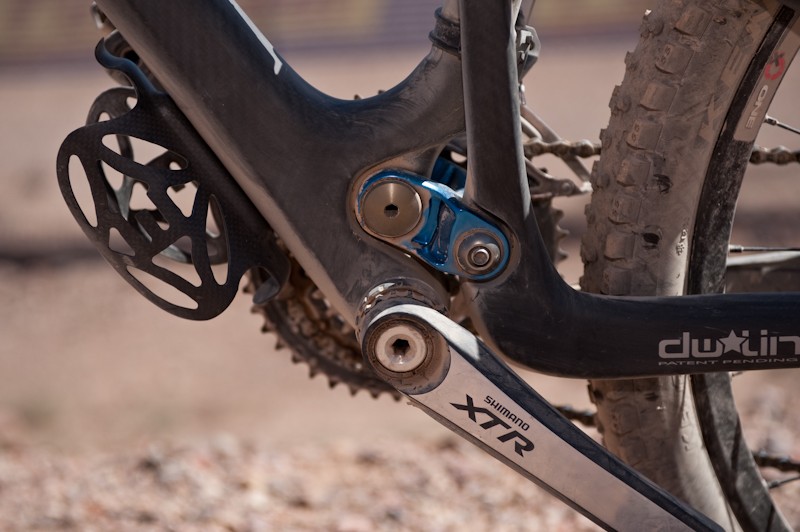
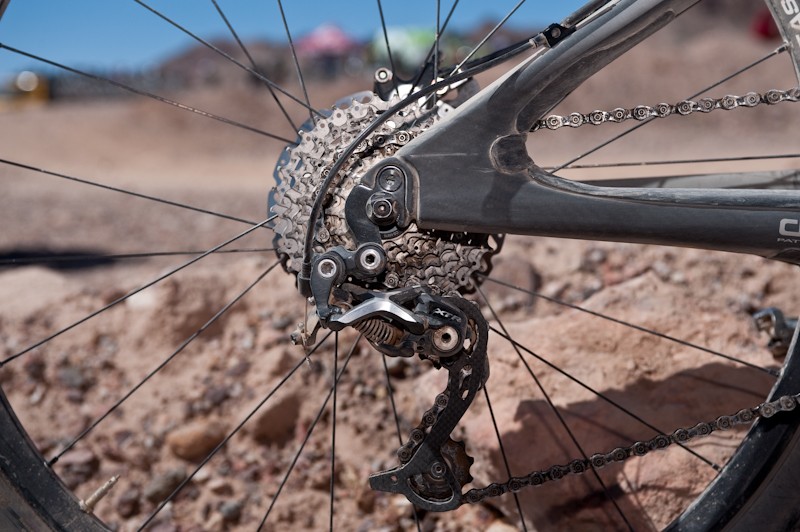
Learn more about the Mojo SL here.
Now for the real reason you've read this far, you want to know more about the all new Mojo HD. At 160mm of rear travel via the DW Link suspension platform, the HD is a whole new level of AM bike. Listen to Colin and learn.
Prototype Ibis Mojo HD:

160mm of rear wheel travel via the DW Link Suspension platform

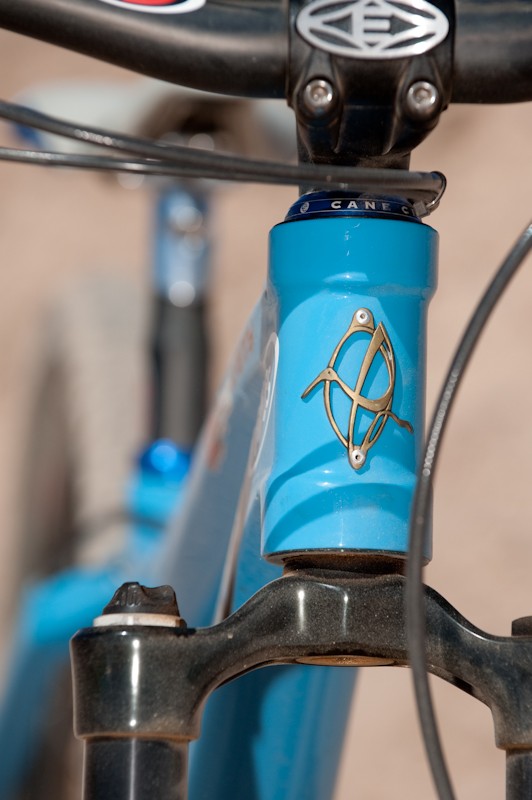
The tapered headtube is compatible with the new tapered steerer standard of 1 1/8th upper and 1.5 lower.
If you want to run your current straight 1 1/8th fork, you are covered too as there will be an adapter available
and you will be able to use a traditional headset top and bottom.
If you want to run your current straight 1 1/8th fork, you are covered too as there will be an adapter available
and you will be able to use a traditional headset top and bottom.

67 degree head angle with a 160mm fork (Brian's been running a 170mm fork, you can also run up to a 180mm).


The chain guides will be proprietary and brands will be announced once the frame hits retailers.
The frame will not have ISCG mounts so it will not be HammerSchmidt compatible
The frame will not have ISCG mounts so it will not be HammerSchmidt compatible

The leverage ratio on both the Mojo and Mojo SL is designed for air shocks. The Mojo HD comes with an 8.5" x 2.5" Fox RP23. Note - A DHX air will work on all but the small size. A coil shock is not offered because the linkage rates weren't designed for it. The top tube has be lowered to get slightly better stand over than the regular Mojo while having a higher BB because of the longer travel.

12 x 135mm Maxle rear axle

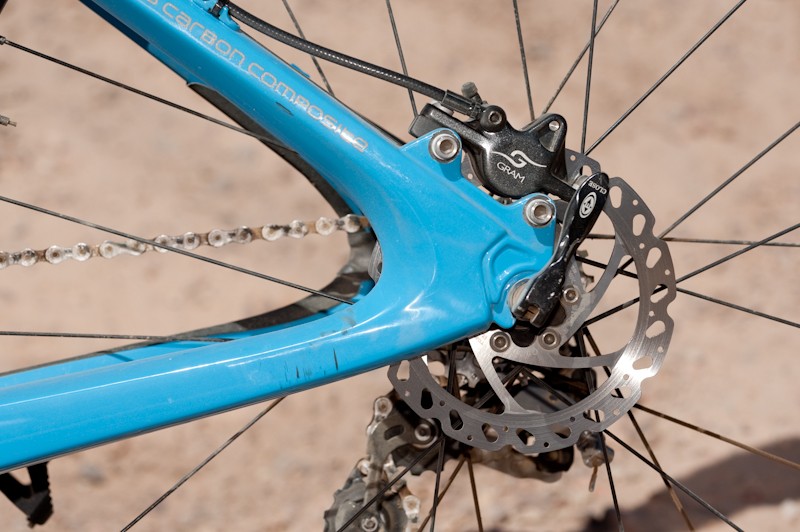
Post mount magnesium left dropout, carbon right dropout

Dual row angular contact bearings in the front of the lower link that have less play than standard sealed bearings. Preload adjustment is not necessary. Large 28mm x 15mm x 7mm radial bearings in the rear for stiffness and long wear.

Front derailleur and adjustable seat post housing (if you use them) run along the top tube

The HD runs full length cable housing. Rear brake and rear derailleur run on the down tube,
and there will be a cable guard made of foam-backed polycarbonate.
and there will be a cable guard made of foam-backed polycarbonate.
Additional Mojo HD Prototype Specs:
•Price and delivery date are both to be decided.
•26" Wheels.
•Target weight for the frame and shock: 6.2-6.5 lbs.
•Chain stay length: 17.125".
•Top tube lengths are the same as regular Mojos.
•Max rear tire sizing - 2.35"-2.5" depending on brand and height of the side knobs.
•The bottom bracket height is 13.8"-14" depending on tires.
•The graphics on the production models will be different than that which is pictured above.
As you can see there are some exciting things happening over at Ibis Bicycles right now and moving forward. You can be sure that we'll be getting our greasy paws on a Mojo HD in the new year, so stay tuned to see where we take it!
-Tyler "Brule" Maine
Author Info:

 Smithers, BC, Canada
Must Read This Week
Oh ya, two of the sweetest rigs I could picture!
the truth is: CF frames are more fragile to hard hits (like stones) with no regard how they are made (in fact most are made in a same way). That's why Trek and few others start using shielding under downtube and chainstay around BB area in bikes being a subject to gravity oriented use (and the Mojo HD is one of them). Nevertheless even with shielding the weight loss factor is significant.
With your Slayer... poo happens but some manufacturers just allways have had issues, and RM is one of them. At least they are one of those who replace broken stuff without problems
I've had a few carbon frames and wheels and stuff and I love it. When I was a newb to DH I raced a carbon Trek XC bike (9600 pro) for a season and it stood up to the battering just fine.
Generally speaking, carbon can only move in an unintended way (I say unintended as it can be designed to flex) about 1-2% and return but after that it will snap. Aluminum can move a few percent more and return but any more and it will stretch or bend.
BTW to which kind of force resistance do you refer by saying "the strongest"?
By 'strongest' I'd have to find the article about the bike - I can't even remember which mag or site it came from. I do know that they measured the force needed to either deflect or break the head tube and the Fury took the most amount of force they've seen on any of their bikes - the previous record was held by one of their BMXs - they may not even have busted the headtube. I think BB stiffness was out of sight too.
The bottom line of the interview with the GT dude was that they were concerned about building a carbon DH bike that people would blame the material if it failed, so they made it as strong (in every way) as possible. Even though they could have made the Fury lighter than the Aluminum version and be just as 'strong', they made it the same weight but made it much stronger (stiffer, impact resistent etc) than the Aluminum version.
I expect that when people come to accept carbon DH frames and finally realise the material's benefits, then the manufacturers will start making the DH frames light as well as strong.
I've got a dollar on Giant making a carbon Glory in the not-to-distant future. I'd love to see that because they always want to take weight off the carbon version and the Glory is selling like hotcakes.
Bottom line though, I dont care who "claims" what.. the simple fact is that carbon is more prone to damage from direct impacts than nearly ANY alloy material. It's not even debatable, it's a simple fact of the material composition. As far as strength to weight ratio and such, it's considerably stronger but the simple fact that carbon is essentially a woven fabric allows for more material displacement upon direct impacts. Put simply, the "threads" in the carbon can seperate much more easily than the molecules of an alloy material. No lay-up technique or anything else can work around that.
Wouldn't that make us a hydrogen based life form???
Anyone care to explain???
Many thanks to Bill at Horus Bikes in Victoria for the bike to try, he has a demo bike in all sizes I believe, so if you're in the area go take one for a spin, it's super fun
I love the techy reviews I really do, but what about more reviews on things average riders can afford? Id expect these complete rides are in the 4-5,OOO dollar range, and myself liking to keep a few decent bikes in the stable just cant afford such candy.
I would also like to see just random bike checks instead of always seeing what the pros can and do ride, which is neat mind you, but what about just a pinkbike user bikecheck?
just checking out what, why and where we ride.
Just a thought.
But yes, I also test rode an Ibis mojo and it rocked my world, so big ups to Ibis.
I am shopping for a new big bike for next season but alas can only afford around 2500 or 3 large.
BTW, a bike "snapping" from falling over was probably pinned between the car and garage wall previously LOL.I weigh 265 and haven't broken a carbon frame yet. I did break an aluminum bmx frame though.
I had a standard (8.75x2.5) and shorter (8.x2.5) shock for my 6 point. The 8.5x2.5 just feels more planted when you point the bike down.
I wish IBIS had engineered the head tube with changeable headtube cups like the Mondraker does.
'bout time all these knucklehead mfgrs got down to 66-67 head angles with a 150-170mm Fork.
And Kudos to ROCK-SHOX for nailing what I think is best design for axles; 20mm Front Maxle and 135 X 12mm rear Maxle - bye-bye crappy old road bike Tour-de-France developed 9mm.
If you keep making parts stronger, eventually you get to a point where the thing that breaks is most expensive. ISCG is on that path. Bruce Lee would not have run ISCG: "Be like water, my friends."
[Edit] I'm guessing that ISCG adapters only rely on friction to counter the torque of a Hammerschmidt or Tribewerk and so won't work.
Anyone have experience with multi-speed crankset and an ISCG adapter?
I much prefer ISCG mounts to the alternative. When a non-iscg chainguide takes a hit and rotates around the bb, it will eventually rotate so far that it will smash into the chainstay. When it butts up against the stay, every hit it takes from then on will be damaging to the frame.
Nice bikes, shame that they're not quite up to the job...
I know how many first generation Mojos I've witnessed fail (four) and how many second generation frames fail in the same way (none, and that's from a larger number of units).
My dad is a roadie, he said one of his roadie homies had an Ibis and it fell over (no one on it just bike fell over) and the chainstay snapped
sketchy carbon is sketchy