Do you need flat bars?
Here is a good conversation piece:
If flat bars are so good then why don't any of the top WC racers ride flat bars? Saw that appear on a forum somewhere and one tinternet champion piped up and said it's because none of their sponsors make a flat bar!
![photo]()
I know one top UK pro who was riding flat bars this year but had to take them off as his team boss went crackers as he had taken his sponsored "riser" bars off his bike.
We all know everyone has gone a little wider with their bars, even I don't cut mine down anymore. That said I'm only 5ft 6ins and a 710mm is still good for me but that is personal preference.
![photo]()
Most guys are bigger than me, no surprise there then so the average size bars on the DH tracks we're seeing are now around 730mm. This means the bikes feel more stable at high speed and you can go faster! Downsides are bleeding knuckles, a few grams in extra weight (insignificant) and your bars are higher off the ground. This is due to the sweep and rise of your bars, the longer they are the higher they will be. This means you are more upright in your riding position, further away from the ground and a higher centre of gravity. All bad news.
![photo]()
Then someone clever mentioned the axe-saw. What happened to Kore and these bars, nobody seems to know. Remember this story is not about wide bars but flat bars!
Let's go back to the beginning to why we rode riser bars in the first place. Once DH started to appear in the early 90's we needed a more upright position as we were running rigid forks. Therefore on came the 50mm risers, don't laugh! Then suspension forks began to appear, first with elastomers (rubbers) inside giving us 1-3inches of travel. Springs and oil appeared and those who could, had a pair of Marzocchi Z1 Bombers with 4inches of travel! Yet we still had those 50mm riser bars on even though the front end had lifted 4inches.
Next big break through were the Boxxers, originally 6inches of travel, then 7 inches and then 8inches like what we have today. Let's get this right then, the cockpit has risen over 8 inches yet we still run 50mm riser bars? Some idiots do, the rest of us went down to 40mm, 30mm, 20mm and now the likes of Funn produce 15mm rise bars.
I was just about to start talking about Chromag, just went on their website and it's down, have I missed anything there? Anyway I originally rocked the Chromag Fubars flat bars over two years ago and haven't "risen" since.
![photo]()
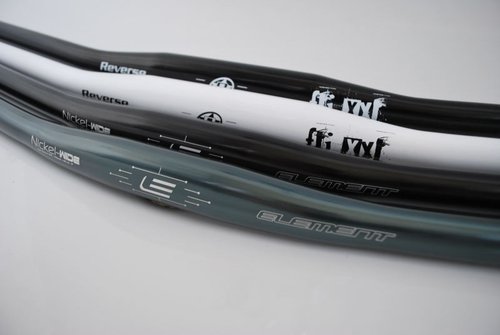
To be fair Reverse jumped on the Chromag rolling band wagon first with there REVERSE XXL DH-Race "fli-bar" FLAT that comes in at 760mm wide and 279grams. EN tested and approved they tell me. Priced at under £49.99 they come in either black or white and do exactly what they say they do.
Reverse Germany
Reverse U.K
Looking on the forums some guys are saying it's just another fashion statement and plan to get you to splash out on another new product. Whilst in their next post say they look ugly!
How do they ride, feel? Well for starters make sure on your first outing you give these broom sticks an extra tug up when popping off a jump or drop as they will have a tendency to nose dive a fraction. After a few hits you will re-correct yourself and be flying again.
Most bars have a degree of sweep on them, these are no different 9 degrees for both. If I blind folded you and gave you a pair of flat bars to grip onto and then a pair of standard riser bars with the same sweep you couldn't tell the difference. If they were fitted onto two identical bikes again they would feel exactly the same, except the flat bar would of course be sat slightly lower on the bike.
Now before you go spending any cash dollars on your pride and joy firstly make sure you remove as many spacers as possible from between your stem and headset. Meaning your stem is as close to the top of your headset as possible.
Note: All the flat bars seen here and mentioned all come in 31.8mm clamp size, that's "Oversize" to you and me. Will you ever see a 25.4mm flat bar? I'm guessing not but I'm always more than happy to be corrected, especially by you.
![photo]()
I took the Elements with me on holiday with Switch-BacksDH
Available in three colours, Black, Gun Metal and now Show Chrome in a limited 150 pieces World Wide will be the ticket. Definitely EN tested and passed the finish on the Elements is super shiny and they look a million dollars. Priced under £49.99 and available through Element U.K.
Be an Organ Donor.
Si Paton..
Descent-Gear.com
661 Kyle Strait Patriots 29.99GBP Posted
If flat bars are so good then why don't any of the top WC racers ride flat bars? Saw that appear on a forum somewhere and one tinternet champion piped up and said it's because none of their sponsors make a flat bar!

Chromag were the originals, Sunline have just followed, who will be next?
I know one top UK pro who was riding flat bars this year but had to take them off as his team boss went crackers as he had taken his sponsored "riser" bars off his bike.
We all know everyone has gone a little wider with their bars, even I don't cut mine down anymore. That said I'm only 5ft 6ins and a 710mm is still good for me but that is personal preference.
The way forward
Most guys are bigger than me, no surprise there then so the average size bars on the DH tracks we're seeing are now around 730mm. This means the bikes feel more stable at high speed and you can go faster! Downsides are bleeding knuckles, a few grams in extra weight (insignificant) and your bars are higher off the ground. This is due to the sweep and rise of your bars, the longer they are the higher they will be. This means you are more upright in your riding position, further away from the ground and a higher centre of gravity. All bad news.

Kore's at 800mm wide received much abuse.
Then someone clever mentioned the axe-saw. What happened to Kore and these bars, nobody seems to know. Remember this story is not about wide bars but flat bars!
Let's go back to the beginning to why we rode riser bars in the first place. Once DH started to appear in the early 90's we needed a more upright position as we were running rigid forks. Therefore on came the 50mm risers, don't laugh! Then suspension forks began to appear, first with elastomers (rubbers) inside giving us 1-3inches of travel. Springs and oil appeared and those who could, had a pair of Marzocchi Z1 Bombers with 4inches of travel! Yet we still had those 50mm riser bars on even though the front end had lifted 4inches.
Next big break through were the Boxxers, originally 6inches of travel, then 7 inches and then 8inches like what we have today. Let's get this right then, the cockpit has risen over 8 inches yet we still run 50mm riser bars? Some idiots do, the rest of us went down to 40mm, 30mm, 20mm and now the likes of Funn produce 15mm rise bars.
I was just about to start talking about Chromag, just went on their website and it's down, have I missed anything there? Anyway I originally rocked the Chromag Fubars flat bars over two years ago and haven't "risen" since.

Element and Reverse
To be fair Reverse jumped on the Chromag rolling band wagon first with there REVERSE XXL DH-Race "fli-bar" FLAT that comes in at 760mm wide and 279grams. EN tested and approved they tell me. Priced at under £49.99 they come in either black or white and do exactly what they say they do.
Reverse Germany
Reverse U.K
Looking on the forums some guys are saying it's just another fashion statement and plan to get you to splash out on another new product. Whilst in their next post say they look ugly!
How do they ride, feel? Well for starters make sure on your first outing you give these broom sticks an extra tug up when popping off a jump or drop as they will have a tendency to nose dive a fraction. After a few hits you will re-correct yourself and be flying again.
Most bars have a degree of sweep on them, these are no different 9 degrees for both. If I blind folded you and gave you a pair of flat bars to grip onto and then a pair of standard riser bars with the same sweep you couldn't tell the difference. If they were fitted onto two identical bikes again they would feel exactly the same, except the flat bar would of course be sat slightly lower on the bike.
Now before you go spending any cash dollars on your pride and joy firstly make sure you remove as many spacers as possible from between your stem and headset. Meaning your stem is as close to the top of your headset as possible.
Note: All the flat bars seen here and mentioned all come in 31.8mm clamp size, that's "Oversize" to you and me. Will you ever see a 25.4mm flat bar? I'm guessing not but I'm always more than happy to be corrected, especially by you.

Winter Sun Photoshoot
I took the Elements with me on holiday with Switch-BacksDH
Available in three colours, Black, Gun Metal and now Show Chrome in a limited 150 pieces World Wide will be the ticket. Definitely EN tested and passed the finish on the Elements is super shiny and they look a million dollars. Priced under £49.99 and available through Element U.K.
Be an Organ Donor.
Si Paton..
Descent-Gear.com
661 Kyle Strait Patriots 29.99GBP Posted
Author Info:

 Malvern, United Kingdom
Must Read This Week
had them on my bike for a good few months now, i am in complete love with them, i would never go for anything else now i use these
deffiniatly one of my better up grades i made to my cycle
what bars do you ride?
Someone fill me in please. Or is this just another trend.
''Let's go back to the beginning to why we rode riser bars in the first place. Once DH started to appear in the early 90's we needed a more upright position as we were running rigid forks. Therefore on came the 50mm risers''
''Next big break through were the Boxxers, originally 6inches of travel, then 7 inches and then 8inches like what we have today. Let's get this right then, the cockpit has risen over 8 inches yet we still run 50mm riser bars?''
but no mention of the bike geo thats changed with the rise of fork travel. surely its personal choice and not just a fad, same as flats or cleets... or even down to the type of clothes we wear.
i gots some really long arms, and i like a low stack hight/front end for free riding and dh-ing.
i noticed a few drawbacks and a few big plusses....
i miss up sweep for starters, and the up sweep thing really is noticable if you turn your bars much when jumping, or do much for tricks. so for serious FR with some style, the flats lose to a good pair of real risers, though i am digging the width side of things, and the dh control in the tight shit is great, and the flats just added to the increased control and responsiveness when cornering in the woods.
still, when the going gets really tough at speed, and i mean REALLY tough, like sustained un-lineable rock gardens on a speedy steep degree face or wide open dh run, i struggled to get back REEEEEEAL far.
so I have determined that the flats really do rule, but just not for everything.
the thing is that my low rise 30's actually are just as awesome where the flats are the best, but more versatile for all around performance.
i ended up missing a little low rise wide boy, and will probably let the flats sit in the tool box for those special tracks, or the 29er!
good to have around though, and i really enjoyed the education of actually riding something.
ya'll should try em, you might really dig em, and then you know, for really realls.....
The super wide bars seems to mimic MX where they still have bar widths of 810mm, but they still use risers and slide right forward to load the front wheel for more traction. Are the flat bars just for poeple only at the expert end of downhill racing? Do 4X racers not need the same advantage or does the ability to get the unweight the front matter more on bmx/4x tracks? Is it all just fashion or has a manufacturer tested if there is any significant advantages to weight distribution? How come the same traction can't be found from just pressing the front down harder?
2nd. Pressing the front harder creates more traction just for a short period of time and with higher bars it's simply harder to put as much weight forward. You have a limited amount of arm length and you have first to reach the damn bars.
3rd. Sam Hill recently is used more and more like a bashing golden word. I 've seen many other riders rocking wide/low bars and some of them did it before him (remember the times of old dh when ppl used MX bars?). If pros thought it was hurting their results they'd choose the higher rise models as most companies still have them for the DJ, SS and parts of FR community.
on the MX side of life- they still use the riser bar as its designed to take much higher tolerances of down force than a DH bike. Look at the weight difference in the two sports. DH bike is on average maybe 40lbs (very average number) and a MX bike would be what, 200-250lbs (a very rough guess here guys) and if you then add on to the math the distance and height the MX bike's are falling from. if they had a flat bar on a MX bike I'd be happy to bet large amounts of money on the fact that you'd see a lot of bent/snapped bars at the tracks.
Uhm?
Since when has what 'everyone' is doing related in any way to what I like to ride with?
Actually, I do *not* find that all riders want flat bars. What I actually find is that all vendors want to *SELL* flat bars and low rise bars.
These are two dramatically different things. I don't think it takes a rocket scientist to see that a very significant portion of the riders here are not even a little bit interested in flat bars.
Comparing rigid forks to the amount of travel in a compressible fork is nonsensical because it's not about the travel, it's about the actual length of the fork. I have 2.5 inches of sag on my front fork. I can alter that simply by changing how I place my body. That means that of my 7.2" of travel, I'm still around 5 inches from the bottom. My hardtail has a fork with 5 inches of travel and .75 inches of sag. So it's a little over 4 inches from the bottom.
none of that makes one scrap of difference because the forks are totally different lengths, but it shows how travel is not actually such an important factor.
The thing that really gets me scratching my head is articles that compare 40mm rise vs 10mm rise as if 30mm of difference means anything at all when compared to a 200mm travel fork that's easily 100mm taller than forks of 10 years ago anyways.
There isn't a lot of difference between today's weak 50mm riser bars and a flat bar anyways.
FWIW, I ride a 3" riser bar.
I switched to 31.8mm thick bars some time ago and I cannot conceive of any reason why I would ever go back. I use the same reasoning to avoid tapered forks.
After paying X thousand dollars to get 1.5 on the stem, why would I want to throw that stiffness away by making a weak link in the chain right in the middle of my leverage forces.
Gimme a break.
Also you theoreticize much but apparently you had no real life contact with a flat bar. I have in my stable 50mm, 2x30mm bars and flatbars and the sentence that there isn't a lot of differance is pure bullshit. The differance is humongous. Try before you pull a theory like that out of your ass.
Also most people who say no to flat bars simply never tried them. I don't know one person who converted from low/flat to high rise outside of the DJ/Street community.
Can anyone explain why they are flat bars are good, cant think one reason.
in my opinion its not a trend (for some maybe) but its got to be personal preference for me.
But still nobody has given a logical explaination of the flat bars thing.....
These are predominately aimed at the DH racing market. Its personal choice as with everything in the sport but if you are intrigued by the flat bar revolution then try them on someone's bike first. You never know, you may just like it?????!!!!!!!
It's pretty funny that your theory for bar height is based off of bikes from back in the day when it was all about climbing and bikes were set up whack. Ask around, bars were way too low and it wasn't fun. Remember jumping your bike clipped in with your a$$ a foot higher than your bars? I guess the guy that wrote this does not.
Bars were slammed (but with a 6" long stem) for climbing, so front-ends were kept as low as possible which made the bikes handle horribly for everyone that didn't have 4ft long arms.. I'm going to say risers are the single most useful change I've ever made to any bike, definitely more significant than increased travel. And you can actually still ride uphill just fine with them.
The bars on a dh bike are not 8" higher than and older xc bike, trust me. The slack HT angles and HT placement on dh bikes puts the bars lower at a given travel as compared to the older bikes with steep xc geometry like you're referring to.
Besides the fact that flat bars were about 12 inches wide, had no sweep and snapped if you frowned at them, I think most of us just figured out that the super low front-ends you're using as reference just sucked.
Why not just try moving your bars around and see what feels best? just because some random pro dh'er likes 'em doesn't mean you will!
Can I remember clipping in, seat a mile high?
If you read the first few lines of my article you would have worked that one out. I rode a Klein Pinnacle from the early 90's, no SPDs but I used to have toe straps! Please don't tell anyone..
I am not running a DH bike, so I like rise. It is a bit disappointing that DH flat and low rise is dominating the wide bar trend. Hopefully mfg will catch on and more wide rise bars will come on the scene. I have been eyeing a Truvativ Boobar. At 6'3" riding an AM bike I need width and rise. I have been riding either 685 or 710mm bars with about 2in rise for the last 5 years. Seeing the possibility to run 740mm is a good thing, but not if it drops the bar height by over an inch.
The day I got a riser stem and riser bar was also the first day I ever managed a manual. That was a long time ago.
How the heck do you know what kind of real life contact I have had with a flat bar.
Just by slightly changing the position that I'm sitting on my full suspension bike, I can change the height of my hands by 1.5 inches. That's 40mm.
I say no to flat bars because I HAVE used them.
I also say no to flat bars because I like to have more control over my bike.
I also say no to flat bars because my knees hit my shifters with less than 2 inches of rise.
As to the number of people who prefer flat to high rise, read the comments above and do a little math.
It is true that we all choose kit to suit our riding, but the only people that I can think of that might want to use a flat or low rise bar are people with triple clamp forks. While that is a significant chunk of the user base on PB, it's not everyone. I use SC Totems and I can't see ever needing more (although I may change the springs one day).
And I assumed you didn't ride them because well even your "theory" about the little to no influence of bar height and not taking into the comparison the change in head angle in different bikes, types of tracks ppl ride and many different other things simply seemed very ignorant. Flatbars are a group specyfic bars, do you say crap when someone speaks about 2.5'' tires or 8'' travel frames? There is a differance between saying it's not for me and it's crap.
Also as I stated above 90% of people put off by flat bars either don't ride dh or had no contact with them. I have a lot of dh friends that were using higher and narrower bars for quite some time and now after the change they say they'd never go back. Even though many of them were sceptical of the idea.
Spaced.
You are welcome to continue to think that 30mm difference in hand placement makes a significant difference to the way you ride on a bike with 180-200mm travel front and back.
I don't. There's a difference, but it's minor.
Sure, there are some people out there with really tall forks and who got used to riding with nosebleeder flat bars and flat stems on XC bikes back in the day, but I've experimented with a lot of different geometries and it's not for me. I have a very hard time believing that the consistent trend of the last 10 years is total bollocks because there are some guys on the podium with a flat bar.
Here are some figures for you.
Maxxis Mobster 2.6x26 with X-Vert 2002 X-Vert Super 4" and a 40mm rise FSA - My hands are 102cm from the ground. 99cm with sag.
Same tire, with 2007 Totem 7.2" with a 75mm riser bar and stubby stem. 110cm from the ground. 104cm with sag.
So going from a 4 inch fork, nearly 10 years old to a 2007 fork with 7.2" of travel moved my hands 5 cm upwards while seated. Note that the riser bar is 3.5 cm taller and you end up with an increase of 2cm in height.
The X-vert is 49cm from center of axle to the bottom cup.
The Totem is 57cm from the center of axle to the bottom cup. That's an unsprung length difference of 8cm, or a little shy of 3 inches. That makes sense.
So what happened to this argument? " Let's get this right then, the cockpit has risen over 8 inches yet we still run 50mm riser bars? "
I don't really buy this reasoning.
If you ride more freeride stuff and like to move around the bike than I really understand why you don't feel the need for flat bars but for dh I really felt the change and don't try to force upon me it was otherwise. Especialy that it's not only my opinion but a lot of people that RIDE DH ,TRIED IT and now LIKE IT. You can do all the e-engineering you want but you can't fight real user feedback. It's not about how high you grip your bars but about overall riding position (for most of the dh people I know, myself uncluded the front forward one works the best) and if you don't understand that than you need to ride more and talk about your bike industry experiance.
BTW. It's a component for a very specific target group. Get it? Same as susp with very heavy damping, dual crowns and very slack frames.
Shaving ure arms and legs or wearing spandex will also make you go faster,do you wear/do that? hmm i didnt think so,lol.
And just think how unstable you will feel when ure forks are at the bottom end of the travel,your body weight would be way too far over the front,any1 think of that!! Or if you are on a seriously steep descent,you weight would be too far forward to weight the back wheel for any breaking control!
Plus i have a bit of a dodgy back,having my cockpit too low doesnt agree with me,thus making me slower.
1. Slack Frames
2. Correct Balance instead of going face forward of jumps
Yeah, cos an increase in travel DIRECTLY corresponds to an increase in axle-crown height, and nevermind grip-ground height... Especially when you're comparing technology 20 years apart.
I might have to dig up a set of them from my "takeoff box" from 1996 and install them. Perhaps the Onza ones?
Next trend..... bar ends?
Ehhh NO!
nice and cheap to
hahaha