To The Point: European Protection Standards
TO THE POINT EXTRA
European Protection Standards
WORDS & PHOTOS: Matt Wragg
 | If I was going out looking for a protector, I would go for a CE, because I know that the non-certified products can be anything. Maybe they still offer some protection, but really, it's a charade. It's looking protective, feeling hard, but does nothing. If it doesn't have a CE mark on it, then the protection is unquantified. - Colin Ballantyne, Alpinestars |
How do you know if a protector is going to actually protect you in the event of a crash? For almost ten years Colin Ballantyne has been the man at Alpinestars responsible for their product certification, and he also heads up their special development projects. His laboratory team test all of the protectors and every fabric used in an Alpinestars product extensively to be sure that they will perform when you need them most. The results of his work can be seen on many of the world's fastest racers, from Formula One, MotoGP through to World Cup downhill and Supercross. From Sebastian Vettel and Marc Marquez, to Mic Hannah and Justin Barcia. We sat down with him to understand how the body armour you wear on your bike is certified safe to use.
 What standard, or standards are mountain bike protectors tested to?
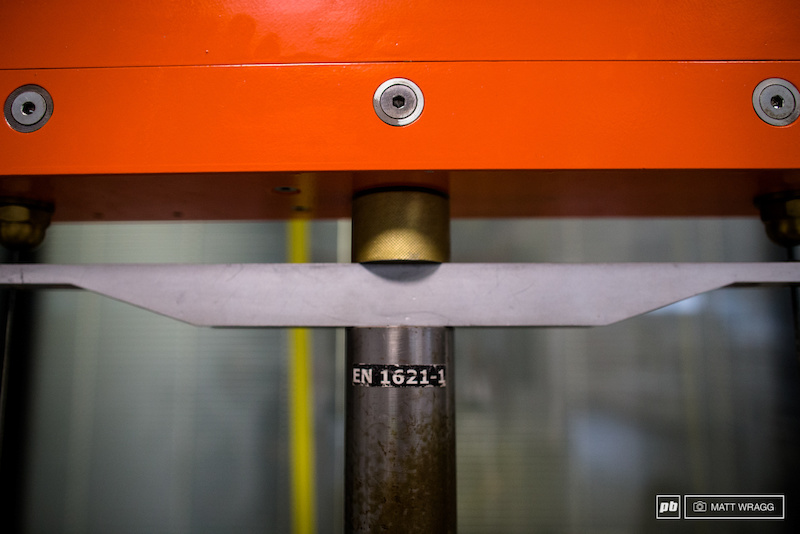
In terms of protection, if it's a protector, then we test it to motorcycle standards, of which there are two principle ones. There are the European Standards, EN1621-1, which deals with the knee, elbow and shoulder, and EN-1621-2, which deals with the back protector.
What does the standard relate to in terms of real-world impacts?In terms of real world crashes, the standards are already quite detached. The standard is a tool to assess whether the product meets a certain requirement or not. So, for example, in a crash the amount of energy on the body will be hundreds, even thousands, of joules. In the test in the lab, we only use 50 joules, which can be a tenth of the actual amount. However, when you hit the ground, it is unlikely you will hit the ground all in a single spot, so that energy isn't in a single, tiny area. It's more likely that you stumble on the ground and more than one part of the body hits the ground at once. Therefore, from some original tests, the standard was formulated. It was before my time, maybe throwing dummies out of vans and stuff, and it was equated that 50 joules was a reasonable energy to start with. Then with the energy we deal with the transmitted force and the aim is to have lower transmitted force, meaning that the armour is giving better protection.
 How are motorcycle standards relevant to mountain biking? And how have they been adopted?
As I mentioned earlier, the motorcycle impact protector standards only deal with the protector and the transmitted force. Within Alpinestars we have a team of developers who concentrate on cycling technology, rather than motorcycle products, and they create products specifically for mountain-biking. This means that while there is very little restriction on the design of the protector, which means there is a reasonable flexibility of how it can be used, we have developed products that are dedicated to mountain biking which use the CE motorcycling certification standards as a performance benchmark. If you were to take the standard for the motorcycle garment, which is not widely adopted, it's got all these particular regulations for the fabrics and the materials, which would not be suitable for mountain bikes. But as a pure protector... I'm not going to say, "Yes, it's an ideal standard," because I am a big cyclist, I don't participate in competition, but I can say that it's acceptable. I think what's more important is your first question, "Why have we decided to adopt these standards?" When I speak here, I speak from a European perspective, not an American or Australian perspective. In the EU they have the PPE (personal protective equipment) directive. Which means that if you say, "This is giving you protection. I am going to protect you," what the government is saying is, "Prove it." The directive is like the Bible, it's the top document that everything descends from. So, if I put something on the market and say it's protective, people should be able to see it's got a CE mark on it.
Can you explain how we reached this situation?In the earlier days of bicycle protection, there wasn't much talk. Nobody really knew about it, or asked for it, so people could do whatever they wanted. But all the time, if something were to happen and they were to go to court because of someone being killed, or whatever, it would very quickly come out that you were using a piece of equipment that said it was going to protect you, but didn't have a CE mark on it. So then the industry said, "We need to put a CE mark on our protectors so we can legally sell them, what can we do?" The directive is flexible, in the sense that if there is no standard existing you can create a set of requirements which correspond, which are called the essential requirements of the directive. If they meet, then the notified body, which is the person that gives you the certificate, can certify to this set of requirements that is assessed as appropriate. But, if the notified body gives you this certificate, the notified body doesn't have a defense, the notified body is taking responsibility. If, however, the notified body gives you a certificate to a harmonised European Standard, so if it says EN or even ISO, then they just checked that it conformed with the standard. If anything goes wrong, there's no responsibility in testing as long as they conducted the test correctly. The test lab is absolved of any responsibility. So if you find the right test lab, they may say, "I will give you a certification, not to a harmonised standard, but to the directive that has the same legal status as the harmonised standard," but most of them won't take the responsibility, they won't take the risk. So what's happened is, in terms of mountain bike clothing, the companies have said, “We need a CE mark." And the labs have said, "This one from the motorcycle protectors is probably ok and if we use it, it's a harmonised standard. You can get a certificate and everyone's happy. Everyone knows about it and is experienced." So, I would say that decision was made in the first case out of convenience.
 Do you think it's fair to use the motorcycle standards?
Whether it's unfair is a different question. I think with the bare requirement for the transmitted force it's not a bad start. But obviously, if the cycling community is going to get bigger and bigger and bigger, then maybe people will start to say, "Actually I need it adjusted for this." In the CEN, the European Centre Normatif, for European Standards, there isn't a working group for cyclists' clothing. Before you even have the Standard, you have to create the working group. We (Alpinestars) are a member of the working group for motorcycle clothing and at one point a question came up saying, "Can the working group for motorcycle clothing cover some of the work?" It's not just mountain biking that is taking our protectors, skiing is taking our protectors and they are saying, "Can you also work on the ski protectors?" As a committee we say no, because we design for motorcycles, not for skiing. We're not going to take that work on voluntarily, they need to build a new committee and I don't know how and when that will ever happen.
So how come mountain biking isn't represented at CEN?I don't know if it's a political lobbying thing, it's a case that nobody is saying, "You can't have it." It's a case that the industry would have to organise themselves. It's a case that the main stakeholders getting together and saying, "We want to create a new working group that's a member of the protective clothing division." Again, we're only speaking about Europe here, that doesn't automatically mean the standard you decide here is automatically going to be accepted by the US or other countries. It's a matter of fact that in Europe, the armour standard has made it, because it's so old - it was 1997 when it was introduced. It's just that Europe has a structure in place with the notified bodies, which are the independent labs to give the certificates and the support of the government agencies to enforce the directive. Because the directive, for good and for bad, is for work clothing, it's just because we are offering protection that it has fallen inside it. Ultimately it's more for hearing protectors and all that kind of stuff.
Has enforcement been an issue with a relatively small industry like mountain biking?Let me say that, in a way I think it's taken a much longer time for certified products to be available in the mountain bike market because of the enforcement. But, overall, the amount of enforcement is still relatively low. It's still a case that the countries where they might mention something are... Well, France is number one, they are the most on top of the enforcement. Then you might get something from Germany, maybe the UK. Sometimes the Eastern Bloc countries might want to see a certificate before the product goes through customs, but I'd say overall there's not a lot of enforcement for the motorcycle, so for the bicycle there's even less.
 What should consumer be looking for when they buy protectors?
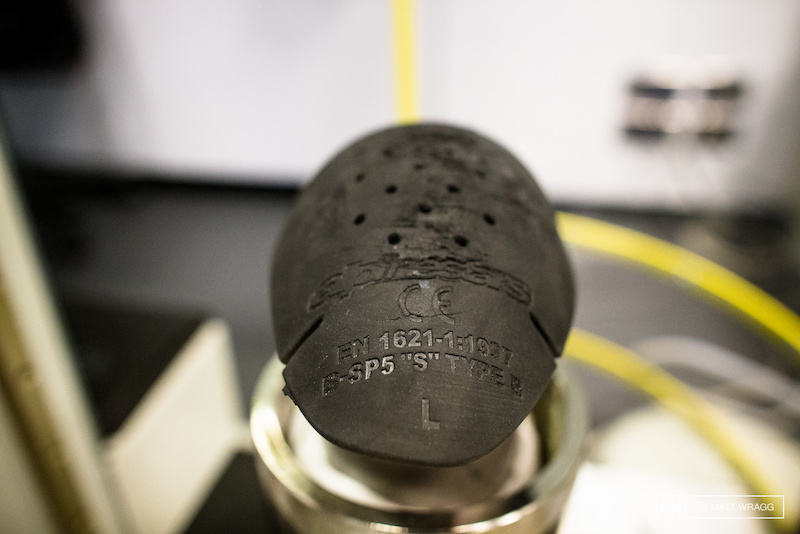
There's another thing I need to tell you. Certification to a directive has three categories, they have to be 1, 2 or 3. Category 1 is what is called "simple PPE", which means that if it fails, the person can understand in due course and take corrective action. An example for that might be swimming goggles. If I'm in the water and they leak, I notice the water coming in and say, "Oh, these are broken." At the other end of the scale you have category 3, complex PPE, which means that not just the product is certified, but the manufacturing procedure is certified. These products are considered life-threatening products. So it might be a harness for rock climbing, which you need to know works all the time, not a bit of the time. Or a breathing mask, or even a pair of rubber gloves for chemical use. If you put your hand in some acid, you need protection all the time, not "Oh, it's leaking," because by the time you spot that the acid is leaking in, half of your hand is dissolved. Anything that doesn't fall into category 1 or 3, is category 2. Basically, all motorcycle clothing, which is giving what is described as limited protection, is called category 2. Category 2 means you must use an external lab to give the certificate, while category 1 you can self-certify. So the confusion for customers is that some people will put a CE mark on a product referring to it as a category 1 protector and people think it's certified, when actually it's not. So I can decide, with the impact test, that under 100 kilonewtons is a pass and put a CE mark on it myself. So what the customer needs to check for is, first of all, the CE mark. Then you need to check if it refers to the harmonised standard, which will say EN-1621-1 or EN-1621-2, if it's referring to the motorcycle standard, but it doesn't necessarily have to be a harmonised standard . If that's not the case, you need to look at the marking or in a booklet, and a booklet must always accompany the product. The booklet it will say," This is certified to 89/686/EEC, which is the name of the directive, and it might even say category 2. An example of that is a neck support, as there is no standard for neck support or neck protectors, but we are offering protection. So over two and a bit years, we were able to persuade the notified body that we work with to release us a category 2 certificate. So we don't say the number of a standard, but on the label of a neck support we say category 2 89/686/EEC. They are things you need to look for: a CE, a harmonised standard or, if not, a reference to category 2 89/686/EEC.
What would you buy, if you were shopping for a protector?If I was going out looking for a protector, I would go for a CE, because I know that the non-certified products can be anything. Maybe they still offer some protection, but really, it's a charade. It's looking protective, feeling hard, but does nothing. If it doesn't have a CE mark on it, then the protection is unquantified. If it says it's a protector, under the motorcycle standard we generally mean the transmitted force, the make up of the garment is not included, which means if the material is very weak and you crash, it could be the case that the fabric could tear. Which is why we also developed test to check the strength of the fabric.
Where would you like to see mountain bike protection standardisation move towards in the future?At the moment we're dealing primarily with impact protectors, which is the same kind of thing we're using for motorcycling. As the standards are updated for motorcycling, and the standard for the limb protector was updated this year, that was probably also an acceptable upgrade for the mountain bike one as well. It's just that for the motorcycle, there's the standard for the garment that holds the protector as well. The way the standard is written is not well accepted, but we're working on that, it'll be fixed in future. That means there should be more certified garments, but is that something that will also slide across to mountain biking or not? It's much less transferable.
 One big problem with cycling is that what an average leisure cyclist does is so far away from World Cup downhill, should there be a distinction in the standards?
Possibly, in the sense that the draw of armour into cycling has understandably been through downhill. Up until that point, everyone in cross country has been surviving, not to say they're not having nasty crashes, but there's not been the draw, which I think is also related to the ergonomics and the ambient of the garment. If you're going downhill, maybe it's more acceptable to wear this heavier clothing, but if you're going uphill you don't want all the protection. In any case, what can be said is that the customer, regardless of whether they're a cyclist or motorcyclist, in terms of the protector wants the same - it needs to be as light and thin as possible.
www.alpinestarscycling.com
Author Info:

 Sospel, France
Must Read This Week
 but yeah i get what you are saying.
@foghorn the issue wakaba was talking about isn't "suing vs not suing", it's "suing vs legislation/certification". I would argue that the ability to sue places MORE freedom in the hands of consumers and offers a way for consumers and businesses to work things out on their own if they want to, without broad sweeping changes to the industry. The equivalent to your example would be if people got hurt at your bike parks and the govt decided to step in and say ALL parks have to do A, B, and C, and ALL jumps have to be constructed in a certain way. That forces broad changes for all parks and doesn't give people the ability to choose how to run their businesses or what features to ride. Sure, lawsuits can shut down businesses, but legislation can screw the whole industry. In reality, those aren't the only two solutions, and in response to a lawsuit the other bike parks get to CHOOSE whether to keep big trail features, or they could simply tighten up the legal coverage in their waivers or whatever.
This scale will always slide depending on who you are and how you see the roles of the individual, corporations, and government intersecting. If it were easy to figure out where these lines should cross, then there would be a dearth of lawsuits, few regulations and corporations that acted responsibly as a matter of course. However, the lines are blurry as hell, and in countless cases, neither individuals nor corporations want to take responsibility for their choices, be they personal, design, manufacture or perceived or actual liability. So we've come up with a breadth of legal systems and regulations to ostensibly clear the waters after disagreements where the lines cross. And still we debate where they should cross. Always will.
So many economic decisions in these discussions, cost-benefit analysis, supply and demand, regulations, opportunity cost... Almost makes me wish I was teaching economics...
I think it is more important to have a proper fitting helmet with the straps tight! The helmet should be replaced after a few years as well.
What happened to Snell and ANSI standards? Not good enuf?
Based on what I just read, and the little bit I know, it seems the standards have more to do with material selection and manufacturing processes than mechanisms of injury.
Its excactly the opposite. Company liability protection instead of consumer protection. It means CE is worth s;:8 because if you buy CE, you limit your ability to sue. Non CE is probably in most cases as strong. So there is no inherent quality advantage in the CE label. Which makes this a turdhead proposition. It just needs to comply to EN1621 protective mx gear. CE is not necessary for the consumer.
Frankly, PPE standards aren't always that stringent. For example, safety glasses can be CE/ANSI certified against impacts, but that doesn't mean the side shields on lots of commercially available safety glasses aren't a f*cking joke. Those standards exist to protect the companies from liability because they can point to the test and say their product passed, but was the test REALLY representative of a potential accident? That's the issue here.
And to those saying "take responsibility blah blah blah", what happens if a bike park does a shitty job building a catwalk and it breaks and injures people? Or your bike gets hung up in a shitty lift rack and gets damaged, and the park won't cover it? You might think lawsuits are frivolous or stupid, but citizens have to have a legal means of forcing businesses/people to take responsibility.
@fractalman: I do none of that. I just read an interview and am flabbered at the spin someone plunks at an audience.
For myself and my kids: MX gear tested to high EN1620 is doing the trick. CE is not. That looks like this: EN-Dh helmet because MX are a bit too heavy for my and kids neck. EN roost guard from FOX with shoulder/spine/ rib protection, solid plastic. EN ixs knee and shin protection, solid plastic. EN roadmotorbike and mx gloves with plastic and kevlar pads. I dont really buy dh-stuff - overpriced, shortwearing or enduro marketed stuff which is even worse and almost always CE tested. The marketed softshell vests are really illconceived - they can be CE tested and fullfill min. requirements but dont offer much protection.
I found food for thought in @wakaba's comments, yet they are neg propped, while @FractalMan's wish for the death of a fellow human being is upvoted. Now that is messed up. Community? Hmmmm.
I believe in this crazy thing called, being accountable for your own actions. In all walks of life. I know with the amount of stupidity in this world, that is not a reasonable possibility, but I can dream can't I?
So let me try to explain myself in a slightly less violent, more well though out manner.
Say you are riding a bike park for the first time. You don't know the trails at all, and you see a sign saying advanced ladder bridge line. Not knowing what the ladder bridge is like, but thinking you are an advanced rider, you decide to take it. Keep in mind this is all hypothetical. Now if you are not as good as you thought, and fall off said ladder bridge, it is 100% your fault. And if it is 100% your fault, you have no right to sue anyone.
However lets say instead of falling off, the bridge breaks, and you fall off and break your leg. Now it is 0% your fault, so you have all the right in the world to sue them.
Basically bureaucracy has ruined the world, because it handles everything the same, based on a predefined set of rules. And life is way to complex for that shit. So I don't want anyone to die needlessly (especially a mountain biker, because lets face it, most of us are pretty fricking awesome) and I don't really even care about safety standards, as pertaining to this article.
I just don't think you should ever think "Will I be able to sue them if I f*ck up," before you buy something. I realize now that is not what Wakaba was saying, but at first glance that is what prompted my mean spirited response
Though, with the rise of multinational corporations and the fact that they exist longer than human lifespans, and have the ability to affect legislation and regulation to mitigate their liabilities over generations, is worrisome. Corporations are NOT people, (despite what the Supreme Court of the USA might have to say on the matter) and there is no human to hold accountable for their harm of people or the environment. Granted, this applies to corporations that are larger than the average bicycle or parts/gear manufacturer, but I am much more wary of corporations than I am of bureaucracy.
Don't buy your helmet from Walmart!
www.youtube.com/watch?feature=player_embedded&v=VYxYSLY820A
CE def'n sounds like make what you want of anything, the actual EN standard of performance which is what we are interested in seems pretty weak. Motorcycle gear? Uh... Not so good. There are sharp edges in the woods not nice round things! Two different sports.
Sure bike stuff is category 2 gear, but that only seems to refer to reliability and consistency. For example lesser protective pads could be in the highest category(3) if they perform poorly but with high reliability. What really makes the difference is the EN std. Something we don't need to worry about with other standards that deal specifically with cycling...?
.
for example : would you buy a car that has not passed the crash test?
please note, do not confuse C E (European Commission) and CE ( China export ) : en.wikipedia.org/wiki/CE_marking