2010 Fox Shox - 32 Talas RLC and Float RP23 - Reviewed
2010 marks a big step for Fox Racing Shox. Not only will they be further expanding their 15mm QR system that they worked on, in conjunction with Shimano to create, but the all new FIT (Fox Isolated Technology) damper is now lighter, and more functional. A lot of thought has gone into Fox's 2010 fork line up, and it's showing through on the final product. Not only is the new 32 Talas fork amazing, but the all new Float RP23 with BoostValve is a piece of work as well.
![photo]()
![photo]()
Let's look at the 32 Talas RLC fork. Starting at the visuals, Fox has continued to coat their forks in Fox Titanium. This color has proven to be flashy, and specific enough to distinguish it against other greys, and to be durable enough to take a beating and still look good. Fox has also re-designed all the adjustments to be ergonomic to your fingers, and easy to work with. Well labeled, color coordinated, and a logical design make this fork easy to work with.
![photo]()
Fox Racing Shox has recently come out with a new standard for securing your wheel in your fork. The 15mm QR system that was designed in conjunction with Shimano is not only a Thru Axle design, but it features a couple small tid bits of technology that make it unique. The new 15QR system is lighter than a 20mm system and has greater stiffness over the standard 9mm open dropouts. One of the nicest touches on the 15QR system however is the clock-able thread. What is this? Fox has developed a system that allows users to pick which direction their axle release lever faces when it's tight. Obviously you wouldn't want your QR facing forward, because it could get caught by a branch or a plant, and potentially open it and release your wheel. On the same token you don't want it facing directly backwards, because then you could squash your fingers between the fork leg and the QR. Fox's 15QR system allows you to select where the QR lever will be located when snugged down.
![photo]()
The Talas 32 RLC features Talas travel adjust, which is a travel adjustment from 110mm to 130mm to 150mm. These three settings of travel should cover all your riding needs when out on your local loop, or peeling off shuttles like banana skins.
![photo]()
The Talas 32 RLC also features Fox's FIT system, which is Fox's answer to a high end damper system. FIT was originally designed for downhill racing applications, however Fox has adapted it into some of their single crown forks for 2010. Some of the changes Fox made to the FIT system include making it lighter, an even wider low speed compression range, and a finely tuned high speed compression damping circuit designed to provide superior traction. More traction generally means more control, and better performance as well. Fox has relocated the rebound adjustment to the bottom of the FIT cartridge to make space for the Talas travel adjustment, and the lock out/compression adjustments which are now found on the top of the right leg crown. Fox has also re-designed the bladder system in the FIT cartridge, providing the lowest friction rating for sealed dampers. Our fork was also labeled with RLC - Rebound, Lockout and Compression. The black knob in the middle is referred to as lockout threshold - this is an internal adjustment that Fox designed that allows you to tune the lock out pressure on your fork. Meaning you can now finely tune how "locked out" your fork feels when the adjustment is set up. There is also an RL model and RL stands for Rebound and lockout.
![photo]()
Fox constructs the 32 Talas RLC with both a 1 1/8" steer tube, and in a 1.5" taper steer tube option. Our fork tipped the scales at 3.96 pounds, which is an extremely acceptable weight. That being said, the tapered steer tube option is slightly lighter 3.94 pounds (claimed). External adjustments include rebound, lockout, compression (RLC), Talas travel adjust and air spring pressure. The Talas 32 RLC features post style disc mounts, and an included cable guide on the arch.
Riding characteristics of the 32 Talas were that it was very reliable, and supple, yet stiff when it came to steering and flex. Offered in either standard or tapered steer tube, I am sure that the increased contact area of a tapered steer tube's 1.5" base would greatly increase stiffness even further for this fork. The adjustments made to the FIT damper allowed it to absorb minor bumps as well as large impacts such as rocks and logs with ease.
![photo]()
![photo]()
The travel adjustment on the 32 Talas RLC is one thing that I want to touch on for a moment. We have seen travel adjustment in the past, however, the adjustment system that Fox is using is very reliable, and precise. Not once has the fork had any issues with the new FIT damper or the Talas travel adjustment. As well, having a travel adjustable fork allows you as the rider to cover more terrain more comfortably. Whether you're climbing with it lowered, or descending at full travel, the 32 Talas is a great fork that continues to perform at an above par level.
![photo]()
![photo]()
I'd also like to note some small things about the new RP23 with BoostValve technology. BoostValve is a position sensitive compression damping circuit that Fox has been using from the beginning on the DHX air and coil shocks. Fox has equip the new RP23 shock with BoostValve for 2010, and it's proving to be a very smart move.
![photo]()
![photo]()
The RP23 features the same structural design as the RP2, however it features more advanced internals. Not only does the RP23 shock have ProPedal lock out, but it also features 3 levels of ProPedal adjustment which adjusts the threshold in where ProPedal is effecting the bike. I found myself riding in setting 2 most of the time, with the ProPedal lever open.
The new Boost Valve Technology from Fox is a very nice addition to the RP23. By adding the Boost Valve Technology to the shock, Fox has made it a position sensitive shock, meaning it now features a progressive compression curve. On rapid impacts, or repetitive impacts the RP23's boost valve will kick in, giving you progressive compression damping all the way through the stroke. On smaller bumps the Boost Valve will not open, meaning you will not have to overcome an increased amount of compression for the suspension to become active.
![photo]()
I found that this new system works extremely well. On large bumps such as climbs over stumps or rocks, the Boost Valve kicks in and gives me a progressive rear feel, and while out on leisurely pedal rides where I am not encountering larger bumps, I do not feel any increases in compression at all. For 2010 Boost Valve Technology is going to be available in the RP23 and RP2 shocks.
Sizing options are as follows:
-5.5 x 1.0
-6.0 x 1.25
-6.5 x 1.5
-7.5 x 2.0
-7.875 x 2.0
-7.875 x 2.25
-and 8.5 x 2.5
I would highly suggest either of these two products to anyone in the market for new suspension for their All Mountain or aggressive trail bike. They are both very light, strong, and functional. For the 2010, 32 Talas RLC in 150mm travel you can expect a US MSRP price of $775 and a weight of 3.96 pounds. The RP23 with Boost Valve will run you $395 US, and for the 6.5 x 1.5" shock it weighs in at 0.46 pounds. For more information on these, and all the other products by Fox check out their site.


Let's look at the 32 Talas RLC fork. Starting at the visuals, Fox has continued to coat their forks in Fox Titanium. This color has proven to be flashy, and specific enough to distinguish it against other greys, and to be durable enough to take a beating and still look good. Fox has also re-designed all the adjustments to be ergonomic to your fingers, and easy to work with. Well labeled, color coordinated, and a logical design make this fork easy to work with.

Fox Racing Shox has recently come out with a new standard for securing your wheel in your fork. The 15mm QR system that was designed in conjunction with Shimano is not only a Thru Axle design, but it features a couple small tid bits of technology that make it unique. The new 15QR system is lighter than a 20mm system and has greater stiffness over the standard 9mm open dropouts. One of the nicest touches on the 15QR system however is the clock-able thread. What is this? Fox has developed a system that allows users to pick which direction their axle release lever faces when it's tight. Obviously you wouldn't want your QR facing forward, because it could get caught by a branch or a plant, and potentially open it and release your wheel. On the same token you don't want it facing directly backwards, because then you could squash your fingers between the fork leg and the QR. Fox's 15QR system allows you to select where the QR lever will be located when snugged down.

The Talas 32 RLC features Talas travel adjust, which is a travel adjustment from 110mm to 130mm to 150mm. These three settings of travel should cover all your riding needs when out on your local loop, or peeling off shuttles like banana skins.


The Talas 32 RLC also features Fox's FIT system, which is Fox's answer to a high end damper system. FIT was originally designed for downhill racing applications, however Fox has adapted it into some of their single crown forks for 2010. Some of the changes Fox made to the FIT system include making it lighter, an even wider low speed compression range, and a finely tuned high speed compression damping circuit designed to provide superior traction. More traction generally means more control, and better performance as well. Fox has relocated the rebound adjustment to the bottom of the FIT cartridge to make space for the Talas travel adjustment, and the lock out/compression adjustments which are now found on the top of the right leg crown. Fox has also re-designed the bladder system in the FIT cartridge, providing the lowest friction rating for sealed dampers. Our fork was also labeled with RLC - Rebound, Lockout and Compression. The black knob in the middle is referred to as lockout threshold - this is an internal adjustment that Fox designed that allows you to tune the lock out pressure on your fork. Meaning you can now finely tune how "locked out" your fork feels when the adjustment is set up. There is also an RL model and RL stands for Rebound and lockout.

Fox constructs the 32 Talas RLC with both a 1 1/8" steer tube, and in a 1.5" taper steer tube option. Our fork tipped the scales at 3.96 pounds, which is an extremely acceptable weight. That being said, the tapered steer tube option is slightly lighter 3.94 pounds (claimed). External adjustments include rebound, lockout, compression (RLC), Talas travel adjust and air spring pressure. The Talas 32 RLC features post style disc mounts, and an included cable guide on the arch.
Riding characteristics of the 32 Talas were that it was very reliable, and supple, yet stiff when it came to steering and flex. Offered in either standard or tapered steer tube, I am sure that the increased contact area of a tapered steer tube's 1.5" base would greatly increase stiffness even further for this fork. The adjustments made to the FIT damper allowed it to absorb minor bumps as well as large impacts such as rocks and logs with ease.
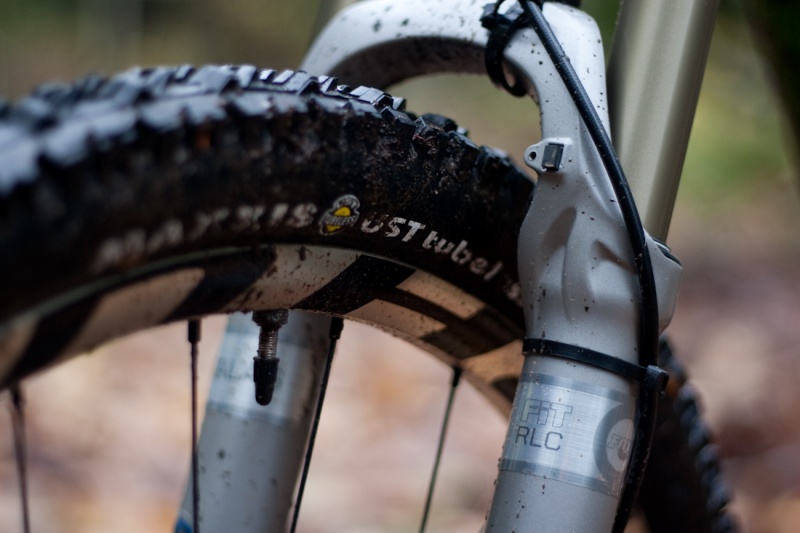
Lost the cable anchor, so back to zip ties.

The travel adjustment on the 32 Talas RLC is one thing that I want to touch on for a moment. We have seen travel adjustment in the past, however, the adjustment system that Fox is using is very reliable, and precise. Not once has the fork had any issues with the new FIT damper or the Talas travel adjustment. As well, having a travel adjustable fork allows you as the rider to cover more terrain more comfortably. Whether you're climbing with it lowered, or descending at full travel, the 32 Talas is a great fork that continues to perform at an above par level.

Lots of mud and junk on the fork, but clean stanctions tell us that the seals are doing their job.

I'd also like to note some small things about the new RP23 with BoostValve technology. BoostValve is a position sensitive compression damping circuit that Fox has been using from the beginning on the DHX air and coil shocks. Fox has equip the new RP23 shock with BoostValve for 2010, and it's proving to be a very smart move.
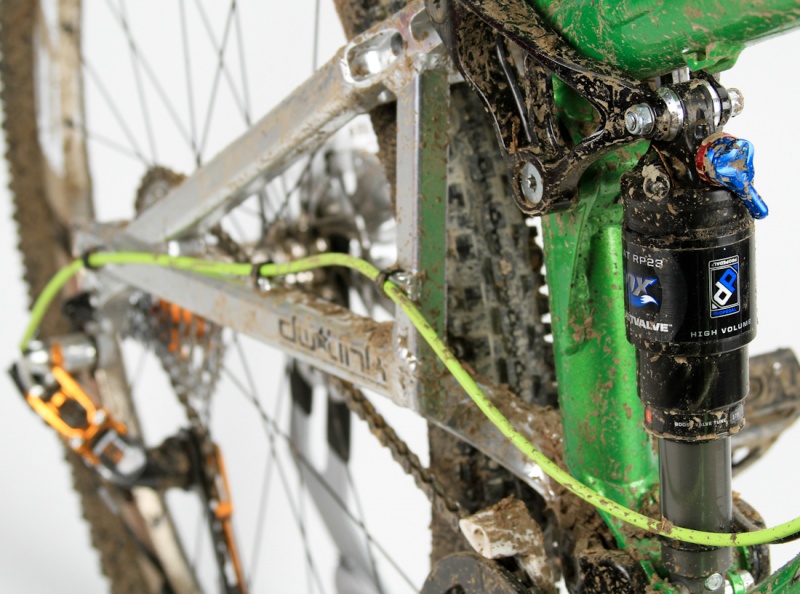
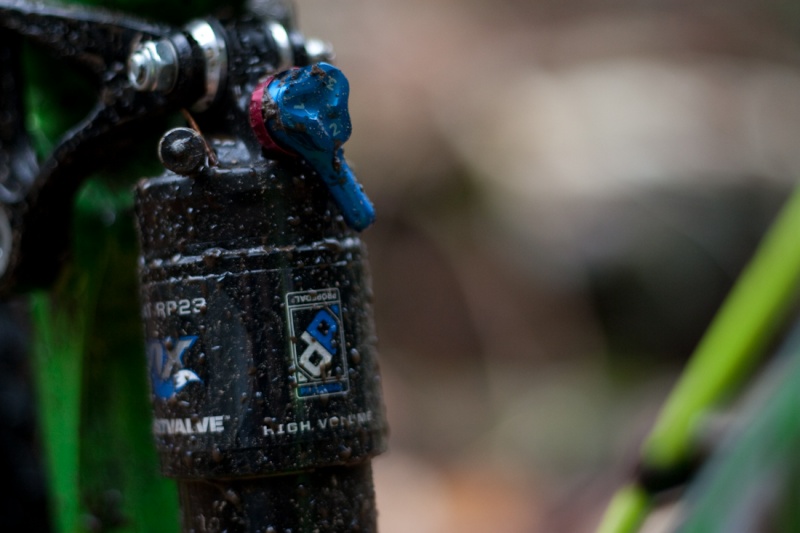
The RP23 features the same structural design as the RP2, however it features more advanced internals. Not only does the RP23 shock have ProPedal lock out, but it also features 3 levels of ProPedal adjustment which adjusts the threshold in where ProPedal is effecting the bike. I found myself riding in setting 2 most of the time, with the ProPedal lever open.
The new Boost Valve Technology from Fox is a very nice addition to the RP23. By adding the Boost Valve Technology to the shock, Fox has made it a position sensitive shock, meaning it now features a progressive compression curve. On rapid impacts, or repetitive impacts the RP23's boost valve will kick in, giving you progressive compression damping all the way through the stroke. On smaller bumps the Boost Valve will not open, meaning you will not have to overcome an increased amount of compression for the suspension to become active.

I found that this new system works extremely well. On large bumps such as climbs over stumps or rocks, the Boost Valve kicks in and gives me a progressive rear feel, and while out on leisurely pedal rides where I am not encountering larger bumps, I do not feel any increases in compression at all. For 2010 Boost Valve Technology is going to be available in the RP23 and RP2 shocks.
Sizing options are as follows:
-5.5 x 1.0
-6.0 x 1.25
-6.5 x 1.5
-7.5 x 2.0
-7.875 x 2.0
-7.875 x 2.25
-and 8.5 x 2.5
I would highly suggest either of these two products to anyone in the market for new suspension for their All Mountain or aggressive trail bike. They are both very light, strong, and functional. For the 2010, 32 Talas RLC in 150mm travel you can expect a US MSRP price of $775 and a weight of 3.96 pounds. The RP23 with Boost Valve will run you $395 US, and for the 6.5 x 1.5" shock it weighs in at 0.46 pounds. For more information on these, and all the other products by Fox check out their site.
Author Info:

 Vancouver, BC, Canada
Must Read This Week
"I found myself riding in setting 2 most of the time, with the ProPedal lever open."
its not a 'known' problem - try using a good quality hub from Hope, King or Hadley and you won't be having any issues with 20mm
new 2010 Fox stuff looks dope
I am switching the 2009 DHX 5 Air shock on my Devinci Hectik Ltd. to the new RP23 XV BV in the New Year, after getting over the financial shock of the Christmas vacation.....
don´t tell me it has to do with less weight, if you ask me, that´s just a good way to make money in corporation with shimano.
sorry, but this really sucks in my opinion
(here come the neg props)
Companies like DT SWiss made a 20mm through-axle fork for stiffness but people busted them and then cried "No fair - its 20mm, it should be strong enough for hucking cliffs!". So now DT only make 15mm to clarify the fork use to the end user.
Blame stupid mountain bikers for 15mm, not Fox and Shimano.