What's Up at Hayes, Manitou and Answer?
Hayes is the parent company for Sun/Ringle' wheelgoods, Answer components, and Manitou suspension, so there is always something cooking in their kitchen. PB got a sneak peek at some sweet new wheels from Sun/Ringle', a run-through on the Hayes 'Crosshair' micro-adjust brake caliper system, and an explanation of why Answer's outlandish looking 20 20 handlebars make good sense. We promised not to tell about the wheels until a bit later, but the rest was open season.
Hexlock Explained
Manitou developed a super-fast 15QR through axle release system called 'Hexlock.' For those not up to speed, Manitou owns a patent on a hexagonal though-axle and dropout interface. The hex prevents any rotation between the axle and fork lowers, which reportedly increases the fork's torsional stiffness dramatically. The hexagonal interface, however, prevents the use of screw-in quick release axles like the Maxle design, so Manitou developed its own QR system.
![Tower 29er fork and Hexlock QR15 axle]()
Flip the Hexlock lever open and give it a twist and the axle pulls out of the fork. The end of the Hexlock axle engages into the left dropout with a T-shaped key that only requires one half turn of the quick release to lock into place. Slide the axle in, twist the quick release lever one half turn, snap it shut and the deed is done. The QR lever always indexes in the same spot and a knurled dial inboard of the lever adjusts the closing force of the mechanism. The Hexlock shaft must be indexed (a warning printed in white letters makes it hard to miss) in the hexagonal dropouts correctly before the locking mech will work, but once you get the hang of it, Manitou's new QR system is mighty fast.
The Return of the Mustache Handlebar
Take two pieces of straight handlebar tubing, one in each hand. Close your eyes and put your hands in front of you where you believe you should be steering your bike. Hold position, open your eyes and your hands will be grasping the tubes at about 18-degrees, with a slight downturn. Answer's 20 20 handlebar emulates the natural ergonomics of your hands and wrist to reduce fatigue over long distance rides. Co-designed by 24-hour solo racer Evan Plews, the 20 20's Mustache bend does what it was intended to do in the 1800s when it first gained popularity: provide a comfortable sweep-back, without placing the rider's hands behind the stem. The 20 20's design keeps the grips in roughly the same place in relation to the stem as the standard, 5- or 8-degree-sweep bar.
![20 20 mustache handlebar]()
Easy-Adjust Brake Calipers
The story goes that one of Hayes' engineers thought up the Crosshair idea, got out of his chair, grabbed a caliper and went to the machine shop where he drilled and threaded two holes in the caliper's mounting tabs. He returned with the finished product - two Allen set-screws that lever against the caliper's mounting screws. Hayes immediately adopted the improvement, which makes perfect rotor alignments possible in less than a minute in most cases. Cross hair makes its debut on Hayes' Prime disc brake lineup and after seeing it in action, we wondered why we didn't think of it. Simple is always best.
![Prime Comp Brake]()
![Prime caliper Crosshair adjust system]()
Want more info? Keep up with Hayes' latest burst of innovation on the Hayes Component website and we'll get back to you on the new Sun Ringle' wheels as soon as we get a set on our test bikes.
Hexlock Explained
Manitou developed a super-fast 15QR through axle release system called 'Hexlock.' For those not up to speed, Manitou owns a patent on a hexagonal though-axle and dropout interface. The hex prevents any rotation between the axle and fork lowers, which reportedly increases the fork's torsional stiffness dramatically. The hexagonal interface, however, prevents the use of screw-in quick release axles like the Maxle design, so Manitou developed its own QR system.
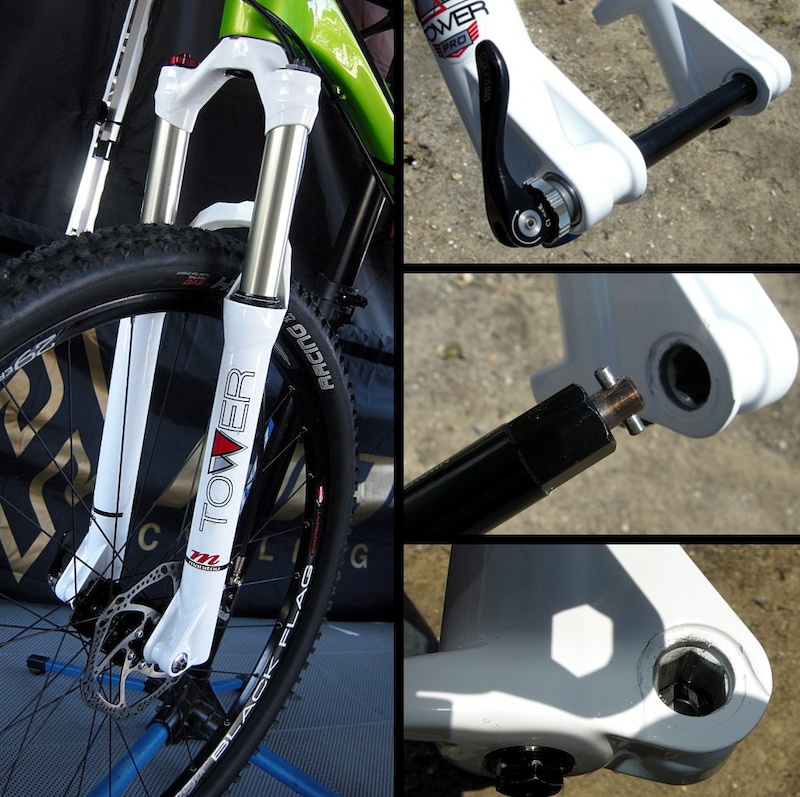
(Clockwise) Manitou's Tower Pro 29er fork is designed for XC/Trail and features travel up to 140 millimeters as well as the new Hexlock 15-millimeter quick release axle system. The Hexlock axle in place reveals the adjustment dial between the release lever and right fork dropout. The steel T-shaped locking mechanism twists inside the hollow hexagonal-tipped through-axle. A look down the left dropout shows the slot that engages the "T" on the Hexlock axle.
Flip the Hexlock lever open and give it a twist and the axle pulls out of the fork. The end of the Hexlock axle engages into the left dropout with a T-shaped key that only requires one half turn of the quick release to lock into place. Slide the axle in, twist the quick release lever one half turn, snap it shut and the deed is done. The QR lever always indexes in the same spot and a knurled dial inboard of the lever adjusts the closing force of the mechanism. The Hexlock shaft must be indexed (a warning printed in white letters makes it hard to miss) in the hexagonal dropouts correctly before the locking mech will work, but once you get the hang of it, Manitou's new QR system is mighty fast.
The Return of the Mustache Handlebar
Take two pieces of straight handlebar tubing, one in each hand. Close your eyes and put your hands in front of you where you believe you should be steering your bike. Hold position, open your eyes and your hands will be grasping the tubes at about 18-degrees, with a slight downturn. Answer's 20 20 handlebar emulates the natural ergonomics of your hands and wrist to reduce fatigue over long distance rides. Co-designed by 24-hour solo racer Evan Plews, the 20 20's Mustache bend does what it was intended to do in the 1800s when it first gained popularity: provide a comfortable sweep-back, without placing the rider's hands behind the stem. The 20 20's design keeps the grips in roughly the same place in relation to the stem as the standard, 5- or 8-degree-sweep bar.
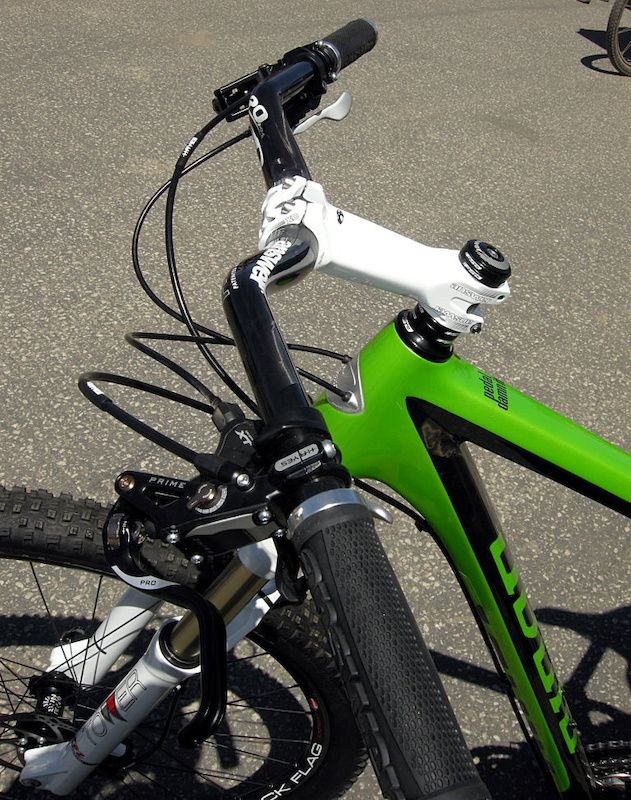
Answer's 20 20 handlebar provides almost 20 degrees of sweep-back comfort without moving the grips beyond where a conventional bar would place them in relation to the stem.
Easy-Adjust Brake Calipers
The story goes that one of Hayes' engineers thought up the Crosshair idea, got out of his chair, grabbed a caliper and went to the machine shop where he drilled and threaded two holes in the caliper's mounting tabs. He returned with the finished product - two Allen set-screws that lever against the caliper's mounting screws. Hayes immediately adopted the improvement, which makes perfect rotor alignments possible in less than a minute in most cases. Cross hair makes its debut on Hayes' Prime disc brake lineup and after seeing it in action, we wondered why we didn't think of it. Simple is always best.

Hayes Prime Comp brakeset looks sharp with its radial master cylinder and flush reach-adjuster in the lever blade. Hayes developed a tapered piston that eliminates the need for seal-eating bypass ports inside the master cylinder, which makes the pad contact point very consistent. Note the Allen set-screws in the Crosshailr caliper mounts.

The Hayes Prime caliper with its Crosshair adjustment screws (left). Push the brake pads against the rotor, snug up the caliper mounting bolts. Spin the wheels and then and use an Allen wrench to move the caliper away from the rotor until the pads stop rubbing. Tighten mounting screws. Done.
Want more info? Keep up with Hayes' latest burst of innovation on the Hayes Component website and we'll get back to you on the new Sun Ringle' wheels as soon as we get a set on our test bikes.
Author Info:
Must Read This Week
Sign Up for the Pinkbike Newsletter - All the Biggest, Most Interesting Stories in your Inbox
PB Newsletter Signup
thinking more abou this idea from hayes and the one thing it definitely is , is fool proof 100% satisfaction that its gonna work...unless you have a bent rotor
I personally think it's great, and instead of going to the bike shop and spending hunreds of $ on new brakes that I don't really like, I'm going to the drill press and tapping my slx's with the same set screw. Wish there was a USA company that made brakes, but I give lots of props to shimano for using mineral oil in their brakes!!! That's an improvement in gear that is good for mother earth, who we every day suckle at her teet for sweet sweet adrenaline, that is most important to me.....and the breaking power is unmatched with the "ice" rotors......but anyway.....
y the neg props to someone not really being an a**hole???
How does "the fastest quick-release through-axle in the world" compare to Suntour's Q Loc system?
www.youtube.com/watch?v=5jks8YjSM1E
"The return of the Mustache handlebar"? Aren't those currently called "alt" bars, and as people are pointing out, above, haven't others like On One, Radley, and Origin8 been making alt bars for quite some time?
Oh, I get the biggest kick out of "Simple is always best," when talking about Hayes brakes. The Crosshair system looks great, but their pad contact adjustment poppet cam has got to be the most complicated turnoff of the decade.
I do miss the old HEXlock with 4x4mm bolts - it was the best thing ever.
Lighter riders will probably fare just fine though as far as braking power.
Also, anyone notice how crazy long the stem is on that bike?
That said... I think it's a brilliant idea. If the caliper tabs were thicker, that'd be nice.
Great for Manitou... they have already the axle for the new 160mm fork. Now they only need the rest of it!
www.on-one.co.uk/i/q/HBOOMA/on_one_mary_handlebar
I've tried the Mary bars and they are very comfy... but not for me - I likes me my widish DH bars, even for XC. My riding buddy in the States loves his, but he got used to them. He is a very good technical rider - I think everyone from Colorado is.
Should go well with my upcoming hardtail design - it will be a 29-650Ber. 29" wheel up front, 650B in the back, 15mm + 142x12 axles in hubs, and 35mm handlebars with 1 1/4 fork. Stem with direct attach for Garmin GPS is a must... I also plan to design a handlebar with direct mounts for all sorts of dials from FOX as well as lamps and GoPro.
No seriously if I met a bloke on such bars in the woods, I'll ask him to let me try his bike.
And as far as "what's old is new again" I had a good chuckle when I realized that the flat bar trend for big bikes so closely matched the bars I was running 20 years ago, too. (Though today's bars are significantly wider!)
New Hayes = bad
I will never be able to get past the fact that they actually released the El Caminos.