Pivot Mach 5.7 Review
TESTED
PIVOT
MACH
5.7
MACH
5.7
WORDS Richard Cunningham
Pivot’s best selling trail bike was decided the moment the Arizona bike brand released the five-inch-travel Mach 5. By luck or design, it was a near-perfect blend of honest handling and cross-country efficiency. While the Mach 5 was designed to be a longer-travel XC/trailbike, the Mach 5.7, with its slack head angle and re-curved suspension metrics retains the efficient pedaling of its sibling’s position-sensitive dw-link suspension, but adds a new level of handling and confidence that encourages its pilot to stray deeper into the technical realm. Set up with Pivot’s Shimano XTR build kit, our medium-sized test bike weighed 25.9 pounds ready to rock with Shimano XT trail pedals. Expect to pay around $6899 for a similar build.
Placement of the dw-link pivots is critical and in the case of the Mach 5.7, the lower link competes with the front derailleur location. Pivot offsets the linkage bearings to the left and incorporates a direct-mount derailleur to solve the crowding there. Pivot uses a two-piece bottom bracket forging that captures the outside of the lower link. The hollow, welded forging enhances frame stiffness and with its wide-stance pivot placements, promises to extend bearing life. On the subject of bearing life, Pivot doubles two sealed cartridge bearings in each location to be sure that the suspension won’t waggle due to premature bearing wear.
Following the frame back to the Mach 5.7’s swingarm, Pivot redesigned the triangulated bracing between the seat and chain stays to provide clearance for 2.35-inch and larger tires, and then beefed it up with stiffer, C-section struts. At the dropout, Pivot’s burly replaceable derailleur hanger is designed to take a serious beating. Pivot did not outfit the Mach 5.7 with the new 142/12-millimeter through-axle. However, complete builds are set up with the 10-millimeter DT Swiss through axle system that works well with standard dropouts.
Those of us who believe that every bike requires a chainguide will be sad to see that there are no ISCG tabs on the Mach 5.7, but somewhat relieved to discover that Pivot offers a sturdy adapter that both clamps onto the bottom bracket shell and bolts to the frame. Pivot’s ISCG-05 adapter, and is intended for single-ring cranksets. Check it out here. For riders who want to build up a Mach 5.7 at home, Pivot sells the frame only for $2199 (including the Fox Kashima RP23 shock) in five sizes, from extra small to extra large, as well as specific women’s sizes. Colors are charcoal anodized (ours) and white, and either pink or baby blue as female options. Complete Mach 5.7s start at $3899 for the Shimano SLX build and top out around $6900 for SRAM XX and Shimano XTR options.
Our test bike was fitted with a Fox 32 Float RLC fork and a QR15 axle system, which is pretty important to keep a 150-millimeter-stroke fork with 32-millimeter stanchion tubes carving a tight line through the turns. Kashima coating was conspicuously missing from the Fox fork, and when asked, Pivot officials said that the Mach 5.7 seemed to perform just fine without the slippery coating – especially so after a brief break-in period. The same function that makes dw-link bikes pedal well tends to overdrive the fork, so the fact that the stock Fox fork works well with the Mach 5.7 could be science or serendipity.
Shock setup: Successful suspension setup is the key to all long-travel trail bikes, and the process is made easy with Pivot’s shock-mounted sag meter. The Mach 5.7 requires a bit more negative travel than most, about 30-percent sag, so use the tool to get it right. Turn off the Propedal function, gently climb aboard, set the spring pressure so that the O-ring lines up with the red line on the plastic indicator and you’ll be good to go. We used the center Propedal option with five clicks out from full slow for rebound.
Fork setup: Up front, we found that 30-percent sag with 3 to 4 clicks of low-speed compression balanced well with the shock. The Fox Fit damping system has an anti-bottom-out feature, so don’t expect the O-ring on the stanchion to run to the end of the fork travel unless you pound something hard enough to bend a rim. Rebound was set 4 clicks out and all seemed well and good.
Pedalling: Rolling out on the Mach 5.7 feels like a different animal than its predecessor. Where the original felt like a long-travel XC ride, the Mach 5.7’s 67-degree head angle steers with more purpose and its suspension feels deeper and more responsive. The sensation leaves the legs wondering if the Mach 5.7 will be a disappointment when powering on the flats or when the climbs begin. Not to worry though, because the new machine accelerates quite well with the shock wide open and nearly matches the original with the assistance of the Propedal lever.
Climbing: Where the Mach 5.7 shines is pedalling up and over rough terrain, where the suspension keeps the bike moving forward noticeably better. The recurved shock rate seems more responsive to terrain under pedalling tension and manages this without stealing leg power. Using Propedal produces a correspondingly rougher ride that feels easier under power, but if you are willing to accept a small amount of pedal-bob, the ‘5.7 will roll smoothly, faster and more efficiently up rooted trails or stepped, slick-rock type climbs with the shock wide open. That said; the advantage of Propedal-assist is more than bob-free pedalling. The Mach 5.7’s rear suspension rides higher when the shock is firmed up which makes the head angle a degree or so steeper. The two actions combine to make the Pivot feel a lot fresher to the legs, especially when ascents last longer than free will. We were not ashamed to reach for the blue lever.
Turning: Surprisingly, the Mach 5.7 corners like it is on rails. There is a beautiful balance that can be felt when the ground is rough and cornering forces are high that makes a ‘5.7 rider want to push harder with each successive turn. The head angle is not so slack that the bike has to be pushed around corners with the outside handlebar. Rather, the 5.7’s steering feels like an integrated part of its handling package – light at the bars with just the right amount of turn-in to encourage a confident flow. We attribute the Pivot’s new found cornering abilities to its lower bottom bracket, modern steering geometry and a better-balance between the shock and fork action. The limiting factor for hard cornering was the rear tire, which turned this phase of testing into a driftathon. Standard fare for the Mach 5.7 is Kenda Nevegals on both ends. The Slant Six rear tire that the factory set us up with accelerates well and rolls fast, but it steals fun from the downhills and is too easy to lock up under braking.
Technical descending: Get ready for some high speed fun when you turn the Mach 5.7 loose on a descent. With sharp, Super D acceleration on tap for rolling climbs and corner exits, and its point-and-shoot turning skills, the Mach 5.7 gets going in a hurry when it catches the scent of gravity. With its Shimano ICE Trail brakes, the choice to pick through the boulders or send it over the top can be made with nanosecond precision and its smooth, balanced suspension action can cover a multitude of errors. Where the original Mach 5 felt like it had a bit less than five inches of wheel travel when pressed, the new ‘5.7 feels a bit better than its posted numbers, especially under braking and when landing flat.
Jumps: On the subject of flying, there is a slight lift in the rear end when popping short, steep ramps, which is typical of trail bikes and short-chainstay all-mountain designs, but a little pull on the handlebar corrects it and from that point, the Mach 5.7 rider will start racking up frequent flier miles. Unless you ask for a tail whip, the ‘5.7 stays on line after the wheels leave the ground and when it returns, the bike is business as usual.
We feel that the now-standard 40/28 (SRAM 39/26) double-chainring gearing is too tall for trail work unless your legs are race ready. Shimano’s lower-geared, 38/26 chainrings are a step in the right direction, but unless we hit the steeps when we felt fresh, the tallish low gear often robbed the opportunity to showcase the Mach 5.7’s tractability when the trail got nasty for a lengthily pitch. On the occasion when we did top uber-technical climbs with fresh legs, we left defeated riders open-mouthed on the sideline. Insist on a two-by crankset, but consider 38 by 24 or a 36 by 24-tooth gearing to maximize the Pivot’s performance.
Missing conspicuously from the Pivot Mac 5.7 was a remote-adjust seatpost. The hose guides are on the frame, but the bike did not have the one item that almost every '5.7 rider needs to maximize this stealth shredder's fun factor. As mentioned, we also pondered Pivot's decision to fit a nearly bald Kenda Slant Six tire to such a technically capable trailbike. Order yours with real rubber and shred happily unto the world.
Pinkbike's take:
View all the options for the mach 5.7 on the Pivot website and check out the new carbon fiber Mach 5.7 due to arrive in late 2011.
Inside the Mach 5.7
In profile, the Mach 5.7’s minimalist simplicity masks a number of innovative design elements. Its double-butted main frame tubes are rectangular profiled to put more metal in line with the frame’s highest loads. The deeply curved top tube provides a lot of stand-over clearance (26.5 inches for the X-small frame) and also eliminates the need for a separate strut to support the seat mast. Like all top trail bikes, the Mach 5.7 has a tapered head tube, so if you don’t agree with its 67.6-degree head angle, you can add an AngleSet and try a home-grown version. 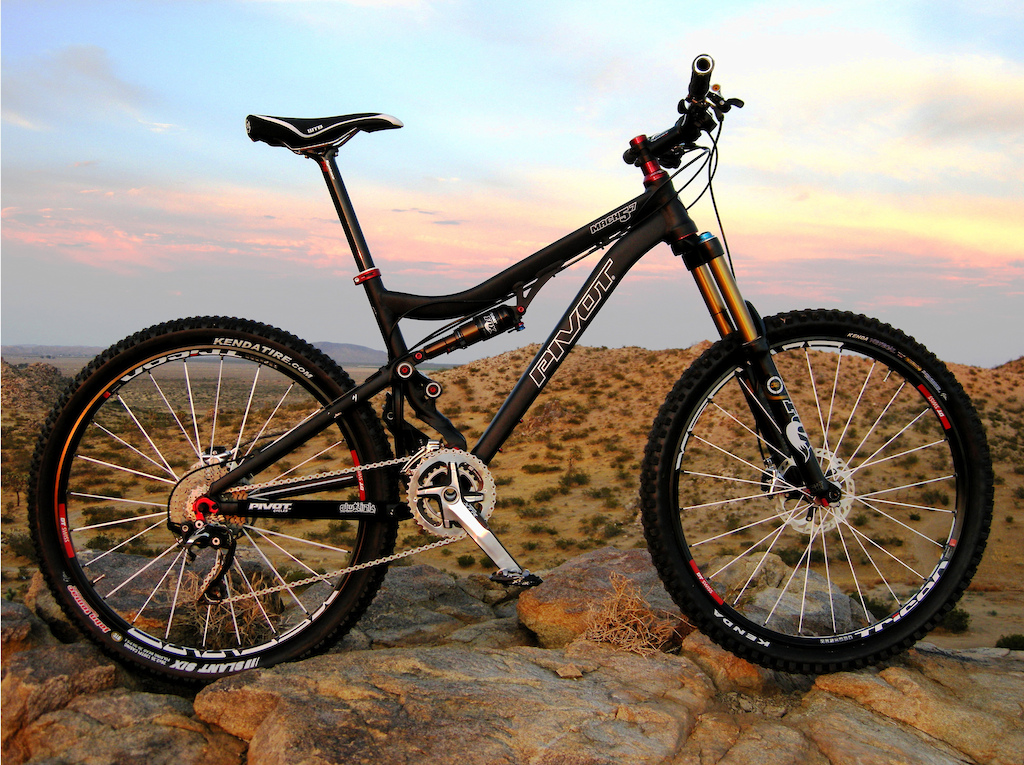 |
Mach 5.7 Details
• Purpose: Epic trail and all-mountain
• Frame: Welded aluminum, larger-diameter, butted and formed main tubes,
5.7-inch travel dw-link position-sensitive suspension, tapered head tube,
hollow-forged bottom bracket and frame junctions, double bearings at all pivots.
• One-pound lighter frame than original Mach 5
• 92-millimeter PressFit bottom bracket shell for wider pivot bearing stance and more lateral stiffness.
• Lower bottom bracket height
• Relaxed, 67.6-degree head angle
• Higher shock leverage rate with smoother mid-stroke action
• ISCG-05 single-chainring option
• Compatible with 140 or 150-millimeter–travel forks.
• Weight: 25 pounds (no pedals)
• Price as tested: $6899
View frame geometry - all sizes
View component options - all models
• Frame: Welded aluminum, larger-diameter, butted and formed main tubes,
5.7-inch travel dw-link position-sensitive suspension, tapered head tube,
hollow-forged bottom bracket and frame junctions, double bearings at all pivots.
• One-pound lighter frame than original Mach 5
• 92-millimeter PressFit bottom bracket shell for wider pivot bearing stance and more lateral stiffness.
• Lower bottom bracket height
• Relaxed, 67.6-degree head angle
• Higher shock leverage rate with smoother mid-stroke action
• ISCG-05 single-chainring option
• Compatible with 140 or 150-millimeter–travel forks.
• Weight: 25 pounds (no pedals)
• Price as tested: $6899
View frame geometry - all sizes
View component options - all models
Placement of the dw-link pivots is critical and in the case of the Mach 5.7, the lower link competes with the front derailleur location. Pivot offsets the linkage bearings to the left and incorporates a direct-mount derailleur to solve the crowding there. Pivot uses a two-piece bottom bracket forging that captures the outside of the lower link. The hollow, welded forging enhances frame stiffness and with its wide-stance pivot placements, promises to extend bearing life. On the subject of bearing life, Pivot doubles two sealed cartridge bearings in each location to be sure that the suspension won’t waggle due to premature bearing wear.
Following the frame back to the Mach 5.7’s swingarm, Pivot redesigned the triangulated bracing between the seat and chain stays to provide clearance for 2.35-inch and larger tires, and then beefed it up with stiffer, C-section struts. At the dropout, Pivot’s burly replaceable derailleur hanger is designed to take a serious beating. Pivot did not outfit the Mach 5.7 with the new 142/12-millimeter through-axle. However, complete builds are set up with the 10-millimeter DT Swiss through axle system that works well with standard dropouts.
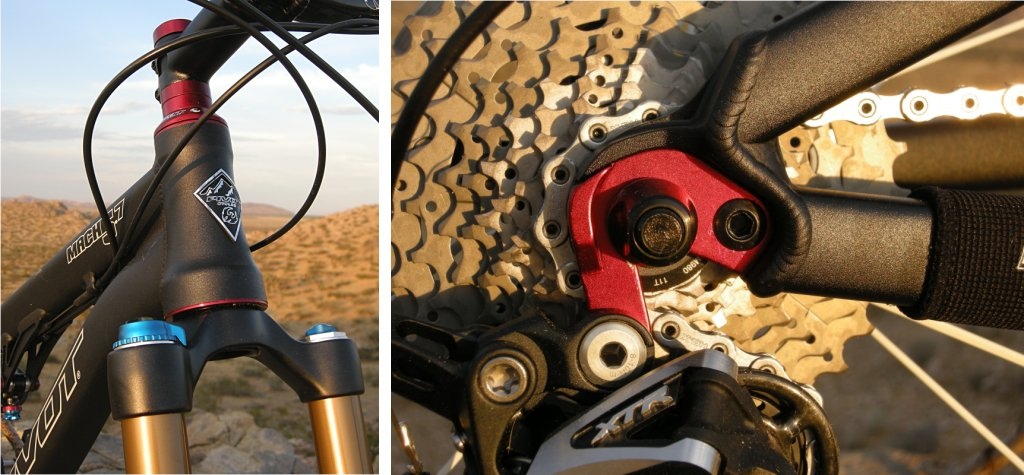 |
 Pivot machines the Mach 5.7's tapered head tube to better support the bearings and minimize weight - A close-up of the rear dropout reveals the DT Swiss 10-millimeter through-axle quick release and Pivot's super-strong rear derailleur hanger. Pivot machines the Mach 5.7's tapered head tube to better support the bearings and minimize weight - A close-up of the rear dropout reveals the DT Swiss 10-millimeter through-axle quick release and Pivot's super-strong rear derailleur hanger. |
Those of us who believe that every bike requires a chainguide will be sad to see that there are no ISCG tabs on the Mach 5.7, but somewhat relieved to discover that Pivot offers a sturdy adapter that both clamps onto the bottom bracket shell and bolts to the frame. Pivot’s ISCG-05 adapter, and is intended for single-ring cranksets. Check it out here. For riders who want to build up a Mach 5.7 at home, Pivot sells the frame only for $2199 (including the Fox Kashima RP23 shock) in five sizes, from extra small to extra large, as well as specific women’s sizes. Colors are charcoal anodized (ours) and white, and either pink or baby blue as female options. Complete Mach 5.7s start at $3899 for the Shimano SLX build and top out around $6900 for SRAM XX and Shimano XTR options.
Mach 5.7 Suspension
Pivot reconfigured the Mach 5.7 dw-link suspension geometry with a higher leverage rate and a flatter curve to feel a lot more plush in the mid-stroke and then consulted with Fox Racing Shox to tune its Boost-Valve RP23 shock to work in harmony. The result is a much smoother feel throughout the suspension travel with less ramp-up at the end-stroke. The changes in shock tune and suspension geometry, added to the fact that the Mach 5.7 comes with an ultra responsive Kashima-coated shock, cause the suspension to move a little more when pedalling than some climbers like. Pivot recommends that Mach 5.7 owners use (or at least try) the RP23 shock’s Propedal function when laying down serious power. We were interested to experience this because previous Pivots, like the Mach 4 and Mach 5, had sufficient anti-squat built into the suspension to never need the Propedal anti-bob function to enhance pedalling efficiency.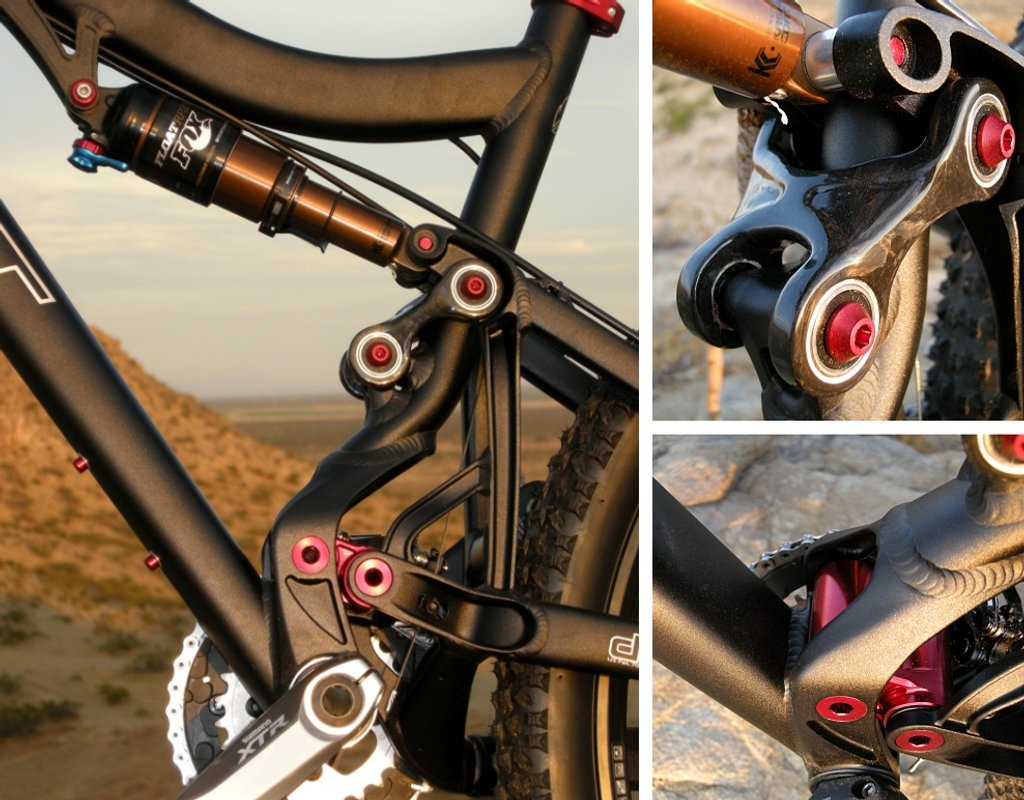 |
| Pivot's configuration of the dw-link suspension imposed some engineering challenges - The carbon fiber upper link wraps around the seat tube to capture the swingarm in exactly the right spot - The lower link is enshrouded by a hollow, two-piece aluminum forging that forms a rigid support for both suspension and pedalling forces in the bottom bracket area. |
Our test bike was fitted with a Fox 32 Float RLC fork and a QR15 axle system, which is pretty important to keep a 150-millimeter-stroke fork with 32-millimeter stanchion tubes carving a tight line through the turns. Kashima coating was conspicuously missing from the Fox fork, and when asked, Pivot officials said that the Mach 5.7 seemed to perform just fine without the slippery coating – especially so after a brief break-in period. The same function that makes dw-link bikes pedal well tends to overdrive the fork, so the fact that the stock Fox fork works well with the Mach 5.7 could be science or serendipity.
Mach 5.7 Components
Pivot offers five build kits for the Mach 5.7. Our test bike was appointed with the Shimano XTR ensemble highlighted by a 38/26 two-by-ten crankset, hard-stopping Trail brakes with ICE semi-metallic brake pads, and ICE 150-millimeter rotors. Wheels were DT Swiss Tricon 1550 wheels, while tires were a trail-blend of a Kenda Nevegal up front and a Slant Six in the rear (both 2.35-inch). Cockpit items were refreshingly different, with a Syntace P6 carbon seatpost topped by a Pivot signature WTB Vigo Team saddle, and a 90-millimeter Syntace F109 stem clamping Pivot’s 700-millimeter Phoenix carbon riser handlebar. If you haven’t deduced it by now, our Mach 5.7 was outfitted on the trail rider’s side of the mountain bike meter.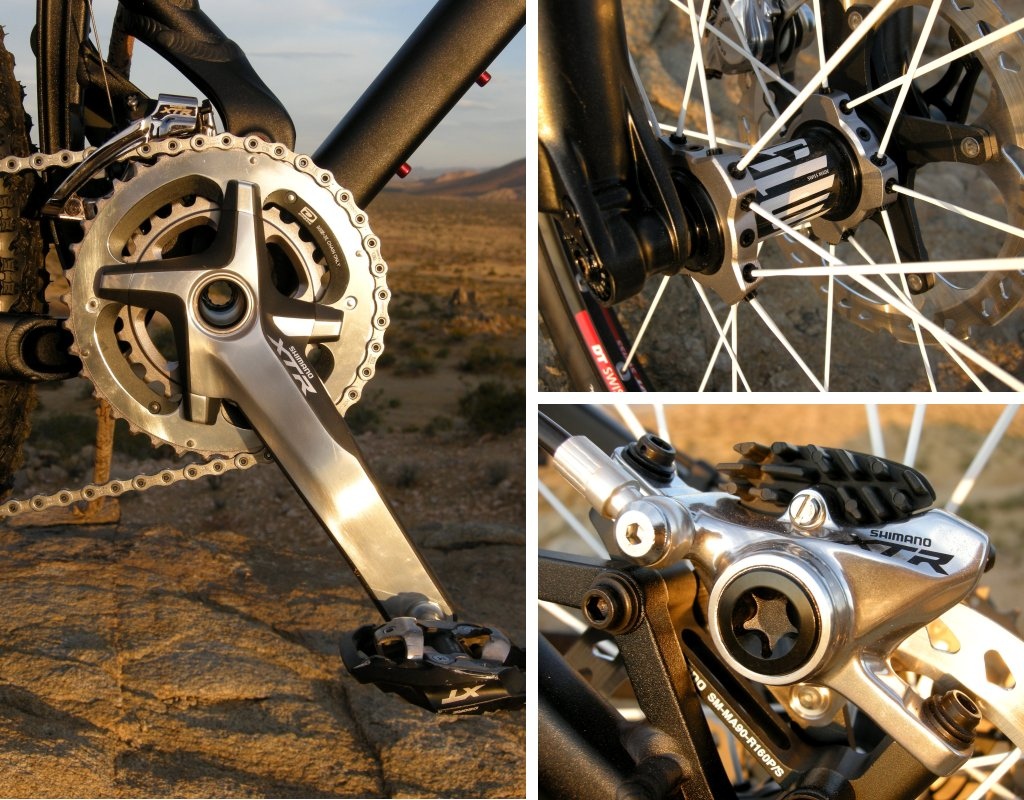 |
| We were surprised by the excellent rough-trail performance of the Shimano XTR two-by-ten drivetrain - Higher spoke tension of the DT Swiss Tricon wheels seemed to enhance the bike's turning and lateral stability - Shimano ICE brake pads and rotors did the work of larger-diameter rotors. Impressive stoppers. |
Riding the Mach 5.7
We tested the Mach 5.7 on a wide range of Southern California terrain from fast-paced mountain singletrack, to motorcycle routes in the high-desert, and suspension-eating technical boulders and slick-rock in the coastal ranges. Conditions were mostly dry with a couple of lucky super-tack days fed by monsoon rains.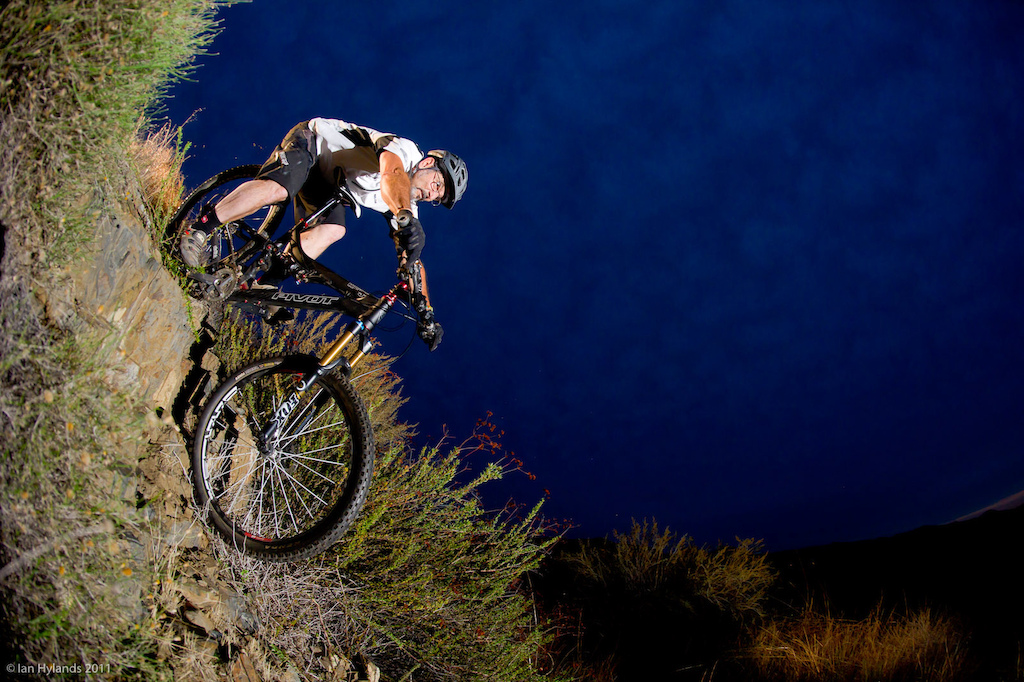 |
| Those in search of a single bike that can span the wide gap between a lightweight climber and a capable all-mountain rig will find the Mach 5.7 will be tough to beat. |
Shock setup: Successful suspension setup is the key to all long-travel trail bikes, and the process is made easy with Pivot’s shock-mounted sag meter. The Mach 5.7 requires a bit more negative travel than most, about 30-percent sag, so use the tool to get it right. Turn off the Propedal function, gently climb aboard, set the spring pressure so that the O-ring lines up with the red line on the plastic indicator and you’ll be good to go. We used the center Propedal option with five clicks out from full slow for rebound.
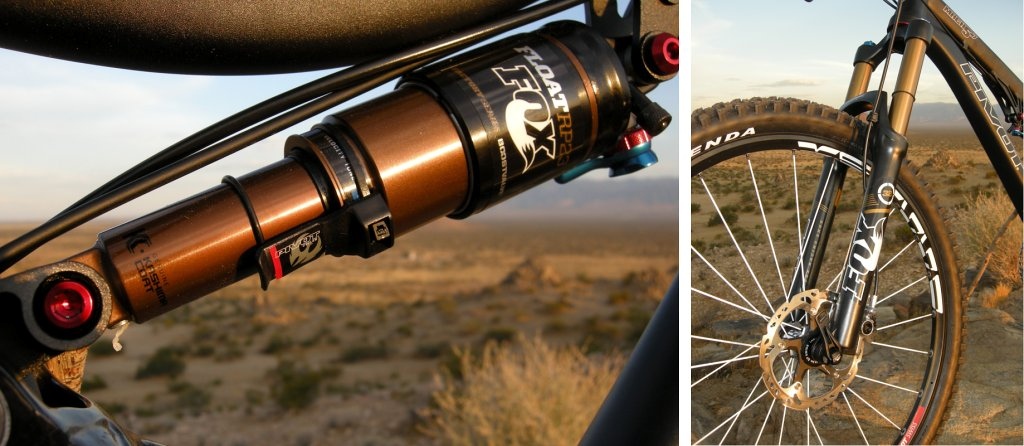 |
| Pivot's shock-sag meter is tough to get wrong - just add or subtract air pressure until the O-ring sets under the red line - The '5.7's new dw-link suspension geometry doesn't overdrive the fork, so the Fox 32 rides smoother and higher in its travel at speed. |
Fork setup: Up front, we found that 30-percent sag with 3 to 4 clicks of low-speed compression balanced well with the shock. The Fox Fit damping system has an anti-bottom-out feature, so don’t expect the O-ring on the stanchion to run to the end of the fork travel unless you pound something hard enough to bend a rim. Rebound was set 4 clicks out and all seemed well and good.
Pedalling: Rolling out on the Mach 5.7 feels like a different animal than its predecessor. Where the original felt like a long-travel XC ride, the Mach 5.7’s 67-degree head angle steers with more purpose and its suspension feels deeper and more responsive. The sensation leaves the legs wondering if the Mach 5.7 will be a disappointment when powering on the flats or when the climbs begin. Not to worry though, because the new machine accelerates quite well with the shock wide open and nearly matches the original with the assistance of the Propedal lever.
Climbing: Where the Mach 5.7 shines is pedalling up and over rough terrain, where the suspension keeps the bike moving forward noticeably better. The recurved shock rate seems more responsive to terrain under pedalling tension and manages this without stealing leg power. Using Propedal produces a correspondingly rougher ride that feels easier under power, but if you are willing to accept a small amount of pedal-bob, the ‘5.7 will roll smoothly, faster and more efficiently up rooted trails or stepped, slick-rock type climbs with the shock wide open. That said; the advantage of Propedal-assist is more than bob-free pedalling. The Mach 5.7’s rear suspension rides higher when the shock is firmed up which makes the head angle a degree or so steeper. The two actions combine to make the Pivot feel a lot fresher to the legs, especially when ascents last longer than free will. We were not ashamed to reach for the blue lever.
 |
| Up or down, the Mach 5.7 negotiates tricky corners with a relaxed composure that saves energy and focus for truly technical sections that lay ahead. |
Turning: Surprisingly, the Mach 5.7 corners like it is on rails. There is a beautiful balance that can be felt when the ground is rough and cornering forces are high that makes a ‘5.7 rider want to push harder with each successive turn. The head angle is not so slack that the bike has to be pushed around corners with the outside handlebar. Rather, the 5.7’s steering feels like an integrated part of its handling package – light at the bars with just the right amount of turn-in to encourage a confident flow. We attribute the Pivot’s new found cornering abilities to its lower bottom bracket, modern steering geometry and a better-balance between the shock and fork action. The limiting factor for hard cornering was the rear tire, which turned this phase of testing into a driftathon. Standard fare for the Mach 5.7 is Kenda Nevegals on both ends. The Slant Six rear tire that the factory set us up with accelerates well and rolls fast, but it steals fun from the downhills and is too easy to lock up under braking.
Technical descending: Get ready for some high speed fun when you turn the Mach 5.7 loose on a descent. With sharp, Super D acceleration on tap for rolling climbs and corner exits, and its point-and-shoot turning skills, the Mach 5.7 gets going in a hurry when it catches the scent of gravity. With its Shimano ICE Trail brakes, the choice to pick through the boulders or send it over the top can be made with nanosecond precision and its smooth, balanced suspension action can cover a multitude of errors. Where the original Mach 5 felt like it had a bit less than five inches of wheel travel when pressed, the new ‘5.7 feels a bit better than its posted numbers, especially under braking and when landing flat.
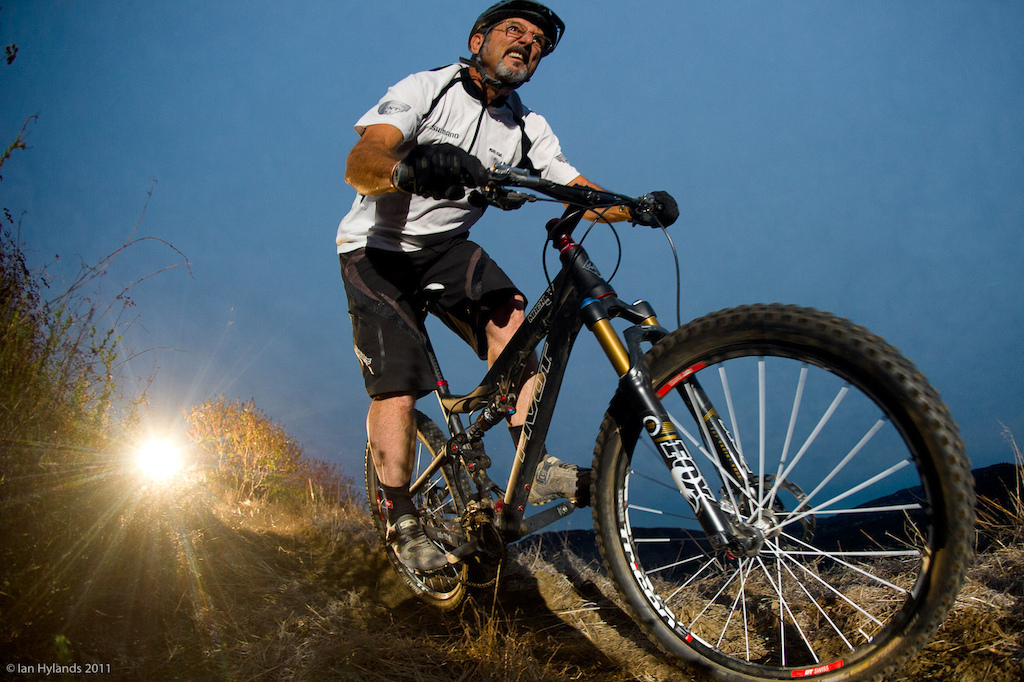 |
| Careful component selection, like tubeless DT Swiss Tricon wheels, Shimano XTR and carbon cockpit items keeps the weight of the Mach 5.7 in the mid 20's, yet the bike holds a sharp line through technical sections and feels capable at the outer limits of its performance envelope. |
Jumps: On the subject of flying, there is a slight lift in the rear end when popping short, steep ramps, which is typical of trail bikes and short-chainstay all-mountain designs, but a little pull on the handlebar corrects it and from that point, the Mach 5.7 rider will start racking up frequent flier miles. Unless you ask for a tail whip, the ‘5.7 stays on line after the wheels leave the ground and when it returns, the bike is business as usual.
Technical report
Shimano’s latest XTR two-by-ten transmission is impressive. Shifting feels spot on with every click and we never lost a chain, even when we were pounding slick rock descents spun out in the 38/11 top gear. For those who shift in the push-push (SRAM) mode, Shimano’s dual-action trigger lever feels cramped and slightly out of position regardless of how the shifters are angled. In its intended thumb-and-forefinger mode, however, the latest RapidFire ergonomics feel just right. We feel that the now-standard 40/28 (SRAM 39/26) double-chainring gearing is too tall for trail work unless your legs are race ready. Shimano’s lower-geared, 38/26 chainrings are a step in the right direction, but unless we hit the steeps when we felt fresh, the tallish low gear often robbed the opportunity to showcase the Mach 5.7’s tractability when the trail got nasty for a lengthily pitch. On the occasion when we did top uber-technical climbs with fresh legs, we left defeated riders open-mouthed on the sideline. Insist on a two-by crankset, but consider 38 by 24 or a 36 by 24-tooth gearing to maximize the Pivot’s performance.
Missing conspicuously from the Pivot Mac 5.7 was a remote-adjust seatpost. The hose guides are on the frame, but the bike did not have the one item that almost every '5.7 rider needs to maximize this stealth shredder's fun factor. As mentioned, we also pondered Pivot's decision to fit a nearly bald Kenda Slant Six tire to such a technically capable trailbike. Order yours with real rubber and shred happily unto the world.
 |
| The Mach 5.7 gets moving easily and covers a lot of ground - especially over rough, rolling terrain. |
Pinkbike's take:
 | PIvot's redesign of its most popular trail bike hits the mark for experienced riders who need no-compromise technical handling and don't want to sacrifice cross-country attributes like sharp climbing, acceleration and cockpit ergonomics. The Mach 5.7 competes in the pedalling department with the likes of Specialized's Brain-equipped Stumpys, and can run downhill with most all-mountain middleweight spawn of the Northwestern brands. For those searching for a dedicated park bike that is also capable of trail riding, however, Pivot's 5.7 falls short. While it is capable of shredding mid-mountain Whistler-type trails such as A-Line, the lack of a through-axle rear end and a dedicated chain guide belie the fact that the DNA of the Mach 5.7 comes from trail bike roots. If your DNA and the Mach 5.7 are a match, then its stiff, lightweight chassis, bomb-proof handling and smooth-rolling suspension will be your secret weapon should you find yourself surrounded by big bikes and full-face helmets with a couple of thousand feet of vert' below your front wheel. - RC |
View all the options for the mach 5.7 on the Pivot website and check out the new carbon fiber Mach 5.7 due to arrive in late 2011.
Author Info:

 San Diego, CA, United States
Must Read This Week
Finally, the bike is offered in both 2X and 3X XT or XTR drivetrains and on the SRAM bikes the new X/O and X-9 bikes come with a 24/38 gear combination which is a really sweet combination.
Finally, I have had the pleasure of riding with Richard, and I have seen him drop some pretty crazy shit at press camps where the vast majority of other editors wouldn't touch it. He can ride, he can write and he is a super talented engineer/designer, and builder in his own right.. To top it all off, as one other person mentioned, he was Mantis bikes and is the inventor of the elevated chainstay, separate (bolt on) front and rear triangles, and several other major innovations. The modern mountain bike would not be where it is today without his innovations. Most people dont know that but they should.
You must mean epics and stumpys, enduros don't have brains.
"We feel that the now-standard 39/28 double-chainring gearing is too tall for trail work unless your legs are race ready"
I think you mean 28/40.
My titus is ahead of it's time, the frame has no play or issues but will be replaced with the 5.7 as my new xc bike. I don' t criticize rc's bias of Chris cocacis cause he creates great riding, great quality bikes.
You really can't say anything bad about this bike like you can't say anything bad about any of the high quality bikes out there. Reviews like this are great to give you more info to make more informed decisions. Also, this bike isn't widely available in Canada so this is probably the best way to get the word out and to let the rest of the world know of its existence.
I'm sure it will have it's place in my stable. I'll be building it light and agree it would not be the best bike park bike, if only because why would you want to run a thoroughbred down that nastiness? That being said, I did ride the 5.7 on some of our more techical north shore trails and it is pretty capable. Like the other poster compared his firebird and 5.7, both have their place but can overlap.
As for rc and pinkbike, I'm sure their relationship is mutually beneficial. Kudos to rc for having foresight to move to the Internet. Pb seems to be benefiting from rc's experience as well. As for the negative comments - my view has always been if you're making everyone happy you're doing something wrong! (just let mike review the wet weather stuff, rain jacket. In the desert? Lame...)
Surely thats a bad thing, as the point of the hanger is to be weaker than the mech, so if something does go Pete Tong, just the hanger gets f*cked and your mech stays ok?
Moral of the story ? Mechs need to go into the pages of history ,pulling/dragging/pushing chains across cogs is such an archaic way of changing gears that it has no place on modern bikes in my opinion !
P.S. Wide format for these articles is SICK. Better than having a magazine in your hands.
Also, with regards to the bitching, I didn't see anyone whine when Levy tested the ASR 5 which is an even more XC oriented bike.
I think people should stop believeing that suddenly this new standard is going to put down to any pains connected with "the old" stuff. Many behave that way. Oh this bike doesn't have this or that - I want a "MODERN" bike. Sorry stiffness increase, better weight to strength ratios and all that stuff is just a small part of the puzzle that makes a product truly performance enhancing and reliable at the same time.
There are new products coming up to cater those "modern" standards and how about issue like making new axles, bearings - stuff that evolved for years to make this old componentry work well. To be reliable. Now some part of that development goes to garbage. Devil lives in details and you never know if making a new axle with slightly different dimensions doesn't mean that we will have to wait some years until they make it stop cracking? new axle means new freehub body, or new dropout in the fork?
12x142 - 1.) Most good+widely available 135mm rear hub adapt to it(my hope pro2 for example) 2.) Because you're still using your old 135mm hub you don't have to run any different bearings or freehub or w/e 3.) Any frame with a 12x142 rear end comes with an axle, and I'd be willing to bet it's pretty darn reliable(let's be honest they've been making 12mm rear axles/maxles/rws axles for awhile now) 4.)12x142 rear dropouts are keyed for the hub so the wheel w/slide in and bolt up without you having to align the axle and whatnot.
I think 15mm front axles are unnecessary when a 20mm will more than do the job.
Tapered steerers are noticeably stiffer than straight 1 1/8" steerer and you don't have to buy a dumb 1.5" stem.
Straight 1.5" steerers are just dumb from the get go and should have never existed(it will die).
By the way, I would put a 15mm fork only on my small travel XC bike (except the fact that I will never have one, cuz I would prefer a trail bike, lol), and 20mm on everything else.
RC looked technically ready to ride. on one hand Im not sure what to think. I think with his presence one can safely say that it will be a fair review. However, I do think coming from MBA it throws a bit of dirt up.. However, Not really. He's one of us.....
I understand the prices for bikes these days. Fine. However, I feel the economies are causing imbalances. Enough said.
I hate the word " FUN" . I don't need reviewers or product managers manipulating me with the word " FUN" to sell a bike for 7000$. " Fun" is for jet skies., I understand that the new weekend warrior that is to buy this bike is the old Jet ski, motocross guy. Thats who is going to pay for this, unless he is a dedicated biker. I don't feel their selling bikes like this anymore to dedicated bikers. Their pushing a market for money. Where is the money. We will call what well sell " FUN FUN"// make it sound like " KEN AND BARBY".. And away we go.
Personally I take my biking seriously. I don't do it for " FUN FUN" I feel that word is despicable for those that take biking seriously. I got into biking to save my life. It was one of the things that got me outside... I didn't do it because it was fun. I did it for the hard work and the joy of that hard work and for other less fun concerns. mental heath reasons. Economic reasons. Physical health reason as I get older. If it is fun for me. Thats non of your business. Thats a personal experience when on the trail. My personal experience. And it is " HOLY GROUND". The word " Fun" is that spontaneous moment within the jungle that you have no conception of " its personal" Its mine..!! . It requires a thousand personal variables of intimacy that belong to no one else but me. Including comments to dictate what it is and when I should have it... STAY OUT OF MY JUNGLE PLEASE......... I didn't invite the marketer past the fence. whats he doing in the kitchen..!!
It never enters into most riders minds that the "chainstay" of an FSR is just the lower link, the "seatstay" is the actual swingarm that the wheel is attached to, and the shock link is the the upper link (and the main frame itself is the fourth link in the 4-bar equation). Apparently you're one of those types of riders. Because if you were in the minority type category... those of us who actually understand suspension design geometry and functions, you'd have known ahead of time that the lower link's size, and movement only plays a small part of the overall leverage rate of the suspension design. The angles that the elements pivot around each other, relative to one another, plays a bigger role to the overall rate than the lengths of the elements that make up the suspension linkage.
I agree they do a really good job here compared to most magazines. I mainly come here for the videos, photos, and and user generated TRs anyways.
As someone else commented- it's a DW bike with full XTR, what's not to like? RC did a good job of showcasing the Mach 5.7's traits. You can call it an ad or bias because it is information to influence someone's buying decisions. Read deeper into it. If you were in the market for this bike, wouldn't you want to know everything you can about it? The goal here is to provide the riding community with information. A company that makes a good bike is going to score on getting a free bike review, and those that are lacking, well, they also get a free review from a qualified rider that has tested hundreds of bikes therefore able to apply their relevant experience to nit-pick on the finest details for what would make a bike perform better. Bike companies read the reviews as well, so even Pivot's competitors are taking note as to what revisions they can make in the future to build a better bike. It's a win-win situation for everyone involved, and helps, even if minutely, to progress the industry.
Take it with a grain of salt.
It's a bit like when you met your girlfriend for the first time and you had to seperate the history between her and that other a-hole she used to be with. Regardless of her history, you appreciate who she is now, what she has learned in life, and that those experiences brought her to you. I've never met RC, but he sure brings a lot to the table as far as experience in our industry, and that's something we will all learn to appreciate.
Which would be, bike companys..... strawman point.
Hahahaha, "so here at pinkbike we got to ride Natasha from FitnessSingles.com..."
For those that are bashing RC, I may be wrong, but I think I recall reading a note somewhere that when he left MBA it was for some of the reasons you are bashing him(I'm considering not renewing my subscription because of the way they flog 29'ers). If my memory serves me correctly about this, than, to me, that speaks tons about his integrity. As a person looking to buy a new bike in the next year or so, I am gathering information now.I'll take in to consideration that he rode this bike with a build kit that I likely will not be able to afford, but I can use his suggestions in regards to drive train etc to make a more informed decision as I'm slapping xt/x7/x9 parts on my bike.
I enjoy reviews on PB and that other site; what is it nsm... sumpin or other, that seem to be written by average joes like me, but I also liked having somebody with considerable knowledge and expertise dissect a bike that is on my radar.
Thats my 2 cents so somebody pay up!!
As for one I am curious as to how the whole process works and on the other hand you wouldn't have to deal with the hassle of explaining that no, you don't get to keep the bikes/products and no they don't pay you, or your travel expenses or whatever every single time an article comes up. I think everybody would love to test bikes, it could be interesting to see how it actually works.