Knolly Endorphin Review
TESTED
Knolly
Endorphin
Endorphin
WORDS Mike Levy
PHOTOS Amy McDermid
With 26'' wheels and an aluminum frame, Knolly's 140mm travel Endorphin may not trigger nearly as much excitement as the hyped-up 650B-wheeled bikes that seem to be taking the lion's share of attention these days, and we'd say that the sturdy looking machine is a bit of a sleeper in the current trail bike marketplace. The man behind Knolly, Noel Buckley, seems to have purposely steered clear of much of the design details that lead to marketing-friendly buzzwords, choosing to instead use a threaded bottom bracket shell and the aforementioned 26'' wheels. There are some smart concessions, though, with routing for a dropper post and a 12 x 142mm rear end, as well as a set of replaceable ISCG 05 chain guide tabs in place. It is those tabs, a bit of a rarity on a 140mm travel bike, that hint at the Endorphin's intentions as a trail bike that doesn't shy away from a spot of rowdy riding.

Knolly Endorphin Details
• Intended use: trail/all-mountain
• Rear wheel travel: 140mm/5.5''
• Designed for 140 - 160mm fork
• 'Four by 4 Linkage' suspension
• Threaded BB shell
• Replaceable ISCG-05 chain guide tabs
• 12 x 142mm threaded axle
• Dropper post routing
• Weight: 28lb (as tested, w/o pedals)
• MSRP: $2,275 USD (frame only)
Frame Details
Aside from the small 'Four by 4 Linkage' decal on the bike's non-drive side chain stay, the Endorphin is refreshingly free of any slick three letter acronyms or phrases that would claim to make you a better rider than you actually are. There are some smart details that can only be spotted by looking a bit closer, and the lack of marketing belies a beautifully made aluminum frame. While they were once manufactured in Canada, Knolly has moved frame production to Taiwan in order to stay competitive in a today's marketplace. Don't let the unwarranted stigma of offshore manufacturing give you the wrong idea, though, with the welding and finishing on the Endorphin rivaling anything we've seen built locally.
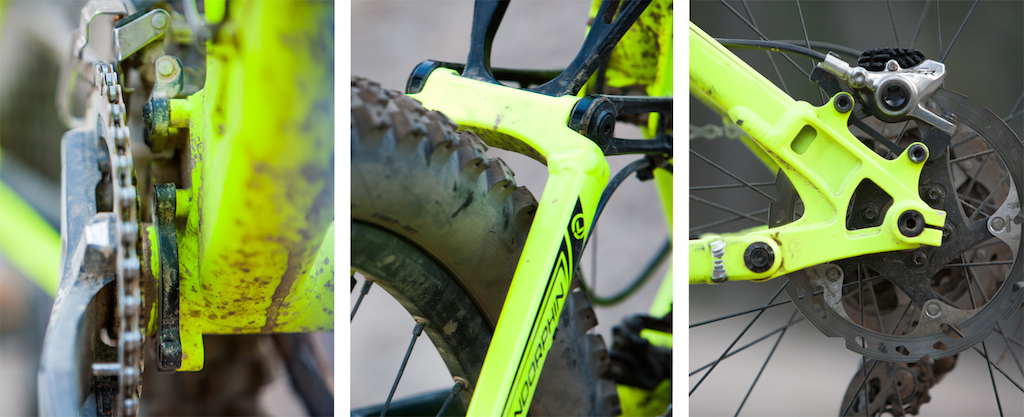 |
 Frame details include replaceable ISCG-05 chain guide tabs, loads of tire clearance (even with 2.5'' wide Kenda Excavators), and a standard threaded 12 x 142mm thru-axle out back Frame details include replaceable ISCG-05 chain guide tabs, loads of tire clearance (even with 2.5'' wide Kenda Excavators), and a standard threaded 12 x 142mm thru-axle out back |
The frame's cable routing is far from invisible, with external housing guides along the underside of the top tube and the top of the down tube, but we'd still call it clean looking. There is no allowance for an internally routed dropper post, but there are plenty of external options that should work well with every post on the market, and the cable stop for the front derailleur is removable if you decide to run a single ring over a double or triple setup. Likewise, a set of bolt-on ISCG-05 tabs can be removed if you don't require a guide (or replaced if you happen to damage them), and the bike uses a direct mount front derailleur that is bolted to the front triangle rather than an extension off of the chain stays as found on some designs.
We weren't surprised to see ample tire clearance at the Endorphin's seat and chain stays - Knolly is a B.C.-based company, after all - but the amount of space in there actually puts many DH bikes to shame. Just for fun, we installed a set of high-volume 2.5'' Kenda Excavator tires front and back and found that there was nearly enough room left over for us to slide our thumbs in on each side. While tire clearance, chain stay length, wheel size, and front derailleur positioning are all factors in the amount of tire clearance a bike sports, Knolly seems to have figured it out correctly. Moving further back, a 12 x 142mm rear end has been used, with a standard threaded axle that requires a 6mm hex key along with a 4mm to loosen the pinch bolt. While obviously not as convenient as a Maxle layout, it does appear to be both quite burly and impervious to working its way loose over time.
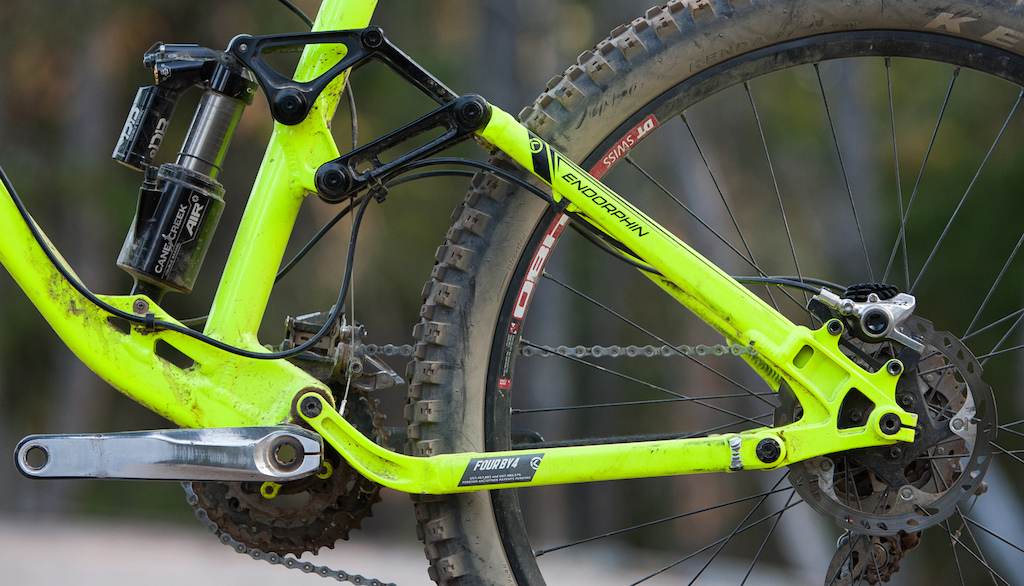 |
| The Endorphin's 140mm travel rear end may look as if it has a few extra pieces, but there is a sound theory behind the layout. |

The Endorphin's Suspension Explained
The Endorphin's 'Four by 4' linkage may look like a standard four bar design with an added set of links that only complicate matters, but Knolly's Noel Buckley has some sound theories behind the layout. Interestingly, the bike's seat tube position is a key factor in the design, with its forward position relative to the norm allowing the bike's seat to be more out of the way when lowered for technical terrain (the slack angle of the seat tube means that it is more or less in the correct position for pedalling, though). The tube's position, along with Knolly's desire to not have to use lengthy and therefore more flexible seat stays, necessitates the nicely machined secondary linkage that is used to both activate the rocker arm and tie the system to the seat tube. There is no denying the added complexity and associated hardware that comes with the design, but we have to admit that it has been executed smartly and with as little fuss as possible. The clevis pivot that joins the rocker arm and push link uses DU bushings to save weight in a location that sees minimal stress, and the co-pivot at the top of the seat stay saves further grams by eliminating another set of pivot hardware.
The Endorphin's 'Four by 4' linkage may look like a standard four bar design with an added set of links that only complicate matters, but Knolly's Noel Buckley has some sound theories behind the layout. Interestingly, the bike's seat tube position is a key factor in the design, with its forward position relative to the norm allowing the bike's seat to be more out of the way when lowered for technical terrain (the slack angle of the seat tube means that it is more or less in the correct position for pedalling, though). The tube's position, along with Knolly's desire to not have to use lengthy and therefore more flexible seat stays, necessitates the nicely machined secondary linkage that is used to both activate the rocker arm and tie the system to the seat tube. There is no denying the added complexity and associated hardware that comes with the design, but we have to admit that it has been executed smartly and with as little fuss as possible. The clevis pivot that joins the rocker arm and push link uses DU bushings to save weight in a location that sees minimal stress, and the co-pivot at the top of the seat stay saves further grams by eliminating another set of pivot hardware.
|  | ||||||||||||||||||||||||||||||||||||||||||||||||||||||||||||||||||||
Riding the
Endorphin
Endorphin
 | Not a KOM hunter on access road climbs, but a bike that truly does shine on technical uphill pitches that resemble more of a chess match than a time trial. |
Climbing/acceleration: The Endorphin isn't exactly a purebred climbing machine, but it can more than hold its own when the time comes to gain elevation. In fact, the trickier the climb, the better it performs, with great traction on hand that seems to search out any available bite. Rear wheel spin was near nonexistent so long as we had the slightest bit of form, even when we were flailing up a stepped pitch that did its best to make our life difficult, and that fact always seemed to keep the bike moving forwards rather than stalling out. Much of this Super Glue-like stickiness is surely down to the bike's relatively short 425mm/16.7'' chain stays that helped the rear tire find adhesion, and it really let us concentrate on staying on line rather than if we were about to spin out. Praise also has to be heaped on the Endorphin's Cane Creek DBair CS shock that, even when set to its firmer and more efficient pedalling setting, allowed the rear end to track the ground and find traction when it was needed most. And when that traction was found, the front end suffered from very little too no front end lift on pitches that have had other bikes wanting to rotate backwards over the rear axle, an issue that we were fully expecting to deal with but one that never reared its head, despite our test bike's short Chromag Ranger stem.
While the Knolly was well balanced and forgiving, traits that let it make surprisingly short work of steep, technical ups, it seemed to lack a bit of spirit when putting the hammer down. The feeling was not unlike using a set of heavy wheels (mind you, the bike's DT wheelset is far from heavy), and was there even with the DBair's Climb Switch feature activated. It just didn't leap forward with the enthusiasm that other bikes of the same travel have displayed, and the stopwatch also confirmed that we were consistently slower on extended grades.
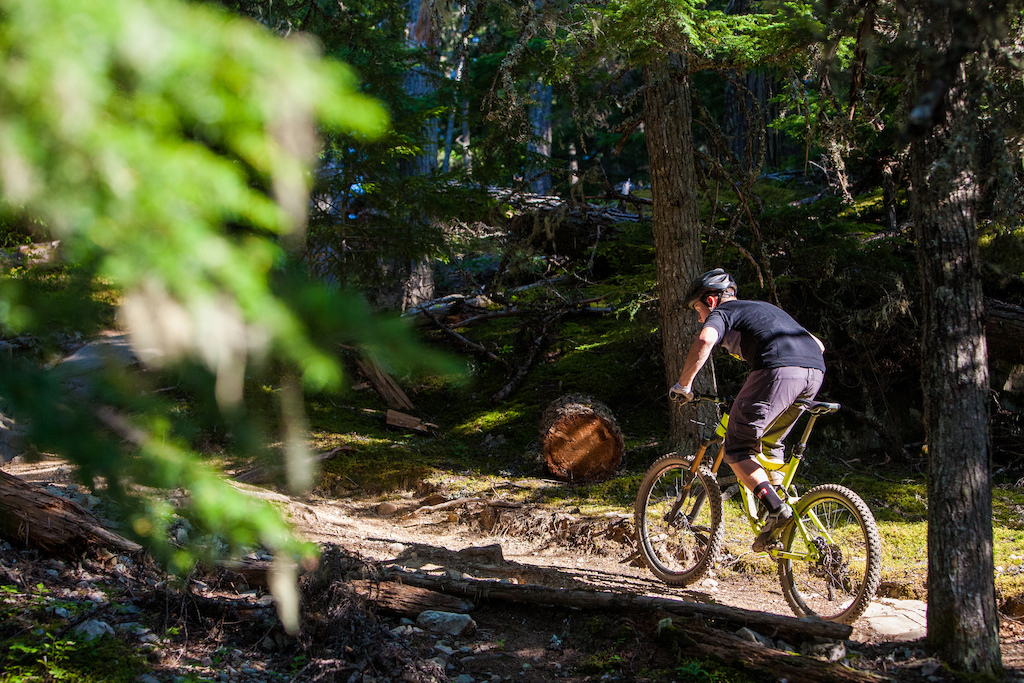 |
| Pick your battles wisely and you'll be rewarded by cleaning technical uphill pitches that will have your riding buddies walking, but don't bother chasing records on gravel road climbs that favour spritelier machines. |
Technical riding: Given the Endorphin's spiritual home of North Vancouver, it doesn't come as much of a surprise that the bike can hold its own on rooty and slow speed moves. Sections that test a rider's balance more than their ability to find a line at speed are not difficult to deal with, and the bike has a low feel to it that makes such situations easily manageable. Need to pivot the bike around what looks like an impossible corner? No big deal. Likewise, the front of the bike pops up as needed, whether under power or not, and it didn't take much effort to put it down exactly where it needed to be. All of this added up to a machine that performed well at near standstill speeds.
The bike's aforementioned balanced handling and ability to seemingly pull traction out of a hat like a magician made steep chutes feel not quite so steep. Kudos has to be given to its active yet neutral feeling suspension that doesn't punish a rider for grabbing a handful of brake to prevent certain death, and its FOX 34 Float CTD fork felt more controlled and forgiving of such situations than we expected. Of course, the power of the bike's XTR Trail brakes, along with the 150mm drop of its KS Lev seat post, are all factors in the its adeptness on the steeps.
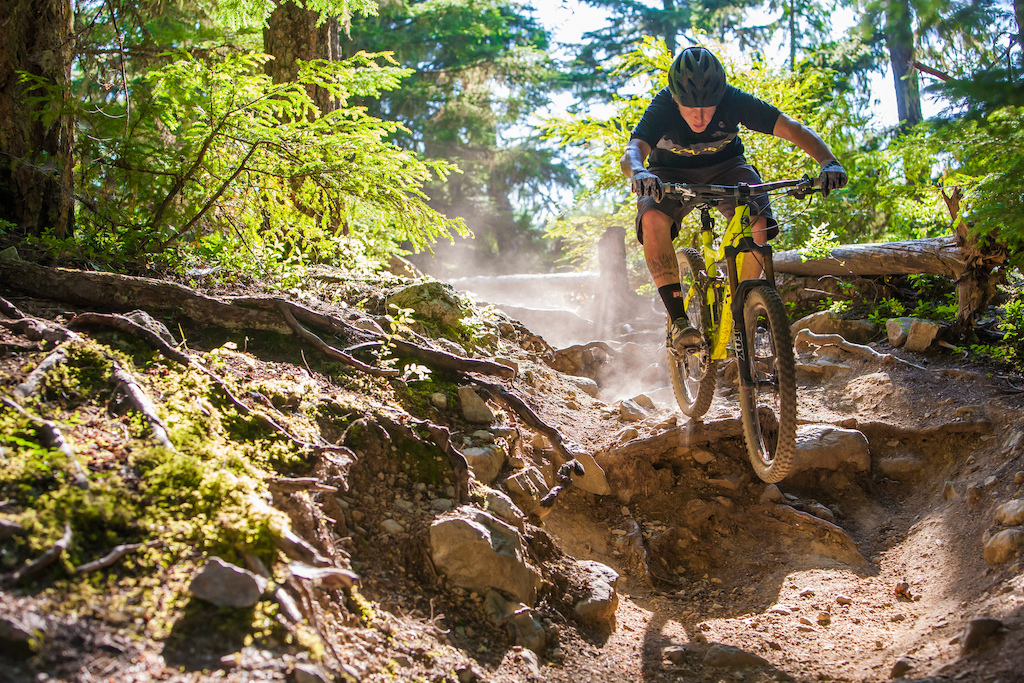 |
| Do you like it smooth or chunky? The Endorphin doesn't mind it either way. |
Downhill: What should a 140mm bike be capable of? A whole lot, at least in our minds. With that sort of thinking, we pointed our bright yellow Endorphin down everything from smooth pump lines to hairball trails like Goat's Gully and Joyride in the Whistler Bike Park. A rig like the Endorphin might see anything, after all, so we why not test it on everything? Besides getting a lot of funny looks from downhillers, we came to the conclusion that the Endorphin is one hell of a solid machine, one that manages to hold its own on some serious terrain relative to how much travel it sports. Nowhere is this more apparent than on rough ground full of small to mid-sized impacts, places where the bike's rear suspension can mute such terrain as if it had an extra 20mm of travel - it simply felt more forgiving than other 26'' wheeled, 140mm travel bikes that we've ridden in the same places. Don't get the wrong idea - it's best to ride the bike like the mid-travel machine that it is - but we felt comfortable carrying a bit more speed into toothy segments of trail or dropping off something that we might otherwise roll down on similar travel bikes, and that sort of ability adds up to a whole lot of fun on the Endorphin. And with suspension that can punch above its weight class, including its FOX 34 Float CTD fork that performed well once we nailed the correct air pressure, the Endorphin can be pointed towards some bold moves that would worry most other 140mm travel bikes. You'll still always want to search out a good transition before leaving the ground (that is true with any bike, though, isn't it?) but the Endorphin tolerates hard impacts without causing much concern.
| The Endorphin's predictability and solid nature also allows its rider to take a different approach to the trail, rewarding a mindset that is more about exploring the trail than simply surviving. Take the line less travelled, for sure, but the bike's short stays give it a playful side that can also lay down a long manual or a foot-out slide through a loose corner, whether it's called for or not. |
The bike's biggest strength lies in its balanced handling, with our large-size test bike finding traction and remaining predictable when hanging it out beyond our comfort zone. And getting to the edge of that comfort zone and beyond was quite a bit more fun on the Knolly compared to some other lighter duty trail bikes on the market, very much because of the bike's rock solid personality - it isn't a DH bike, but it certainly thinks it is sometimes. There was very little shuddering or protesting, and very few skittery and loose moments that often become a real problem in the heat of the moment, especially on a 140mm travel rig, and the day-glo bike constantly surprised us with its composure.
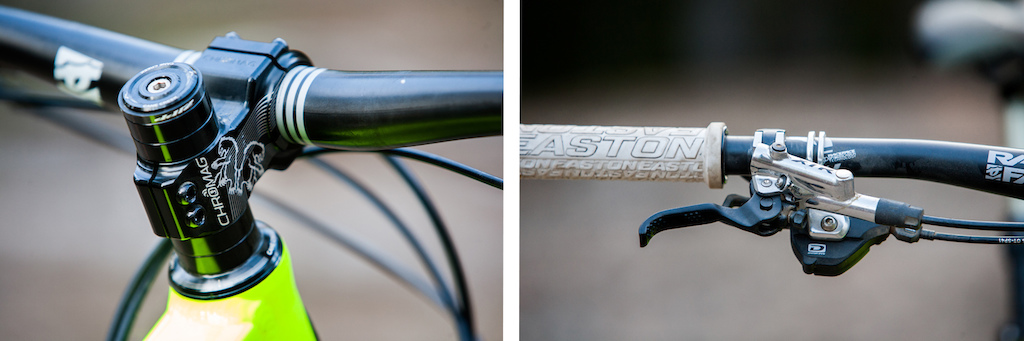 |
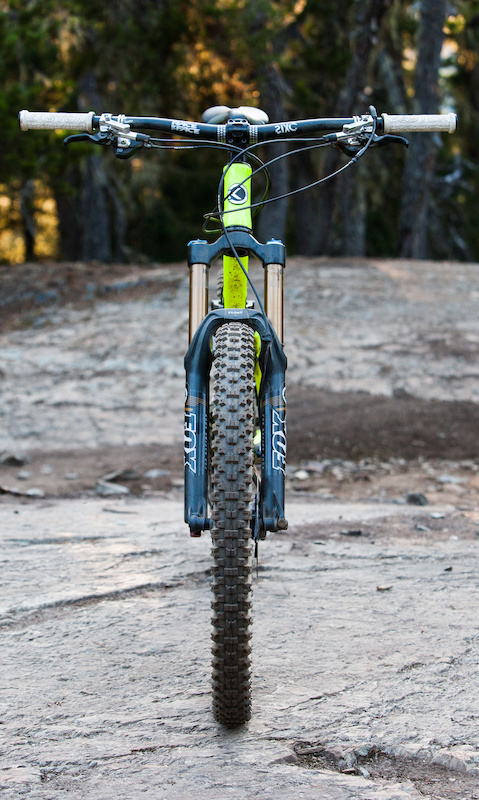
| The Endorphin's Chromag Ranger stem, Race Face SIXC bar, and Joystick Digital Feather seat added up to one of the more agreeable cockpits that we can remember using. We added a set of Easton's thin yet comfortable lock-on grips to round things out. |
Component Report
• Shimano's XTR Trail brakes have enough power to slow down a runaway train, let alone a sub-30lb trail bike, and comfortable ergonomics that feel spot on. They do have more initial bite than a set of equivalent stoppers from Avid, which can be either good or bad depending on what you're looking for, but it is their consistent lever feel that wins us over in the end. No pumping up, lever reach that doesn't migrate, and not even a hint of fade. Our only gripe is the lack of an effective bite point adjustment, something that we've often harped on about in the past.
• Our Endorphin test bike came from Knolly with a set of Maxxis' Minion tires that felt a touch skittery when pushing hard in our dry, dusty summer conditions. There is no denying their performance, though, as they are used worldwide by some very accomplished riders, but silty and loose trail certainly aren't their forte. We installed a set of more aggressive Kenda Excavator tires and instantly felt more comfortable when riding on the edge.
• The combination of a Chromag Ranger stem and Race face's SIXC carbon handlebar not only suits the Endorphin's solid and dependable personality, it also creates a cockpit that feels spot on for a bike that is intended to be ridden hard on demanding terrain. We point this out because it isn't often that we agree with a company's stem and bar choice, but Knolly certainly nailed it.
• The Endorphin's Joystick Digital Feather seat honestly felt a bit too soft for us at the first push with our fingers, but it proved to be one of the more comfortable seats that we've spend long periods of time sitting on. Those used to harder racer-style seats would be losing out to assume that it isn't ideal for the long haul.
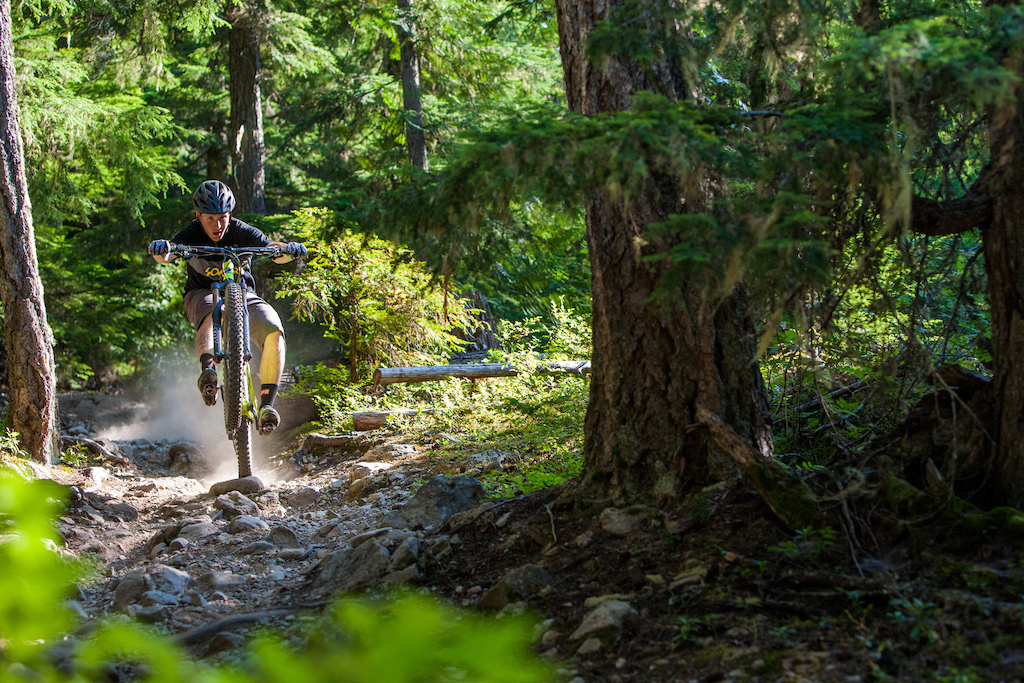 |
| The Endorphin can find the fun on trails that would cause most other 140mm travel bikes to simply search out the cleanest line. |
Pinkbike's take:
| The Endorphin is admittedly a bit of a niche bike, one that a skilled rider can take places that would normally eat up and spit out a bike of its size, yet it also manages to keep from feeling overbearing on less demanding trails. And while it likely wouldn't be out first choice if we spent more time climbing access roads than singletrack to reach to the tops of our local mountains, its amazing technical climbing credentials make it a contender on any sort of tricky uphill. Who is the ideal Endorphin owner? We'd say that it is a rider who doesn't shy away from hairball terrain, even if it took them fours hours of difficult riding to reach it, while also being open to swinging a leg over a bike that doesn't come from a major brand.- Mike Levy |
www.knollybikes.com
Author Info:

 Squamish, BC, Canada
Must Read This Week
Knolly Endorphin has 44mm inner diameter head tube that allows you to accommodate a 1.5/1.125” tapered steerer with a proper headset:
goo.gl/Sbab7i
chrisking.com/files/upload/headsets/44mm-Headtube-Fit-Guide.jpg
But seriously this bike seems to be an amazing machine, bringing tons of fun. In $2275 for a frame this doesn't come cheap though.
This is what I was looking for, it's a lot more indicative of the descending capabilities than blanketing it with the cliché "climbs like an Xc bike descends like a dh bike"
May have glossed over that bit
It sounds like a 140mm Rocky Mountain Altitude would be a bit more cross-country oriented than this Endorphin, but it would remove any doubt if you would just come out and say it.
You obviously haven't ridden this bike, it really does descend extremely well for a 140mm bike, I have a 2008 one and it is still just as good as the new ones just released.
www.pinkbike.com/news/Knolly-Endorphin-Garett-Buehler-Edit.html
"Knolly's 140mm travel Endorphin may not trigger nearly as much excitement as the hyped-up 650B-wheeled bikes that seem to be taking the lion's share of attention these days"
Hello kettle? It's the pot calling
I have a 2004 Giant AC frame and 2012 Trek Remedy built up exactly like this bike, both with 2.35 & 2.4 tires.
They go anywhere, they're endless fun and weigh in at 29.5lbs.
Everyone else, Give us more clearance please !!
"AM" category to replace it............."oh it rolls over square edged bumps like a 29er" people claim of their 650b etc.
So does a 26" with properly designed rear suspension and chassis design......My bike"s frame is a clear 4lbs heavier
than would be considered market competitive right now, but at 197lbs before gear, and 15 years of dedicated BC
single track experience I still prefer my Knolly...............and du bushings and bearings bare so little load that I
don't have to keep replacing or servicing shocks, du bushings, bearings or rear triangles. If you ride ALOT than
you should consider the very well and pridefully thought out Knollys.....once again...in my humble opinon.
goo.gl/3HC65H
I was never a fanboy of one brand but Knolly was always my favorite company since their goal is the highest quality possible.
For a long time I could not afford their frame so I got by with other bikes, perfecting my skills and destroying stuff.
Finally, when I got my first job and adequate amount of money came my way I could choose the bike I like.
Being a perfectionist [the terrible condition that I suffer from
When after 5 years my old Endo was finally subjected to euthanasia, I went with new Chilcotin which is simply awesome!
goo.gl/gugqBg
the one best addition to this frame i made was putting a rwc enduro needle bearing into the upper shock bushing.
Not that the suspension ever was sticky but with that addition you get a coil like suppleness and sensitivity on an air shock. un-be-lie-va-ble. you casually lean on the bike and it goes a tiny bit into its travel without any initial stiction to overcome.
As for the descent. The more you open it up, the better it feels. At slower speeds I find it can hang up on things, but the solution to that problem was easy.
I had to send the shock in for warranty 2 weeks ago and I've been sorely (literally) missing my Knolly since then.
They sent the new frame out, I received it, changed the links, boxed up the old frame and sent it back.
Total time without a bike = 6 days.
Distance from Knolly HQ = 3500+ km
Bikes shops involved = 0
Dollars involved = 0
CreditCard needed = No
Happy Customer = yes
Repeat customer since event = yes
S.H.I.S. : EC44/40
Hope has them.
44mm is really useful, I don't know why all bikes don't have 44mm head tubes.
knollybikes.com/bikes/chilcotin