Crankbrothers Kronolog Telescoping Seat Post Review
Crankbrother's Kronolog telescoping seat post steps away from the hydraulic internals that were used within the infamous Joplin design, instead utilizing a full mechanical layout that greatly resembles the locking plate system found on bar clamps. The design makes the Kronolog the only mechanical post that is infinitely adjustable, allowing users to select any seat height between its fully dropped and fully raised positions. Total available travel is 125mm, although that number can be lowered by way of an internal spacer. The 465 gram Kronolog retails for $300 USD, and is available in 30.9 and 31.6mm sizes.
The details
Locking Plates: A set of twin steel plates, each one encircling the post's upper tube, sit within the larger diameter portion of the post's lower tube. A spring positioned between the plates pushes them apart, forcing both the forward and rearward inner edges of plates into contact with the upper tube, which in turn holds it steady from rising or lowering. When the remote lever is pushed the cable pulls the plates together so that they are parallel with each other, allowing the upper tube to cycle freely. Release the remote lever and the spring between the plates force them apart at an angle into the upper tube's clamping surface. The system may sound complicated at first, but it is actually one of the simplest telescoping post designs out there, with possibly only the Gravity Dropper being more straightforward. Crankbrothers is quick to point out that the inspiration for the post's locking mechanism comes from the locking plate design found on bar clamps, a system that has been in use for countless years.
An air spring is employed to raise the saddle, with it being adjustable via a schrader valve at the bottom of the post. Air pressure is recommended to be set between 55 and 75psi, which will also effect the effort it takes to lower the post. Adding air will speed up the Kronolog's return speed, while lowering the pressure will slow it down.
![Crankbrothers kronolog clamping mechanism]()
Stationary Cable: The Kronolog's clamping mechanism is tucked away inside the larger diameter section of the lower tube that, when the post is installed into your bike, sits just above the frame's seat post clamp. This brings us to what is likely the Kronolog's most attractive feature: the design means that the actuation cable is stationary - it does not move as the post goes through its travel - so that there will not be a surplus of cable loop that can rub on your leg or rear tire when the seat is in its lowered position. Riders who have had to use copious amounts of zip-ties to keep their dropper post cable in line will likely appreciate this, although the design also limits the Kronolog's insertion depth. The Kronolog measures 217mm/8.5'' from maximum insertion to the saddle rail clamp when at full height, compared to a Reverb's 195mm/7.6'' height. Riders with short legs take note, the Kronolog may not work for you.
The post is operated remotely (there is no post mounted lever option) via a hinged, bar mounted lever that can be fitted to the top or bottom of either side of the handlebar. The sturdy looking remote is home to the shift cable that operates the post, with a small spring fitted under the cable head in order to take up the 3 - 4mm of cable slack that the Kronolog requires to function properly. A barrel adjuster makes tuning cable tension easy, and the post comes from Crankbrothers pre-strung with 4mm brake housing that offers more flexibility than shift housing.
![Crankbrothers Kronolog locking mechanism]()
![Crankbrothers Kronolog saddle clamp]()
Performance
Setup: The Kronolog comes ready go out of the box with a cable and housing already installed, but we stripped it down in order to see how easy it was to setup the post up from scratch. Fitting a cable is relatively simple, and Crankbothers' illustrated instructions do a good job of explaining how to go about it. There is a small and very important spring, positioned under the cable's head that can be easily lost if you are not paying attention, that allows for 3 - 4mm of lever free play before cable tension is applied to the post's locking mechanism. This part of the setup is crucial for consistent action from the Kronolog - too much cable tension and the post will lower or raise on its own, so it is important to get it correct. A barrel adjuster on the remote lever makes this task easy, and the lever is also hinged for straightforward installation and removal. We installed ours on top of the bar at the left side, but it can be positioned on the top or bottom of either side.
The saddle clamp is a single bolt affair, although it appears to be offer quite a bit more support than what was employed on the older Joplin post. The torx head bolt is to be clamped at 106 in/lbs, and the female side to the clamping bolt is captured within the post's head to make fitting a saddle as easy as possible.
![Crankbrothers Kronolog detail]()
On The Trail: The Kronolog has close to zero play at the nose of the saddle, much less than what we've seen from other designs. This lack of movement is down to a few reasons: it's forged upper tube employs flat sides that mate with a bushing chosen specifically for each post, and the twin locking plates also grip firmly to help take out any wiggle. Having said that, we'll admit the even the worst offending posts in this regard don't have us noticing their excessive play when on the bike, but it is nice that the Kronolog is the tightest feeling of the many posts we've tested. The remote lever is also among the most ergonomic that we've used, with the thumb paddle in just the right spot in relation to its bar clamp. Its thin, hinged mounting band takes up very little real estate, letting you position it where it makes the most sense for you.
The Kronolog's most talked about feature has to be its stationary cable entry point located on its lower tube, meaning that the cable stays put as the post goes through its travel. This is in contrast to the majority of the competition who's actuation cable terminates at the post's head. The latter design often necessitates creative cable management with far too many zip-ties, and even then it is common to either have surplus cable hang out from the bike that rubs on your leg or rear tire when the saddle is lowered. No such complications with the Kronolog: size the cable to the correct length and forget about it. Some riders may not be fans of the bulbous 'growth' on the lower tube that houses the cable entry point and locking mechanism, but form follows function with the Kronolog.
![Crankbrothers Kronolog sequence]()
The post's action is reasonably smooth in a mechanical sort of way, even after many rides in nasty conditions and an equal amount of abusive cleanings with a power washer. Hit the lever and the saddle rises or lowers fluidly, although it does take slightly more force to lower than some of the competition. The ability to infinitely adjust the saddle height is beneficial on steep and technical climbs where a slightly lower center of gravity can lift your confidence. The same can be said on rolling or technical portions of flat trail, both scenarios where a slightly lower seat height can make a world of difference. Having also used telescoping posts that offer a set 'cruiser' position that is slightly lower than full height, we have to say that we do prefer the Kronolog's infinite adjustability that allows you to decide the height that works best for you. The twin locking plate design will also not allow the saddle to be pulled up when already lowered unless the remote is pushed, a plus if you ever have to lift your bike by its seat when out on the trail.
Required lever force isn't excessive, but you are fighting the spring between both locking plates, forcing them together to free the upper tube, and you can feel this in your thumb. Pushing the remote lever while weighting the saddle results in it dropping freely, unlike some of the mechanical designs out there that require you to unweight the saddle slightly to keep the mechanism from jamming. This, along with the very ergonomic remote, go a long way in making the post highly intuitive when in the heat of the moment on the trail.
![Crankbrother Kronolog remote]()
Issues
There is a lot to like about the Kronolog post, but we still wouldn't call it trouble free. The design uses air pressure to raise the saddle, a system that is clearly going to be much lighter than a coil spring, but it isn't without issue. The post's return speed slows noticeably as it nears the top of its travel, a trait that Crankbrothers' boasts ''... allows the saddle to return to a normal riding position in two, smooth stages'' but, more often than not, it just left us wondering if it was actually at full extension. An audible noise, a simple 'klunk' when it tops out, would be welcomed to let the rider know that yes, the post is at its full height. The air spring had the same effect at the opposite end of the stroke, sometimes making it difficult to get it to fully lower in the heat of the moment, and even requiring a firm push with the bum to get that last bit of travel out of it. While accessing the final 10mm of the Kronolog's stroke might not seem like a big deal, its 125mm of travel should be easily available. The post's single bolt saddle clamp also rotated once under us, putting the saddle at a wonky angle and further enforcing our belief that all saddle clamps should use two opposing bolts.
Crankbrothers Responds:
We talked to Crankbrothers' Clark Brewster, the lead developer on the Kronolog project, regarding our concerns about their new telescoping post. Brewster was quick to point out that the Kronolog employs an O-ring atop the post's piston that acts as a top out bumper, and that removing it will result in the audible 'kunk' that would let us know that the saddle is at full height. The modification is quite simple, and the same job can be performed on the damper piston to allow the rebound speed to be increased as well. The bigger issue at hand, though, is the scoring we experienced on the post's upper tube. The grooves that have been machined into the post from the factory are, Brewster says, "purely cosmetic and they are there to hide the marks that naturally occur with use. Over time, the marks form a nice patina, but we found that without the cosmetic grooves, the marks don't look very good." Brewster continues, "The grooves however, are a good indicator of wear. If there are no grooves, it means that the diameter of the circular section has changed, and some sort of bad wear is occurring." This brings us to the premature wear inflicted to our Kronolog that, Brewster says, is down to an incorrect setup.
The Kronolog's relatively simple twin steel locking plates either must be fully open to allow the post's upper tube to cycle up and and down freely, or fully closed against the upper tube in order to hold it in place. It's when the rings are only partially activated that damage to the upper tube will occur, says Brewster. "Please note that during our ride testing, we have posts that have over 2000 hours of riding on them," he continues "and without the shaving or slipping that you experienced. Fundamentally, the system works and is robust. When the system is adjusted correctly (with the proper amount of lever play), and the parts are made correctly, then the post should operate extremely well." Brewster puts the blame for our post's damage on either faulty cable tension setup or a burr on the cable that prevented it from releasing properly, and also admits that 3 - 4mm of lever free play is ideal instead of their original number of 2 - 3mm.
Pinkbike's take:
www.crankbrothers.com
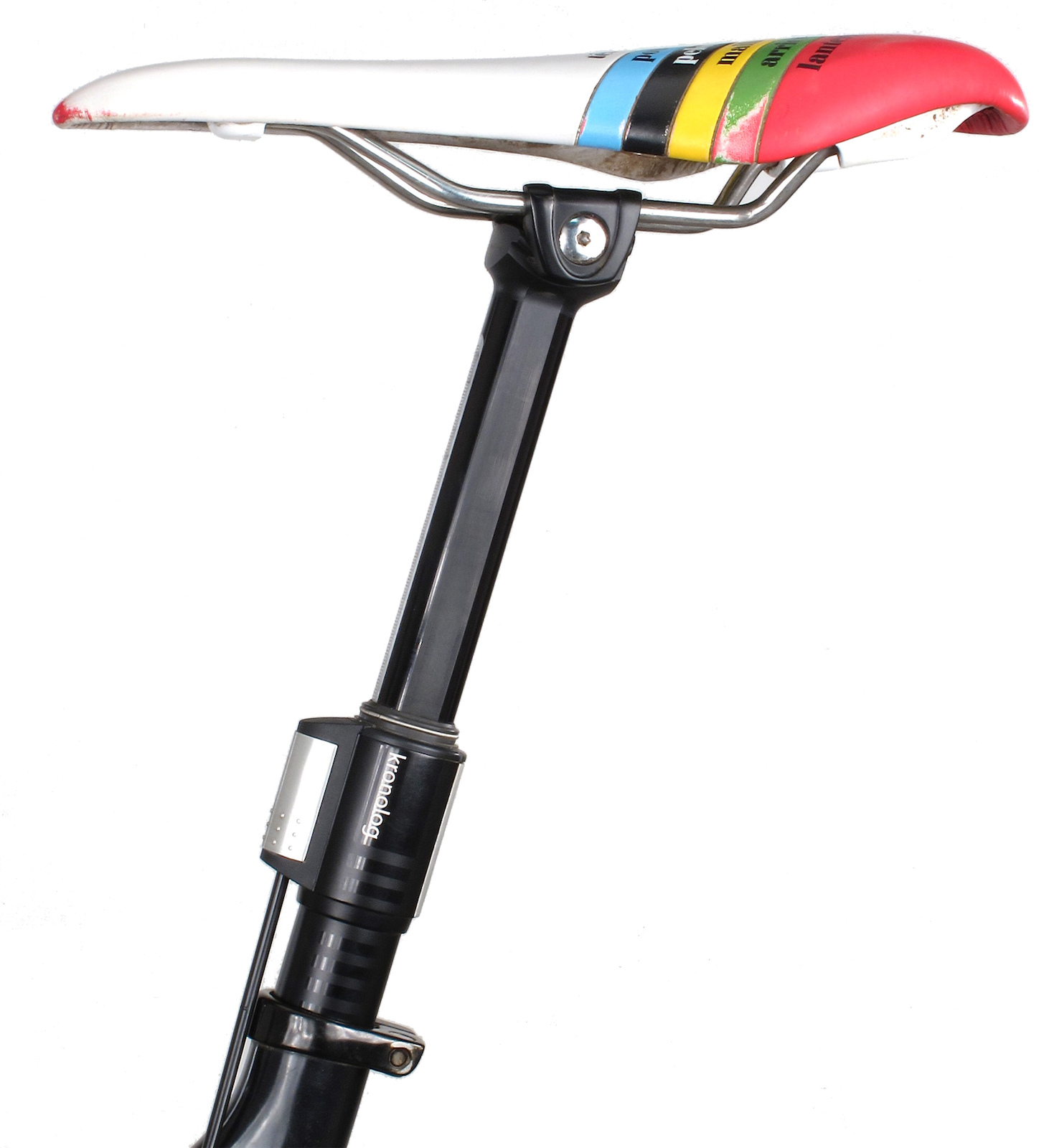 |
| The 125mm travel Kronolog employs proven technology that is very similar to what you'll find on the common bar clamp. Crankbrothers Kronolog details: - Adjustment range: 125mm/5in (can be lowered 20mm via an internal spacer) - Infinite height adjustment - Operated by a bar mounted remote w/ a standard shift cable (4mm brake housing recommended) - Diameters: 30.9mm, 31.6mm - Post length: 405mm - Weight: 465g/28g (30.9mm post/remote) - Warranty: 2 years w/ proper maintenance - MSRP: $300 USD |
The details
Locking Plates: A set of twin steel plates, each one encircling the post's upper tube, sit within the larger diameter portion of the post's lower tube. A spring positioned between the plates pushes them apart, forcing both the forward and rearward inner edges of plates into contact with the upper tube, which in turn holds it steady from rising or lowering. When the remote lever is pushed the cable pulls the plates together so that they are parallel with each other, allowing the upper tube to cycle freely. Release the remote lever and the spring between the plates force them apart at an angle into the upper tube's clamping surface. The system may sound complicated at first, but it is actually one of the simplest telescoping post designs out there, with possibly only the Gravity Dropper being more straightforward. Crankbrothers is quick to point out that the inspiration for the post's locking mechanism comes from the locking plate design found on bar clamps, a system that has been in use for countless years.
An air spring is employed to raise the saddle, with it being adjustable via a schrader valve at the bottom of the post. Air pressure is recommended to be set between 55 and 75psi, which will also effect the effort it takes to lower the post. Adding air will speed up the Kronolog's return speed, while lowering the pressure will slow it down.
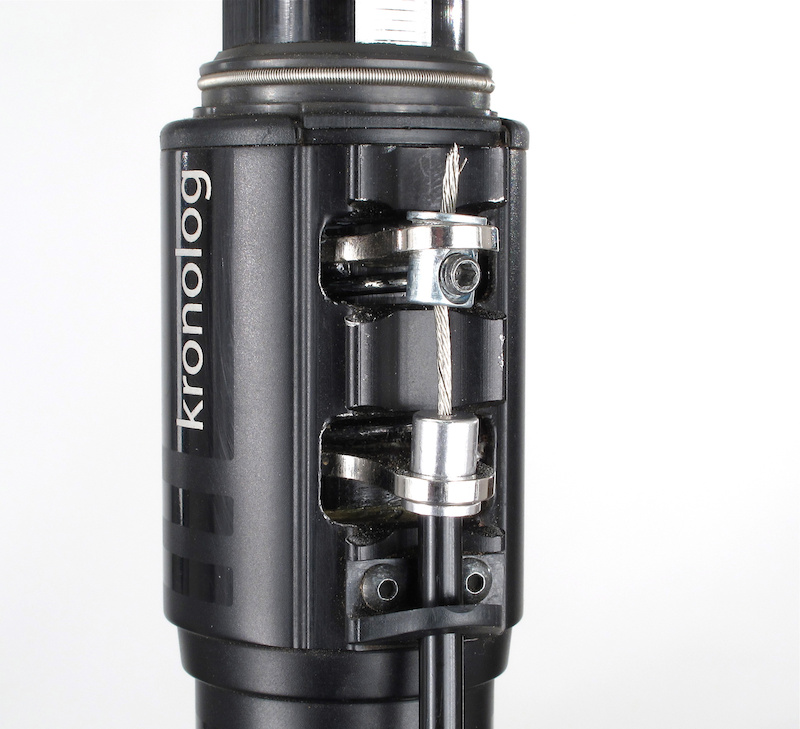
The housing stop is located in an insert at the lower plate, while the upper plate is home to the cable clamp insert. Pushing the remote pulls the plates parallel to each other, which lets the upper tube slide freely until cable tension is released and the plates return to an angled position, gripping the upper tube.
Stationary Cable: The Kronolog's clamping mechanism is tucked away inside the larger diameter section of the lower tube that, when the post is installed into your bike, sits just above the frame's seat post clamp. This brings us to what is likely the Kronolog's most attractive feature: the design means that the actuation cable is stationary - it does not move as the post goes through its travel - so that there will not be a surplus of cable loop that can rub on your leg or rear tire when the seat is in its lowered position. Riders who have had to use copious amounts of zip-ties to keep their dropper post cable in line will likely appreciate this, although the design also limits the Kronolog's insertion depth. The Kronolog measures 217mm/8.5'' from maximum insertion to the saddle rail clamp when at full height, compared to a Reverb's 195mm/7.6'' height. Riders with short legs take note, the Kronolog may not work for you.
The post is operated remotely (there is no post mounted lever option) via a hinged, bar mounted lever that can be fitted to the top or bottom of either side of the handlebar. The sturdy looking remote is home to the shift cable that operates the post, with a small spring fitted under the cable head in order to take up the 3 - 4mm of cable slack that the Kronolog requires to function properly. A barrel adjuster makes tuning cable tension easy, and the post comes from Crankbrothers pre-strung with 4mm brake housing that offers more flexibility than shift housing.
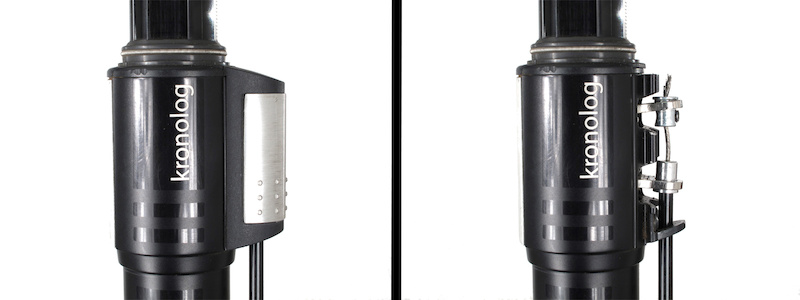
The actuation mechanism and cable anchor point are both found under a removable cover on the post's lower tube. The cover is slid up to gain access to the internals, and slid back down over top and clicked into place. The cable is pinched in place within an insert in the upper plate by way of a 2mm set screw.
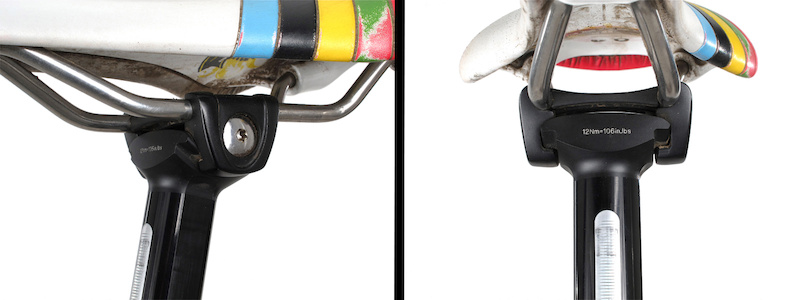
The upper tube and clamp head are both forged from the same piece of aluminum, eliminating the bonded joint between the two that is found on most other designs, and a juncture that can often be home to creaks and groans.
Performance
Setup: The Kronolog comes ready go out of the box with a cable and housing already installed, but we stripped it down in order to see how easy it was to setup the post up from scratch. Fitting a cable is relatively simple, and Crankbothers' illustrated instructions do a good job of explaining how to go about it. There is a small and very important spring, positioned under the cable's head that can be easily lost if you are not paying attention, that allows for 3 - 4mm of lever free play before cable tension is applied to the post's locking mechanism. This part of the setup is crucial for consistent action from the Kronolog - too much cable tension and the post will lower or raise on its own, so it is important to get it correct. A barrel adjuster on the remote lever makes this task easy, and the lever is also hinged for straightforward installation and removal. We installed ours on top of the bar at the left side, but it can be positioned on the top or bottom of either side.
The saddle clamp is a single bolt affair, although it appears to be offer quite a bit more support than what was employed on the older Joplin post. The torx head bolt is to be clamped at 106 in/lbs, and the female side to the clamping bolt is captured within the post's head to make fitting a saddle as easy as possible.
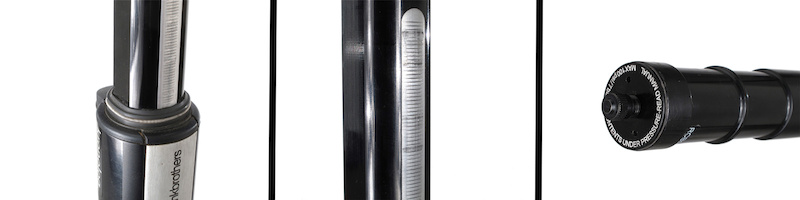
The dust seal conforms to the upper tube's oval shape (left) to keep grime out of the inner workings. Knurling has been added to the clamping surface of the upper tube (middle). An air valve that is located at the bottom of the post lets users adjust the pressure in order to tune rebound speed.
On The Trail: The Kronolog has close to zero play at the nose of the saddle, much less than what we've seen from other designs. This lack of movement is down to a few reasons: it's forged upper tube employs flat sides that mate with a bushing chosen specifically for each post, and the twin locking plates also grip firmly to help take out any wiggle. Having said that, we'll admit the even the worst offending posts in this regard don't have us noticing their excessive play when on the bike, but it is nice that the Kronolog is the tightest feeling of the many posts we've tested. The remote lever is also among the most ergonomic that we've used, with the thumb paddle in just the right spot in relation to its bar clamp. Its thin, hinged mounting band takes up very little real estate, letting you position it where it makes the most sense for you.
The Kronolog's most talked about feature has to be its stationary cable entry point located on its lower tube, meaning that the cable stays put as the post goes through its travel. This is in contrast to the majority of the competition who's actuation cable terminates at the post's head. The latter design often necessitates creative cable management with far too many zip-ties, and even then it is common to either have surplus cable hang out from the bike that rubs on your leg or rear tire when the saddle is lowered. No such complications with the Kronolog: size the cable to the correct length and forget about it. Some riders may not be fans of the bulbous 'growth' on the lower tube that houses the cable entry point and locking mechanism, but form follows function with the Kronolog.
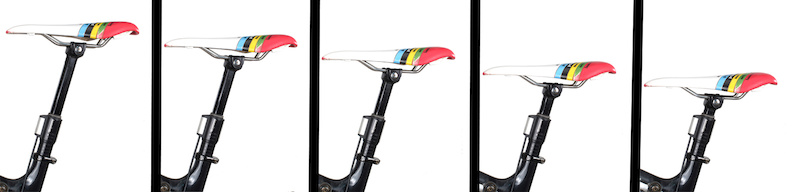
The locking plate mechanism allows the saddle height to be positioned anywhere between full height and fully dropped.
The post's action is reasonably smooth in a mechanical sort of way, even after many rides in nasty conditions and an equal amount of abusive cleanings with a power washer. Hit the lever and the saddle rises or lowers fluidly, although it does take slightly more force to lower than some of the competition. The ability to infinitely adjust the saddle height is beneficial on steep and technical climbs where a slightly lower center of gravity can lift your confidence. The same can be said on rolling or technical portions of flat trail, both scenarios where a slightly lower seat height can make a world of difference. Having also used telescoping posts that offer a set 'cruiser' position that is slightly lower than full height, we have to say that we do prefer the Kronolog's infinite adjustability that allows you to decide the height that works best for you. The twin locking plate design will also not allow the saddle to be pulled up when already lowered unless the remote is pushed, a plus if you ever have to lift your bike by its seat when out on the trail.
Required lever force isn't excessive, but you are fighting the spring between both locking plates, forcing them together to free the upper tube, and you can feel this in your thumb. Pushing the remote lever while weighting the saddle results in it dropping freely, unlike some of the mechanical designs out there that require you to unweight the saddle slightly to keep the mechanism from jamming. This, along with the very ergonomic remote, go a long way in making the post highly intuitive when in the heat of the moment on the trail.
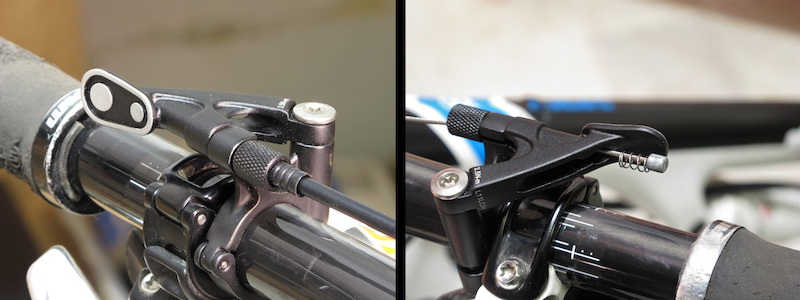
The remote is one area where many manufacturers seem to fall short in. Not so with the Kronolog. Its ergonomics are spot on. We also didn't manage to damage it, despite multiple bike-cartwheeling spills, and plenty of flat repairs that saw the bike upside down and resting on the remote.
Issues
There is a lot to like about the Kronolog post, but we still wouldn't call it trouble free. The design uses air pressure to raise the saddle, a system that is clearly going to be much lighter than a coil spring, but it isn't without issue. The post's return speed slows noticeably as it nears the top of its travel, a trait that Crankbrothers' boasts ''... allows the saddle to return to a normal riding position in two, smooth stages'' but, more often than not, it just left us wondering if it was actually at full extension. An audible noise, a simple 'klunk' when it tops out, would be welcomed to let the rider know that yes, the post is at its full height. The air spring had the same effect at the opposite end of the stroke, sometimes making it difficult to get it to fully lower in the heat of the moment, and even requiring a firm push with the bum to get that last bit of travel out of it. While accessing the final 10mm of the Kronolog's stroke might not seem like a big deal, its 125mm of travel should be easily available. The post's single bolt saddle clamp also rotated once under us, putting the saddle at a wonky angle and further enforcing our belief that all saddle clamps should use two opposing bolts.

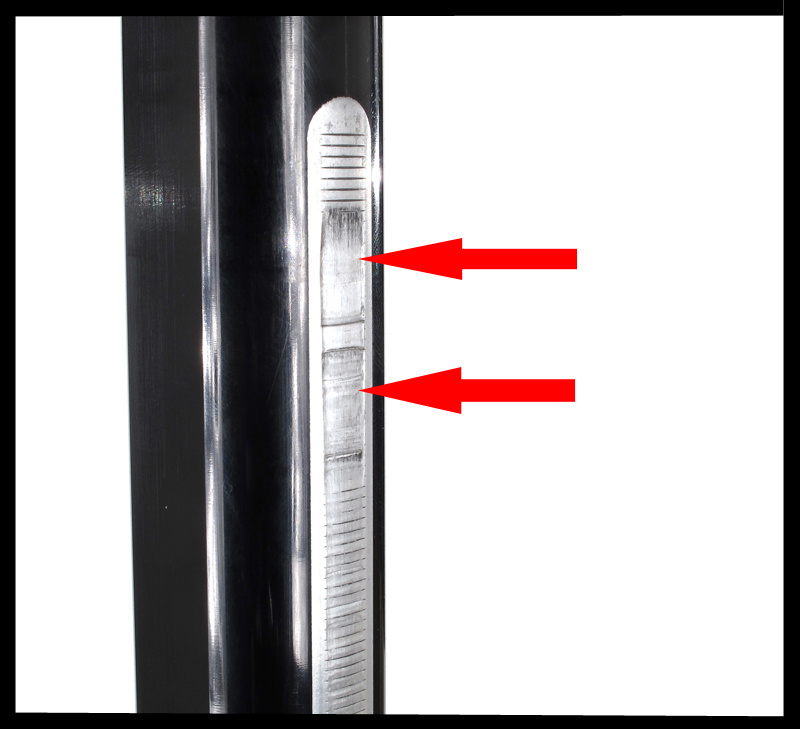
The bigger issue, though, involved the Kronolog's inability to hold the saddle at either full extension or fully lowered. The post's upper tube makes use of a knurled surface where the locking plates grip hold, and it took about a month's worth of riding time until this knurled aluminum clamping surface was worn smooth by the twin steel locking plates in the two locations where it was most commonly locked into position: fully extended and fully dropped. The profile of the upper tube was altered enough that the locking plates simply refuse to hold the post at full height when the saddle is weighted (letting it drop roughly half of one inch ), and it also will raise up slightly until the plates grip onto an undamaged section of upper tube when fully lowered. This slipping will even occur when the actuation cable is not attached to the locking mechanism, and it means that we actually have to raise the post slightly in the frame to compensate for when it lowers under our body weight. This compounds the issue of it popping up a half an inch when it should be in its fully lowered position on a downhill section of trail. The damage can be seen in the photo to the right.
Crankbrothers Responds:
We talked to Crankbrothers' Clark Brewster, the lead developer on the Kronolog project, regarding our concerns about their new telescoping post. Brewster was quick to point out that the Kronolog employs an O-ring atop the post's piston that acts as a top out bumper, and that removing it will result in the audible 'kunk' that would let us know that the saddle is at full height. The modification is quite simple, and the same job can be performed on the damper piston to allow the rebound speed to be increased as well. The bigger issue at hand, though, is the scoring we experienced on the post's upper tube. The grooves that have been machined into the post from the factory are, Brewster says, "purely cosmetic and they are there to hide the marks that naturally occur with use. Over time, the marks form a nice patina, but we found that without the cosmetic grooves, the marks don't look very good." Brewster continues, "The grooves however, are a good indicator of wear. If there are no grooves, it means that the diameter of the circular section has changed, and some sort of bad wear is occurring." This brings us to the premature wear inflicted to our Kronolog that, Brewster says, is down to an incorrect setup.
The Kronolog's relatively simple twin steel locking plates either must be fully open to allow the post's upper tube to cycle up and and down freely, or fully closed against the upper tube in order to hold it in place. It's when the rings are only partially activated that damage to the upper tube will occur, says Brewster. "Please note that during our ride testing, we have posts that have over 2000 hours of riding on them," he continues "and without the shaving or slipping that you experienced. Fundamentally, the system works and is robust. When the system is adjusted correctly (with the proper amount of lever play), and the parts are made correctly, then the post should operate extremely well." Brewster puts the blame for our post's damage on either faulty cable tension setup or a burr on the cable that prevented it from releasing properly, and also admits that 3 - 4mm of lever free play is ideal instead of their original number of 2 - 3mm.
Pinkbike's take:
 | There is a lot to like about Crankbrothers' Kronolog seat post; its stationary cable entry point, infinite adjustability, great remote, and sturdy saddle clamp all adding to its point tally in our minds. But it does, unfortunately, have a few foibles. More consistent compression and rebound speeds throughout its entire stroke, as well as an audible indicator as to when it is at full height, would make a huge difference in the performance of the post out of the box. But it's the damage to the upper tube that concerns us the most. The twin locking plate design has been proven in other forms for many years, but we have our reservations about its use on the Kronolog if its function is compromised by the cable being out of adjustment by only a millimeter or two, although we still stick to our guns about our installation being spot on. Ideally, we'd like to see Crankbrothers change the clamping surfaces on the upper tube to something sturdier before we give the Kronolog full marks, eliminating the chance of damaging the post.- Mike Levy |
www.crankbrothers.com
Author Info:

Must Read This Week
Sign Up for the Pinkbike Newsletter - All the Biggest, Most Interesting Stories in your Inbox
PB Newsletter Signup
I understand what he's saying, but like you said, it's just prone to have problems, because if I understand the issue correctly, in plain speak, the rider must unweight the saddle before depressing the bar mounted remote and then use your body weight to lower the post. with some practice this could happen pretty fluidly, but I imagine for the most part, people will not be doing this on the trail. you don't want to have to think about anything other than the trail your riding,
I think they're a great addition... Depends on your riding though, if you ride technical cross country trails with lots of undulating terrain then I think they're a great way of adding more fun and flow to your rides!
I've been so happy with my mission control post that I just picked up a 125mm Black light for the extra 1" of travel. If you're looking for a post, I highly recommend it. PM me if you are want a 100mm (4" travel) 30.9. $160 and includes a full rebuild kit ($30 value). It never needed servicing..
1. Way too pricey
2. Way too cluttered (bars & seatpost)
3. Way too many reliability issues
I'm just gonna stay stuck in the past untll somebody actually comes up with a sleek design that works. Specialized seem to be in front though !
yes, of course...
28.media.tumblr.com/tumblr_m2yh8qtntG1r0kgheo2_500.jpg
Funny thing about that seal; it seemed to actually do a good job of keeping grime out of the mechanism. I rode the post in a lot of bad weather in B.C., loads of riding in super dusty Utah and Arizona locations, and also jet washed the hell out the bike for cleaning, and the seal seemed to work just fine. I was surprised and pleased about that!
1.I try sit only on the way to the woods and to regenerate after standing pedalling efforts in technical terrain. at least until I'm getting really beat up by the trail.
2.Having the seat up you should be able to do 90% of what you can do with the dropper - you have skills taking you through certain obstacles or you don't have them and you cheat yourself with technology which sooner or later will take you down badly. Hint: look how high are the saddles of good DHillers - way higher than those of some dropper warriors...
The best fk up you can do to your knees and lower back is get some clipless pedals, stiff XC/road shoes and do lots of riding while not doing any lower back training. My sister in law is an accomplished roadie, her boyfriend rides Giro d'Italia now, I know injuries that they and their cycling friends go through. Standing pedalling on flat pedals is as close to walking and running as biking can make your body move - and we evolved to do move that way, not to sit on some tight thing and spin our legs in circles.
Some decent enduro bloke on Dirt TV said it well (maybe a bit exaggerated but still) on why isn't he using dropper post - if you can't pedal standing for 4 minutes or so, maybe you should rethink what you do and change the hobby...
Hence why in my shop, we have Cobalt and Iodine bars on the wall, but alongside Shimano pedals, Mavic wheels and RockShox seatposts
So dear customer if you buy their wheels - you've got balls!
2) The reviews are already coming in on MTBR and these things are suffering failure right out of the box.
3) CB is claiming here that it's 'user error'. Here's news CB, a design that isn't idiot proof is designed by idiots. Merely claiming you have posts that have been successful in testing highlights the quality control that you fail to comprehend. The fact that one unit is good is meaningless...it's HOW MANY UNITS FAIL! How can you still not comprehend this? For the love of God, would you brand and industrial design wannabes at CB please hire somebody who understand the first thing about quality control and design for manufacture!!!
4) CB will go belly up in less than 5 years, mark my words. Who in their right mind would buy anything knowing their track record on pedal, wheels, Joplin posts, the list goes on!
It must be the price point. A good dropper seat would cost 600 dollars and last 3 years, when you'd throw it out and go again, or send it off for a rebuild of the guts and replacement of the seals and seal surfaces. Instead you pay 300 bucks and get less than a year out of it. Economy!
Crank Brothers is trying to be Apple and get the aesthetics down only without making mechanical things work well. They certainly sell their wares because there are people who go for the industrial look of their products. Yet, every single person I know who have had their products hates them. They will eventually kill themselves with poor design.
I don't personally see the need for a dropper post but I wouldn't get this one.
Crank Brothers needs more focus on engineering. I don't really care about their oh-so-cool aesthetic emphasis, where how something is "packaged" is more important than its sound function or its durability. Planned obsolescence and intentionally cheap construction seem to be driving forces at Crank Bros.
Saying it is a set up error or a manufacturing error is just a way to try to talk your way out of admitting it is a poorly designed product. I love how simple it is, but if it doesn't last and is super sensitive to set up "errors" then something needs to be changed. I was excited about this post, but not anymore. Let's see how the KS Lev holds up.
I wish I had the means to develop my own concepts for bike parts....hopefully soon...
Hey Mike, when will you learn to setup bikes properly? :-)))
Great review, CB should focus on functionality and not only on design.
www.bikeradar.com/mtb/gear/category/components/seat-post-seat-pin/product/review-crank-brothers-kronolog-46205
I have a KSi900 and have had no probs with it in over 2 years.
Any chance on a longterm review on the new KS LEV?
Cheers
www.bikeradar.com/mtb/gear/category/components/seat-post-seat-pin/product/review-crank-brothers-kronolog-46205
sounds like crank bro's were a bit premature getting this one out.
Has anyone had a similar experience with CB?
The up-and-coming post I am most excited about is the KS Lev. That could be worth the wait (and the $$$).
I call BS. I seen the reviews on MTBR about the seat post not going back up. Also I actually met one person who had the ED problem in Fruita where the seat post will not go up. At least when RockShox had teething issues with the 11 Reverb; they actually admitted fault and repaired it right away. Great idea, poor execution on this product. I don't mind spending the money, but if I'm spending 300-400 on a product to have it sometime work is unacceptable.
As I understand it, a good portion of the wear is occurring where the post is being forced to move before / without the clamps fully disengaged. If you had an indexed point on the lever, you could ensure proper [full] disengagement before weighting / unweighting the post.
There's a bit of figuring out to indexing point, but you could have it indexed to lever throw independent of the barrel adjuster/ cable tension/ free play.
Just thinking out loud.
www.bikerumor.com/2012/05/10/review-crank-brothers-kronolog-dropper-post-weighed-dismantled-ridden
Mike's experience here is no aberration, it's the norm any sucker stupid enough to buy CB can expect.
Also there's lots of grease leaking onto the post
I'm requesting a refund for being sold a faulty product and looks like I'll have to spend the extra £110 (EEK!) on a KS LEV.
Also the instructions are poor - it's just diagrams without any textual explanations - a cheap but unacceptable way to accommodate multiple languages! There is an online video which apparently shows you how to install, but all it does is show you what it should be like once installed = pathetic!
BTW: Warranty says 2 years, provided it is serviced annually by Crank Brothers.
Having said all this I am very concerned about the wearing issue, I think CrankBrothers are trying to weasel out of a known design flaw there. This needs to be fixed before I will buy, but I will buy if it is fixed.
Now I don't know anymore, how can these guys screw up every new product launch, and keep on repeting it???
I think Iwill go for the reverb in the end...
GUTTED !!!!!!!!!!!
Clark Brewster and his team clearly don't know what they're doing.
The reverb is a POS own ine for long enough and it will fail on you. Google doesn't lie. The KS LEV is hands down the best dropperbout there. Im picking up a CB Kronolog tomorrow for $200 caah. Going to gamble in this one just to see if Mike knows what he's talking about. I also.own a KS Lev and. Reverb so don't hate.
Looks like a good point of entry for trail crud and water, right into the internals of the post.
I'll not be in a rush to buy one just yet.
brimages.bikeboardmedia.netdna-cdn.com/wp-content/uploads/2012/05/crank-brothers-kronolog-seatpost-review-internals10.jpg
cdn.mos.bikeradar.com/images/bikes-and-gear/components/seat-post-or-seat-pin/1336594035298-12ysuvut2ou6k-500-70.jpg
customerservice@crankbrothers.com>: host
CRANKBROTHERS.COM.S6A1.PSMTP.com[64.18.5.10] said: 550-5.1.1 The email
account that you tried to reach does not exist.
Think I'll wait for the Chainlove sale....
www.bikerumor.com/2012/05/10/review-crank-brothers-kronolog-dropper-post-weighed-dismantled-ridden
kssuspension.com/wp-content/uploads/2012/09/MBA-Review-of-KS-LEV.pdf
I couldn't care less whether this seat post is any good or not. I have a joplin that hasn't failed, and 2 KS posts that are still working. Proper setup and maintenance of all components is necessary. This review is biased. The manufacturer provided the post properly adjusted, Mike changed it and it failed. A proper review would be to get another post, keep it set in its recommended tolerances and see what happened. If it happened again, there is a design flaw. No one would say Shimano put out crap if Mike loosened the limit screws on his Saint derailleur and took out his rear wheel.
Maybe the seatpost is crap, but control for the reviewer messing with it first.
You are changing your story now, which was at minimum poorly written, and at worst covering your tracks. This makes you lose your credibility as a reviewer.
If your story was true, did you try to "slip the clutch" type use, which causes premature wear. When racing moto, I could burn out a clutch in one race or less, if used aggressively (costs $300.00 to replace) or a whole season if I didn't use it aggressively. I wouldn't say the product was junk because I like the performance of slipping the clutch.
Regardless of the response, you flat out dismissed the manufacturer as lying. That is biased. Did you verify there wasn't something wrong with the cable as the manufacturer suggested? Did you try a second post to vwerify the problem was not a fluke that would be fixed under warranty? If you duplicated the problem without slipping the mechanism on a second post, there is a problem.
As an experience design and manufacturing mechanical engineer it is clear that this design is terrible and will fail. I mentioned this in my post during the press release of this seatpost. Nobody with any good experience in materials and mechanical engineering would think this is a decent design. Crank Brothers must hire recent graduates and industrial designers to design their products because they look nice but just don't last. Why do you think they're rebuilding their pedals for free at the Sea Otter and giving out free bearing kits?
Regarding your comment "...you flat out dismissed the manufacturer as lying. That is biased" - I have to disagree, obviously. I simply backed up my words about the post being set up correctly, which it was. I replaced the cable and housing, correctly, and the issue was still occurring.
There is a good chance that I'll be on another Kronolog in the future and that you'll get to read about that one as well, but in the meantime there looks to be other reviews popping up online that corroborate my thoughts.
Mike, you are not expected to "test" warranties, but there are many situations when something is out of spec, and the replacement is trouble free. It appears CB is acknowledging the clamp may be out of spec and will warranty the posts affected (separate issue from my concern with the review.) The review presents opinion along with fact.