First Look: Scott Genius LT
FIRST LOOK
Scott Genius LT
WORDS & PHOTOS: Matt Wragg
Scott have always taken a different path to most other people for the long-travel version of their Genius trail bike, the Genius LT. Combining freeride-esque amounts of travel, trail bike geometry, lightweight construction and an obsession with the latest technology, they certainly have never been bikes that blend into the background. In the recent past, one of the most distinctive features were the pull-shocks that sat at the heart of the frames. Yet last year, Scott unveiled all-new Genius and Spark models that dropped the pull-shocks, the 26-inch wheel size, and returned to a more conventional suspension layout based around 29 and 27.5 inch wheels. That left the long-travel Genius LT sitting atop the range looking conspicuously old-school among its brethren, and left us wondering how long it would be until we saw a revised Genius LT. We didn't have to wait long.
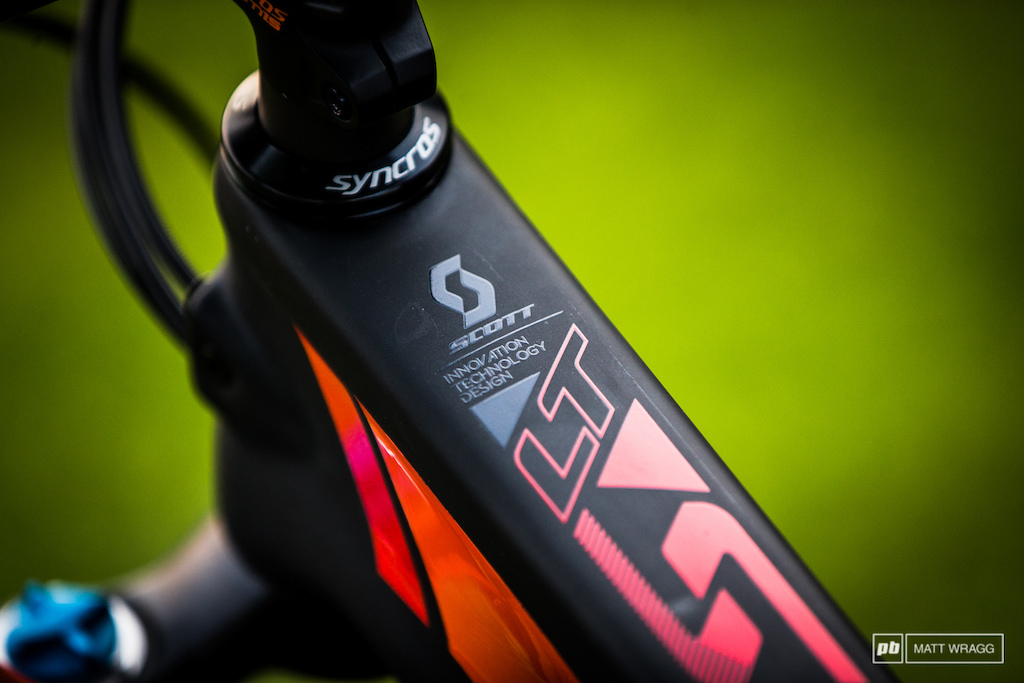 |
The new Genius LT debuted in Gstaad, Switzerland, where we were on hand to get up to speed on its technical aspects and for some first-ride impressions. Where previous incarnations visually screamed out "I'm different," the new frame is a far more subdued affair. Its chassis design has shifted from a complex feat of Swiss engineering to something altogether prettier. Gone is the boxy profile, and in are flowing, clean lines and a lovely matte black finish. While the trademark pull-shock may be gone, the recipe for the Genius LT hasn't changed. Sporting 170 millimeters of travel front and rear, a sensible 66.3-degree head angle, a total weight of 27.33 pounds (12.42kg), on-the-fly adjustable suspension, and an array of the latest innovations to reach mountain biking, the DNA of its predecessor is clear to see underneath its smooth lines
Details
• Intended use: All-mountain
• Revised suspension platform with dual-travel Fox Nude shock
• 170mm travel front/rear, rear reduces to 135mm in Traction Control mode
• 66.3 degree head angle (in open setting)
• SRAM X01 drivetrain
• 27.5" wheels
• Weight: 27.33lbs (12.42kg)
• MSRP (North American pricing TBD)
 | For an alloy tube frame, you can just cut it, weld it and paint it. It takes you six hours for one frame. For a Genius LT carbon mainframe, you have more than two hundred pieces. Each piece is laid by hand. It's about 24 hours from raw materials to a painted frame. - Benoit Grelier |
Construction
Scott are rightly proud of their expertise working with carbon, they have been making carbon bikes for longer than nearly anyone else out there. That experience shows when you start digging into the construction of the bike. Scott's openness about their construction gives great insight into why their carbon frames are so much more expensive than the aluminium equivalents. Generally, carbon monocoque construction, where the frame is laid up in a single, complex piece, is considered a premium way of building a frame, but Scott takes the concept further.
Two molds per frame size: Chief engineer for the Genius LT, Benoit Grelier, explains that "If you have a monocoque structure, you need two halves and you need an overlap of material to make a good join. Here, we do it with a core so we can save some weight." The core he talks about it is a rigid mandrel structure molded to duplicate the shape of the finished part. The mandrel is used to accurately position up the layers of carbon fiber. During the curing process, the heat and internal pressure softens the mandrel and it can be removed easily from the finished frame. While that sounds fairly straight forward, to make that core requires a second mold. Benoit puts the price of the mainframe mold sets at $100,000. Most carbon frame construction techniques require a single mold.
Perfecting the design: Once you have your molds it isn't just a case of popping some material in there and out comes a frame either. As Benoit explains: "For an alloy tube frame, you can just cut it, weld it and paint it. It takes six hours of effective work from raw round tubes to the final painted frame. For a Genius LT carbon mainframe, you have more than two hundred pieces. Each piece is laid by hand. It's about 24 hours from raw materials to a painted bike. Engineering-wise, it means we need different pieces for each frame size. With an alloy tube set, you can simply cut it longer. In total, for the two versions of the carbon Genius LT we need about 1,200 unique pieces to make the range of bikes- roughly 200 per front triangle, roughly 100 for the chainstays and roughly 100 for the seatstays. This adds up to roughly 400 pieces per frame set, of which there are three." These 1,200 pieces of pre-cut unidirectional fibers are selected and numbered so the workers can align the fibers with the stress that the frame will experience in each particular area of the structure. By doing this, Scott can be very precise about the weight and strength of the frame as they know how much each piece weighs and stiffness it adds.
Translating technology to mass production: There is one final element to the construction that needs to be kept in mind as well - the frame needs to be mass-produced. As Benoit states, "When our engineers go [to our production line in China] they do the forming of the prototype themselves, so they realize the amount of work behind it, to understand what the guys will have to do in production. I could make it a lot lighter if you asked me to make it with one piece, I would do it very carefully here in Switzerland, that is no problem. The challenge is to put it into production." What all of this expertise results in is a 170-millimeter-travel frame with a weight of 5.4 pounds (2455 grams), including the shock and hardware for the top-end, full-carbon HMX version of the bike. To put that further into context; the HMF version of the frame, with an alloy rear end is 320 grams heavier, and the full-aluminium version is 430 grams heavier still.

Suspension
Dual-travel shock: At the heart of the frame is the unique Nude shock, which Scott have partnered with Fox to produce. While they may have dropped the pull-shock design, what Benoit calls the "heart of the suspension" from the old system is in fact the twin air chamber technology which is something Scott have patented and brought over into this all-new shock. From the outside, it may look a lot like a standard Fox Float CTD shock and indeed, the lower portion of the shock is the same, which means most of it can be serviced with standard parts. However, there is a lot going on in the head - inside is a second air chamber. When the bike is in the fully open, "Descend" setting, both chambers are in use. When you use the bar-mounted Twinloc remote to shift into the middle
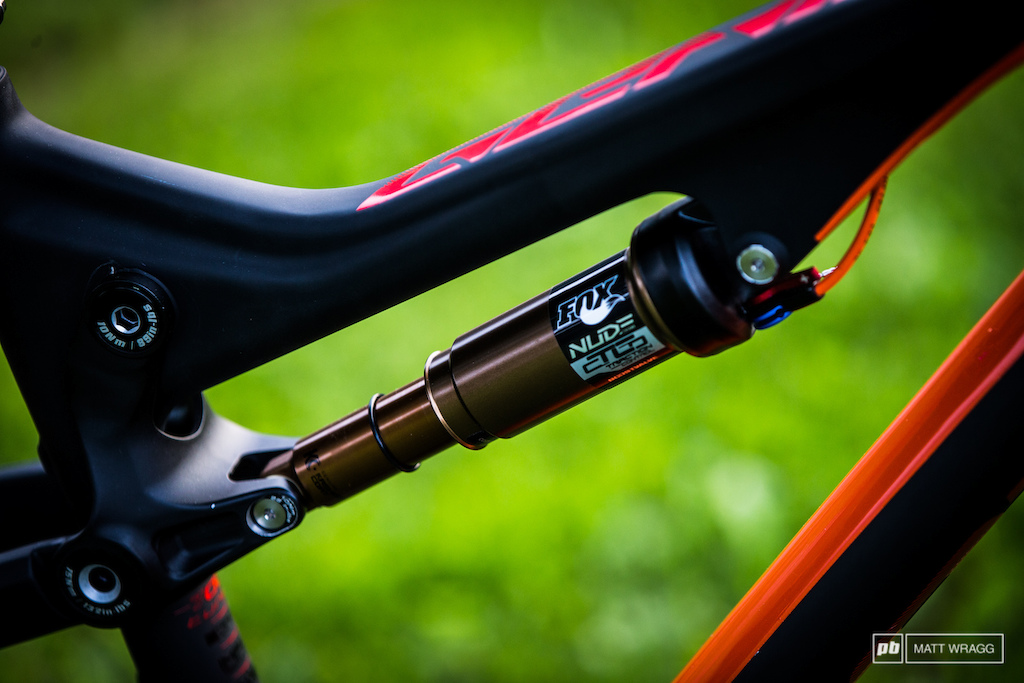 |
 The Fox Nude shock which Scott describe as the "heart of the suspension," it may look fairly normal, but inside, the shock replicates the dual-travel feature of the more complicated three-tube pull shock of the 2012 Genius LT. The Fox Nude shock which Scott describe as the "heart of the suspension," it may look fairly normal, but inside, the shock replicates the dual-travel feature of the more complicated three-tube pull shock of the 2012 Genius LT. |
"Traction Control" mode, it closes off the second air chamber in the head, reducing the overall air volume in the shock, dropping the travel to a manageable 135mm and making the shock sit higher in its travel to improve your climbing position. Traction Control replaces the middle "Trail" function of the Fox CTD system. The Nude shock's "Climb" position, however, adds the stiff low-speed compression of Fox's CTD "Climb" option to the reduced travel mode of the Nude Shock.
Simultaneous action: The bar-mounted Twinloc remote lever operates both the fork and shock at the same time, so it switches the fork between Fox's three CTD options while it selects three matching options at the shock. Existing Genius owners may be disappointed to know that the new Fox shocks are not backwards compatible, as the clearance on the frame is slightly different.
 |
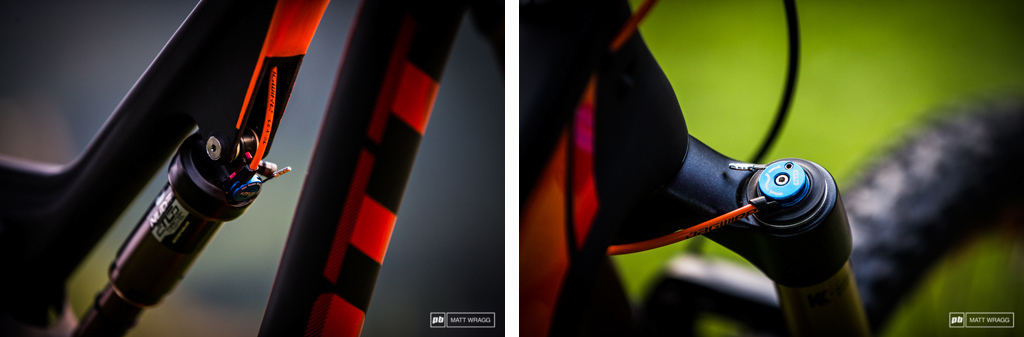 |
| The Twinloc remote sits on the left-hand side of the bar and you can see two cables leaving it - one for the fork and one for the shock. The orange linings of the cables are a particularly nice touch. |
The theory behind the system is that with what Benoit describes as the "in-between mode", riders can manage the climbs efficiently with the "Traction Control" setting and then open the susupension to add full travel to enjoy the descent. It is also worth noting that, by switching from the pull-shock to the Fox Nude CTD unit, they saved around 200 grams.
Extended-travel fork: Out front is a custom Fox Float 34 CTD fork. What makes it unique is that its stroke has been extended out to 170mm. Talking to Fox's Chris Trojer, he is confident about taking the 34 from 160 to 170 millimeters. He says simply, "It works. Scott asked us specifically for a 170mm 34 and we have tested the fork extensively and it works." Other than the extended travel and a longer CTD damping cartridge, it is a completely standard 34 chassis. As we noted above, it is controlled by the same remote as the rear shock so the three suspension options on the bike work in unison.
The Build
Grabbing the headlines for the rest of the build is inevitably the wheel-size. With the new Genius, Scott have chosen to upsize the LT to 27.5 -inch wheels. They have been one of the biggest supporters of the new size from the outset, being the first company to win a World Cup on them (Nino Schuerter at Pietermaritzburg last year) and one of the first to have DH factory riders racing World Cups on them, so it should surprise few people. Previously the Genius LT sported 185 millimeters of travel, but with the larger wheels, they felt that with the added roll-over ability, they could reduce the suspension to 170mm.
 |
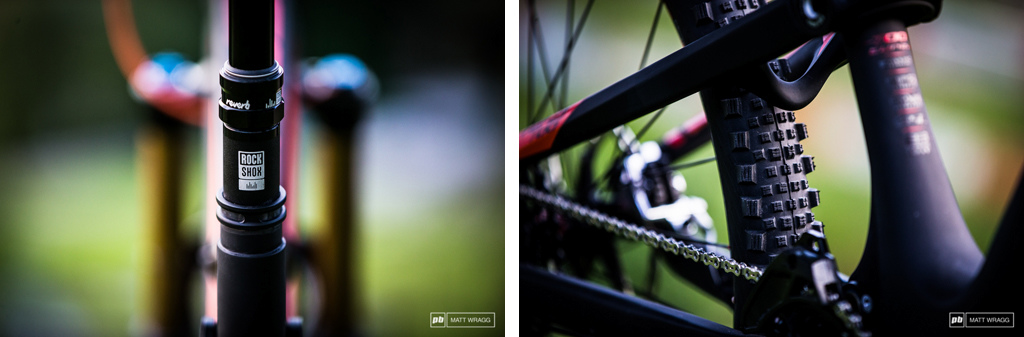 |
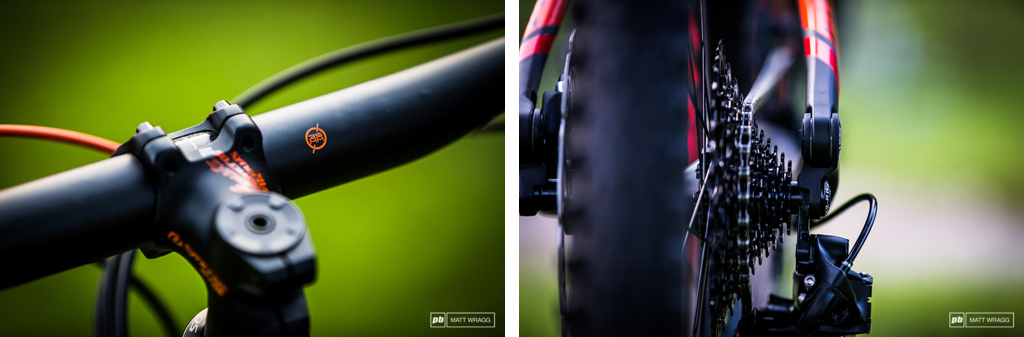
| (Clockwise) Oversize, 35-millimeter handlebars aren't a standard we have seen picked up too widely yet, but as ever, Scott are keen to be one of the first adopters; SRAMs X01, one-by-eleven drivetrain provides the running gear for the bike; Spec'ing Schwalbe's newly released Rock Razor rear tire is another good call - the low center-tread profile means it rolls fast, but it has a big, sturdy side tread for the corners; They may be a common sight now, but internally routed dropper seatposts, like the Rockshox Reverb, are a big improvement, as they keep the delicate hydraulic connections inside the frame. |
Looking up and down the length of the bike, Scott's interest in new technologies is evident once again. The Rockshox Reverb seatpost uses the internal "Stealth" routing, which, while it may be becoming more common now, Scott were one of the first companies to adopt. The drivetrain is supplied from SRAM's forthcoming X01 range with all the trickle-down technology from their flagship XX1 group, including 11 gears, chainring chain retention technology and the re-designed rear derailleur. At the front of the bike, Scott's in-house part company, Syncros, supplies the 35-millimeter-diameter handlebar. Scott claims they can reduce the weight of the 740-millimeter-wide bar without compromising strength. Fittingly, the Rock Razor tires are from Schwalbe using their innovative Super Gravity casing, which is pushing on what is possible in terms of strength and weight for trail bike tires. For the wheels, Syncros have partnered with DT Swiss and you can see some of DT's newest technology coming through, for example their new nipple and washer technology, and the new Spline One hub design.
 |
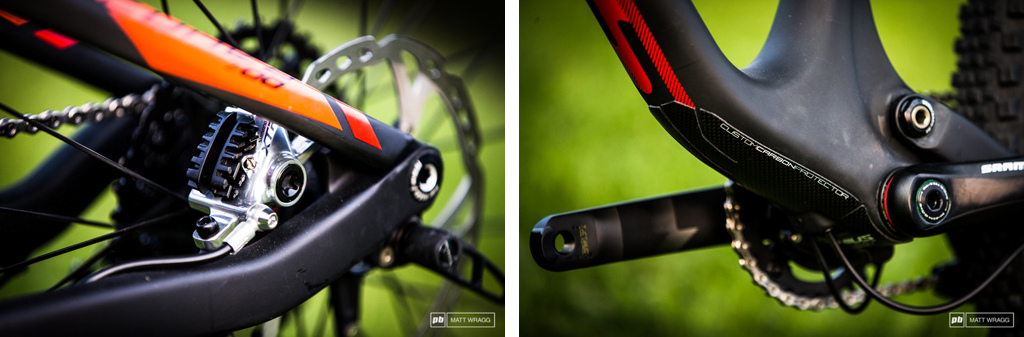 |
| (Clockwise) The entry point for the internal cable routing is one of the tidiest we have seen anywhere; The same goes for the exit just above the bottom bracket, the carbon you can see around it is the protector plate; Another angle on the frame protector, it's not bulky, but is enough to look after the carbon underneath; The rear brake nestles neatly in between the stays. |
Where the kit is less innovative, there is still a great attention to detail. Shimano's XTR trail brakes are regarded by many as the best brakes on the market right now and they are a welcome addition to any spec. We especially like how clean the rear brake mount is, tucked in above the seatstay. At the base of the shock, is a simple chip that can be reversed to offer lower and higher bottom-bracket settings, offering six millimeters of bottom bracket drop and 0.5 degrees of head angle adjustment. Hanging below the drive-side chainstay is a simple plastic chainguide that is well-proven to help manage a chain more effectively. In fact, with the guide mated to the X01 chainring and e-thirteen XCX chainguide, we'd almost say there's too much chain retention on the bike. Beneath the bottom bracket, the down tube has a simple, carbon fiber guard to protect the frame from rock strikes.
First impressions:
 | We had little time to get a proper feel for the new Genius LT. This was amplified by the fact that Gstaad is still at a fairly early stage of their impressive trail building program. While we never felt we had the chance to experience the bike in the environment it was designed for, the first aspect of the new LT that struck us was how easy it was to just get on and ride - the cockpit feels comfortable, the linkage undemanding and even through our first tentative descents with the bike, we felt at ease. This is always a good place to start, because once you feel settled with a bike you can start to push on and see how far you can take it. Secondly, we were surprised how often we found ourselves reaching for the Traction Control mode on the shock when there was pedaling to do. The adjusted pedaling position and shock settings do make a real difference, They make the bike lively going up the hill, living up to Benoit's claim that their system means people can live with longer-travel bikes far more easily. We look forward to a complete review of the 2014 Genius LT, put to task in a true all-mountain environment. - Matt Wragg |

Author Info:

 Sospel, France
Must Read This Week

if the ali version is cheaper and i was in the market don't get me wrong i would take ali, but if the same or comparable price i go carbon now without a doubt, so long as it's a good manaufacturer.
I do agree that your argument stand with the fork though, but thats not made by Scott.
Ransom worked much better than the LT overall, but it had its own pile of problems (again mostly in the shock).
You couldn't do that with the last LT because Scott 'downgraded' it to a pull shock.
This new one should be much better because it has much more modern sizing and geometry.
Those 'all day traverses' in The Alps involve al shit load of downhill… a short steep bike is severely compromised there.
"With an alloy tube set, you can simply cut it longer."
Feels like that guy never made an aluminium frame. Hydroforming has been used by Scott i think no?
Let's finish on a positive note: they stopped using those stupid shocks!!
www.pinkbike.com/news/Scott-Advert-Gives-a-Detailed-View-of-the-Carbon-Fiber-Manufactu.html
And watch the vid
carbonexperts.scott-sports.com/videos/carbon.mp4
Wait a secondd...He actually didn't call Brendog?! -_-
The new Genius LT is SO DAMN HOT! I want this more then the Gambler. If I sold all of my camera gear I could get this bike as I'm sure this bike will be $8k-$9k easily. T-T
- no proprietary parts
- no brands that are so big that they might design/spec based on marketing to large audiences
The former are most of the time a result of the latter and innovations proven in the field become generally adopted with or without marketing.
The latter inevitably involve uninformed buyers who can be swayed by unique selling propositions for their lack of experience. New usps are supposed to be proven by inhouse r&d but the superior capacities of large companies are subordinate to company policies tailored to maximise revenue to support the large organisational overhead of the large company and the results might never get public, thus negating that advantage.
Bottom line trusting the large companies because they have large r&d departments is a bogus argument. It would be more in the interest of riding experience to educate/demystify the uninformed buyer and go with open, accepted standards.
Based on this i have to doubt brands like Scott, Spesh or even Fox unless proven over the years and favour underdogs who might need to deliver performance in order to emerge or smaller companies for whom marketing does still play a marginal role.
Spoken purely from a ride experience point of view.
My 120mm steel HT weighs 28lbs. Incredible that they can get 170mm travel below that.
If you took off the additional cluster **** you would save even more weight.
I would be over bike on everything if I bought this but why not if it weighs less!
Seriously though, I have a stumpy and I've always loved it. This, however, is a dope bike. One that is more than worthy to replace my old stumpy
At $2 and hour for labor in china that's not a big deal.
And unlike specialized no proprietary mounting system, so what is keeping you from mounting a differ shock if you want?
End of the day: Good looking bike, lots of thought gone into the design/development, probably the wheel size that will be dominant on new bikes in a two or three years time. Like it - a lot!
I would love a ride on this bike to test my theory, anyone at Scott listening?
I'm pretty sure there's one out showing the opposite in tests. I'll try to find it.
20mm is stiffer, 15mm is incrementally stiffer than QR. No way around it.
put it into some track testing!!!