Riding Trek's Session 9.9 in Whistler - First Impressions
What better place to debut two new bikes than Whistler, B.C.? Especially if those bikes happen to be Trek's new carbon framed Session 9.9 downhill race rig and the 160mm travel do-it-all Slash. The area's lift serviced terrain is second to none, offering up everything from high speed bermed runs to the most technical of technical singletrack, making it the premier zone to test a downhill bike. But that's not all, just outside the park you'll find all-mountain trails that are filled with sections where'd you'd like to be on a DH rig, only to be followed by steep climbs that will test even the fittest rider's legs. In other words, Trek wanted us to spend our two days in Whistler pushing the new bikes hard. To that end they brought Aaron Gwin, Ross Schenll, Rene Wildhaber and Andrew Shandro for us to try and keep up with, all of whom were on hand to also show us just what the new bikes are capable of.
Trek Session 9.9 and Slash Launch in Whistler, B.C.
Session 9.9 Downhill Race Bike
Trek hasn't been shy about wanting to create the most capable off the shelf race bike available and to do that it needed to come stock with first-class suspension. As such, the production 9.9 sports Trek-developed proprietary Fox suspension, including a radical Fox Hybrid Air fork that uses an air-assist spring that you'll find only on the 9.9, and a custom shock tune that is currently used by the TWR team. Both get the full Kashima treatment as well. If you purchase the 9.9 as your race bike you now officially have no equipement excuses.
• Intended use: Downhill racing
• All new carbon frame
• Carbon EVO Link and seat stays
• 210mm of rear wheel travel (up 10mm from last year)
• Tapered E2 1-1/8'' - 1.5'' head tube
• Frame is approx. 800 grams lighter than the TWR team's aluminum version
• ISCG-05 chain guide tabs
• 12 x 157 ABP DH rear axle spacing (slotted 150mm rear end for easier wheel alignment, can also accept standard 150mm wheels)
• Internal or external cable routing for both brake and derailleur
• Custom Fox RC4 shock with TWR tune
• Adjustable geometry allows head angle range from 62.5 to 65.4 degrees
• Revised suspension rate for better square bump performance
• Frame weight: 7.2lbs (w/ Fox DHX RC4 shock with a steel spring)
Chairlift Gwinterview by Mike Levy
Trek's new 160mm travel Slash
Photography by Sterling Lorence
www.trekbikes.com
Stay tuned for a full review of the Session 9.9

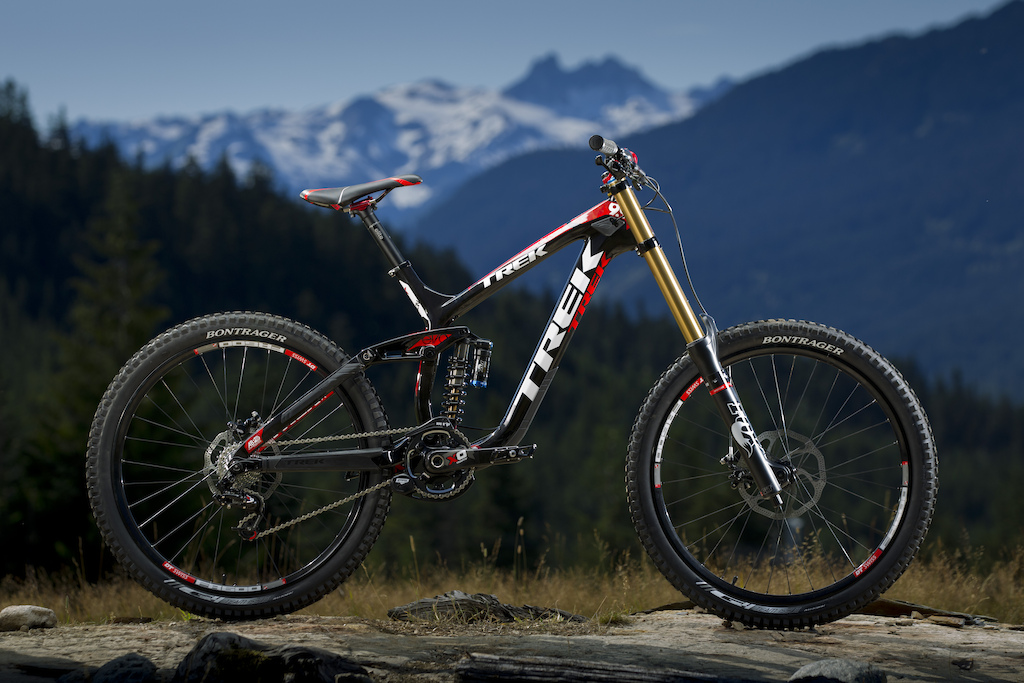 |
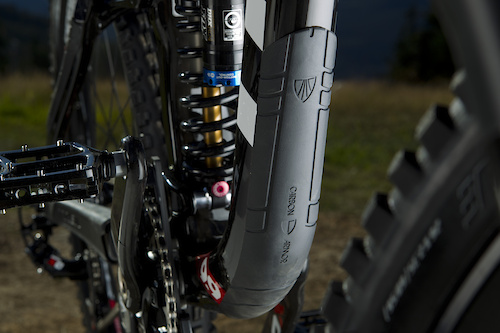
 There is no point making you wait, this is what you're here to see. Pinkbike had the first and most in depth look at the new carbon fiber Session 9.9 back in July, but our vist to Whistler would be our inaugural ride on the much anticipated machine. To say that I was giddy about throwing a leg over this bike would be an understatement. The frame is entirely new for 2012, with the front triangle, seat stays and EVO Link all being made from carbon fiber. Total weight for the production bike pictured above is just 35lbs, making it the lightest production downhill bike available, and that's completely stock and without any component trickery that would prevent the bike from being a daily ride in the Whistler Bike Park. The frame alone weighs a meager 7.2lbs, including the stock Fox DHX RC4 shock and its steel spring. There is no point making you wait, this is what you're here to see. Pinkbike had the first and most in depth look at the new carbon fiber Session 9.9 back in July, but our vist to Whistler would be our inaugural ride on the much anticipated machine. To say that I was giddy about throwing a leg over this bike would be an understatement. The frame is entirely new for 2012, with the front triangle, seat stays and EVO Link all being made from carbon fiber. Total weight for the production bike pictured above is just 35lbs, making it the lightest production downhill bike available, and that's completely stock and without any component trickery that would prevent the bike from being a daily ride in the Whistler Bike Park. The frame alone weighs a meager 7.2lbs, including the stock Fox DHX RC4 shock and its steel spring. |
Trek hasn't been shy about wanting to create the most capable off the shelf race bike available and to do that it needed to come stock with first-class suspension. As such, the production 9.9 sports Trek-developed proprietary Fox suspension, including a radical Fox Hybrid Air fork that uses an air-assist spring that you'll find only on the 9.9, and a custom shock tune that is currently used by the TWR team. Both get the full Kashima treatment as well. If you purchase the 9.9 as your race bike you now officially have no equipement excuses.
SESSION 9.9 FRAME DETAILS:
• Intended use: Downhill racing
• All new carbon frame
• Carbon EVO Link and seat stays
• 210mm of rear wheel travel (up 10mm from last year)
• Tapered E2 1-1/8'' - 1.5'' head tube
• Frame is approx. 800 grams lighter than the TWR team's aluminum version
• ISCG-05 chain guide tabs
• 12 x 157 ABP DH rear axle spacing (slotted 150mm rear end for easier wheel alignment, can also accept standard 150mm wheels)
• Internal or external cable routing for both brake and derailleur
• Custom Fox RC4 shock with TWR tune
• Adjustable geometry allows head angle range from 62.5 to 65.4 degrees
• Revised suspension rate for better square bump performance
• Frame weight: 7.2lbs (w/ Fox DHX RC4 shock with a steel spring)
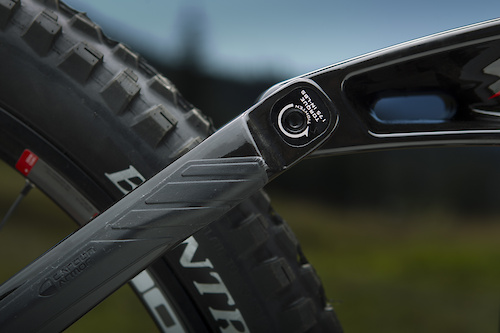
The bike's low weight and suspension is only part of the story, with its adjustability also playing a big role in its performance. Between the Session's Mino Link system (rotatable chips used to attach the seat stays to the EVO Link, pictured to the right ), the Cane Creek AngleSet headset that comes stock, and 12mm of adjustability in the Fox fork’s axle-to-crown length, the new Session has over 28 geometry settings. This unique combination of adjustability provides 1/3 of a degree adjustments at the head tube, and bottom bracket adjustments down to the mm. Excessive? Certainly not, considering the bike's intentions as a top tier race machine. It should also be stressed that although using a combination of the Mino Link and AngleSet allows you to select a head angle between 62.5 to 65.4 degrees, the Mino Link's prime intention is to tune the suspension by varying the leverage ratio to either devour square edge impacts or to pop, enabling the rider to clear rough sections with ease. The AngleSet and axle-to-crown length compensate for the geometry changes made by altering the Mino Link.
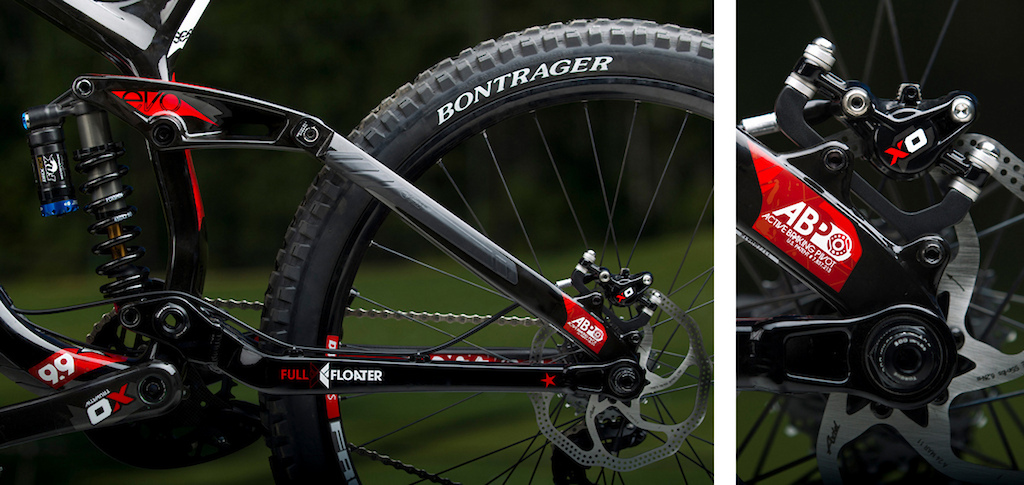 |
| While the layout may look the same as previous years, closer examination reveals slight changes to the pivot locations that have been made, enhancing the bike's ability to handle those square momentum killing impacts. The main swingarm pivot is still in the same location relative to the bottom bracket, but both the EVO Link rocker's shock pivot and seat-stay pivot locations have been changed slightly. Trek has also altered the length of the swingarm's 'Full Floater' extension at the lower shock mount. Why? Trek is adamant that the suspension's leverage rate plays a much larger role in allowing the bike to carry momentum over rough ground. The new design features a slightly flatter rate through the middle of the stroke - where the bike spends a lot of its time - which allows the rear wheel to react quicker to abrupt impacts that try to suck your speed away. In simple terms: the rear wheel can move out of the way faster if the suspension uses a flatter leverage rate, and the faster the rear wheel can move out of the way, the more momentum the bike will carry. That flatter rate also adds an extra 10 mm of rear-wheel travel, upping the total amount to 210 mm. Of course the 9.9 employs Trek's ABP system (right) that allows the dropout pivot to rotate concentrically around the rear axle, limiting the amount of rotation between the caliper and rotor, making for more active suspension under braking, but the design is also interchangeable to accept both common 12 x 150mm hubs and the new 12 x 157mm size. |
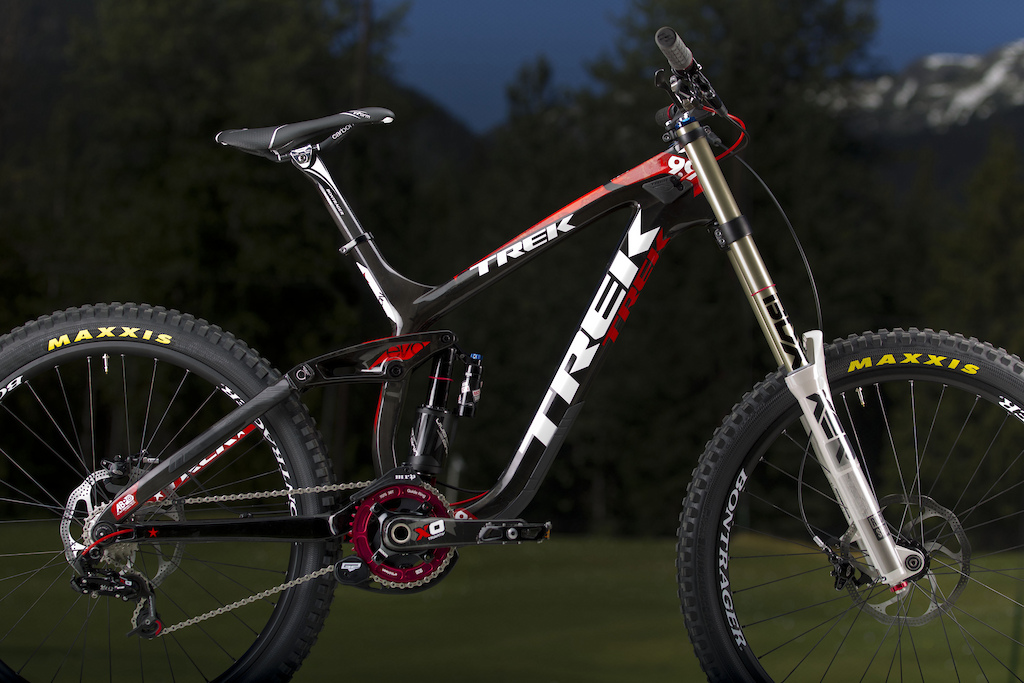 |
| Trek's Project Flyweight Session 9.9 weighs in at just 28lb 13oz and is built with real world components that any rider can purchase. The Session 9.9 frame weighs a scant 7.2lbs, including it's Fox DHX RC4 shock with a steel spring, making it quite easy to build up a featherweight downhill bike that will blow minds. Trek wanted to demonstrate just how light the 9.9 could be built up without resorting to exotic one-off parts that aren't available to most consumers. Providing that they wanted to spend the money, any rider could put this package together and have a completely rideable bike that is ready for action. In fact, this very sub-29lb Session spent multiple days hammering out laps in the Whistler Bike Park with zero issues. Suspension is an all air affair, with a RockShox Vivid R2C and BoXXer World Cup utilized, and component highlights include SRAM's new XO DH group and a massive 820mm wide (32.28'') Bontrager Rhythm Pro Carbon handlebar. While there have certainly been some concessions for weight, including the Maxxis Minion tires with their mid weight EXO sidewalls and a lightweight Bontrager wheelset, clever riders will be able to spot opportunities to shave even more grams while keeping the bike completely rideable. The Project Flyweight Session 9.9 is impressive, but it begs the question of just how light is too light? There will never be a consensus to that question, but it must be agreed upon that having a frame so light, especially one that performs as well as the Session 9.9, allows riders the option of running heavier components that may make more sense for their conditions, without ending up with a tank of a bike. |
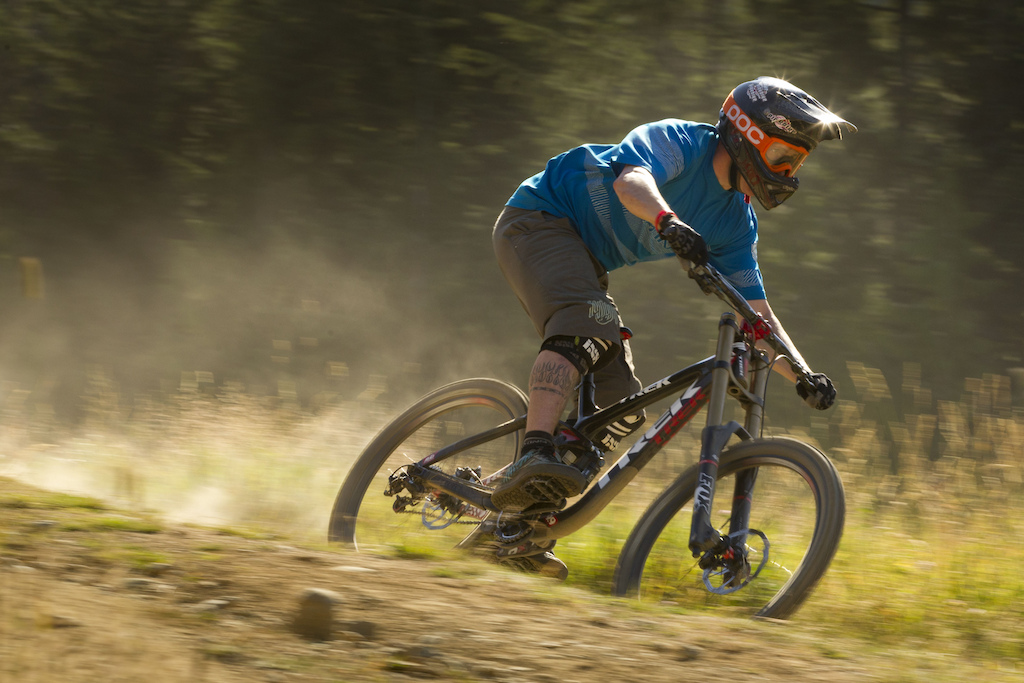 |
| I rode the Session 9.9 on trails that I'm intimately familiar with, having spent the last decade riding the Whistler Bike Park. This gave me a unique perspective of the bike and allowed me to compare it to the massive number of downhill bikes that I've had at the mountain. What did I think of it? Pinkbike left Whistler with our very own Session 9.9 test bike, meaning that you'll have to wait for the full review to learn what I really make of it, but I will say that it is incredibly easy to ride fast. While it can take time to bond with some machines, it was kismet the first time that I let off the bike's XO DH brakes. I've now had plenty more time on my home trails aboard our test bike, giving me the chance to spend some time with the suspension and angle adjustments - stay tuned for a review in the near future. |
(Password protected)
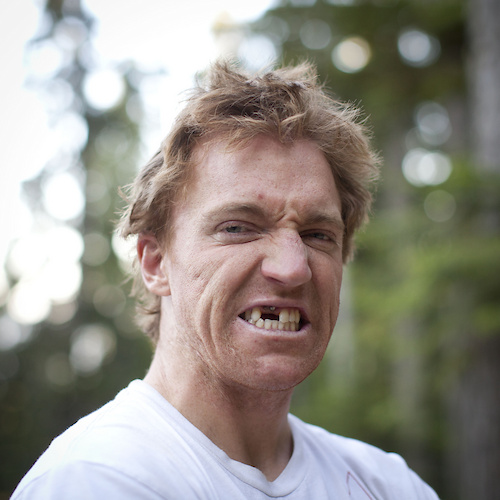
Sometimes it's the smallest of things that catch up with you, even when you are the best of the best. Gwin lost his front teeth thanks to a small wheelie drop gone wrong, but his new chompers are such an exact match that you'd never know unless he took them out. Anyone who has spent time with him would likely agree that he is probably one of the nicest guys on the circuit, but he looks the part of a bruiser with his teeth removed. Maybe he takes them out before each race run to intimidate the Euros? Whatever he is doing, it's working. He finished the season with five World Cup wins, the most by a male racer, and an incredible feat considering that he broke onto the World Cup scene a few seasons ago after riding downhill bikes for roughly eight months. Watch the video interview above to hear is opinion on tracks, the World Champs and what he thinks about racing.
 | At the end of the day it's just bike racing. So whether you're first or tenth, it really doesn't matter at all. It's just trying to keep a level head and have fun riding bikes. You know, we're super lucky to be able to do this for a living... - Aaron Gwin |
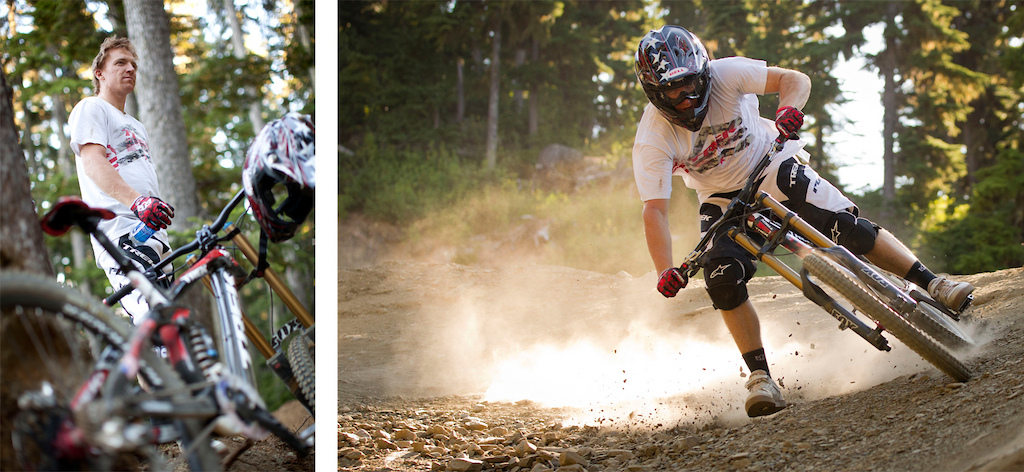 |
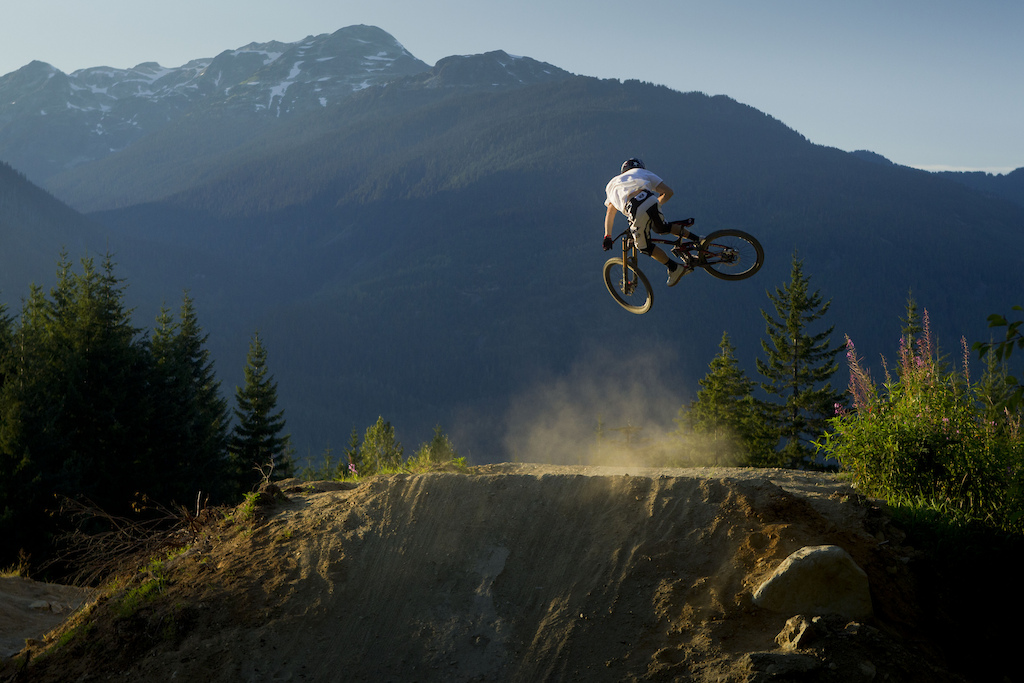 |
| It is a fact that jumps simply don't get any better than those found on the reworked Crab Apple Hits line. These bad boys are what mountain bike jumps should be: large and in charge, and with lips that send you into orbit without being steep enough to require one of those 20'' wheeled kids bikes. Gwin was clearly comfortable making the most out of the terrain that has been shaped to perfection by the Whistler Bike Park trail crew. The Session 9.9 was as quiet as could be through here, but I think all of those watching the show were making dirt bike sounds in their head as he passed. Aaron looked so relaxed on these jumps that he made other riders, those who would be considered advanced by anyone's standards, look tentative and as stiff as a board in the air. Watching him would have you believe that flying sideways through the air on a forty foot jump is as simple as could be. |
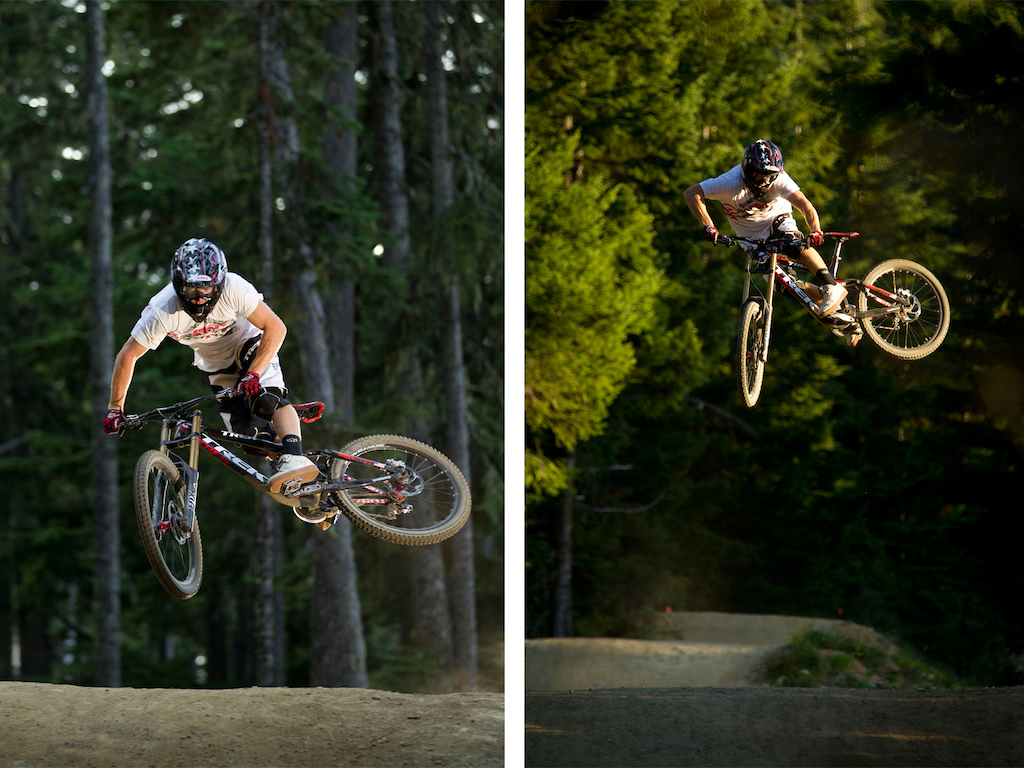 |
| Being the rider that he is, Aaron obviously has a bag full of skills. He could literally blast off the face of one jump, sending himself into a flight that looked as if he would need clearance from the FAA, only to squash the next lip so hard that one had to stand back in fear of getting blasted with a spray of dirt and gravel. Regardless of how high in the air he was he would also be bent as hell, with the back end threatening the front for who was going to lead. He may be one of the most dedicated and precise racers of our time, but the boy knows how to have fun as well. |
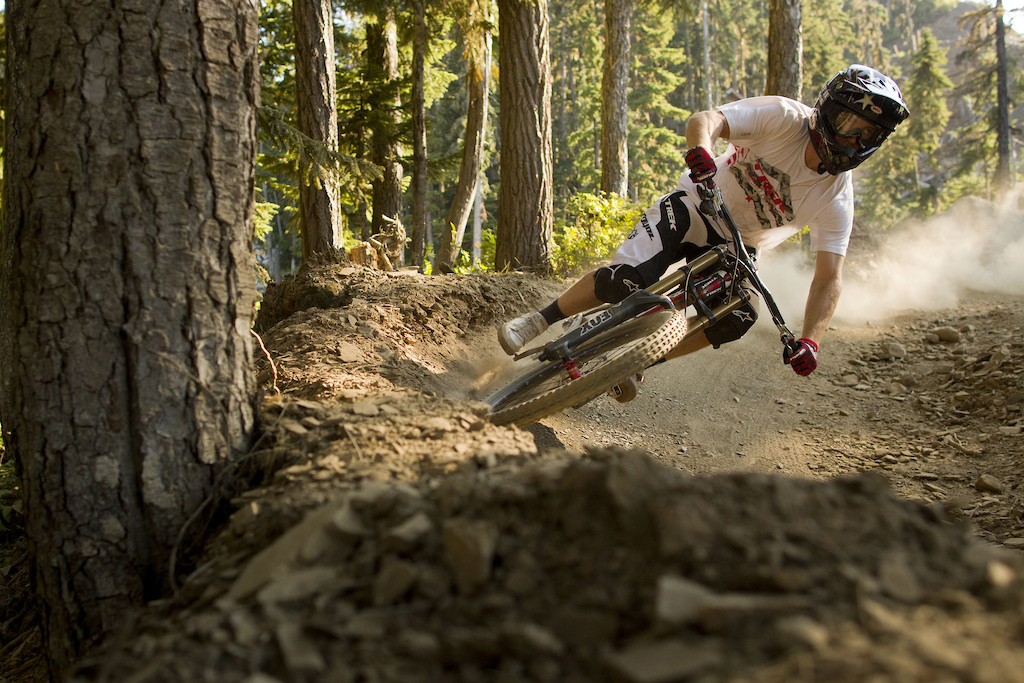 |
| Sure, you may have no fear and not take issue with hucking your meat in a race run, but I have some news for you: races are won and lost in the corners. You have absolutely no chance of getting on the top step unless you can absolutely rail those turns, no matter what level you race at. I've had the chance to watch the best slope style riders in the world throw down in person, and while that will always be impressive, seeing Aaron go through a corner, any corner, blew my mind. Telling you that he can corner faster than you can imagine simply doesn't do it justice... It was like watching a Scalextric car come through the trails. He carries so much entry speed into corners that he had us all holding out breaths - ''Does he know that the trail turns?! '' - but the result was always the same: feet up, controlled and on rails. While other riders certainly can make a big show of going through a bend, Gwin does does it efficiently and with no fuss. It seems to be working quite well for him. |
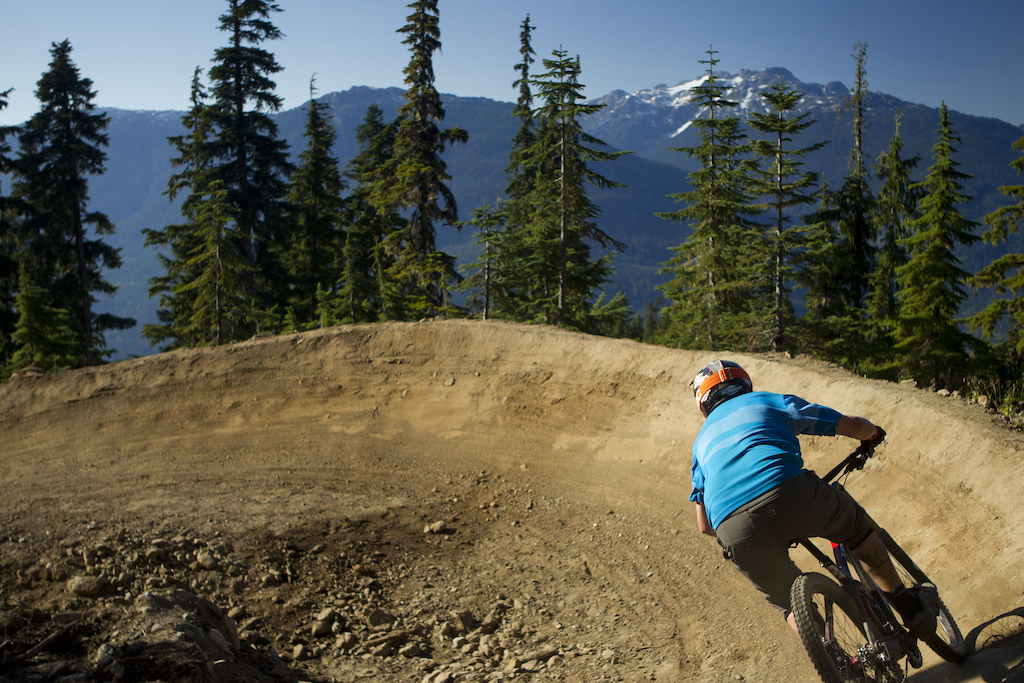 |
| ''If you go down to the woods today you're in for a big surprise... ''. We had the Teddy Bears Picnic theme song in our head when we stumbled upon some of the most beautiful berms up in Whistler's Garbonzo zone, all looking freshly built within the last few days before our arrival. I'm talking about five and six foot high brown monsters that make you feel stupid for dragging a brake into them - it simply isn't required. The Whistler Bike Park trail crew has been busy late into the bike season sculpting these behemoths for those who happened to find them, and while the WBP is soon closing the mountain to bikes for the season you can be rest assured that some serious berms await your arrival when the snow clears in 2012. |
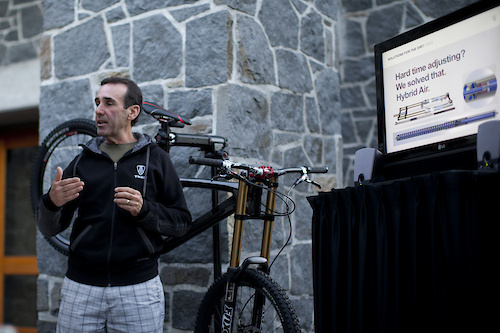
With decades of experience in the world of motocross, not to mention many years spent working on pushing the envelope of mountain bike suspension, Trek's Jose Gonzalez has been one of the major reasons for the success of their recent full suspension designs. Jose is part of a team of engineers known as the Advance Concept Group, or ACG, who's job it is to constantly raise the the performance status quo. Jose, along with Eli Krahenbuhl, primarily focus on suspension, often working on products that we won't see for a full year or two down the road. He and Eli were in Whistler to not only educate us on the 9.9's Fox 40 Hybrid Air fork and TWR tune equipped rear shock, but also to get some time in on his creations in the perfect testing environment.
| Our goal was to create a bike that any rider could use on the World Cup circuit and not be held back. We feel that the stock Session 9.9 will actually outperform many factory race bikes, it's that dialed, off the shelf. - Jose Gonzalez, Trek suspension engineer |
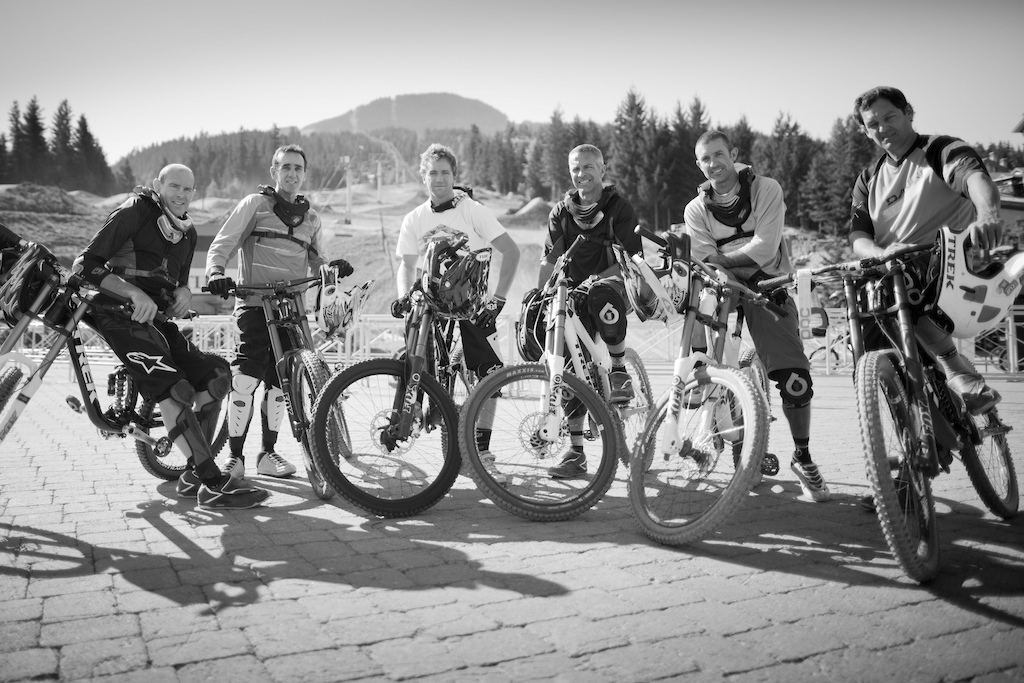 |
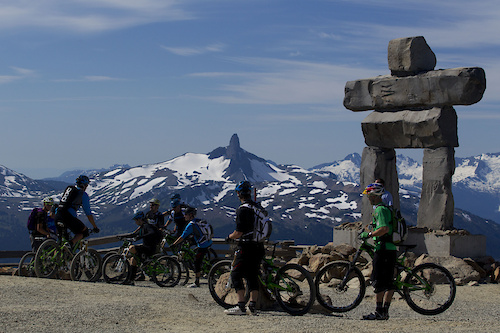
| Trek is a big company, there is no reason to deny that, but it is also fact that these boys shred. Sure, Shandro and Gwin can hang with the big boys, but the rest of the crew are no slouches either. From left, Scott Daubert, Jose Gonzalez, Gwin, John Riley, Dylan Howes and Andrew Shandro spent the entire day riding the lift and banging out hot laps like each one would be their last for the season. |
 |
| While the Session 9.9 will surely attract the most attention, the new Slash deserves some time in the spotlight as well. The 160mm bike replaces the Scratch and is intended to let those aggressive riders who like to get rowdy to still pedal to the summit. That concept may not be a new, but the execution of it gets better and better every year. The Slash blends the technology found on both the Remedy and Session into a package that weighs in around the 30lb mark, and looks as if it will just as happy on a day long epic as it would at your local jump and drop zone. |
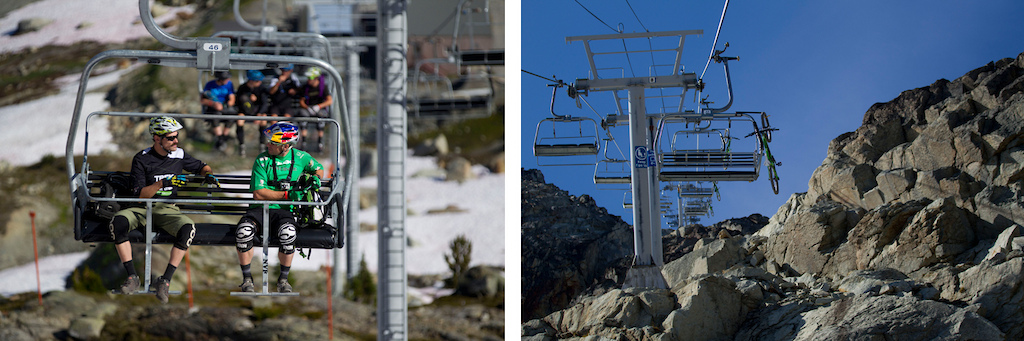 |
How do you best get a feel for a bike like the Slash? Easy, you have Whistler open up one of their highest chairlifts, the Peak Chair, for our select group of media friends and pro riders to get dropped off at the very tip top of the worlds most famous bike park. But we'd be avoiding the crowds in the park and heading down Khyber Pass, a burly trail that is named after the forbidding mountain pass linking Afghanistan and Pakistan. From there we'd drop into Babylon, followed by some lightening fast singletrack that would spit us out at the lake in the Whistler Valley roughly 7,000 feet below. It wouldn't be all downhill though, not even close, as there were plenty of steep pitches to power up and keep you breathing heavy. I've had a great Summer on the bike, having had the chance to ride a number of new-to-me trails that I'd happily trade a close family member to ride just one more time, but our route down Khyber Pass sits at the top of my ''to do again'' list.
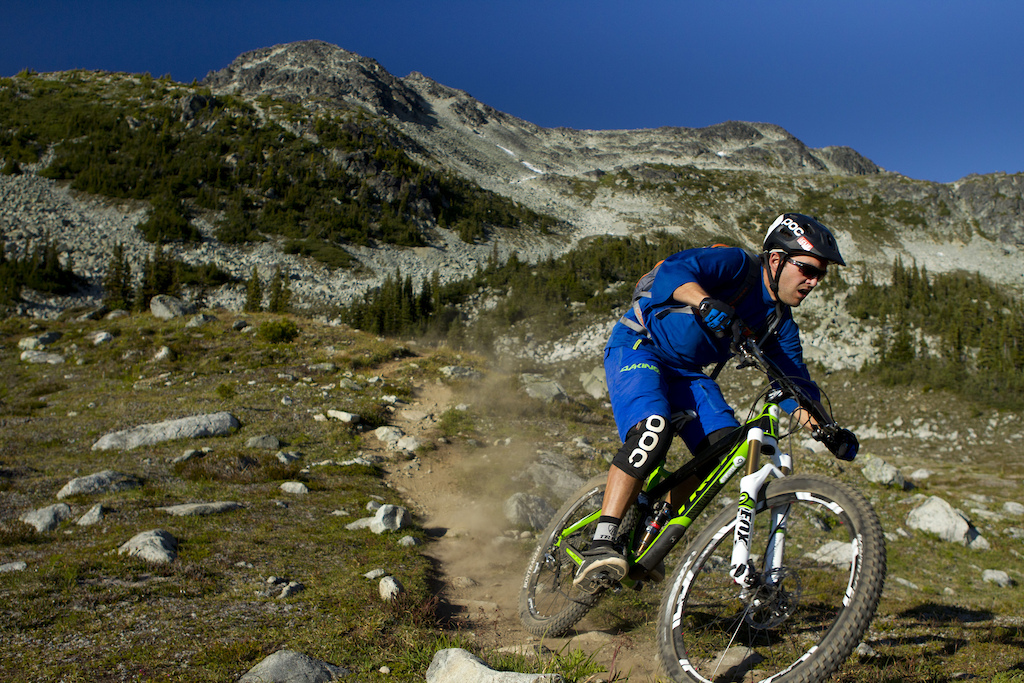 |
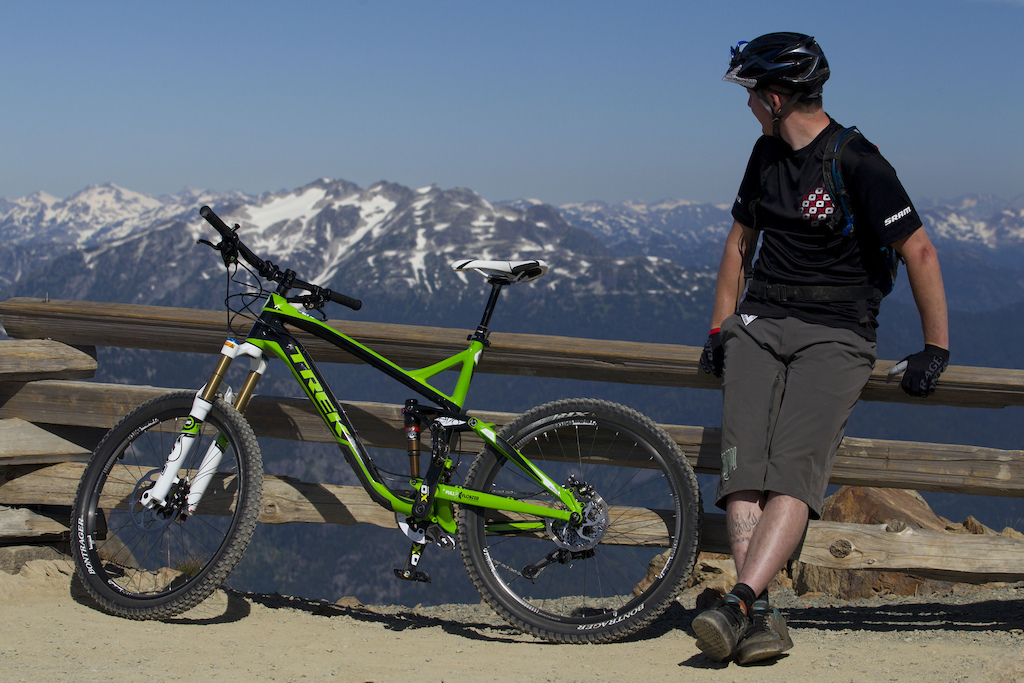
| Shandro in his element, high up in the Whistler alpine letting the Slash run. There is something about being in the alpine this is special, no matter how many times you've done it. Part of you wants to tear the trail a new one, knowing that you don't often get the chance to do so in such a place. But the other half wants you to ease up, take in the scenery and enjoy the moment. Shandro leaning toward the former option in the photo above. |
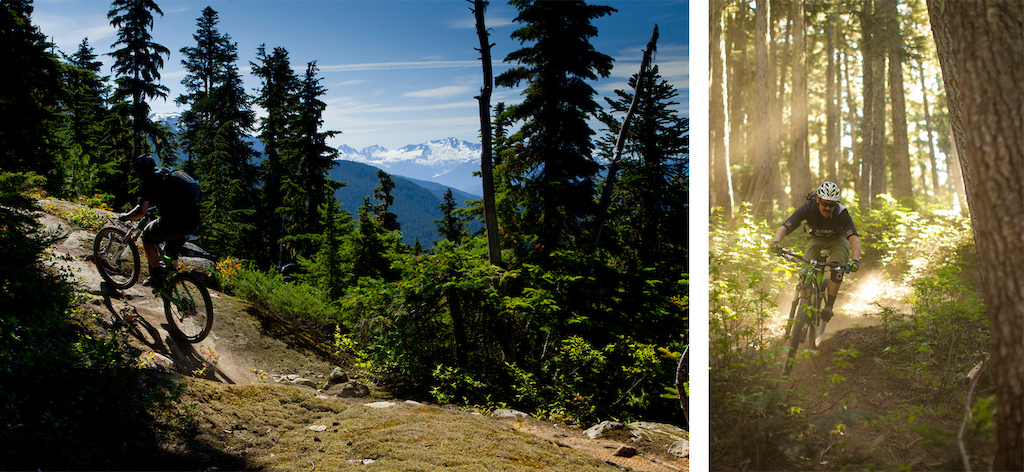 |
| Sure, we took the lift up, but that doesn't mean that we didn't still get spanked on a few of the trail's steep climbs. Giving the Fox fork's Talas dial a turn did wonders to allow the Slash to hold a line up these sudden pitches, letting me concentrate on putting the power down instead of dealing with a wandering front wheel (left). Thankfully, there was far more descending than climbing, all of which was ridden at mach chicken by Trek enduro rider and mustache aficionado Ross Schnell. (right) |
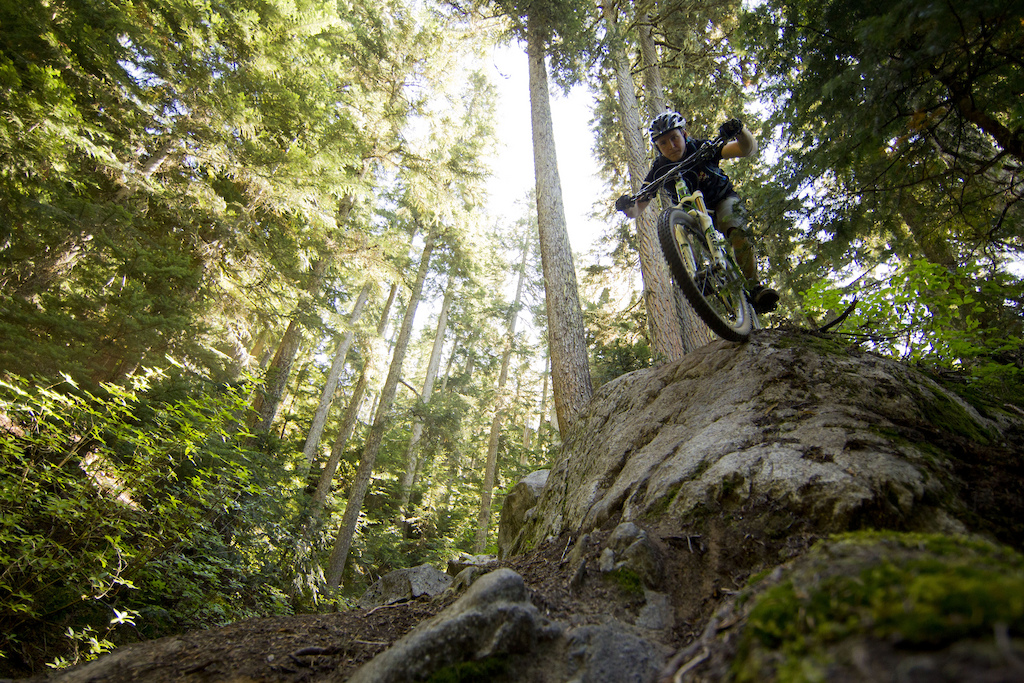 |
| There are plenty of sphincter tightening moves on the Khyber Pass trail, but the flow is also easy to find, especially once we got into it and began to roll through the burliest of sections blind. Collective whoops and hollers rang through the dusty forest as our group cleaned section after section without incident, letting the green bike carry momentum over the roots and steep rocks on the trail. While I'll admit to being an advocate of riding shorter travel bikes than most would prefer, letting skill and line choice take the place of suspension travel, I'd hesitate to roll into Khyber Pass on a bike that is smaller than the Slash. In fact, I would say that the 160mm bike felt spot on for the days ride, feeling much like a mini DH bike in the difficult bits, but still allowing you to pump the rollers and spin up the climbs. |
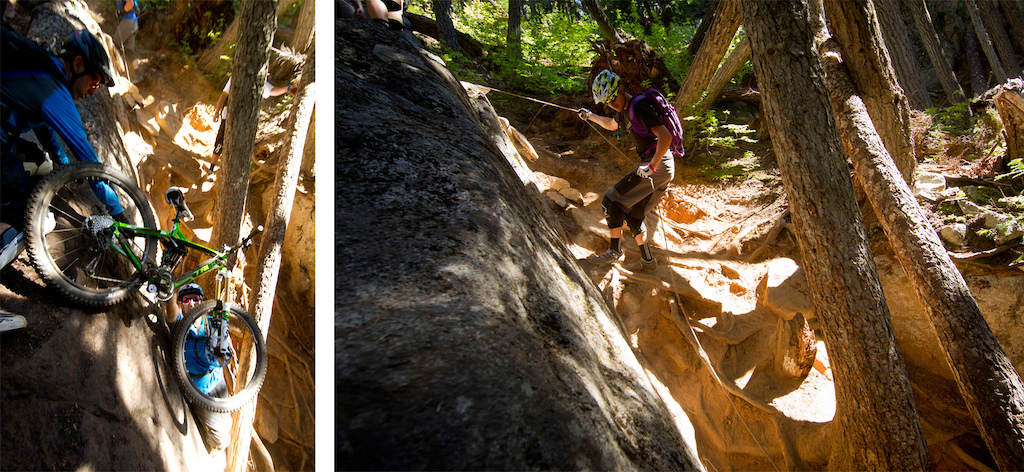 |
| No one said anything about having to rappel on the day's ride. Although this near vertical rock face was certainly rideable, no one in our group wanted to roll the dice. Given how far we were out in the bush this was likely a smart decision. While I was disappointed to not nail through this line, I was quietly relieved when the entire group made the same choice. Teamwork came into play here as we formed a chain, passing the bikes down from person to person over the precipice, followed by each of us gingerly working our way down to our steeds with the help of a rope. |
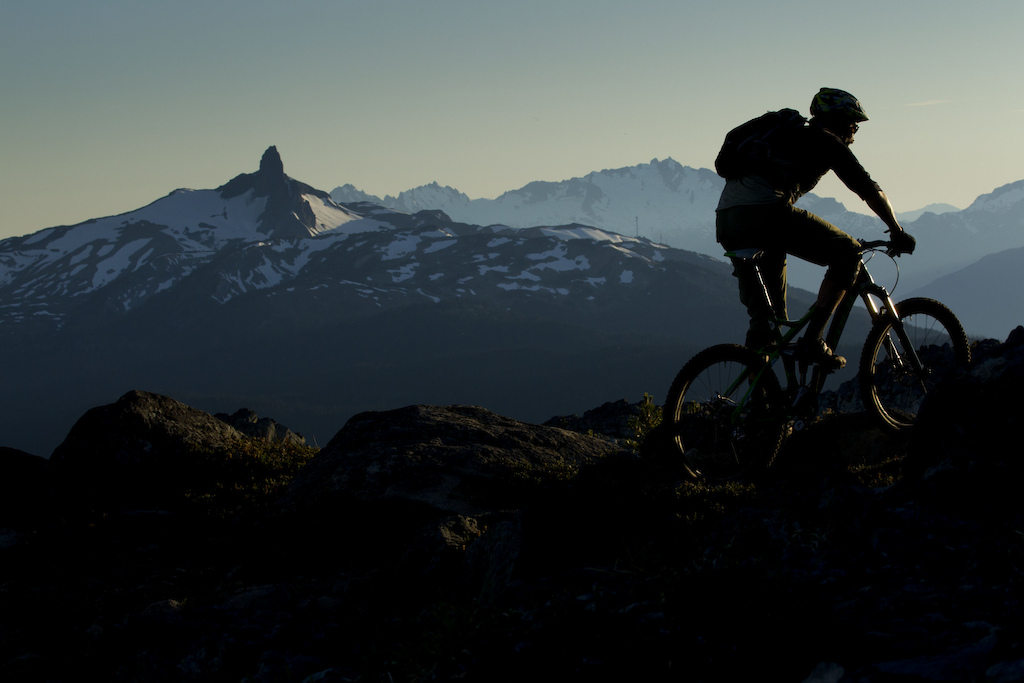 |
| Ross Schnell with Black Tusk in the background. The 'Tusk is all that remains of a volcano that was said to be active over one million years ago, long having eroded away to leave the harder lava core that can be seen from miles away. Part of the Garibaldi Range, its summit sits at 7,608ft high and makes for quite an imposing backdrop. |
Photography by Sterling Lorence
www.trekbikes.com
Author Info:
 Squamish, BC, Canada
Must Read This Week
Most guys (non pro) on a 28 lb bike vs Gwinn on a 48 lb bike - I'd still give it to Gwinn. Make sense?
Last of all, I weigh 190 pounds, so all my 150-170 pound buddies are already toting around 40 less pounds than me. I've never ridden a really light dh bike, so I'm wondering if anyone out there really has experience in this.
PS Rember trek bikes back in 2006? How ugly and how much they sucked? Now i think that the session is the hottest looking bike out there. What a turnaround.
But all in all I think alot of Pinkbike users take weight way too seriously. IMO anyone who isn't competing on a pro/world class level (where those weight differences can actually make a difference) and says that weight is a serious factor for them, just care about bragging rights and industry hype. Because when your enjoying the ride on your favorite trail I can bet the last thing on your mind is how that X9 derailleur or coil shock is weighing you down and that it would be soo much better with an XO and Vivid Air.
If you are, you're doing it wrong
There's a lot of cool stuff in this article, but the main thing I'm taking away is that a handlebar mustache looks great on the trails.
Licence/license is the same: My licence proves I am licensed to drive.
I am assuming where you said Scratch, you meant Slash? Just a tad confusing...
I've done that with 170mm 66rc2x, now I have Lyrik U turn. I don't feel problems on downhills with 160 fork, bike doesn't hold me back in any situation I throw it into. Low & slack trail bike is what I find to be the future of amateur gravity riding, much better than a bunch of ppl riding for fun on DH racing rigs. But lowbb high cockpit & slack ht with next to no compromise to uphilling is a marketing fairytale, just as if someone suddenly found this perfect geometry that was right there all the time and we were all blind not to see it.
It is a lot about own preference, but actual difference between 180mm up front and 160 talas dropped to 120 is huge. I can imagine though that 180 talas set to 140 is still at acceptable if someone really feels that 160 travel and this 1 deg of ha less is stopping him from shredding big time
There's more than a few of us...
Yeah, I could probably get by with a 160 fork and a steeper setup, but why? Why on earth would I want to compromise my DH performance so I could pedal a little better? I'd much rather have the DH gains from 20mm extra travel and a slacker setup than get the uphill gains from 20mm less travel and a steeper HT angle. To me, then thought seems ludicrous, but hey, to each their own
The seat tube angle is about 74deg with 180mm fork and 75 with 160mm. It's steeper than my old hardtail and i can feel the difference in pedaling.
The bar height (from the ground), is exactly the same like my old Enduro SL 2008 model (150mm in front) and level with the saddle in full pedaling position. All these in static mode, in dynamic the more sag of 180mm fork, put me even more (a little bit), in lower position. So no problem at all in technical uphill terrain. Maybe with the fork in 160mm it's still easier, but the difference is very small.
The longer wheelbase and heavier fork almost equals the slacker angle, so the "wandering effect" in steep uphill situations, is about the same. I love my "cockpit"...
Also homeboy's tattoo is proof that if life's about decisions he made a wrong one.
I mean I'm not complaining, the 09 Remedy is my steed of choice.
09 Remedy's seem to attract a premium used price right now, and perhaps Trek are admitting that moving it to more 'xc trail' was a bit of a mistake?
Anyway, both of these bikes look damn near perfect. 2 new models that hit the 'best in catagory' award straight away. Trek are THE company to beat this year.
Thanks for proving my point so well.
Anyway, if that particular made-up marketing term doesn't fit with your last ride, then I'm sure you can coin a whole new one for us.
Slash seems to be a "Nu-school" version of Remedy, just like Stumpy vs Stumpy Evo. It's like Remedy is for those who are old enough that they want a Mercedes, but youngsters prefer Porsche for the same money. It is a more descent friendly bike comparing to Remedy, at the same time less ascent friendly for sure. I think it's just been made aside of Remedy, so that downhillers feel that they have their own trail bike.
I mean, if you put a fixed travel 160 fork on Remedy, that means you are a lot into descending as your cockpit height and headangle are definitely not uphill friendly, they make a hard job even harder. So you might as well get a bike that is slacker and has lower BB.
The slash (which I have yet to ride, will be riding it on the 15th and 16th), is meant to be "downhill/XC" thus the name slash. just by looking at the geo. I don't think that would be my weapon of choice for any AM riding, I'd stick with my Remedy 9.7. However, I'm still keeping an open mind and dieing to ride it in a week or so!
And @britt-100, I put the 36 on my bike because my 32 Talas (stock fork)was leaking oil and I got hooked up with that, it's heavier and more of a big hit fork but I really love it. as for climbing with the fork, it's not as easy as on my S-fly hardtail lol but I can get the job done. Not much of a speed machine up the hill. it's only about a half inch difference for the fork travel, so it isn't impossible to climb, just slower.
overall, my 2011 Remedy 9.7 is an AM machine, and I don't think my rig or the Slash would be suitable for XC riding. it's very nimble but still a big travel bike.
Sorry, Mike, but as a rider of all wheel sizes, including that of the 20" variety, I wonder why you feel like you have to take a shot at BMX. Sounds to me like you're like a large number of mountain bikers who have never ridden BMX for a variety of reasons, most of which boil down to not having the cajones. Don't you think it's interesting that many of the people who have and now do dominate the sport of mountain biking ALL have had BMX backgrounds? Gwin, Peat, Lopes, Berrecloth, Kintner, Carter, Chausson, Tomac to name a few. All of these "kids" love to ride bikes, regardless of how big their wheels are and each of them probably do get out on the 20 from time to time.
Kidding. You can find it on the trail maps. It's a bit of a pain to get to.
www.enve.com/handlebars/mtb.aspx
Edit - in the first vid
but does it blend?
*troll face
Also - noticed Gwin is wearing a Bell MX helmet. Not the "Drop" helmet.
BTW - some people were wondering about how much change Trek has made in last few years. Thats because when Lance was riding in the Tours they didn't pay attention too much to MTB. Now the big dogs realized they are missing out. Build a new factory out in Cali, hired a bunch of young smart engineers and tada... here we are today.
What we are given these days are ready solutions, things that few years back were fixed by switching some components. People get obsessed with low BB hype, I mean I can't even understand that people believe in a miracle of low BB geometry. Previously you put a big fork on a Am bike, the BB went up. Now they make bikes with BB height nearly the same for 5" bike as for 6" bike - hello! where do people think the travel goes? - Imagination land? - no it means that near bottom out your BB is lower than on "old school" bikes. It all dependson trails you ride, if it's deamn rocky New school bikes might not be the best choice. The only major positive difference in modern geo is actualy seat tube angle, as older bikes, when getting slacker due to the bigger fork, were getting stupid seat angles