Santa Cruz Bicycles - Test Lab

Pinkbike recently dropped in on Santa Cruz's California headquarters for a tour of the grounds, including their prototyping facility and company skatepark. We also had the go-ahead to visit their test lab, a room that, until now, had always been off limits to photo and video cameras. Joe Graney, head engineer at Santa Cruz Bikes, not only opened the doors for us, but also fired up their custom test machines for some bad-ass destructive 'research'. Putting frames through their paces until they fail is not unusual, every manufacturer goes through this process. Allowing the likes of us in to film however is far from common. This is especially true when it comes to carbon. Fortunately for us, Santa Cruz was feeling a bit more open minded during our visit, pitting an aluminum Nomad frame against their carbon version in a battle to the death. The goal: destroy both, discovering which one took more force to break in the process.
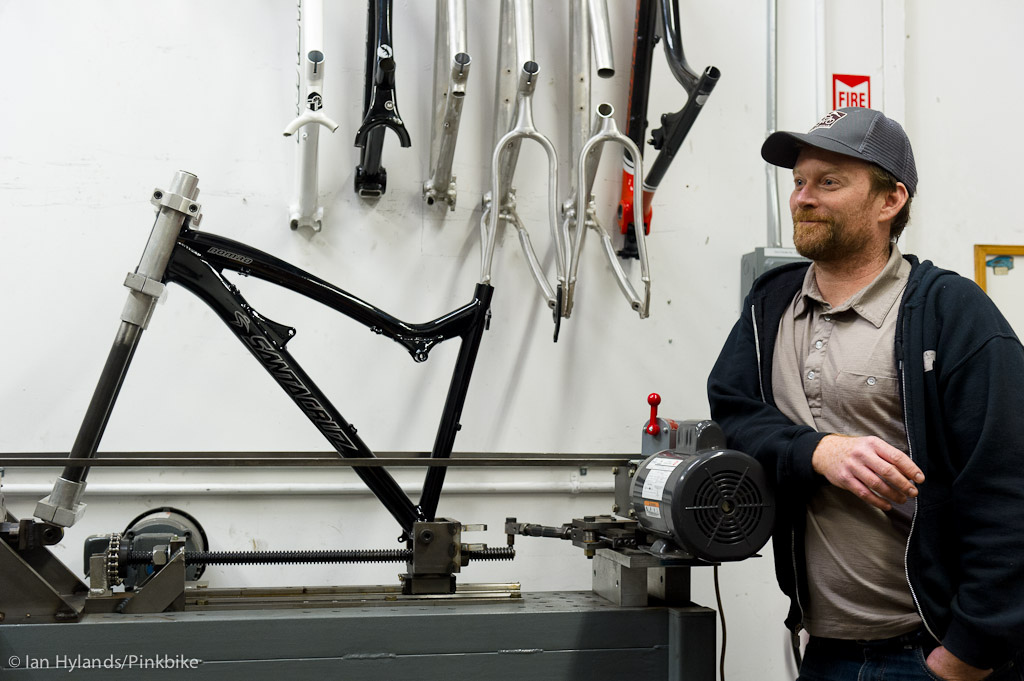 |
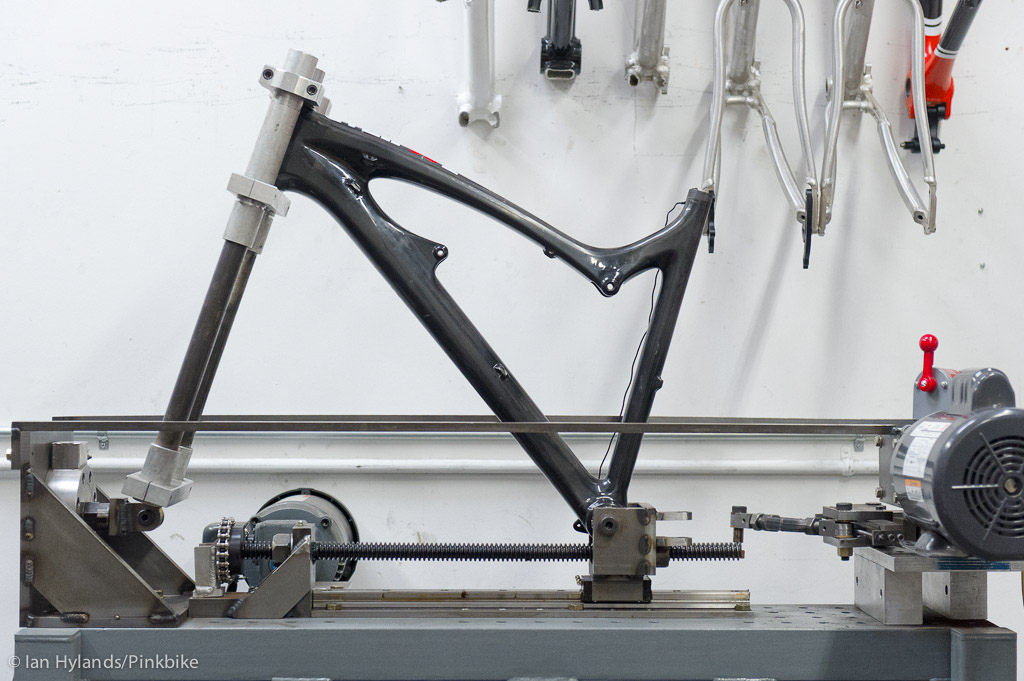
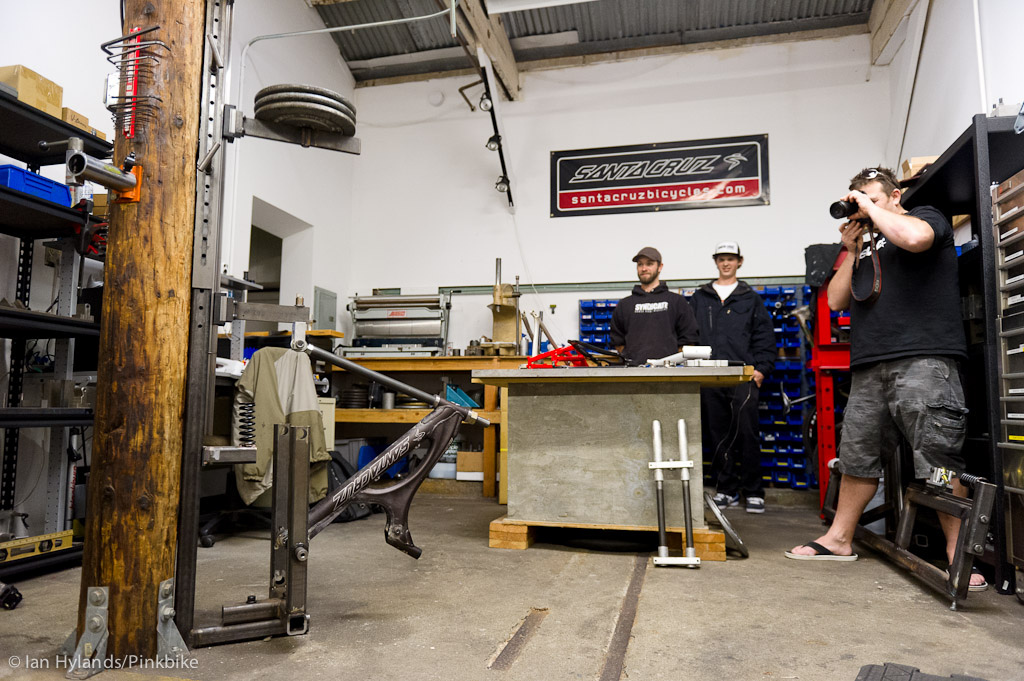
 Graney smiles at the thought of destructive testing, and who can blame him? Breaking stuff in the test lab is always is a dream job, but importantly, information and insight are also gleaned from each and every test. All that then gets put toward bikes that we'll ride in the future. The test machine that Joe is leaning on was custom built by Santa Cruz. They felt that off the shelf test jigs are not capable of properly replicating some of the forces that frames are put through in the wild, especially when it comes to certain full suspension designs. The machine shown above emulates a massive and catastrophic frontal impact, picture casing a rather large gap with your front wheel. The front of the bike is held stationary with enormous steel fork tubes, and the bottom bracket is forced forward until failure. The test lab has aptly named this the JRA Ultimate test. JRA refers to the well known adage 'just riding along', and Ultimate denotes the test's destructive nature. Graney smiles at the thought of destructive testing, and who can blame him? Breaking stuff in the test lab is always is a dream job, but importantly, information and insight are also gleaned from each and every test. All that then gets put toward bikes that we'll ride in the future. The test machine that Joe is leaning on was custom built by Santa Cruz. They felt that off the shelf test jigs are not capable of properly replicating some of the forces that frames are put through in the wild, especially when it comes to certain full suspension designs. The machine shown above emulates a massive and catastrophic frontal impact, picture casing a rather large gap with your front wheel. The front of the bike is held stationary with enormous steel fork tubes, and the bottom bracket is forced forward until failure. The test lab has aptly named this the JRA Ultimate test. JRA refers to the well known adage 'just riding along', and Ultimate denotes the test's destructive nature. |
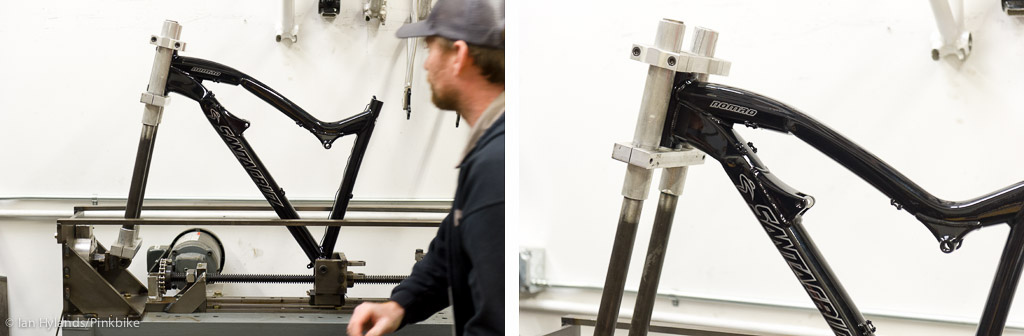 |
| Aluminum Nomad peaks at 1464lbs: When the machine is turned on the motor driven chain turns a steel gear cog that is attached to the threaded rod. The rod then spins within its sealed bearing support, forcing the carrier that is attached to the frame's bottom bracket towards the front of the bike. The forces involved are so immense that the solid steel fork legs can be seen flexing slightly just before they reach their peak. For reference, Graney states that even the worst frontal impact would doubtfully ever exceed 800lbs of force, although he is quick to point out that the variables involved while riding are nearly impossible to measure adequately. While that type of crash is often the worst on your body, it's at least comforting to know that your aluminum Nomad should be able to brush it off. |
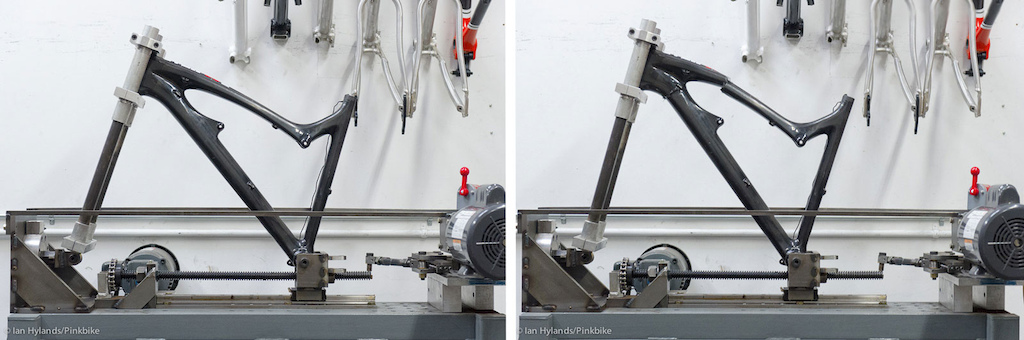 |
| Carbon Nomad peaks at 2050 lbs: The Nomad Carbon is up next, the very first to be filmed during destructive testing. This particular Nomad Carbon has already seen its fair share of abuse, having been through 200,000 cycles of fatigue testing, two different impact test scenarios, and then ridden hard for two years by a Santa Cruz employee. She has more than proved herself, but she still met her maker at the hands of Joe Graney. Mounted in the JRA Ultimate test rig with the same solid steel forks, it took a whopping 2050lbs of force to see it fail. Although the failure mode is clearly more catastrophic than its aluminum cousin, it required an extra 585lbs of energy over the aluminum model, and an impressive 2.56 times the forces that it would expect to see in a worst-case scenario out in the real world, before it finally failed. It's for this reason that Santa Cruz encourages larger and more aggressive riders to choose carbon when considering a new frame - they are simply stronger. |
0% Loaded
1/25
 |
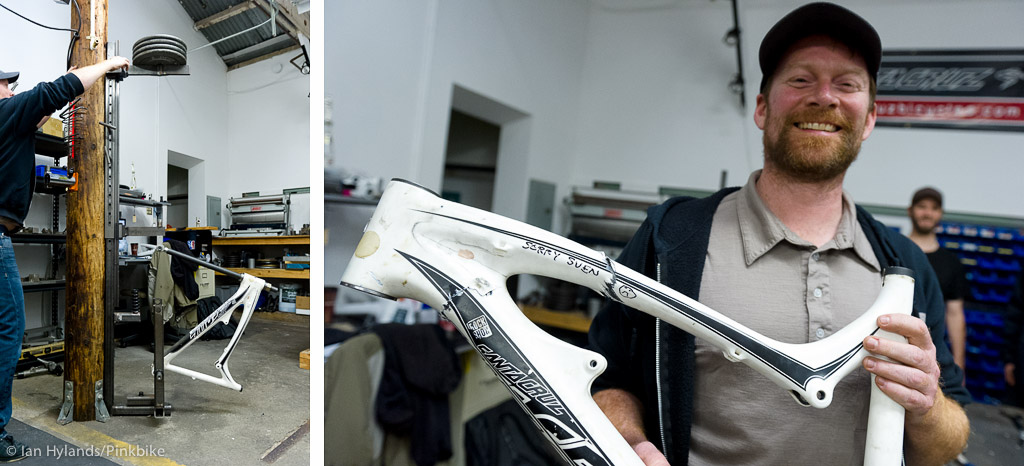
| The next experiment is the JRA Impact test, a destructive procedure that involves dropping heavier and heavier weights from increasing heights until the frame fails. Santa Cruz declined to publish any exact weight figures, although they did say that say that they use ''twice the industry standard, as well as adding another 25lb weight for testing carbon frames''. A sturdy steel bar is installed through the head tube by way of custom made headset cups and is then tightened down firmly to keep it from shifting. The opposite end of the bar is attached to a cart that can cycle up and down on a rail, the very same rail that a different, and heavily weighted, cart follows. This setup ensures that the impacts strike in a consistent manner, regardless of the amount of weight being dropping each time. It also means that whoever is running the JRA Impact test receives a workout when a frame seems to defy physics, as was the case with Sven's Martin's used Nomad Carbon. Thank you Sven. |

JRA Impact test. Again, it was aluminum v.s. carbon in a battle of who could take more abuse before becoming unrideable. Up first was a gloss lime aluminum Nomad front triangle that took its first impact from a height of 350mm, a collision that made some noise, but didn't seem to cause any visible damage. The same weight was then dropped from 400mm, but it wasn't until the height reached 450mm that we saw the front triangle begin to fold just behind the head tube. Next up, another Nomad Carbon, this time Sven Martin's personal frame that, prior to us deliberately trying to break it, spent much of its life travelling the world under the ex-pro WC downhiller. Yeah, it has already had a tough life, but its time had come. Graney is well aware that the Nomad Carbon far exceeds the aluminum version in strength, but it was only fair to replicate the exact testing. Six drops later and he was letting the weight fall from 900mm, twice the height that damaged the aluminum Nomad, with Sven's old frame shrugging it off easily.
The death blow didn't happen until we added extra weight to the cart, making it 35% heaver than what took out the aluminum frame, and upped the height to 900mm. The increased mass and height finally caused fatal damage to the old steed - she had a good life bless her soul. Again, the carbon front triangle proved itself to be considerably more resilient than its aluminum counterpart, this time in a straight up impact test. The failure modes between the two are quite different, with the aluminum triangle buckling and the carbon cracking, but the forces required to bring the carbon frame to failure are significantly higher. Can a rider expect to replicate this impact in the real world? Barring a car accident, it's highly unlikely that even the most miscalculated jump or drop could ever approach them.
0% Loaded
1/11
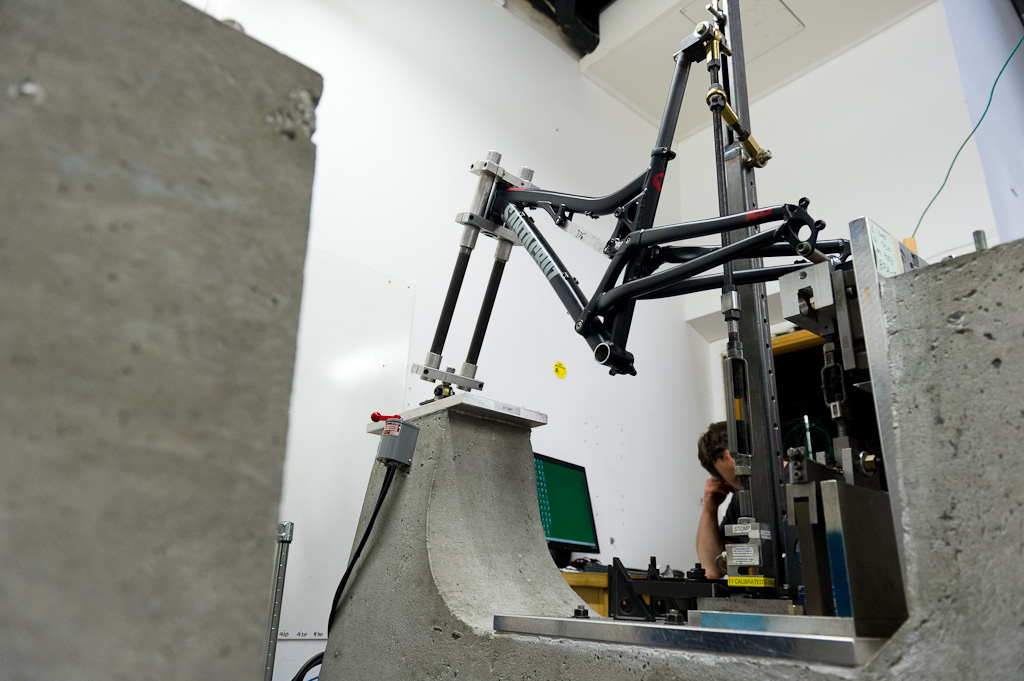 |
| It would have been much easier for Santa Cruz to purchase their own frame testing jigs, but that would have locked them into specific tests. They feel standard tests don't do a good enough job of emulating the abuse their bikes will see in the wild. Instead, they cast their own cement bases, and designed proprietary tests that not only eviscerate the required standards, but also take into account real world forces that the average jig simply can't produce. |
www.santacruzbikes.com
Author Info:

Must Read This Week
Sign Up for the Pinkbike Newsletter - All the Biggest, Most Interesting Stories in your Inbox
PB Newsletter Signup
-
About Us
Contacts FAQ Terms of Use Privacy Policy Sign Up! Sitemap -
Advertise
Advertising -
Cool Features
Submit a Story Product Photos Videos Privacy Request -
RSS
Pinkbike RSS Pinkbike Twitter Pinkbike Facebook Pinkbike Youtube Pinkbike Instagram
Newsletter Signup
Copyright © 2000 - 2024. Pinkbike.com. All rights reserved.
dv65 0.063286
would be very interested to see similar report with "real world" style impacting.
its more valuable to me to see how the small shock mounts would hold up.. also not only pushing forces on the front end but pulling forces too.. when you case or land to flat.. your fork want to go away from the bike . not towards it..
for the rest this was some awesome testing.. but it does not fulfill all my questions..
My V10 has taken some crazy rock hits to the downtube, and unlike my dented up old ally one it still looks brand new.
Carbon is strong enough for F1 cars, strong enough for most of the 787 to be made out of... I think I can trust a bicycle to be made from the stuff!
Unfortunately, some poor quality/badly designed and specced carbon has given it a bad name.
Cases in point, on my Manitou full suspension frame, I found the cracks in the aluminium headtube growing after I cleaned some mud off it. They were already an inch long at that stage. On my Alpinestars titanium hardtail, I didn't discover the crack in the chainstay until it had worked its way around 80% of the tube and the back end suddenlly started wandering off on its own as I went around a corner.
Stems, bars, forks and front rims that fail are a different story. But I trust my Enve carbon DH bars more than my aluminum stem.
I'd be willing to bet you could roll down Bline on a carbon V10 with a 2 inch chunk cut right out of the down tube because the top tube would still be strong enough to hold it together. I simply cannot see a downtube spontaneously going from looking fine to sheering right through both the downtube and top tube simultaneously while riding in control simply because the fracture toughness of composites is significantly less than aluminum. You would need cracks to be present on both the top and downtubes in just the right places, which is making the kind of rare assumptions that you can make about any material and any design. Aluminum breaks. Carbon does too. It seems that people are mostly concerned they will have an impact that would otherwise visibly render their aluminum frame useless but see absolutely no damage and ride it only to find later that it fails in a manner that it will cause them to crash in a situation where they would otherwise not crash more often than an aluminum frame would. I'm afraid I can't see it.
I guess the test that could lay this to rest is to strike the downtube once in the manner they did and then put it on the frame busting machine and crank it up to the failure point of aluminum (new frame) to see if it holds, and keep repeating; one strike then back in the machine. How about it SC?
Never seen anything quite as direct as this. Some one up there was saying that this didn't show for long term testing... They clearly didn't hear the guy when he said that the carbon Nomad frame had been on their long term testing jig for ages and THEN been ridden around for two years by a Santa Cruz employee.
Would be great to see some frames made of steel and titanium go through some similar tests!
AND if they can throw away beautiful frames like that so brutally and easily, how about throwing one my way??!!!!
Kramster you hit the nail on the head... strike the downtube of an aluminum and cf frame in exactly the same spot with the same force and perform a FATIGUE test (not a strength test) and then comment on how long it takes to fail. It could be hours, days, weeks, months or years. As an average consumer that buys a new bike every three to four years I would like to know if I would have to be buying frames more frequently! Skeptical but open minded. No hate, just want to learn about the real issues and not the obvious Al vs. CF strength that has been well known for decades!
I think your concern can be summed up as "is the type of strike required to cause a failure in Carbon equal/better/worse than an ally frame" which I guess I was unjustified in assuming to be better in my comments above, but clearly is the crux of what we all need to know. I was considering the question to be "what if you hit your carbon frame hard enough that it would have destroyed an aluminum frame but you didn't know you damaged it and were forced to crash later because it exploded beneath you when you were JRA".
No, not you.
I want to know what will happen to the integrity of the frame when i occasionally crash. if the frame hits hard a rock?
i want to know how much the integrity of the frame stays intact.
this is the exact reasoning a private customer wants. I DO want my frame to show clear evidence of structural failure. the most dangerous thing that can happen is that my frame will suddenly fail in the middle of a ride. i want to know after an inspection of the frame after a crash if it has any problem. and in this respect i think aluminum is better.
Generally and depending on heat treatments, carbon layering, condition, corrosion, etc, etc:
Carbon - Stiffer, stronger BUT more brittle
Aluminium - stiff, strong and ductile
Steel - less stiff, strong but much more ductile
I think the material you want depends on how hard you are on bikes and your attitude to maintenance i.e. checking the frame regularaly and after crashes.
For this reason I don't think I'd ever buy a carbon frame second hand, but I would consider a new one.
As one of a group of mates who have all recently lost an old school aluminium frame due to fatigue failures it would be interesting to know how long carbon lasts before fatigue sets in. Not sure I'd want to be riding todays carbon frame in ten years time!
CFRP also has better inherent fatigue properties than aluminium and steel, you just need to make sure you don't impact it.
Fatigue will also "set in" the first time you ride it, its just a question of whether it ever reaches a critical level to cause failure.
youngs modulus steel ~210gpa
so as a material steel is stiffer. aluminium frames are stiffer than steelframes because the diameter of the tubes are bigger.
People think of carbon as being brittle because of the "carbon" you get when you burn something in the oven, or the "carbon" lead in a pencil. I have the joy of working with carbon every day, and have to say that the perception of carbon as being weak couldn't really be further from the truth.
Carbon in graphitic form is remarkably strong - but brittle. If you start a crack in it, it will propogate a lot faster than a crack in steel would. This is because the bonds in carbon are typically covalent; that is, they are associated with another specific atom. If you break this bond, it is gone. Within a metal, bonds can be free to break and re-form, as dislocation lines, moving through the metal - the bond from one atom to another is essentially delocalised. This means metals can undergo a certain amount of strain before failing.
In carbon fibre, the fibres themselves are brittle (unable to absorb much energy before failure), but have a very high tensile strength. It is possible to make carbon fibre "strong" be the correct choice of resin.
The ideal is that the resin does not actually bond to the fibre so strongly that it can cause a brittle failure of the fibre. Instead, when the material is stressed excessively, the resin peels away from the fibre. Since there is a huge area between the resin and the fibre, it is possible to absorb a lot of energy in "unzipping" the resin-fibre interface; this is what the creaking noise is as the frame approaches failure.
For the record I have a carbon blur lt and a carbon trek both of which seem to be bomb-proof
As far as recycling goes, it's only part of "reduce/re-use/recycle. These frames should last a long time. If people who buy these bikes keep them for 5 years or more, when otherwise they may have had a new bike every year or every 2 years, then it may not be so bad. But think about it, that means that the industry must stop changing the standards all the time, so that people with frames that may be 5 or 8 years old, can still fit a headset and BB. This means that Santa Cruz may sell fewer bikes in time.
If people go through these every year or two just to have newer stuff, then it will become a real crime in terms of environmental impact. I know that in the WBP coolio-bro-down ego fest lift line up, a 5 year old bike puts you at a distinct disadvantage.
So, if they're making frames this good, but they are basically non-recyclable, people need to keep them for a while and give up this flavour of the month attitude.
I'm sure you can find a headset and BB for any 8 year old frame you would care to still ride. I think the biggest reason why people have moved on from bikes that are 5-8 years old is because they have improved enough to make the upgrade worth it. 2011 Carbon Nomad vs 2003 Bullit? Big change there. Fox RC4 vs 5th Element? Even from the mid 90's I would think every year we'd reached the top of bike design. Every year I was wrong. There was something better than a RS Judy, a Vanilla RC, an S-Works FSR, XTR V-brakes. Fast forward 10-15 years, and I wondered how it could get any better than a Blur 4X and a V10.3 with original Saint brakes. Well, here we are with new XTR brakes that blow them out of the water and carbon frames that do the same. I'm quite sure it's not over yet, so the bike companies will still be selling new gear until every last serious rider has the greatest new gear, or beat up hand me downs that outperforms the best stuff we have today.
Next up, pedals....
completely agree!
cannot believe, any of these clowns are wearing no eye protection in a frame testing environment where sudden failure of aluminium and carbon components is expected due to the huge loads being put into the frames!
personally? If if was in that room with a CF frame being tested to destruction I would also have forced air extraction switched on and would be wearing a filtration mask to prevent inhalation of CF particles that are thrown into the air when CF is snapped or cut?
www.pinkbike.com/photo/7457039
if any of my mechanics pick up a hammer or use the parts-washing machine without eye protection, they get a good chewing out !
It would be really like to see a comparison between all materials, let's say a hardtail frame from CF, Alu, Cro-Mo, Ti. Who will pay for it?
"Do you want play a game?"
*Frame starts crying*
Great article, this site never fails to impress. Thanks PB.
You still see carbon failing at very unusual times that you don't really see happening with metals.
I will agree though that a well designed and built carbon frame is really tough to beat in many ways as it can be incredibly strong while still offering a tuned ride experience. Beyond the capabilities of any metals.
so if the frame has nowhere to go it will most likely break that is what victor was getting at. You ride a frame made from carbon straight off a jump and land the downtube on a concrete edge and see if it survives, bet you good money it snaps and you end up in hospital.
But yea we have huge problems because of being so separated from nature by technology - 99% of us can't tell where does our food come from (many can't tell what is in the food at all) so how should we know how our bicycle frame came to be... I would really like to hear that from some company, instead of essays about suspension technology an essay about production.
That was nothing against SC, it was a "general thing"
But in that situation, the last thing to be concerned about is frame damage
WOOD, ROPES, NAILS....
....IRON, BRONZE ,STEEL, TITANIUM, ALUMINIUM
??????
And yes I know steel rusts but you can SEE that happening and you can FIX it before it gets worse, aluminium oxidizes and same again it can be FIXED before it ruins the integrity of the frame. On another note you can dent and/or bend steel and then bend it back or re-weld the frame.
so what do get for your cash? pretty much nothing except a frame that can never be repaired if it breaks and bragging rights that you spent more money than anybody else at your local trails, sounds like a bargain!! (insert sarcasm here)...
That would be even more impressive then it already is
www.pinkbike.com/video/243714
www.youtube.com/watch?v=dsx2vdn7gpY
That is so insane !!! I will always buy carbon fro now on. Thanks Santa Cruz for this video.
(¯`'•.♥.•'´¯) Carbon (¯`'•.♥.•'´¯)
www.facebook.com/DownhillFreeriders
but yeah, I feel ya.. I sure would love to have had one of those, before they got smashed.. ah well.. time to start saving my dough. I want one. bad.