The Olympic Bike: Developing the Scott Spark
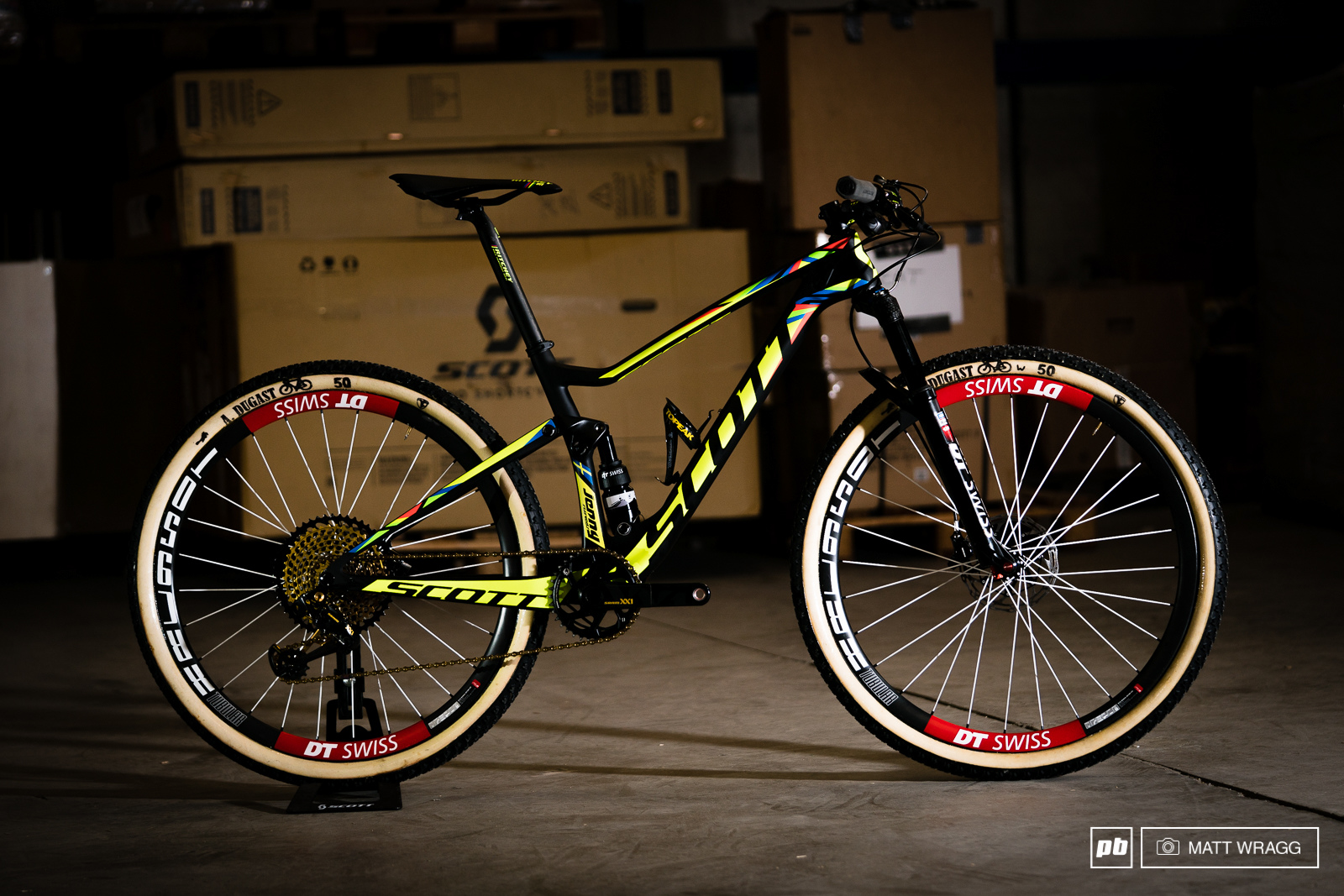
Most mountain bikes are, in the long-run, built to be forgotten. All the innovation and excitement fades from relevance and, in the grand scheme of things, they all start to look very much alike. Hand on heart, can you tell me what was so special about most bikes 5 years ago? 10 years ago? Yet there are a handful of bikes that stand the test of time. These are special bikes. Usually, it is only looking back that their significance is clear, that when we see how they influenced and changed what follows we can understand how important they were. Far rarer are the bikes that cement their standing when they are still new. The current Scott Spark is one of these rarest of all bikes.
Maybe in ten years time, we will look at this period and see that it is a turning point for XC bikes, that 2016 marked the point when the World Cup changed and full-suspension bikes really came of age at that level. This could be one of those watershed bikes that turned the tide for an entire genre. Maybe not. What will undoubtedly stand the test of time is what this bike achieved. Two Olympic gold medals, two World Championships titles and one World Cup overall in a single season. Underneath Nino Schurter and Jenny Rissveds, in 2016 the Spark collected a medal haul that may never be equaled or surpassed in one season.
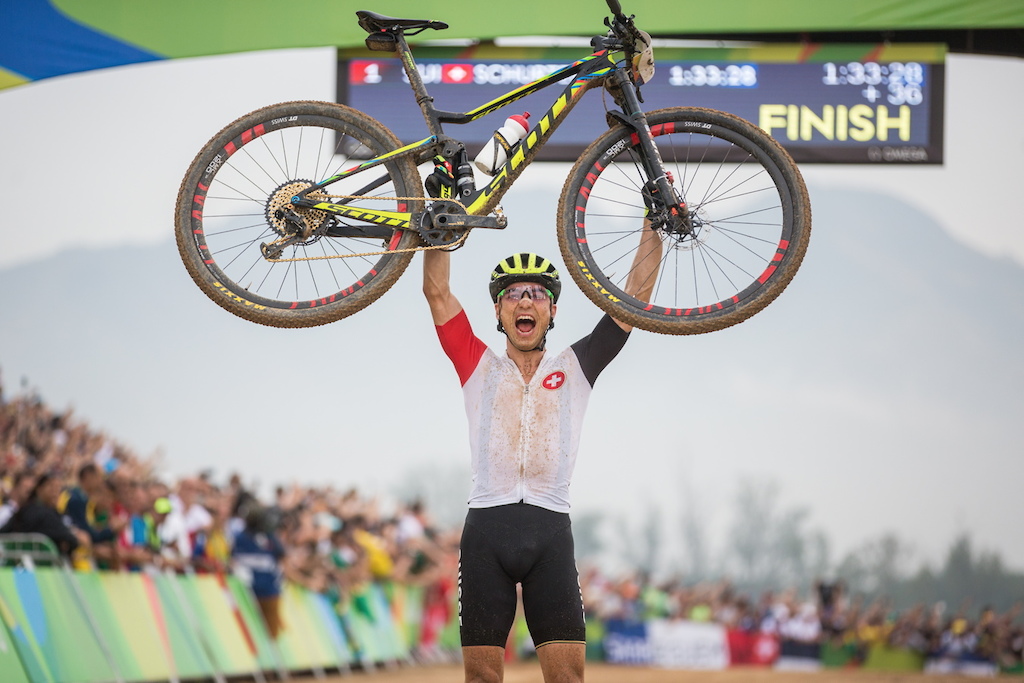
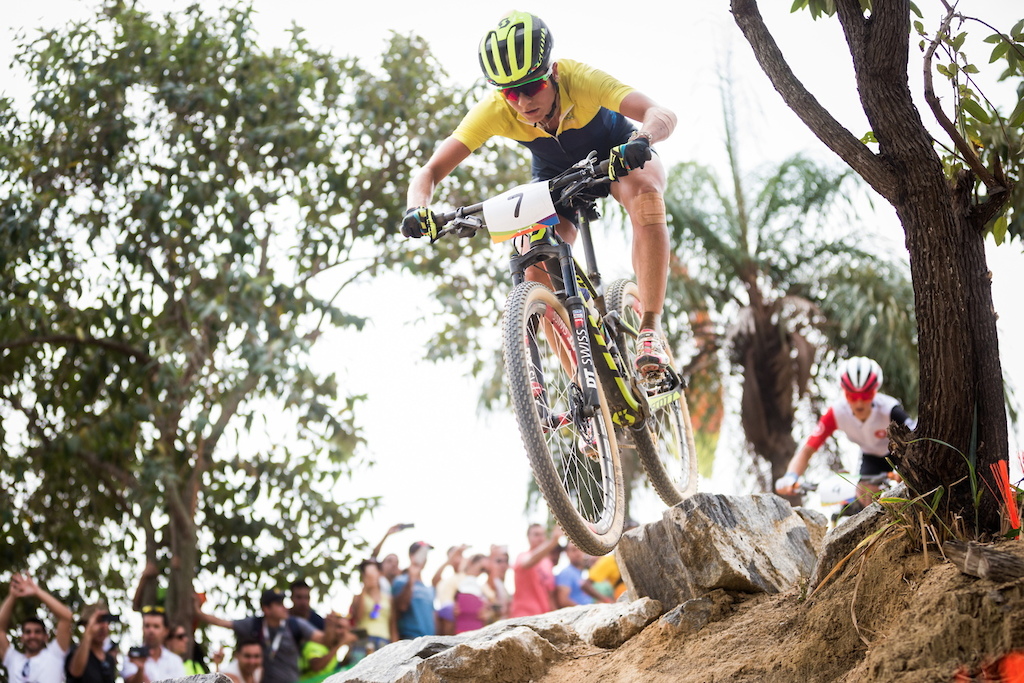

"It started in London when we lost the race. We got second." Rene Krattinger, Scott's product manager responsible for their mountain bike range, doesn't mince his words about the intentions for this bike. For many athletes, an Olympic silver medal is a pretty special achievement, it can be a career-crowning moment that elevates an athlete to national and international attention. For Nino Schurter and Scott, it was not enough. "From this point on we were thinking, 'we have to win it in Rio.' This is where the project started."
The Product Manager
Rene Krattinger
Since joining Scott as a mechanic for their DH team 18 years ago, Rene quickly worked his way into product management and today is responsible for all their mountain bike producrs.
Rene Krattinger
Since joining Scott as a mechanic for their DH team 18 years ago, Rene quickly worked his way into product management and today is responsible for all their mountain bike producrs.

Joe Higgins, Chief of MTB Engineering at Scott was the man charged with this daunting task. He began the project with the people closest to the previous incarnation of the Spark, "We started with a questionnaire about the bike, we asked the racers and the mechanics what they were happy with and what they would change." There should be little surprise what topic came to the top of the list for an XC race weapon: weight. They also wanted the bike to feel similar to their hardtail race bike, the Scale, so they could change between the two as easily as possible to pick the best bike for each course.
While efficiency was up there too, Joe reveals that, "They wanted suspension that really works, that isn't just there for show on the bike. If they were going to carry the extra 600g on the frame it had to really work, they didn't want over-inflated shocks." Joe is candid when it comes to assessing the suspension on the old bike, "The feeling was that it was too harsh at the start of the stroke and then it would rush through its travel." To chase that goal they had to make the radical step of ditching the old suspension layout in favour of an all-new design, one that required them to essentially invert the kinematic of the old bike.

With the falling rate at the start to offer comfort at the beginning of the stroke, it then ramped up towards the end to resist bottoming out. This kind of design should be familiar to anyone who has studied the latest crop of DH and enduro bikes, it is exactly the same shape of curve, just on a smaller scale here.
Of course, you can't just take the shock from an enduro bike and expect it to work for an XC racer. When it comes down to it, they still need ultimate efficiency when it comes time to really put the power down. Rene highlights their three-position adjust system on the shock as the key to making this work for the racers, "It means that in the open position the rider can have very supple suspension on the downhill. We don't need to make any compromises for setup. With the old two-position system, we had to make compromises with a harsh setup that is not 100% for descending performance. With three positions we can make each position perfect and have a really good setup."
One consequence of the direction dictated by the suspension design was a dramatic shift in the appearance of the bike. Joe explains that, "What made the old Spark so popular was that straight line of toptube, shock, seatstays. It was a super-strong line and everyone thought straight away, 'That's a Spark'. To move away from that was quite a nervous decision for us. But we realised that we couldn't get the curve we wanted with a top-link design, it's pretty much impossible."
 | There are so many ways to design a full-suspension bike, but only a few that will give you the curve you want. - Joe Higgins, Chief of MTB Engineering |
The Engineer
Joe Higgins
Hailing from the Isle of Wight off the south coast of England, Joe has been with Scott for nine years. Today he is their head of MTB engineering.
Joe Higgins
Hailing from the Isle of Wight off the south coast of England, Joe has been with Scott for nine years. Today he is their head of MTB engineering.

After several iterations, they settled on a shock that mounts vertically, adjacent to the seattube. This had a huge structural impact on the bike. When you mount a shock on the toptube you need to reinforce the tube to deal with the force the shock transmits through it. By removing these forces, the toptube could be lightened. As Joe explains, "The shock mount is going to need to be reinforced, no matter where on the bike you put it. Before it was in the middle of the toptube and the toptube is not really important for overall frame stiffness. It's the downtube and chainstays that are the spine of the bike. Now the shock is right in the middle of that backbone, so now the reinforcement we add for the shock also helps the overall frame stiffness."
 |


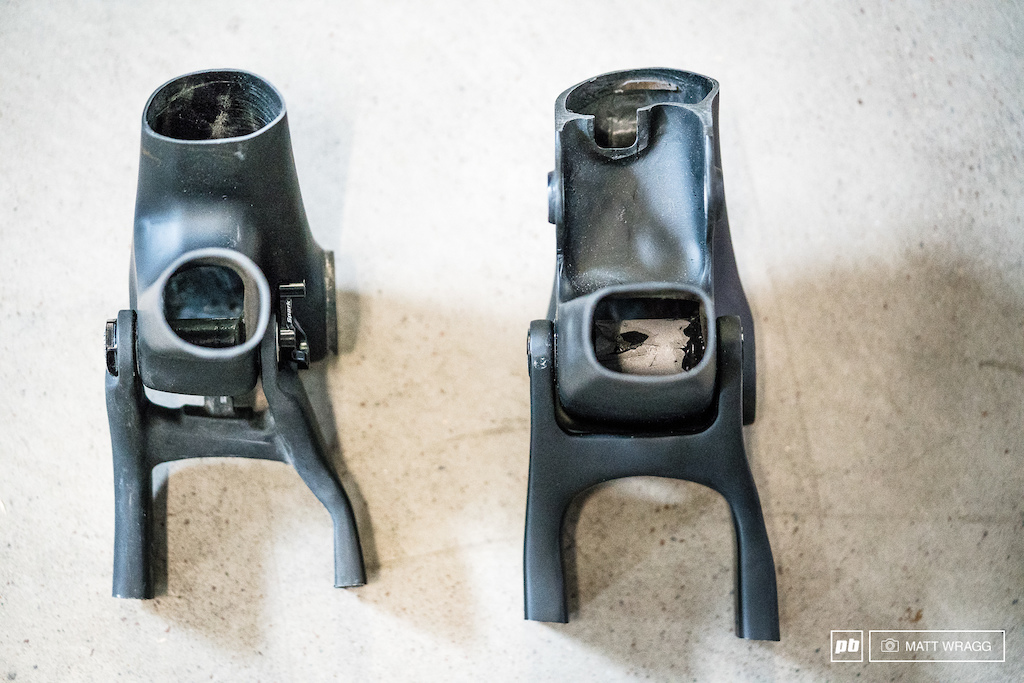 |
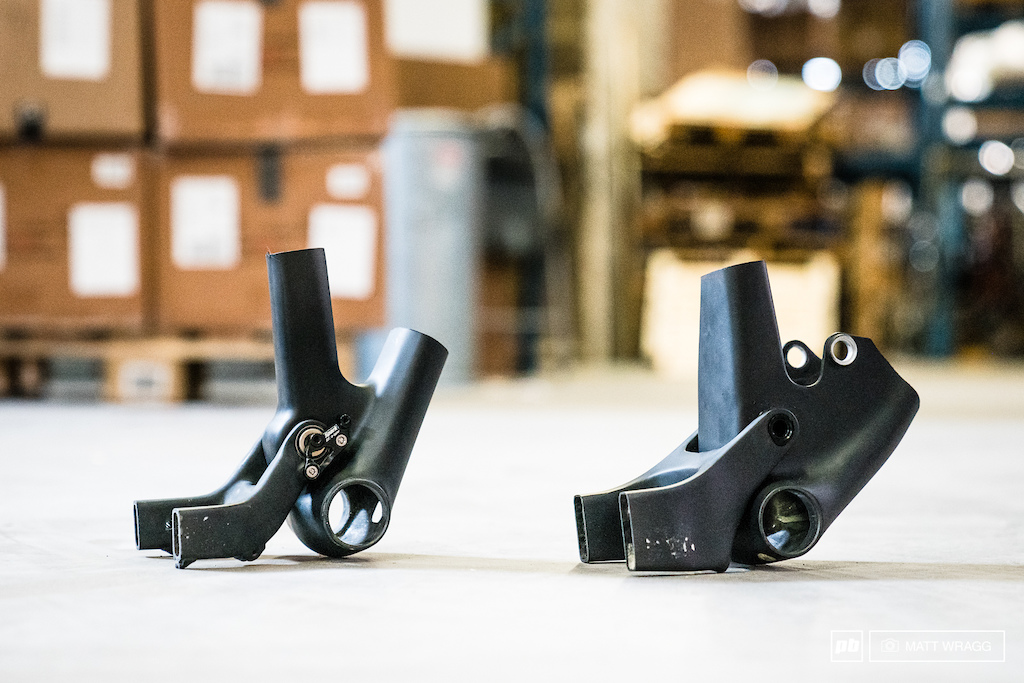
 The old bottom bracket area is on the left, the new one on the right. It should be immediately apparent how much more robust the new design is compared to the old one, with a wider stance and much more substantial tubes. The scales bear this out too - the new bottom bracket is substantially heavier than the old one - evidence that the focus of this bike is performance, not just weight loss for the sake of weight loss. The old bottom bracket area is on the left, the new one on the right. It should be immediately apparent how much more robust the new design is compared to the old one, with a wider stance and much more substantial tubes. The scales bear this out too - the new bottom bracket is substantially heavier than the old one - evidence that the focus of this bike is performance, not just weight loss for the sake of weight loss. |
With the basic layout set, it was time for the fine art of setting the geometry. Working with an athlete like Nino is unlike virtually anyone else in mountain biking. He had been working with a laboratory in Switzerland to find the optimum position on the bike, as Joe recalls, "We have a bike fit, to the millimeter, for Nino. His saddle position, his setback, height, seat angle. The seattube angle is a result of this. XC racers are much more picky about saddle to BB position, that's where they start from. We worked from Nino's measurements - where his saddle had to be, relative to the BB to make sure we gave him the perfect seat angle." Rene elaborates further, "Compared, to an all-mountain bike, it is more tricky to set the geometry for XC because the rider needs to have the perfect position on the bike for the best power transfer to the pedals, not just to have a long toptube and to make everything enduro-style. It's a bit similar to the road-side, you can't just make the bike longer."
Of course, these restrictions don't mean they didn't push the geometry where they could. Asked how different the geometry is on this bike compared to the old one, Joe's answer is just three words: "Longer, lower, slacker." While a 68.5-degree head angle may sound steep to most trail riders, in a discipline where the 70-degree head angle was de-rigeur until recently, it is quite a step. This was coupled with a 15mm increase in the reach and shorter chainstays.
What this all adds up to is an XC thoroughbred that is far more accessible to those of us outside the World Cup circuit, as Joe confirms, "It's definitely got better handling than the old bike, it's more stable, more controlled, which helps everyone. It has taken a bit of influence from the development in trail and enduro, some of the things that make sense there also make sense here. Even in XC, there is a move away from the mentality that, 'if my bike is twitchy and hard riding, it is fast' because it feels fast because you're getting beat up. The new direction is that smooth, controlled power output is what makes you faster. "


One small change in the geometry was more important - they reduced the stack height by 15mm. For a rider like Nino who is super-picky about his bar-height, this is a huge deal. To put into context how crucial it is, the Scott team changed to SRAM this winter. With that came a change of suspension and the axle-to-crown of the Sid is 5-7mm shorter than the DT Swiss fork he rode to gold in Rio, so they have had to go back to scratch for bike setup for him. At the time of this interview, they were still wrestling with how best to correct this for him. The drop in stack height for the new frame was game-changing for both Nino and the new bike. It is those 15mm that mean Nino could run 29" wheels for the first time while maintaining his critical bar-height.
The Athlete
Nino Schurter
Nino Schurter should need no introduction, he is the most dominant XC racer in the world right now and is well on his way to contest the title of greatest XC racer ever. His relationship with Scott in unlike almost any other athlete, having signed for them as a junior right back in 2003 and raced for them his entire career.
Nino Schurter
Nino Schurter should need no introduction, he is the most dominant XC racer in the world right now and is well on his way to contest the title of greatest XC racer ever. His relationship with Scott in unlike almost any other athlete, having signed for them as a junior right back in 2003 and raced for them his entire career.
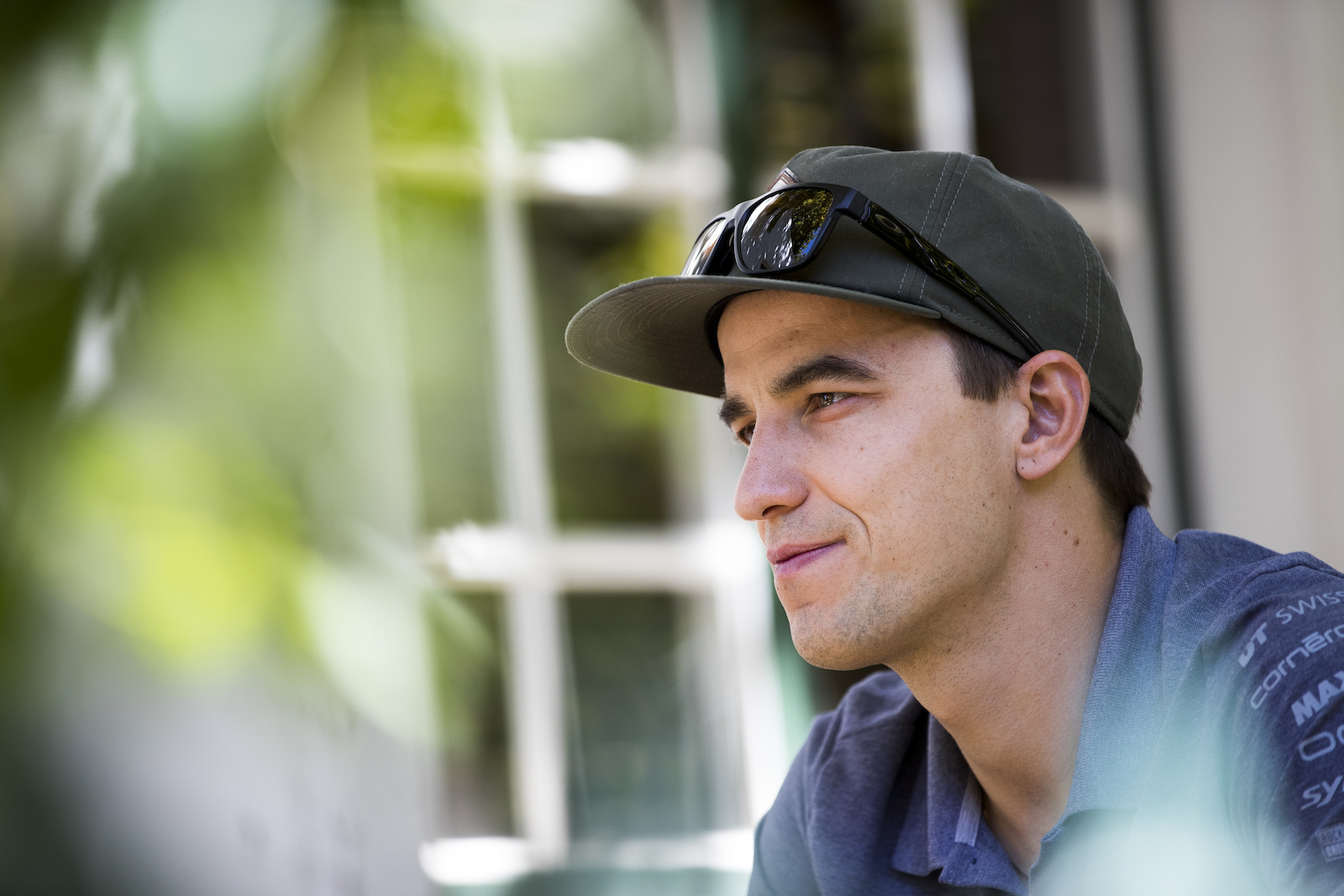
While a 29"-wheeled XC race machine may not sound too radical for most brands, for Scott this was a big departure as Scott, and Nino in particular were at the forefront of introducing 27.5" wheels to the mountain bike world. Rene explains, "When Nino won the World Cup in South Africa on 27.5" wheels we had customers phoning us saying, 'I need to have this bike, when can I have 27.5" wheels?' I have to say that 27.5" was a bit of a door-opener for 29". For most guys who were still on 26", they felt 29" was too big, so they went to 27.5", and now they go to 29" as it's a smaller jump than from 26" direct to 29"." In a sport where every fraction helps, it is hard to deny that there might be something in the fact that Nino had his most successful season when he switched to the bigger wheels.
With the basic layout set, it was time to start sweating the smaller details, stripping every excess gram from the frame, helped by a new generation of carbon technology compared to the old bike. Every single piece of the layup was obsessed over to try and find the perfect balance between strength, stiffness and weight. While the change in shock mount made a small difference to the weight of the bike, moving mass from the toptube into the bottom bracket, it was at the rear end where they could make the most dramatic savings. Most obvious is the lack of a rear pivot, it is now replaced by flex stays, so the carbon gives, meaning they can reduce the amount of hardware needed for the suspension and the number of points where carbon needed to meet metal, saving between 40 and 50g of weight.

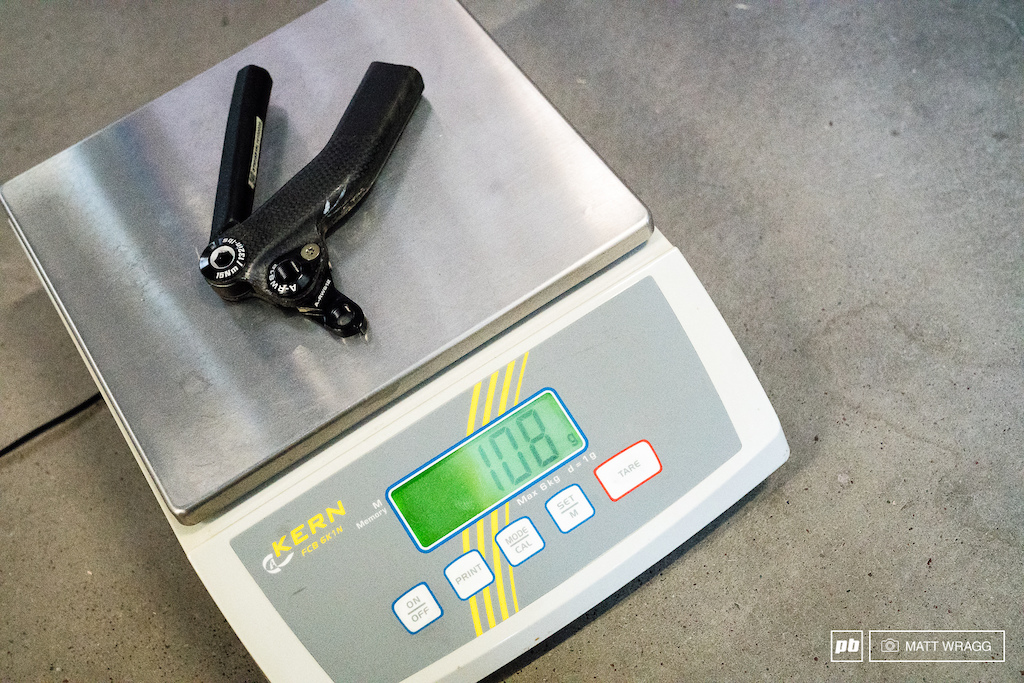
The rocker and dropout from the old bike.
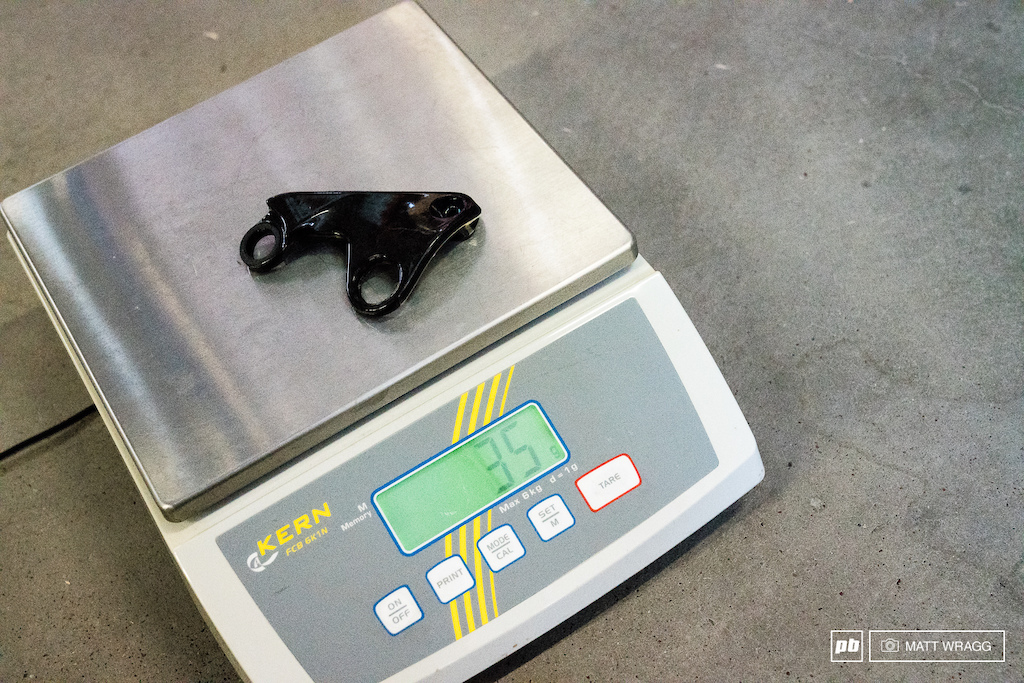

The much lighter new bike (the rocker is only half the assembly here)
The dropouts themselves are massively significant too. The new sandwich design means the swingarm construction can remain fully tubular at the dropout so there are fewer points where the carbon needs to meet hardware, as the meeting of tubular carbon and solid carbon adds weight. This meant they could save around 30g on each side, bringing the weight of the rear end down by over 100g. Then there is the rocker link, using carbon there to replace the old aluminium design saved a whole 100g. Contrastingly, those changes in the bottom bracket added 64g to the bottom bracket area - proof that they were not afraid to add weight where it was needed to help the bike perform.

The result is a 1779g frameset and a race bike that weighs in at just over 9kg - the lightest on the market today. As Joe recalls, "When Nino first got on the bike he checked the weight, then the height of the handlebars and then he rode off." The rest, as they say, is history.
Author Info:
 Sospel, France
Must Read This Week
Results: Ryan Pinkerton & Lisa Bouladou Lead Q1 Qualifying at the 2026 Lake Placid DH World Cup
55614 views
55614 views
Results: Sacha Earnest & Ethan Craik Win Elite Q2 Qualifying at the 2026 Lake Placid DH World Cup
54880 views
54880 views
The Spark RC 900 SL frame set is actually only 1660g complete with shock and all hardware (no remote included) when stripped from paint. And the Scale RC 900 SL stripped is a stunning 788,5g including all hardware. Both size Medium.
Feel free to have a look in my album "2017-XC-Builds" here or at www.instagram.com/dangerholm for two quite special projects.
This is not going to sit in the hall of fame alongside classic bikes that really were the first of their kind like the Speciailized Enduro, the Intense M1, The Fat Chances and Klein's of this world.
Not a clue what my cadence is whilst climbing. My lightest gear is 32x32 (oval) but I don't sit while climbing. My cadence is probably less than half what you mention there.
Even on my hardtail with a 70 deg HA a dropper is quite a bit more fun and lets you corner a lot more aggressively. I think we'll see more XC pros on them soon.
Any fat lazy bastard can take a lift to the top and then ride downhill... XC is for real men!