Brake Force One Disc Brake - Review
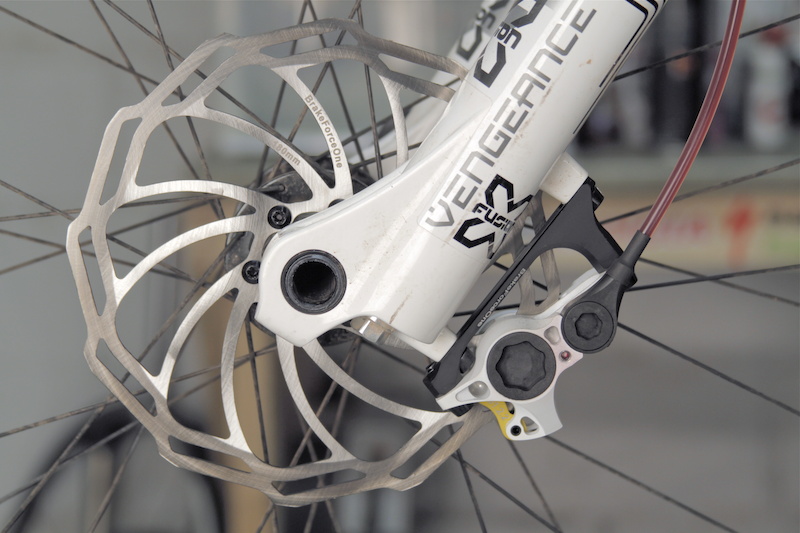
Levers and Lines Brake Force One manufactures both their levers and lever bodies out of carbon resin, with the brake's one-finger blades (there is also a two-finger option) featuring a forgiving and grippy rubber coating where your digits rest. Lever reach and bite point can be adjusted independently of each other, with the star-wheel dial at the front of the assembly allowing for a massive range of pad engagement, and a small 3mm hex adjuster on the side of each lever is used to determine the starting point. The brake's biggest talking point, and the one that most people asked about at the trailhead, is their clear lines that allow you to see the mineral oil within - BFO offers red, blue, green, yellow, orange, black, and even glow in the dark fluid, as well as more traditional non-transparent lines. While this may sound gimmicky at first, BFO says that it does allow users to easily spot any air that may be present in the system. | Brake Force One Details: • Intended use: XC, AM, and DH use • Closed brake system (no reservoir) • Carbon resin lever body and blade • One-piece caliper • Mineral oil • 198 grams per end (w/o rotor) • MSRP $498.95 USD per end |
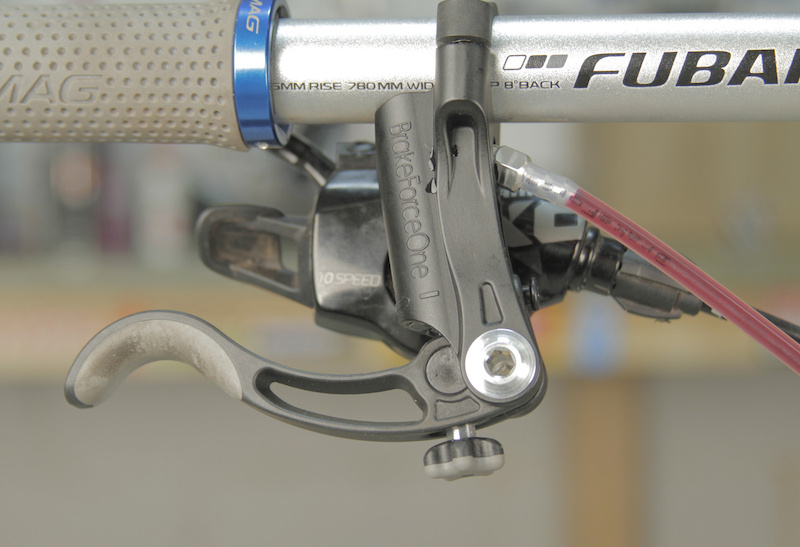
With their clear lines and unique looking carbon resin levers and bodies, the Brake Force One stoppers don't resemble anything currently available.
Closed System
An open brake design refers to a system's reservoir, which is a small chamber of fluid that is usually backed with a rubber bladder that can compress in order to compensate for heat and fluid expansion. When the brake lever is pulled on an open design, the plunger compresses the piston, closing off the oil port for the reservoir and then only acting on the fluid in the brake line and caliper. This means that, in a way, the open design becomes a closed system as soon as the brake lever is pulled, which is why a poorly bled brake can sometimes "pump up" until you release the lever and the reservoir is allowed to compensate for said pumping. Brake Force One's design is closed - there is no reservoir - and they utilize a larger than average gap between the pads and rotor to offset any heat buildup that might occur, as well as their "hydraulic booster" to increase power.
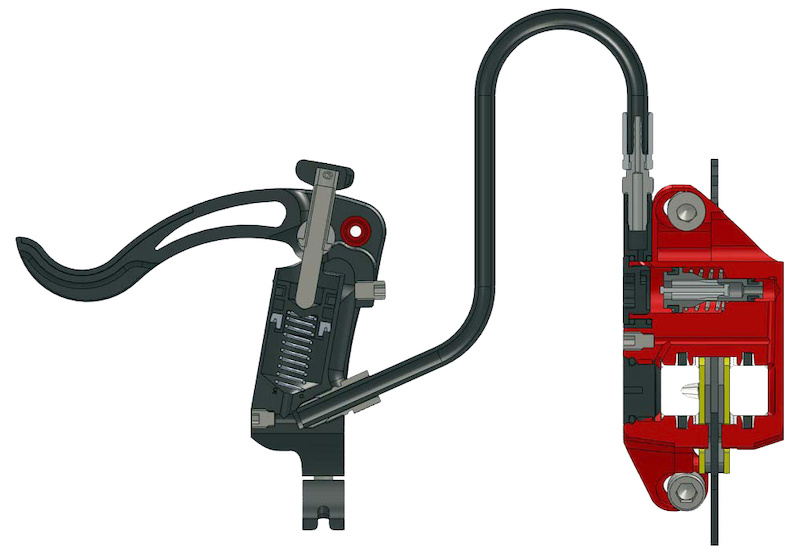
While pretty much everything else on the market employs an open design, Brake Force One uses a closed system in conjunction with a novel hydraulic booster within their caliper.
Power Booster
Hidden inside the impressive looking one-piece caliper is a small "hydraulic booster" that BFO claims adds a considerable amount of power. The design is a two-stage system that allows BFO to control how fast the 22mm pistons move in relation to lever pull, with them travelling out faster during the initial action. This first stage compensates for the extra clearance between the rotor and pads. As the pads make contact with the rotor, the system switches to allow for more oil volume to act on the booster, lowering the required force at the lever compared to a more common brake system, as well as greatly upping the power according to Brake Force One. While all of the above may sound complicated, it is essentially changing the brake's mechanical advantage by altering the oil volume that is acting on the pistons.
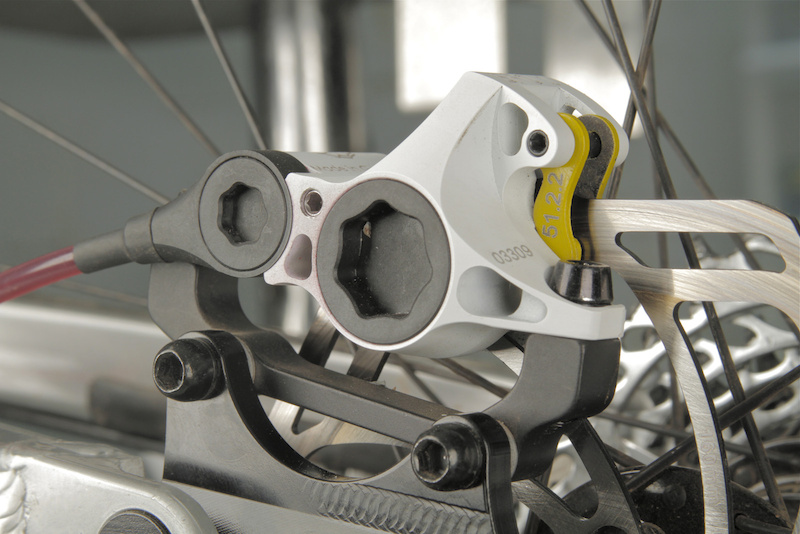
The massive one-piece caliper houses 22mm pistons.
Installation and Setup
BFO may approach braking with a different philosophy than what we are used to seeing, but installation and setup is similar to other offerings on the market. The post mount caliper design makes centering it over the rotor for drag-free running simple, although both our front and rear brakes did require some fine tuning by hand after doing the ‘ol lever squeeze and bolt-tighten routine. The extra clearance between the pads and rotor is a big help at this point in the installation, with us being able to easily sight the gap between the two and use it to align the caliper correctly.
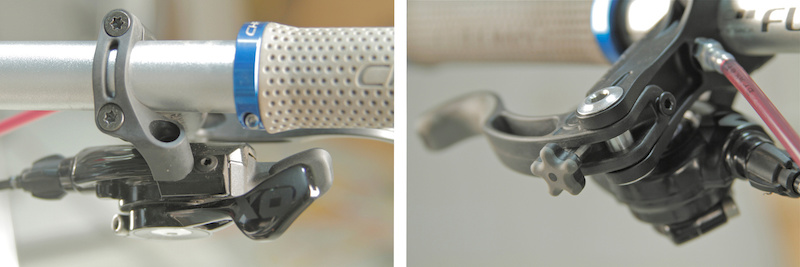
Don't over tighten the brake's hardware - the carbon resin construction is not as forgiving as other materials.
Split perches make fitting the levers to the bar quick and easy, although care needs to be taken when threading the T25 torx head bolts home: we confess that we cracked a clamp when we went to snug up one of the bolts. Although we have to admit to not using a torque wrench at the time, the clamp cracked a bit too easy for our liking - care needs to be taken when tightening the bolts into the composite body. Our BFO brakes came with mounts for SRAM shifters (Shimano compatible versions are also available), and much like other combined mounts on the market, they make for a tidy looking handlebar setup.

Once on the bar it was quickly apparent that lever position is a vital setup point with the BFO brakes. This is due to their pronounced hooked shape that has been designed to function with only one finger. Now, one-finger braking is how we all do it in this age of powerful and reliable stoppers, but the large majority of brakes on the market allow for more digits on the lever should the need arise. BFO’s lever, on the other hand, is not only shaped to function best when used with a single finger, it is actually the only way to do it since the finger-well is so pronounced. We found that it only took a few millimeters inboard or outboard of their ideal position for them to feel awkward under-finger, but taking a short amount of time to really dial-in the best possible location made for a world of difference concerning comfort, and we were quickly able to find a position that worked well us. Having said that, we can see many riders preferring BFO's more traditional two-finger levers that are quite comfortable.
Just as with any other brake system, we began by first tuning the reach to our liking, then adjusting the bite point. There is a softer sensation at the lever when comparing their feel to more common brake options on the market, with the levers pulling in towards the bar more than we’ve become accustomed to, even with the bite point dialled too far out for the large majority of riders. At this point many readers would likely assume that air in the system is the root of the issue – we made the same assumption – but a good bleed ensured that this wasn’t the case, as did the clear brake lines that allow air bubbles to be spotted easily. Another foible popped up while we were trying to tune-out the soft lever feel: that generous pad clearance that BFO touts as making for a drag-free design evaporates as the bite point is brought out to a useable setting, and by the time a workable compromise is found there isn’t much more clearance than you’d find on a standard braking system. Yes, it still ran drag-free, but so does any other brake system when set up correctly.
On the Trail
We ended up spending time on two different sets of BFO's brake, although that's only because our initial set left a lot to be desired when it came to power. Performing a proper break-in is essential if you’re looking to have your brakes perform to their full potential, and we did our due diligence as we worked to get the our first set of BFOs up to operating spec. Doing a countless number of break-in stops didn’t seem to wake up the new pads and rotors, though, with the brakes going from having very little initial bite and power when new to offering only a marginal improvement. Outright braking power isn’t as important as many riders assume, though, with proper, useable power and quality modulation sitting far higher on our priority list. Having said that, those first BFOs were lacking on all of those points, with initial bite not providing the grab that we’ve become accustomed to. This led to more than a few accidental late-braking situations until we eventually got used to the feeling and moved our braking points out accordingly. We wouldn't blame you for assuming that those symptoms read like a set of contaminated brake pads, but both a close inspection and a brake pad and rotor swap ruled this out as a possible cause.
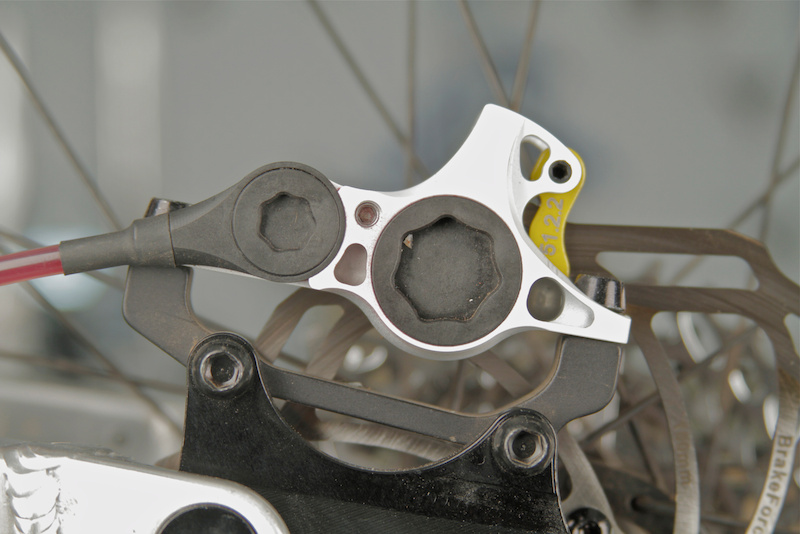
While they are light and look great, the Brake Force Ones left us looking for more
Interestingly, they also seemed to be affected by ambient temperatures, with a very noticeable change in feel when going from our heated workshop to chilly riding conditions, enough so to require us to compensate with the adjustment dial. Anyone who has used closed system brakes from the past will be familiar with this sensation. In the end we never could pinpoint the exact reason for those original BFOs to let us down so drastically, but we decided that spending time on a second set was needed in order to give them a fair evaluation.
How did round two go? Much better, actually. Our second set of BFO brakes showed large gains in power compared to those first duds, with no complaints when it came time to lock up the wheels up in a late braking situation. We would still say that they are down on power when compared to the strongest two-piston brakes on the market, and you likely won't see us using them on a downhill bike anytime soon, but they offer more than enough grunt for any cross-country or trail rider. While their power may not be anything to write home about, the BFOs do offer an impressive amount of feel through the levers that makes it seem as though your brain is connected directly to the calipers. That fact equals great control in medium-force braking moments that are past the initial bite but before you're looking for all-out, anchor dropping stops. This translated to plenty of control in low traction settings such as wet or extremely loose conditions after a long dry spell, and it was easy to modulate the power right up until the moment when the tires begin to lose traction and slide.
Do the BFO brakes perform better than other options on the market? We'd have to say that the answer is no, despite the impressive modulation on tap. It comes down to them being a touch low on power relative to the competition, something that will put off those who frequent steep terrain, or are bigger or faster riders. That's not to say that BFO won't find any fans, though, because their unique appearance, design, and function are points that will likely win over some riders.
Pinkbike's take:
 | Our curiosity was piqued when we spotted BFO's brakes being shown off for the first time at a tradeshow, and we were admittedly quite excited about the fact that a new player in the brake market was not only looking to take on the recognized names, but also doing it in an unorthodox fashion. Trail time has shown that while they certainly won't be for everyone, especially heavier or aggressive riders, their extremely low weight and great modulation will make them a viable option for some, especially those with deep pockets. - Mike Levy |
www.brakeforceone.de
Author Info:

 Squamish, BC, Canada
Must Read This Week
before someone sees i spent $1000 on these brakes.
Blain: I ain't got time to bleed.
Easy-to-repair brakes blowing the market. lost your fluid? air trapped in the brake? have no worries, rider, you can detach this catheter and fill the brake with your urine! done? go, shred the trail!
(tried to think of a quote, but I think we're covered above)
but perhaps you will be "sticking around" as your try to unjam your closed brakes which have overheated
anyone else remember the horrors that were Hope C2 brakes?
So... We have, what? Brakes that A, cost $1000 and B, don't stop well if you're 'heavy or an aggressive rider' that C, are ugly as shit.
Wait, what? Go home, BFO. You're drunk.
Oh, and by the way HA HA! Plastic brakes !!!
Interesting how people either love or hate formula.
Don't forget the lube.
But good, thorough review, Mike. Well done.
Certain things like brakes maybe should come with safety standards....
Take a look at the cross section.... do you have to take the bore caps off to do it?
I guess everybody knows how it will end...
I have doubts about about transparent cables being resistant to increasing pressure from the brake fluid. Stainless braided cables are made from core reinforced with steel and here it looks just like a core without anything on it.
Here, the piston diameter is large, meaning pressure will be lower. What in turn makes these brakes work with a larger MC diameter is the booster valve in the caliper, which increases caliper piston pressure, while line pressure stays the same.
My experience with the brakes
Pro: Plenty powerful(with aftermarket pads), excellent modulation, light weight, lever feels really good, although it looks cheapish.
Con: My fingers get really tired because of the long lever stroke on days with a lot of fast riding, you have to adjust the brakes when temperature changes, price, availability of spares.
Conclusion: BFO's are currently laying in a cardboard box, XT trail brakes fitted to my bike.
But having to adjust the system EVERY. TIME. ANYTHING. HAPPENS??? Complete dealbreaker. Being "different" is not a good enough reason to use a design with such obvious drawbacks as a closed system. Not sure I really understand what they gain by having it closed anyway... isn't the modulation due to their piston design? Seems like you could put an open bath on there and still get the modulation they want.
much of the low end power and mushy/elastic feeling in brakes is caused by flexible lines ...
I have tried a lot of brakes (hayes, formula, tektro, avid, shimano)and none have all these things. So far my favorite brakes have been Shimanos, but they are not perfect. When running the levers close to the bars I have to add fliud preloadind the master cylinder in order to make the throw short. This makes the pads close to the rotor. Cold temperature does make the lever throw very short. The bleed prosses isn't bad but they need better fittings. Another downfall is that they are not serviceable. You have to buy complete levers or calipers and dealing with Shimanos customer service can be like pulling teeth.
I have tried a lot of brakes (hayes, formula, tektro, avid, shimano)and none have all these things. So far my favorite brakes have been Shimanos, but they are not perfect. When running the levers close to the bars I have to add fliud preloadind the master cylinder in order to make the throw short. This makes the pads close to the rotor. Cold temperature does make the lever throw very short. The bleed prosses isn't bad but they need better fittings. Another downfall is that they are not serviceable. You have to buy complete levers or calipers and dealing with Shimanos customer service can be like pulling teeth.
I do like the carbon slurry assemblies though!
I have 3 of them (martha SL on AM bike, now MT8/Martha combo, and latest Louise BAT on DH bike (cheap) and very happy. I've tried Formula One (came with bike, not very powerful and noisy as hell) and Hayes Stroker Trail (really inexpensive in a very bad way) and my friends have nothing but problems with avid elixirs.... never tried XT though. Competition is always good. vote with your $