Park Tool Cyclone Chain Scrubber Review
Photos by Lucas Aguilera
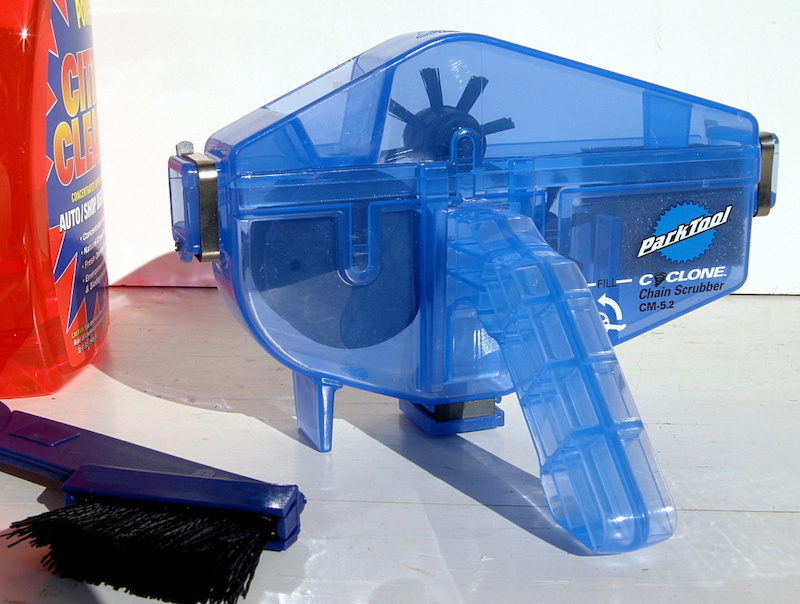
Park Tool's Cyclone Chain Scrubber is designed to use modern non-petroleum-based degreasing agents, and it works well with dish-washing detergent and water. If you ride or race in the mud and wet, the Cyclone can get your chain back in action in a matter of minutes.
Park Tool's Cyclone Chain Scrubber is the mechanized car wash of the cycling drivetrain - a 25-dollar drive-through kiosk for the chain that bathes the links in a pleasant-smelling degreaser, massages the bits with a series of scrubbing rollers, filters out any rogue metal-chips with a magnetic filter, and then gently squeezes out excess fluid as the chain exits through the opposite passageway. Fact is, anyone could mimic the Cyclone's job with a can of degreaser, a shop towel and a brush - which begs the question: 'If you experienced an easier, mechanized option, would you return to the brush and bucket to clean your chain?'
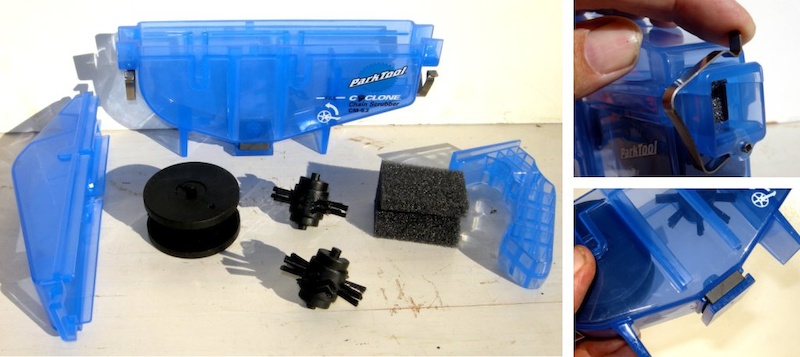
The Cyclone disassembles by hand and without tools, and replacement bits can be purchased from Park Tool. Two, well-designed stainless steel spring clasps (top-right) hold the halves of the body together. A strong magnet (lower right) at the lower end of the basin separates metal fragments from the cleaning fluid.
How the Cyclone Scrubber Works
The Cyclone's plastic body separates into two halves so that it can be installed over the chain without the need to remove it from the bike. The body is filled with cleaning fluid to a level mark on the transparent body and, after securing the Cyclone over the chain, the home mechanic holds the handle while turning the cranks. The first of three roller brushes scrubs the side-plates of the chain. The links then pass through a pair of vertical brushes that scrub the inside of the chain and finally, the chain passes through a gap in a foam element that removes most of the degreasing liquid and returns it to the device's reservoir.
Park Tool recommends two sessions using fresh degreaser the second time as a topper. Park also notes that it is best to shift the bike into the smallest cassette cog, presumably so that any excess degreaser that spills from the chain is kept at a distance from hub's ratchet mech and primary bearings. The Cyclone is quite effective at recovering the fluid, however, so we did not follow that precaution.
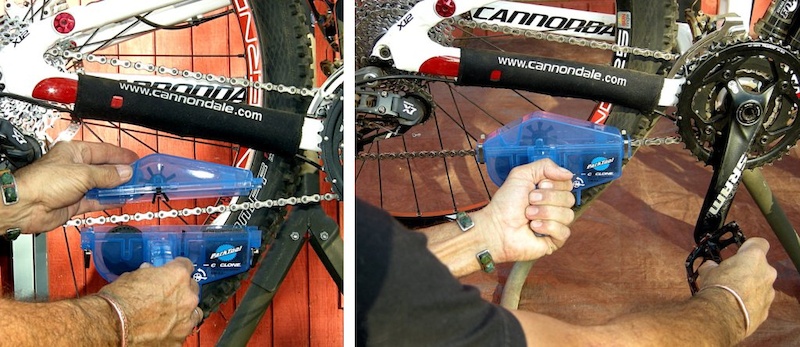
Fill the Cyclone's reservoir with about five ounces of degreasing fluid, snap it over the chain and then slowly turn the cranks for about twenty or thirty revolutions until the chain is clean and bright. We thought that the scrubber wold spit fluid all over the bike and floor, but such was not the case.
The Cyclone in Action
Park's chain scrubber puts in a good performance, with a clean chain in about three to five minutes. Perhaps the better news it that the Cyclone manages the normally messy task with a minimal amount of dripping and over-spray from the mech. We used a variety of cleaners, from cycling-specific sources as well as off-the rack citrus cleaners from automotive stores, with similar results. Just for fun, we tried Park Tool's suggestion of water and liquid detergent and that actually matched the performance of citrus degreasers.
How clean is clean?: Using the automated car wash analogy, Park's Cyclone can get almost all of the crud off the chain in a single washing. By that, we mean that the mechanized brushes leave the chain looking pretty sharp, but the tool leaves minute pockets of discoloration on the links that might be eliminated by a fastidious hand scrubbing. The Cyclone's results are as good as anyone needs to restore a dirty chain to as-new performance, however, and that is as far as most of us want to take that particular job anyway.
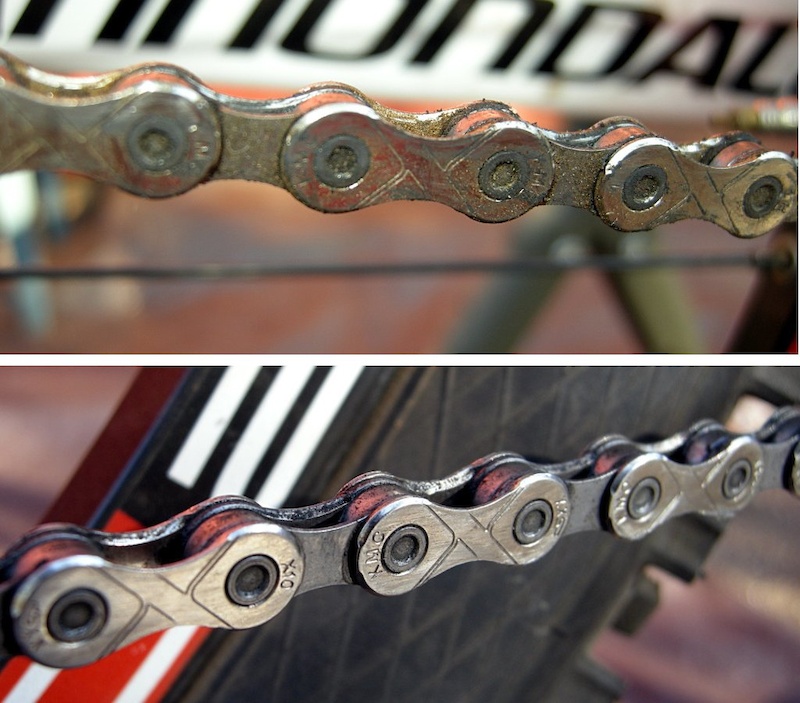
Before and after pictures of the same chain using only one serving of degreaser. Park Tool advises to run the chain through the Cyclone twice for near-perfect results. We found that the minimal areas of discoloration left by a once-through did not affect the performance of the chain.
Cleaning the Cyclone: No worries when it comes to cleaning the inner workings of the Cyclone. Because the cleaners you will be using are water based, the most effort that will be required is to spray some water in the mech to rinse it out. The degreaser-fluid bath seems to keep crud from accumulating on the roller brushes. If you are on the cheap, run your used degreasing fluid through a paper coffee filter and use it once again.
Technical Report
• Like: Replaceable parts, stocked by the most reputable bike tool company in the world
• Like: Minimal mess on the floor and on the bike.
• Like: Uses a relatively small volume of fluid to clean a chain
• Don't like: The Cyclone cannot attain the nearly perfect results of a time-is-no-object, off-the-bike hand cleaning.
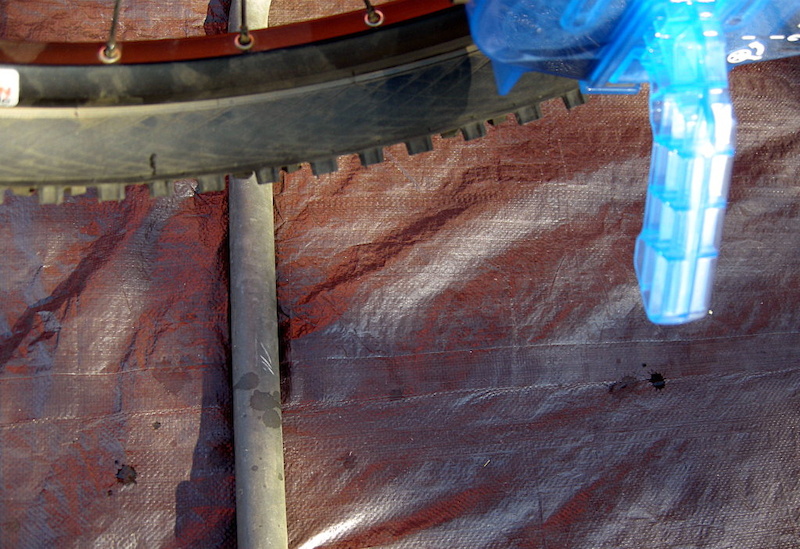
Wonder how much mess the Cyclone makes? Not much, as witnessed by the minimal spots left on Pinkbike's outdoor work-space after a thorough chain-washing session.
Pinkbike's take:
 | We resisted liking the Cyclone Chain Scrubber, because it seemed to be a gimmick designed to convert our money into Park Tool's money. All said, however, the Cyclone is a pretty easy gadget to use. It gets the job done in a hurry with surprisingly little mess or post-cleanup - and it was those attributes that turned us around. Now the Cyclone is a part of our regular maintenance routine. Can you do a better job by hand? Sure. Type 'A' helmet polishers, like retired Firemen who drive 1956 Corvettes, will probably mock the Cyclone's inability to restore chains to out-of the-box condition, but the bottom line is that the little blue box can get your chain running perfectly sweet in minutes. And, about the laziness brought on by yet another automated cleaning device? Well, the downside of today's water-based degreasers, however green they may be, is that the chain must be left dry before it can accept proper chain lubricants - and that can be time consuming. The Cyclone made the job of cleaning the chain so easy that we found ourselves wishing that Park Tool made a tubular brush attachment to fit a hair dryer so we could dry the chain as fast as we could wash it.- RC |

114218 views
Tool's concept is pretty cool, but after 5 years in bikes shops, cleaning who knows how many chains... nothing beats an old rag, some degreaser, and sixty seconds.
Put your chain in a container and cover it with a degreasing solution. Put the container on top of the washing machine or clothes dryer (preferably with a rubber mat between the two so you don't scratch your mom's appliance) and leave it there for a cycle or two. Let the motion of the machine agitate every scrap of dirt out of your chain. Rinse chain in very hot water or solvent.
Your chain will be so clean it wears out prematurely (see my comment earlier), but it will be very, very clean.
the interesting thing about bicycle chains is that they should never be cleaned using any solvent or degreasers, the harshest should be mild soapy water applied with a brush (this is generally for mountain bikes caked in mud) This information comes directly from Shimano and KMC Chain (KMC make 2 million chains a DAY...so they know a little about chains! )
from KMC:
•To remove mud or sand, use a bristle brush, if necessary with light soapy warm water .
•Never use acidic or alkali based detergents (such as rust cleaners), these agents can damage the chain and may cause breakage.
•NEVER EVER use a so-called ‘chain washing machine’ in combination with solvent. This is the one and only sure way to instantly ruin your chain.
•Avoid the use of solvents, not only are these bad for the environment, they remove lubricant from the chain’s bearing.
the best advice I have been given is to brush /wipe the chain as clean as possible, lube, wipe and lube again...and wipe off excess lube. the chain may not look as clean, and will feel rough for the first 1km but this is external "noise" and will soon run smooth
I have been following this method for some seasons on mountain and road bikes with very good results, compared to previous seasons of quickly ruining chains using chain cleaning machines and solvents
I have used both soap and water, and degreaser, and I would say that both clean equally well. Only that it requires alot more soap and water than degreaser (especially if the chain has been overlubed and allowed to get caked in dirt and mud).
That being said I'm not one to argue against a manufacturer. Like I've said elsewhere here... 5+years in bike shops(4 of them as a full-time mechanic), in three different shops in different states (not to mention other shops I've visited in both the states and europe.. aka..I've seen alot of shops) I've only seen one shop use a chain cleaner to clean a bike chain, and all three of the cleaners we had were broken within a season.
The concept of the chain cleaner is cool, and maybe a more industrial one made of a light metal would last longer, but whenever I've wanted to see how something was done I've always figured whatever the trend is among professionals was probably the most economical.
Now I'm not sure that these metal bits wouldn't neccissarily shy away from solvents (maybe ruin the finish?), but any special coatings, or o-rings or whatever else makes up the chain might not like them.
I agree that WD40 has no place on a bike including the chain, but I also don't think it's so evil... I think the primary ingredient is some sort of fish oil.
good information in your post, to add more info:
all modern bicycle chains are the "Sedis" style bushingless design, this was invented by Sedis at the end of the 1970s
Sedis was bought by Sachs (who retained the Sedis name for their chain products) and finally Sachs was bought out by SRAM:- I used to ride on a Sachs sponsored DH team in the mid 1990's using their 'New Success' and 'Quarz' groupsets
on the Sedis style chain, each chain pin forms the centre of a bushingless roller, creating what is effectively a bearing unit, this houses the factory installed lubricant
this is what you want to avoid flushing with solvent cleaning as once this lubricant is evacuated, it cannot be easily replaced, and the factory lubricant is a special composition that is superior to any chain lube on the market
WD40 is bad - not a lubricant but a solvent that leaves useless gunk and degreases holes/rivet interfaces - premature wear/failure of chain. Love the smell.
WD40 is a banned FAA substance - you get fired if you use this near an airplane...
It's light duty, it barely works, but we use it LOL!
brush / wipe off excess dirt, lube, wipe, lube and wipe again (use a clean rag or old t-shirt)
will get even the dirtiest chain surprisingly clean, and does not strip the grease from the chain's roller bushings like solvents and chain cleaning machines do!
of course, there is a part of the bike industry (Muck-Off, etc.) making big £££ $$$ selling all these degreasing and cleaning products....
@Shaunathinshavis: Why have the master link on the chain while cleaning it if it comes off, plus must be pretty poor if it comes off that easy.
I guess he also redid my setup and made my shock link to crack as well as the swingarm and got me a new 2012 frame. Go Gizmo!!!
About that chain: I said it wrong. I often lose that connecting link...so link opens(due to vibration from the terrain) and i lose the whole chain. And if don`t find it i get a new one.
Hot water, couple of drops of salt free washing up liquid, run it through twice, then twice with clean water & it comes out mint. Every time. Dry chain, lube. Takes about 4 minutes.
One of those moments after using it for the first time, thinking 'why the hell did I not buy one years ago'. No more c*cking around with old toothbrushes, stiff powerlinks, jam jars with petrol in etc.
The first post that says these devices aren't durable = TRUTH. They're good for maybe 10 spins then the brushes are folded over and not doing their jobs. And you waste all kinds of solvent.
They are pretty good for people who use wet greasy lubes, though. With wet, greasy lubes you either use one of these things, or remove the chain and put it in a gasoline or kerosene solution and scrub it with a brush.
Using Rock&Roll lubes is way easier, cleaner chain, quieter chain, less hassle, less waste. Not sure why someone working for a MTB journal would promote anything else.
And I don't know if RC is prakitin' witchcraft or not, but mine does make one holy hell of a mess. NOTHING like shown above. And no, I don't overfill it or go too fast. It's just that the end brushes do an amazing job of spittling out cleaner all the hell over the place.
Summary: I use mine, but I curse it every use.
(as for the leftover solvent, I take it to the hazmat section of the dump when I have a half quart or so. NOT down the drain.)
Then I just lubricate a good amount, and wipe off the remains.
I'm using it with degreaser from MEC, rince with water and lube right after. Sometimes I use compressed air to expel residual water.
"NEVER EVER use a so-called ‘chain washing machine’ in combination with solvent. This is the one and only sure way to instantly ruin your chain."
www.kmcchain.eu/?en/maintenance
or use the above, clean chain ( takes about 10 turns of the crank) at the same time it cleans the front ring too and jockey wheels too
then rinse, takes me about 4 min tops, use it about 3 times a month in the winter ( north wales) and chain wear much reduced compared to when i just did the " remove the chain lark"
i use swafega patio cleaner ( neat) cheap and works great!
www.youtube.com/watch?v=es4-i1fHBbs
How specialzied cycling team cleans a bike!
www.youtube.com/watch?v=6xt0eAAAoS8
Don't spend four hours cleaning your bike....just go ride!
Anyone has the Park part numbers for the internals?
and re oil the chain link by link with a syringe !. if its good enough for your teeth it will work for your chain as well and you never get hairs from your brush to fall and get stuck between the links plus you could use this as an excuse to buy a new toothbrush and use the old one for your chain
The next most important part is the outer plate around the link, followed by the inside of the link.
These devices (and I have one) are ok, but you still don't get the important parts of your chain as clean as you really should.
Add to that they use lots of fluid, so are very expensive to use and they are not all that great.
Nothing beats a full clean by jet washing, then soaking, then the old toothbrush, WD40 off all the cleaning fluid, dry lube the chain with a Teflon lube with a good Teflon coating lube (not finish line red, but the purple for example), then before heading out get some finish line green on....
It is wet and muddy up here lots, so power wash and finish line green is the only way unless you want to spend all day cleaning, especially if you ride 2 or more bikes in a day at the weekend!
Your comment must be satire. Seriously? Microscopic inspection of the rollers to ensure you got every bit of grit and dirt? Do you have to put on a White Lab Coat first? Safety glasses? Does it require a B.Sc. in Chemistry?
What makes you think I work for them? Is every comment that is positive a "marketing" comment? Does your comment above "prove" that you work for a competitor?
Don't be such an idiot. I pay whatever my LBS or online retailer charges for RnR lube. I am not employed by anyone in the MTB "industry" and I do not have any promotional interests at stake here. I'm just sharing what has worked for me, and I've tried using things like the Park chain scrubber and other chain scrubbers in the past. They were ripoffs, IMO.
I'm touting RnR because I've used other similar wax/solvent lubes, and they didn't last nearly long enough. Most of the competitors I've tried (ProLink Gold, White Lightning, TriFlow Dry) didn't last more than 2-3 hrs of pedaling and required a lot of excess application to get that 2-3 hrs of usefulness. If you know of another lube that doesn't require wasteful application and the use of cleaning solvents in a pan or machine, please share it. I won't mind.
I have one of these chain cleaners and don't use it anymore. I don't like it. I find it a bit messy and it takes the about the same amount of time as removing the chain [thank you SRAM] from the bike and wiping it down or using my wife's jewelery cleaner. Then dry it with the air compressor and a rag, lube and reinstall.
I prefer to take the chain off of the bike so that the degreasers don't get into the working parts of the hub or BB as the soaking chain moves about the various drive train components. I need to degrease my chain not the bearings in my BB or HUB.
"if you don't have anything good to say, then shut the f*ck up !"
www.youtube.com/watch?v=I71cY9Ysy5U