FOX Factory Series Float DPS Shock - Review
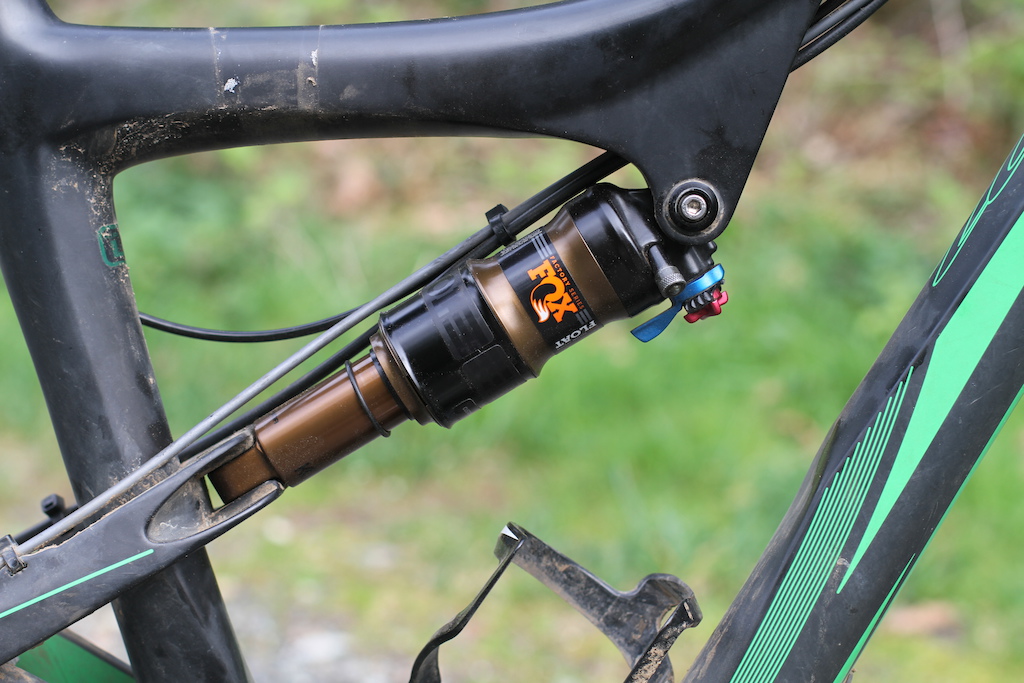 |
FOX has stuffed a lot of changes into a rather small package with their new Float DPS shock. That list includes not only a revamped air spring that's said to provide more supple action, but also an entirely new piston design that should add up to better performance when you need it most. We first showed you a sneak peak of a prototype version of the DPS shock back in February, and it turns out that our guess of it using a longer negative spring rings true, but there are one or two other surprises that were less expected, including the departure of CTD.
Factory Series Float DPS Shock Details
• Intended use: trail / all-mountain
• Open, Medium, Firm compression modes
• Three-position compression in Open mode
• New EVOL air spring
• New Dual Piston System
• Remote compatible
• Intended use: trail / all-mountain
• Open, Medium, Firm compression modes
• Three-position compression in Open mode
• New EVOL air spring
• New Dual Piston System
• Remote compatible
Dual Piston System
FOX's new DPS damper is all about letting you have your cake and eat it too. The design looks exactly as the name likely has you picturing it, with a larger piston overtop of its smaller brother. The two-piston layout allows FOX to separate the modes that riders use most often (Open and Medium) by putting them on the main piston, while the Firm setting (and its requirement to greatly block oil flow in order to function) is on the second piston. FOX says that this separation between Open/Medium and Firm modes allows the former two to perform even better, while the Firm mode can be set even stiffer without compromising how the shock behaves when it's left open.
Just like on the new 34, FOX has abandoned the CTD designation, which makes sense given the new damper layout, but they've also taken the old CTD's supplementary three-position compression setting that used to let riders tweak the Trail mode to their liking and reconfigured it to do the same thing but only in the Open mode.
FOX's new DPS damper is all about letting you have your cake and eat it too. The design looks exactly as the name likely has you picturing it, with a larger piston overtop of its smaller brother. The two-piston layout allows FOX to separate the modes that riders use most often (Open and Medium) by putting them on the main piston, while the Firm setting (and its requirement to greatly block oil flow in order to function) is on the second piston. FOX says that this separation between Open/Medium and Firm modes allows the former two to perform even better, while the Firm mode can be set even stiffer without compromising how the shock behaves when it's left open.
Just like on the new 34, FOX has abandoned the CTD designation, which makes sense given the new damper layout, but they've also taken the old CTD's supplementary three-position compression setting that used to let riders tweak the Trail mode to their liking and reconfigured it to do the same thing but only in the Open mode.
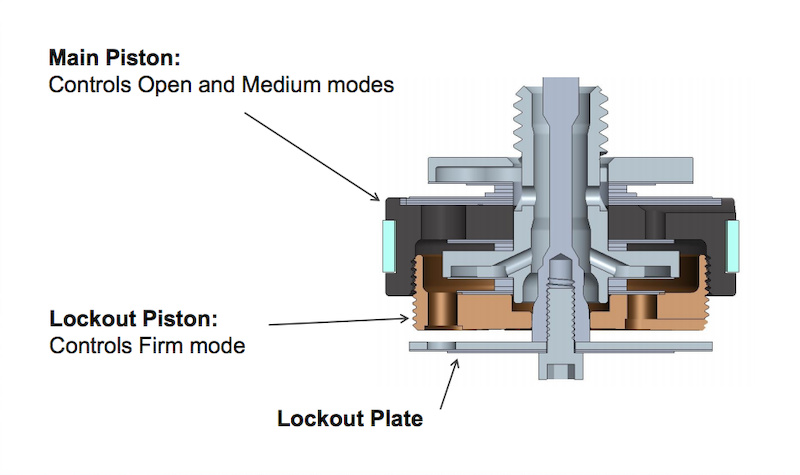
FOX says that moving the Firm mode to a separate piston allows the shock to perform better when it's set to both Open and Medium modes.
EVOL Air Spring
While the new damper updates are hidden inside the shock, the odd looking shape of the shock body is a dead giveaway that FOX has made some changes to the Float's air spring. That black section on the shock body that looks like an add-on is exactly that, a slip-on sleeve that's held in place with a large C-clip to create an extremely long negative air spring. The longer the stroke of the negative spring, the smoother the handoff becomes as the pressure falls off to zero on the negative side and the suspension is completely supported by the main positive side of the air can. This should make for an air-sprung shock that feels quite a bit more active and smoother through its stroke, but especially at the top of the travel. FOX says that the EVOL spring is also more linear and more supportive in the middle of the stroke, which are all things that a lot of trail bikes could benefit from, and the ability to adjust the shock's progression is still possible by adding or subtracting volume spacers.
While the new damper updates are hidden inside the shock, the odd looking shape of the shock body is a dead giveaway that FOX has made some changes to the Float's air spring. That black section on the shock body that looks like an add-on is exactly that, a slip-on sleeve that's held in place with a large C-clip to create an extremely long negative air spring. The longer the stroke of the negative spring, the smoother the handoff becomes as the pressure falls off to zero on the negative side and the suspension is completely supported by the main positive side of the air can. This should make for an air-sprung shock that feels quite a bit more active and smoother through its stroke, but especially at the top of the travel. FOX says that the EVOL spring is also more linear and more supportive in the middle of the stroke, which are all things that a lot of trail bikes could benefit from, and the ability to adjust the shock's progression is still possible by adding or subtracting volume spacers.
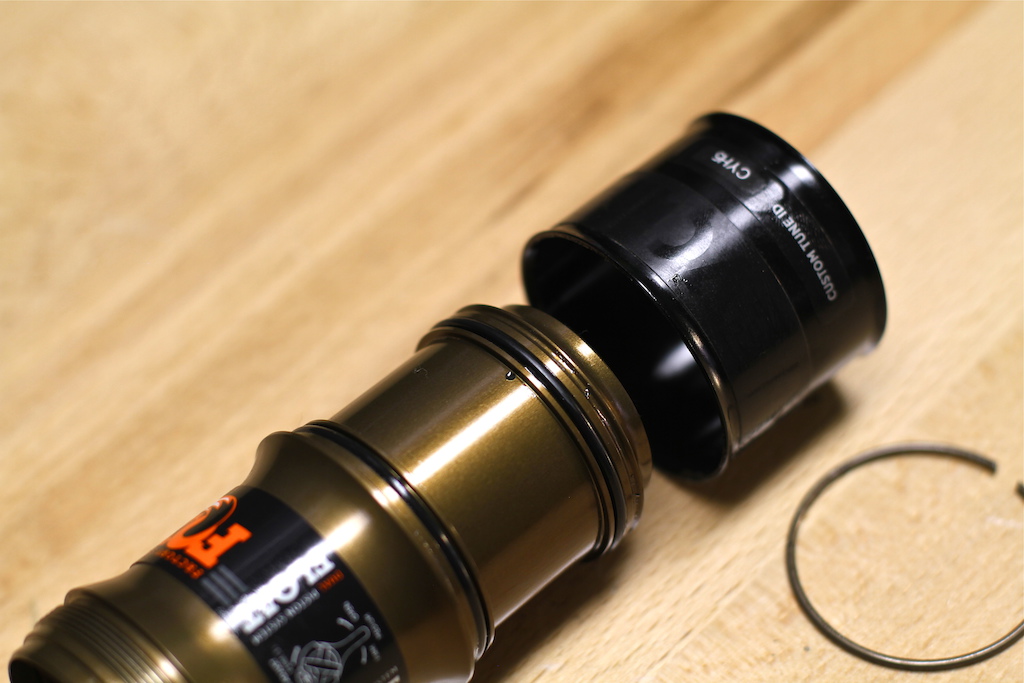
The longer negative spring is underneath the black sleeve, and you can just spot the bleed hole that links the two at the base of the main air can.
Riding the Float DPS Shock
Shocks are a bit of a funny thing to try and review. Forks often have very clear dividing lines in how each different model performs, but because many frames have had their rear suspension designed to perform in a very particular way (think different pivot placements leading to more or less anti-squat, ect), not to mention that they were penned with very specific shock tunes in mind, evaluating how a shock performs on the trail can really only be done on a strict comparison basis. So, that's exactly what I set out to do in order to see if FOX's new Float DPS is a step forward. I had FOX send me two shocks - the new 2016 DPS unit and a Float CTD Trail Adjust from 2015 - both tuned to work with a 120mm travel Ibis Ripley that I'd be bolting them to. Pinkbike is still waiting for our Roehrig dyno to arrive (not really), but this shock vs. shock comparison is the second best option.
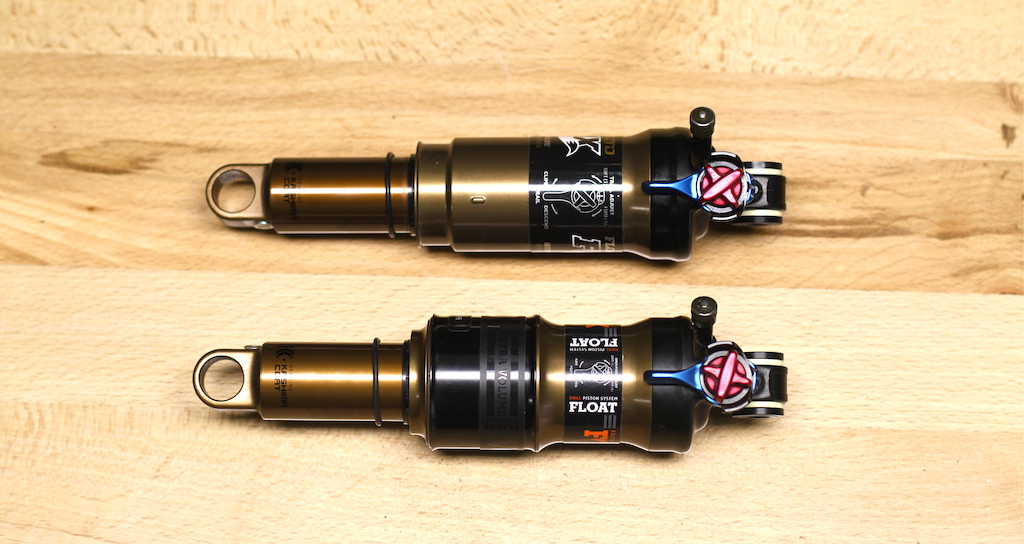 |
 The standard Float CTD Trail Adjust from 2015 shown at the top, and the new Float DPS shock below it, both of which were sent with the stock tunes to work on an Ibis Ripley. Ride, swap, repeat. The standard Float CTD Trail Adjust from 2015 shown at the top, and the new Float DPS shock below it, both of which were sent with the stock tunes to work on an Ibis Ripley. Ride, swap, repeat. |
Air Spring and Sensitivity - The DPS shock's EVOL air can makes it obvious to see which shock is which, and makes for a striking performance difference on the trail as well. First, the added volume of the DPS shock requires much higher air pressures to attain the same sag as the 2015 Float CDT - 220 PSI compared to 170 PSI to end up with the Ripley's recommended 11mm of sag - but that extra 50 PSI doesn't make for a harsher ride. That's because the DPS shock's higher-volume, longer-stroke version of the in-line negative spring goes a long way to balancing the positive spring's static pressure, which sees the initial spring rate start relatively low. This makes for a very coil-like feeling at the top of the stroke, and the DPS shock is noticeably smoother at the top of its travel. It's not life-changing, but I'd equate the added forgiveness to what it feels like if you're running high-volume tires and dropped 4 or 5 PSI out of them - small bumps just feel a touch more muted, and there's the sensation of the bike wanting to stay on the ground a little better. The same could be said for the rest of the stroke as well.
The Ripley features a somewhat linear rear suspension design, not to mention a low-ish bottom bracket height, so it's worthwhile tinkering around with volume spacers if you think you need them. Doing the job is no different between the DPS and the 2015 Float CTD shocks: release the air pressure, unscrew the air can, and then add or remove the spacer as you see fit. I started with one of the smaller spacers, then tried the larger just to see, but I had trouble reaching full travel on all but a single extremely hard impact. I ended up going back to the smaller of the two volume spacers.
It also needs to be said that the DPS shock simply feels more active than its CTD equipped predecessor from last year, which might not be something that all riders are looking for. In my mind, suspension is for keeping your tires glued to the deck in the name of traction, and allowing you to ride faster and with more control, both things that the new EVOL air spring design seems to improve on. Riders who don't want their suspension to feel awesome, or have bikes that might not gel with the EVOL's spring curve, can opt for a standard version of the DPS shock.
Damping - The new Dual Piston System and how it separates the Firm compression mode from Open and Medium is clever, but I suspect that most riders are going to be more impressed by the new air spring rather than the hidden-from-view shim science. That said, the shock felt more active, controlled and impressive than last year's Boost Valve CTD model, which isn't solely down to the EVOL air can. There's also the matter of FOX designing the black three-position compression selector to control the amount of low-speed compression in Open mode rather than in last year's Trail mode on the CTD shock. This change makes a lot of sense for bikes that pedal well because a rider is often just leaving the shock in Open mode all day long, and the three-position LSC option allows for tuning of this without having to flip to the middle setting and sacrificing traction and comfort.
The shock's Medium setting is far from harsh, though, and much like how the new Factory Series Float 34's Medium mode feels more forgiving than CTD's Trail setting ever did, the same can be said of the DPS shock. Again, the air spring obviously plays a role here as well, but the DPS's Medium mode felt more forgiving without handing over any control. Good stuff. The Firm mode is quite firm, as it should be, and most riders are only ever going to reaching for that position when faced with smooth, boring road climbs. Who likes to go up those, anyway?
The shock's Medium setting is far from harsh, though, and much like how the new Factory Series Float 34's Medium mode feels more forgiving than CTD's Trail setting ever did, the same can be said of the DPS shock. Again, the air spring obviously plays a role here as well, but the DPS's Medium mode felt more forgiving without handing over any control. Good stuff. The Firm mode is quite firm, as it should be, and most riders are only ever going to reaching for that position when faced with smooth, boring road climbs. Who likes to go up those, anyway?
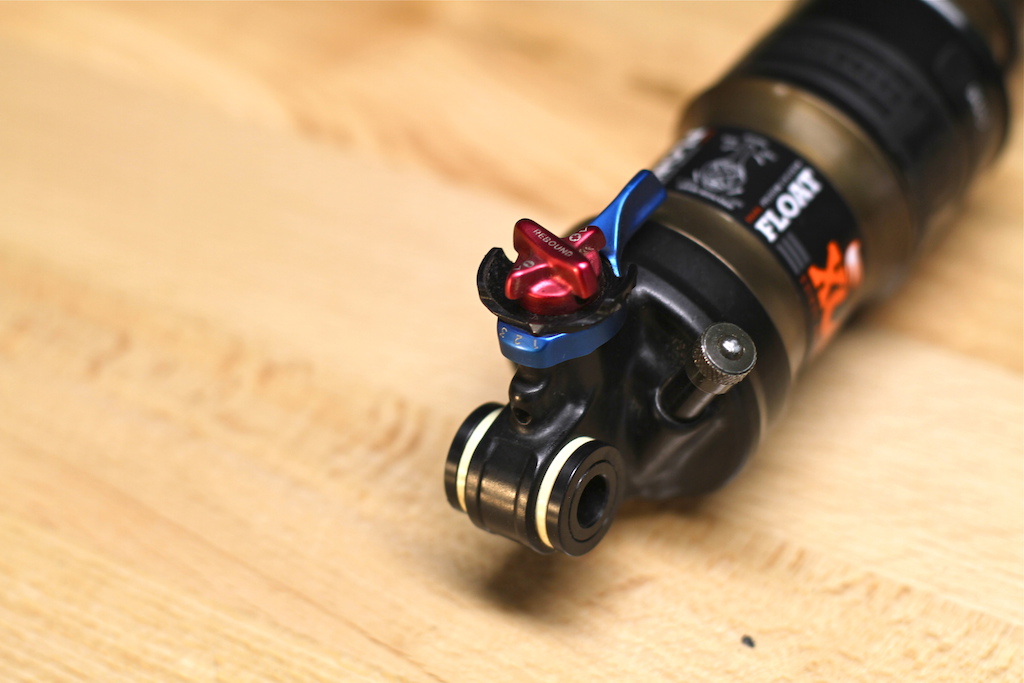
The three-position black selector now controls how much low-speed compression is applied in the Open mode, whereas the old CTD shock saw the same thing applied to the Trail mode.
Pinkbike's Take:
 | I've always said that the less travel you have, the better that travel must be. The challenge, though, is getting a diminutive air-sprung shock to perform better and better every year, especially when you have gram counters out there not willing to take a big hit on the scales in the name of performance. FOX has done that with their new Float DPS, and the new EVOL air spring should get most of the credit here. It added a noticeable amount of suppleness to the 120mm travel bike that I mounted it on, and while I can't exactly measure the gains in traction, I'm confident that it's there. - Mike Levy |

About the Reviewer
Stats: Age: 34 • Height: 5'10” • Inseam: 33" • Weight: 165lb • Industry affiliations / sponsors: None Mike Levy spent most of the 90s and early 2000s racing downhill bikes and building ill-considered jumps in the woods of British Columbia before realizing that bikes could also be pedalled for hours on end to get to some pretty cool places. These days he spends most of his time doing exactly that, preferring to ride test bikes way out in the local hills rather than any bike park. Over ten years as a professional mechanic before making the move to Pinkbike means that his enthusiasm for two wheels extends beyond simply riding on them, and his appreciation for all things technical is an attribute that meshes nicely with his role of Technical Editor at Pinkbike.
Stats: Age: 34 • Height: 5'10” • Inseam: 33" • Weight: 165lb • Industry affiliations / sponsors: None Mike Levy spent most of the 90s and early 2000s racing downhill bikes and building ill-considered jumps in the woods of British Columbia before realizing that bikes could also be pedalled for hours on end to get to some pretty cool places. These days he spends most of his time doing exactly that, preferring to ride test bikes way out in the local hills rather than any bike park. Over ten years as a professional mechanic before making the move to Pinkbike means that his enthusiasm for two wheels extends beyond simply riding on them, and his appreciation for all things technical is an attribute that meshes nicely with his role of Technical Editor at Pinkbike.
Author Info:

 Squamish, BC, Canada
Must Read This Week
vorsprungsuspension.com/products/vorsprung-corset-air-sleeve
The only downside is that the more active suspension sucks the life out of your legs on the climbs (maybe that's mental).
I have been very happy with my Corset can and would recommend to anyone who can't afford the price of a new shock.
For me it was night and day difference, coil-like is a good way to describe it.
Push takes care of the good dampening so i am looking forward to first dirt.
One problem remains though that has not been addressed in the new shock seemingly and cannot be fixed in an existing one: low oil volume which leads to degrading dampening performance very quickly - thus short service intervals. I guess the best option would still be to invest in a bos shock despite everything that cc, rs, fox do.
I only use trail mode on Tarmac, always fully open with a push 10cc volume chip and firm tune 180/160psi depending on content.
ps: all the above sound like im collecting old stuff
I'm just sayn big ol picture wise, big bikes are lil overkill...short travel looks promising now that reviews say they don't blow thru travel, 140 34 or pike on proper bikes like an evil following, intense spyder, transition, gt sensor..mtb is goin off!
www.bikerumor.com/2015/03/31/fox-launches-new-line-of-34-trail-forks-float-dps-shock-evol-air-sleeve-plus-interview-with-mark-jordan
Get the Corset.
www.bikerumor.com/2015/03/31/fox-launches-new-line-of-34-trail-forks-float-dps-shock-evol-air-sleeve-plus-interview-with-mark-jordan
BIKERUMOR: Will the EVOL be available as an after market upgrade?
The EVOL air can is only available on 2016 product right now because the damping tune needs to match the character of the air spring.