Tech Tuesday – Wider Rims Are Better and Why Tubeless Tires Burp Air
Normally, this spot is designated for a how-to feature, but we are going to break tradition for this Tech Tuesday and cover some new ground with a think piece on how rim width affects tubeless tire performance. If you don’t care about tubeless tires and future rim design, then this one may not be for you. If you are running tubeless, or have an interest, then I invite you to consider that significantly wider rim designs are the future of tubeless in all disciplines of the sport.
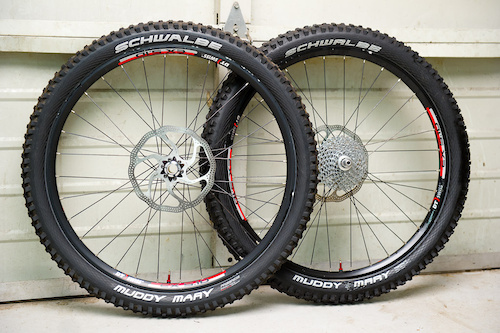
![photo]() We mounted a set of monster-sized Schwalbe Muddy Mary tires to 21-millimeter (ID) DT Swiss EX 5.1D rims and burped them right away at 35 PSI - a pressure that makes a 2.4 inch tire almost rock hard. Big tires on narrow rims - bad. The same tires rocked on 25-millimeter (ID) AM wheels. Big tires on wide rims - good.
We mounted a set of monster-sized Schwalbe Muddy Mary tires to 21-millimeter (ID) DT Swiss EX 5.1D rims and burped them right away at 35 PSI - a pressure that makes a 2.4 inch tire almost rock hard. Big tires on narrow rims - bad. The same tires rocked on 25-millimeter (ID) AM wheels. Big tires on wide rims - good.
Burping Air
Burping air happens when lateral forces on the wheel distort the tire and momentarily unseat the tire’s bead. The tire loses about half its pressure and then the bead magically reseats, leaving the hapless rider with a tire that is neither full nor flat – and absolutely useless for riding purposes.
Having been a first adopter of tubeless, I have experienced the litany of complaints about the subject that readers have posted on Pinkbike, and can say with confidence that two percent are valid technical issues and the lion’s share are generated by well meaning blokes attempting to air up a tire designed by someone who doesn’t give a damn about tubeless, on a wheel that was manufactured by his evil twin. Burping air, however is a complaint that is aired by the most respected riders and mechanics in the sport.
This article is not about wrestling with the impossible. It’s about proper tubeless rim and tire combinations, and a suggestion that we dump the narrow rim standard that cross-country riders adopted in the 1980s. The skinny rim was probably a mistake – especially for tubeless users.
Watch Mavic's Short Video That Explains the UST Tubeless Tire and Rim Interface
First, A Word About UST
Universal System for Tubeless is a patented interface between the tire and rim, as well as a set of standards that determine utilitarian functions. A UST tire has a square bead that interlocks to a matching groove in the rim flange and its inside has a layer of sealing rubber to allow it to be aired up and run dry. Among other items, the standard requires that the tire be mounted and aired up by hand or with minimal tools. Watch the Mavic video shown above to see how UST works. The bottom line is that UST is tough to beat for reliability and ease of use. It’s the best tubeless system in the bike industry by a long margin. If you ride XC or trail and run UST wheels and UST tires up to 2.3 inches, you probably won’t experience many of the problems outlined in this test. Presently, you can’t beat the UST system for hassle-free tubeless, but the best can always be improved upon.
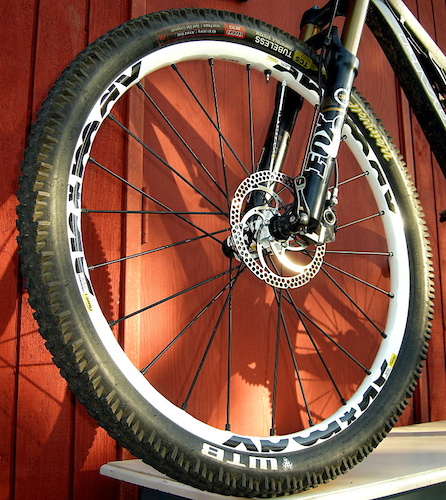
![Mavic SX wheel and Weirwolf tire]() Mavic's Crossmax SX rim measures 21 millimeters inside to inside and is a UST certified tubeless design. The WTB Weirwolf tire is a 'Tubeless Ready' design the requires sealant. When we mounted it to the wider rim, it changed the profile of the 2.3-inch tire and improved its cornering performance.
Mavic's Crossmax SX rim measures 21 millimeters inside to inside and is a UST certified tubeless design. The WTB Weirwolf tire is a 'Tubeless Ready' design the requires sealant. When we mounted it to the wider rim, it changed the profile of the 2.3-inch tire and improved its cornering performance.
Why Rims Need to Be Wider
There are a number of valid reasons that make wider rims a good idea. This is my short list:
• Weight savings is number one. Consider the tire and wheel as an integrated unit. The tire weighs much more than the rim, so a wider rim, though slightly heavier, adds volume to the tire without adding additional rubber and tire casing. This could be especially beneficial to 29ers because the big wheel already spins way too much rubber.
• Stability is another. Wider rims add a significant amount of lateral support to a tire – especially large-volume tires like the 2.35 and 2.4-inch rubber that has become regular fare for XC/Trail and AM riders. A tire casing could be made lighter weight and boosting the tire’s lateral stability should eliminate burping.
• A wider rim puts more of the tread in contact with the ground in a straight line and while cornering because the tread deflects less dramatically under lateral loads and remains more parallel to the rim.
• Finally, advances in materials like carbon fiber and aluminum alloys have made it possible to manufacture wider rim profiles without significant weight penalties.
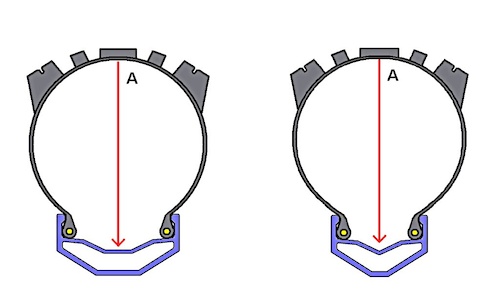
![drawing one]() "Bicycles make their own gravity" a cycling luminary once told me. Because it must be leaned to turn, the loads almost always go through the contact patch (A) and up center-line of the tire and wheel. In normal riding mode, both wide and narrow rims can equally handle the stress.
"Bicycles make their own gravity" a cycling luminary once told me. Because it must be leaned to turn, the loads almost always go through the contact patch (A) and up center-line of the tire and wheel. In normal riding mode, both wide and narrow rims can equally handle the stress.
What We Know From Experience
Experience has shown that switching from skinny, 22-millimeter (OD) rims to 27 -millimeter (OD) width versions dramatically increases the lateral stability of a wheel and tire in corners and in technical terrain. Riders who could burp 22 millimeter tubeless wheels simply by pounding out a climb out of the saddle can hammer away on 27 millimeter rims and never lose pressure. That is a delta of only three millimeters. Once the realm of downhill and freeride, 28 - 30+ millimeter width tubeless rims are now appearing in trail-riding weights. Lightweight high-volume tires like the 2.4-inch Schwalbe Rocket Ron might feel wiggly on narrow rim, but they shred on a wider profile wheel like the Mavic CrossMax SX. I found I can run one size smaller tire casing on a wider rim and it feels like a completely different tire. The 2.3-inch WTB Weirwolf comes to mind. So that got me thinking.
Why Narrow Rims and High-Volume Tires Are Bad for Tubeless
A tire may be made from a flexible material, but once it is pressurized, it acts much like a solid object to a surprising degree. Sure, it can flex and rebound when deflected, but the casing is quite stiff and when you put a lateral load on the wheel, one side of the tire tries to lever the opposite side off the rim. Clamp the tire in a vice and pull the wheel towards you and discover for yourself.
Physics dictates that the same sized tire imparts more leverage on a narrower rim than on a wider one. This probably accounts for the feeling of instability when aggressively riding large-casing tires on narrow rims. The difference of three to five millimeters in rim width only amounts to about an 18-percent change in the moment arm (leverage) of a 2.4-inch tire acting between the rim flanges. The abrupt feeling of a tubeless tire folding underneath you and burping air is a far more dramatic event than an 18-percent difference in lateral stability. There had to be more to the puzzle.
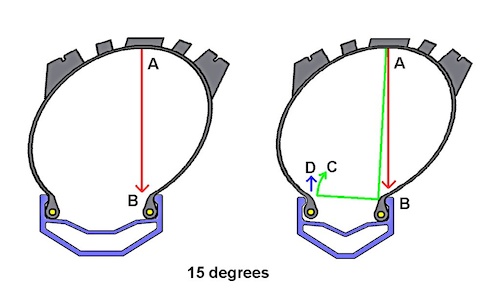
![Drawing two]() The imaginary tires and rims are flexed laterally at 15 degrees to illustrate that the contact patch (A) has shifted to the right. The wider rim's contact patch is still comfortably within the confines of the rim flanges (B), while the contact patch of the narrow rim has shifted to the danger zone over the right flange. The Green lines depict the moment arms of the tire and its fulcrum point at the top of the rim flange exerting an upward force (C) on the opposite bead (D). The tire probably would hold pressure at this point.
The imaginary tires and rims are flexed laterally at 15 degrees to illustrate that the contact patch (A) has shifted to the right. The wider rim's contact patch is still comfortably within the confines of the rim flanges (B), while the contact patch of the narrow rim has shifted to the danger zone over the right flange. The Green lines depict the moment arms of the tire and its fulcrum point at the top of the rim flange exerting an upward force (C) on the opposite bead (D). The tire probably would hold pressure at this point.
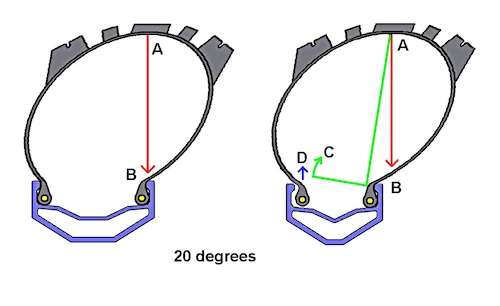
Turns out there may be another culprit that may be to blame for the thorn in the side of tubeless. All pneumatic tires flex from side to side under lateral load shifts – it’s in their nature. One reason that wider rims give tires more lateral support is that a wider rim ensures that the tire’s contact point hovers between the rim flanges. It is possible for a tire’s contact point to migrate outside the rim flanges and in such case, the line of force between the tire and rim would go over-center. In the same way that a quick-release lever generates an exponential amount of clamping force when it goes over-center as it is closed, once the tire’s contact patch moves outside of the width of the rim flanges, the tire’s ability to support the rider is significantly reduced, while the leverage it imparts to lift the opposite side bead from the rim would substantially increase. This effect would explain the feeling of a tubeless tire burping – the tire suddenly collapsing under the weight of the rider or the G-force of a turn and then losing pressure. Of course, a narrow tire could not flex far enough to allow the contact patch to get near the danger zone, but a big, flexible 2.35-inch tire on a 22-millimeter (OD) cross-country rim certainly could.
![drawing three]() At 20 degrees of imaginary lateral distortion, the wide-rim tire's contact point is just nearing the danger zone over the rim flange (B), but it can still support a load. The narrow rim's tire has flexed to the point where the contact patch is over center (B) and the bending forces are creating tension across the tire casing which pulls on the opposite bead, drawing it up and away from the rim flange (D). The seal has been broken and air may be already leaking.
At 20 degrees of imaginary lateral distortion, the wide-rim tire's contact point is just nearing the danger zone over the rim flange (B), but it can still support a load. The narrow rim's tire has flexed to the point where the contact patch is over center (B) and the bending forces are creating tension across the tire casing which pulls on the opposite bead, drawing it up and away from the rim flange (D). The seal has been broken and air may be already leaking.
Why Wider Rims Are the Future of Tubeless
So, by now it seems clear that, if a slightly wider rim is good, perhaps a much wider rim could offer even more benefits. In the illustrations that I drew up, I exaggerated the widths of the rims to give a clearer view of the concept – that the first benefit of wider rims for tubeless is to reduce the moment arm between the tire and the bead interface. Secondly and perhaps more important, the wider rim keeps the tire’s contact patch between the confines of the rim flanges under high deflections. Considering that a wider rim is proven to reduce the effects of lateral forces on a tire, it is unlikely that the tire on the wider rim would distort equally as I depicted in the comparison to the narrow-profile rim.
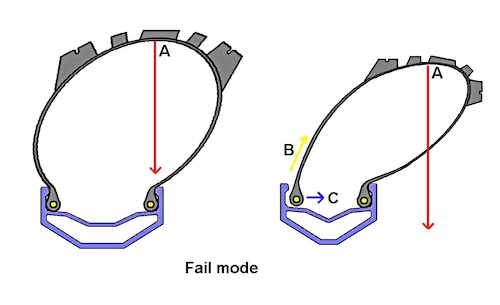
![Drawing four]() Still at 20 degrees, when we add more down force on the tires, the one on the wider rim can still transfer the extra load to the wheel because its contact point is hovering over the rim. Only a small amount of additional down-force collapses the tire on the narrow rim, pulling the opposing bead away from the rim flange and spraying bystanders with a noxious combination of crusty old Stan's sealant and sweat infused floor pump air. With the pressure reduced, the tension is relaxed from the tire casing and the bead returns to the sealed position against the rim.
Still at 20 degrees, when we add more down force on the tires, the one on the wider rim can still transfer the extra load to the wheel because its contact point is hovering over the rim. Only a small amount of additional down-force collapses the tire on the narrow rim, pulling the opposing bead away from the rim flange and spraying bystanders with a noxious combination of crusty old Stan's sealant and sweat infused floor pump air. With the pressure reduced, the tension is relaxed from the tire casing and the bead returns to the sealed position against the rim.
Another potential that a wider rim may bring is a suppler ride over small bumps, and at higher pressures than expected. Tests with wider rims and similar road tires by Mavic and HED shows that the subtle change in the tire’s profile made a dramatic improvement in its performance. The switch from the classic “lightbulb” clincher shape created by confining the tire within a narrow rim, to one resembling a continuous arch made a dramatic reduction in rolling resistance over rough pavement at any tire pressure value. Cornering performance was also significantly better. Similar gains are.probable with mountain bike tires as the tire casing scribes a more relaxed arch over a wider rim, and can flex in a more uniform pattern when the tire is deflected.
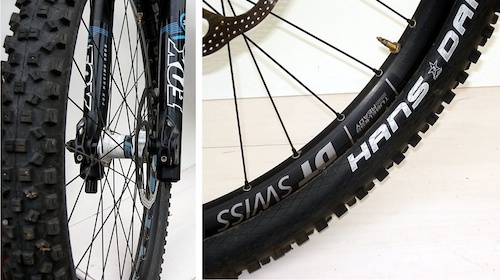
![DT Swiss AM wheel and Hans Damf tire]() The 2.35-inch Schwalbe Hans Dampf is perfectly matched with the DT Swiss AM 10 rim. It mounts up with a hand pump and rides like it's on rails. This matchup is standard fare on the 2012 Scott Genius LT.
The 2.35-inch Schwalbe Hans Dampf is perfectly matched with the DT Swiss AM 10 rim. It mounts up with a hand pump and rides like it's on rails. This matchup is standard fare on the 2012 Scott Genius LT.
TubelessTips For Today's Riders
What all this information suggests is that riders who run tubeless and plan to use UST or tubeless ready tires larger than 2.125 inches should consider pairing them with tubeless compatible rims with an inner flange-to-flange measurement between 21 to 25 millimeters. A number of lightweight AM wheels in that category exist from Easton, Mavic, DT Swiss and Wilderness Trailbikes. After testing numerous combinations, we know for a fact that the wide format pays massive dividends in the handling department, and the tubeless fuss factor is reduced to almost zero. As far as getting rid of the burp, we recently ran 2.4-inch Schwalbe Muddy Marys on a set of old-school narrow DT Swiss XC wheels and they burped flat at 35 psi. We shredded for a few months on the same tires, mounted to wide-format DT Swiss All Mountain wheels without a single fault. The weight penalty of the wider rm seems insignificant when balanced against its performance gains.
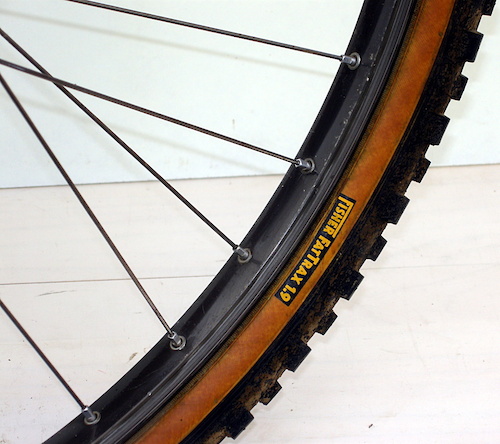
![Bontrager Mavic re-roll]() This is an original Keith Bontrager re-rolled Mavic road racing clincher rim mounted to a Fisher (the real one) 1.9-inch Fattrax skin-wall tire - a popular XC racing tire in the mid 1980s. This is the rim that spawned the skinny, 22-millimeter (OD) mountain bike standard. Keith cut some of the circumference from a 700C 36-hole rim and rolled it smaller to make a 32-hole 26er rim. The Mavic rim is pressed together over an internal sleeve.
This is an original Keith Bontrager re-rolled Mavic road racing clincher rim mounted to a Fisher (the real one) 1.9-inch Fattrax skin-wall tire - a popular XC racing tire in the mid 1980s. This is the rim that spawned the skinny, 22-millimeter (OD) mountain bike standard. Keith cut some of the circumference from a 700C 36-hole rim and rolled it smaller to make a 32-hole 26er rim. The Mavic rim is pressed together over an internal sleeve.
So, Where Do We Go From Here?
The old school 22-millimeter (OD) rim was a product of Keith Bontrager cutting and then re-rolling Mavic road clincher rims to fit 26 inch MTB tires. His creations were so lightweight that it was an overnight game-changer. Every brand that made or wanted to make a mountain bike wheel copied Bontrager’s re-rolled 700C hoops. Nobody really thought it through. Then, however, a 2.125-inch tire was considered huge and tubeless was only a dream. Tire technology has advanced so far, it’s a wonder why rim makers have only recently responded – and who beyond UST has considered tires and wheels to be an integrated system?
For the near future, I say the wider the better. Considering that carbon fiber rims are well proven and silly light, the possibility of an XC race-competitive rim at 23 millimeters between flanges is easily attainable, and rims in the upper 30s – maybe mid 40s – for AM and DH might be the game changers of 2013. If there’s anyone out there making custom rims, I’m thinking that 28 to 30 millimeters is the perfect width for trail riding. Make mine tubeless, please.
Final Notes
It's worth repeating that this Tech Tuesday is based upon my observations and theories in an effort to get an industry wide dialogue started to explore the possibility that wider rims are a better format for tubeless and to investigate the performance potential for significantly wider rims for all modes of MTB riding. I'd love to hear any opinions or theories that relate to the subject. So please weigh in. - RC
Past Tech Tuesdays:
Visit Parktool.com to see their entire lineup of tools and lubes
Burping Air
Burping air happens when lateral forces on the wheel distort the tire and momentarily unseat the tire’s bead. The tire loses about half its pressure and then the bead magically reseats, leaving the hapless rider with a tire that is neither full nor flat – and absolutely useless for riding purposes.
Having been a first adopter of tubeless, I have experienced the litany of complaints about the subject that readers have posted on Pinkbike, and can say with confidence that two percent are valid technical issues and the lion’s share are generated by well meaning blokes attempting to air up a tire designed by someone who doesn’t give a damn about tubeless, on a wheel that was manufactured by his evil twin. Burping air, however is a complaint that is aired by the most respected riders and mechanics in the sport.
This article is not about wrestling with the impossible. It’s about proper tubeless rim and tire combinations, and a suggestion that we dump the narrow rim standard that cross-country riders adopted in the 1980s. The skinny rim was probably a mistake – especially for tubeless users.

First, A Word About UST
Universal System for Tubeless is a patented interface between the tire and rim, as well as a set of standards that determine utilitarian functions. A UST tire has a square bead that interlocks to a matching groove in the rim flange and its inside has a layer of sealing rubber to allow it to be aired up and run dry. Among other items, the standard requires that the tire be mounted and aired up by hand or with minimal tools. Watch the Mavic video shown above to see how UST works. The bottom line is that UST is tough to beat for reliability and ease of use. It’s the best tubeless system in the bike industry by a long margin. If you ride XC or trail and run UST wheels and UST tires up to 2.3 inches, you probably won’t experience many of the problems outlined in this test. Presently, you can’t beat the UST system for hassle-free tubeless, but the best can always be improved upon.
Why Rims Need to Be Wider
There are a number of valid reasons that make wider rims a good idea. This is my short list:
• Weight savings is number one. Consider the tire and wheel as an integrated unit. The tire weighs much more than the rim, so a wider rim, though slightly heavier, adds volume to the tire without adding additional rubber and tire casing. This could be especially beneficial to 29ers because the big wheel already spins way too much rubber.
• Stability is another. Wider rims add a significant amount of lateral support to a tire – especially large-volume tires like the 2.35 and 2.4-inch rubber that has become regular fare for XC/Trail and AM riders. A tire casing could be made lighter weight and boosting the tire’s lateral stability should eliminate burping.
• A wider rim puts more of the tread in contact with the ground in a straight line and while cornering because the tread deflects less dramatically under lateral loads and remains more parallel to the rim.
• Finally, advances in materials like carbon fiber and aluminum alloys have made it possible to manufacture wider rim profiles without significant weight penalties.
What We Know From Experience
Experience has shown that switching from skinny, 22-millimeter (OD) rims to 27 -millimeter (OD) width versions dramatically increases the lateral stability of a wheel and tire in corners and in technical terrain. Riders who could burp 22 millimeter tubeless wheels simply by pounding out a climb out of the saddle can hammer away on 27 millimeter rims and never lose pressure. That is a delta of only three millimeters. Once the realm of downhill and freeride, 28 - 30+ millimeter width tubeless rims are now appearing in trail-riding weights. Lightweight high-volume tires like the 2.4-inch Schwalbe Rocket Ron might feel wiggly on narrow rim, but they shred on a wider profile wheel like the Mavic CrossMax SX. I found I can run one size smaller tire casing on a wider rim and it feels like a completely different tire. The 2.3-inch WTB Weirwolf comes to mind. So that got me thinking.
Why Narrow Rims and High-Volume Tires Are Bad for Tubeless
A tire may be made from a flexible material, but once it is pressurized, it acts much like a solid object to a surprising degree. Sure, it can flex and rebound when deflected, but the casing is quite stiff and when you put a lateral load on the wheel, one side of the tire tries to lever the opposite side off the rim. Clamp the tire in a vice and pull the wheel towards you and discover for yourself.
Physics dictates that the same sized tire imparts more leverage on a narrower rim than on a wider one. This probably accounts for the feeling of instability when aggressively riding large-casing tires on narrow rims. The difference of three to five millimeters in rim width only amounts to about an 18-percent change in the moment arm (leverage) of a 2.4-inch tire acting between the rim flanges. The abrupt feeling of a tubeless tire folding underneath you and burping air is a far more dramatic event than an 18-percent difference in lateral stability. There had to be more to the puzzle.
Turns out there may be another culprit that may be to blame for the thorn in the side of tubeless. All pneumatic tires flex from side to side under lateral load shifts – it’s in their nature. One reason that wider rims give tires more lateral support is that a wider rim ensures that the tire’s contact point hovers between the rim flanges. It is possible for a tire’s contact point to migrate outside the rim flanges and in such case, the line of force between the tire and rim would go over-center. In the same way that a quick-release lever generates an exponential amount of clamping force when it goes over-center as it is closed, once the tire’s contact patch moves outside of the width of the rim flanges, the tire’s ability to support the rider is significantly reduced, while the leverage it imparts to lift the opposite side bead from the rim would substantially increase. This effect would explain the feeling of a tubeless tire burping – the tire suddenly collapsing under the weight of the rider or the G-force of a turn and then losing pressure. Of course, a narrow tire could not flex far enough to allow the contact patch to get near the danger zone, but a big, flexible 2.35-inch tire on a 22-millimeter (OD) cross-country rim certainly could.
Why Wider Rims Are the Future of Tubeless
So, by now it seems clear that, if a slightly wider rim is good, perhaps a much wider rim could offer even more benefits. In the illustrations that I drew up, I exaggerated the widths of the rims to give a clearer view of the concept – that the first benefit of wider rims for tubeless is to reduce the moment arm between the tire and the bead interface. Secondly and perhaps more important, the wider rim keeps the tire’s contact patch between the confines of the rim flanges under high deflections. Considering that a wider rim is proven to reduce the effects of lateral forces on a tire, it is unlikely that the tire on the wider rim would distort equally as I depicted in the comparison to the narrow-profile rim.
Another potential that a wider rim may bring is a suppler ride over small bumps, and at higher pressures than expected. Tests with wider rims and similar road tires by Mavic and HED shows that the subtle change in the tire’s profile made a dramatic improvement in its performance. The switch from the classic “lightbulb” clincher shape created by confining the tire within a narrow rim, to one resembling a continuous arch made a dramatic reduction in rolling resistance over rough pavement at any tire pressure value. Cornering performance was also significantly better. Similar gains are.probable with mountain bike tires as the tire casing scribes a more relaxed arch over a wider rim, and can flex in a more uniform pattern when the tire is deflected.
TubelessTips For Today's Riders
What all this information suggests is that riders who run tubeless and plan to use UST or tubeless ready tires larger than 2.125 inches should consider pairing them with tubeless compatible rims with an inner flange-to-flange measurement between 21 to 25 millimeters. A number of lightweight AM wheels in that category exist from Easton, Mavic, DT Swiss and Wilderness Trailbikes. After testing numerous combinations, we know for a fact that the wide format pays massive dividends in the handling department, and the tubeless fuss factor is reduced to almost zero. As far as getting rid of the burp, we recently ran 2.4-inch Schwalbe Muddy Marys on a set of old-school narrow DT Swiss XC wheels and they burped flat at 35 psi. We shredded for a few months on the same tires, mounted to wide-format DT Swiss All Mountain wheels without a single fault. The weight penalty of the wider rm seems insignificant when balanced against its performance gains.
So, Where Do We Go From Here?
The old school 22-millimeter (OD) rim was a product of Keith Bontrager cutting and then re-rolling Mavic road clincher rims to fit 26 inch MTB tires. His creations were so lightweight that it was an overnight game-changer. Every brand that made or wanted to make a mountain bike wheel copied Bontrager’s re-rolled 700C hoops. Nobody really thought it through. Then, however, a 2.125-inch tire was considered huge and tubeless was only a dream. Tire technology has advanced so far, it’s a wonder why rim makers have only recently responded – and who beyond UST has considered tires and wheels to be an integrated system?
For the near future, I say the wider the better. Considering that carbon fiber rims are well proven and silly light, the possibility of an XC race-competitive rim at 23 millimeters between flanges is easily attainable, and rims in the upper 30s – maybe mid 40s – for AM and DH might be the game changers of 2013. If there’s anyone out there making custom rims, I’m thinking that 28 to 30 millimeters is the perfect width for trail riding. Make mine tubeless, please.
Final Notes
It's worth repeating that this Tech Tuesday is based upon my observations and theories in an effort to get an industry wide dialogue started to explore the possibility that wider rims are a better format for tubeless and to investigate the performance potential for significantly wider rims for all modes of MTB riding. I'd love to hear any opinions or theories that relate to the subject. So please weigh in. - RC
Past Tech Tuesdays:
Visit Parktool.com to see their entire lineup of tools and lubes
Author Info:

Must Read This Week
Sign Up for the Pinkbike Newsletter - All the Biggest, Most Interesting Stories in your Inbox
PB Newsletter Signup
And XC rims are not DH rims. Old school XC and "multi purpose" rims SUCKED. the DH rims were awsome, minus a few, such as the double wides.
And cool stuff on the 25 years of riding. DH how we have it now only existed from the mid 90's and on, all before was fireroads and typical old school riding.
Watch the vids of the Avalanche mTn forks and you will quickly see the conditions real old downhillers rode in with their old school rims.
Ive been racing shimano xt tubeless wheels with mavic tubeless tires for 3 years now, Never flatted, and I DO NOT run sealant. Means I pump my tires up before most rides, but you should be checkin your tire pressure anyways right?
Read the article more closely. We are discussing UST systems that are designed to "run dry", (ie. no sealant), and not retro/ghetto tubeless systems.
And cheaper? How? Tubless tires are much more than tubed tires, and being you can get crazy dh or good thorn resistant tubes that cost about 10$ of less these days, I don't see how they are cheaper, being the tire life is exactly the same btw the two, so with the additional cost being even more than the difference btw tubes and tubeless I don't see how it's cheaper. Also, people rarely blow out front tires, and many times can use the same tube for multiple - many tire changes.
\ /
\ /
\ /
\---/
I've been a huge fan of wide rims since Salsa brought out their 28mm Delgado Disc (sp) about 5 yrs ago. I can't see going back even with slight a weight penalty.
In my tubeless experience, I have yet to run UST (too much cost and too many limitations of choice), but have used Stan's rims, (my fav. the 29" FLOW) with ZERO issues. I've used tires from Maxxis, Panaracer, and Kenda without issue.
A plus, I love being able to run 2.1 tire and having them fit 28-30mm rims with increased volume that you think you are on 2.3's!
The traction you get running pressures of 20 - 23psi in gnarly East Coast terrain at 210lbs is a huge beni too.
I can't wait to have the funds to built up some XC 35-36mm rims.
I'm not convinced on tubeless for DH, especially for the rear tire. Seen too many failures and it's an embarrassing mess to be associated with. It's not like xc where you have a tube and a pump and can fix it on the spot.
Also, what about all the Stans fluid being spilled out of tubeless tires onto the forest ground when people get flats and have to put a tube in. Especially with 29ers or AM bikes that have 2 or 3 cups in them. It is probably pretty bad for life in the ground and the run off I'm guessing. I haven't heard a any discussion about this, but it should be a concern for ecologically-minded mountain bikers.
Actually I run same rims, DT EX 5.1D and Bontrager's XR4 2.35 tires converted into tubeless (with tape and sealant) and I run them at 30 PSI (as written on them as a minimal recommended pressure). Once I had a quick burp on front wheel and now I'm not so confident in that solution.
So I just thinking about Crossmax SX, but will they help against burping with tha same rim width as DT 5.1D?
I also tried to run tubeless on my DH bike this year (combination of Deemax and UST Minion), and have to say I'm not really so much confident in them after few burps on rear wheel.
I have the same rims and set mine up using 2 wraps of 1" wide Guerilla duct tape.. It's thick, and slightly textured from the inner fibers, especially when compressed.. I believe that the added thickness help it to stay in place.. When the bead puts pressure on the tape, it compresses, creating an additional seal holding the bead in place.. after time, this acts like the split inner-tube on a traditional Ghetto set up..
I'll bet you a pack of FishClips ( www.shrockie.com ) that if you mounted the Muddy Mary's onto the same rims with 2 wraps of Guerilla duct tape ($2.50 roll at home depot) that they stay in place under the same conditions.. here's a link to a vid I shot to show friends. if they burp, send me an address.. =)
www.facebook.com/video/video.php?v=2517657694375
my impression, and I may be wrong, is that the tire 'pops' when seating because the bead has pressure on the inner diameter of the rim, so it resists seating.. once there's enough air pressure to overcome the resistance, they forcefully slide into place and make the sound..
My thinking was: if there's a little extra pressure between the bead and the wheel, that will help things stay in place.. kind of like the original Stan’s strips, but in a cheaper version that doesn’t require tossing the gunked up strip in your pack if you get a flat.
Thanks again for the input. Cheers - Joel
That said, for clean riding or just anyone who has some skill, it could work (we've all seen that), but when making mistakes, or probably on landing large jumps I'll rather wait for something more forgiving.
About rims width, I've used to run 23mm, now I'm down on 21mm and can't notice it, but that'll come with time i guess..
All that being said, I run a 28mm I9 EN wheelset and ride it hard, no problems. The weight savings of a 24mm rim are not worth the potential hassle of losing air even once IMO.
Has anyone got any experience with Muddy Marys in wire bead being used tubeless ? I bought mavic EX823's with mind to going tubeless but could not be bothered with swapping tires all the time , now I have found these Muddy Marys which have turned out to be a true all year round tire.
Previously I ran Crossmax SX (UST) with UST tires and it requires no 'juice' but mounting requires a compressor; I needed to inflate to 70psi to get them to snap on to the rim. Once on it was great... then...
... Maxxis came out with my favorite DH tire, the Minion, in a single ply 850g tire 2.5". For an AM bike, this is the perfect front tire. But, no UST option without gaining a pound in the tire. So I was back to tubes just so i could run this tire.
Now I have Stans rims (not UST) they are made for regular tires (read: lighter and more options and I can run my EXO tubeless!) and yes with messy juice but overall performance is awesome. I now have DH feeling grip with near XC weight. So good.
I know of guys that run this on their DH bikes for the resort riding for jump trails; light wheels make H U G E difference to your ride. There is nothing I can think of that has a bigger impact to the feel of your bike and ability to go fast with confidence.
Great topic.
-wider rims are better
-UST works, choose your tires carefully, triple compound tires give you more flexabillity, folding something that should be round and stuffing it in a square box WTF.
-reducing grams is expensive in MTB, but the gains can be rewarding, especially when you focus on unsprung weight like your wheels and tires, just don't forget that stability and traction are priceless.
-Thanks Tech Tuesday for addressing this very very important issue, I would love to here more in the future.
Run "Ghetto Tubless" on my kids DH race wheels on Syncros DPS32 rims and never had a pinch flat or burp in 2 years or so. Put tubes in their thrash wheels and get pinch flats even with good pressures
Only just saying today that I'm going to run even those ghetto
It's a cheap simple alternative that works, rather than converting to proper tubeless rims and tyres.
and if you need to fix a tire on the trail? good luck getting a ghetto tubless setup redone
Read and make an effort to 'comprehend' what has been written rather than just flame it.
Take note of what I wrote.
* DH race wheels. (not out on a trail in the middle of nowhere)
* No pinch flats or burps in 2 years + (who carries a tube and changes it on the side of the track mid run at a DH race anyway)
Fair to say that there is NO issue here at all.
It's a race meet so I take spares.
If they cut a tyre which has happened before I put in a spare wheel.
If they are having that bad a weekend with cutting tyres I put on a new tyre with a tube.
Oh, and as for the name, who cares what it is. You do not know the story behind it anyway.
I understand what you are saying, but will have to disagree.
Both my lads are around the 100kg mark and hammer down a DH track, corners, berms jumps and drops anything and never rolled a tyre.... We have tried it and found it to be more than successful and will continue to run them that way.
I can only think that anyone having trouble may not be seating the tyre initially with a high enough pressure before putting in the latex, wrong tyre pressure or wrong mix of latex/water.
But hey, each to their own what works for some may not for others
I'm already on wider rims, but when I saw that part about going wide for weight weenie purposes... LMAO.
• Stability is another. Wider rims add a significant amount of lateral support to a tire – especially large-volume tires like the 2.35 and 2.4-inch rubber that has become regular fare for XC/Trail and AM riders. A tire casing could be made lighter weight and boosting the tire’s lateral stability should eliminate burping."
I am arguing the content and, to better understand it, you need to know where the author is coming from. RC is talking about XC/trail/AM. He doesn't make any true mention of DH nor 2.5 tires, besides predicting 30-49 rim widths.
You say you *think* a 2.35 tire on a wider rim is better than a 2.5 tire on a narrower rim. Put some numbers to those rim sizes--should I assume 24mm inner width for the 2.35 tire and some 19mm inner width for the 2.5 tire or 25mm inner width rim for the 2.5 tire and a 28mm inner width rim for the 2.35? I said I find it hard to believe that you can enjoy a better tire performance from downsizing a tire and putting it on a wider rim, with weight savings in mind. The tire performance will go down and putting it on a wider rim will not restore that performance; you can't say restore, since it won't ride like the 2.5 tire. It will *alter* the performance, but whether that's good or not is up to the user. What you're trying to argue is that it's optimal for a specific use, such as what you see as AM/enduro type riding.
It's best to ask true experts, such as tire R&D team members, rather than rely on some journalist or some random nobodies. They have the scientific knowledge to understand the properties of everything that goes into a tire and the tools to confirm it.
Here is an illustration of the cross section of a tire mounted on various width rims:
www.pinkbike.com/photo/7493994
Trying to find the area of these individual shapes, you can get an idea of the volume of the tire according to how wide you mount it (actual volume depends on the rim inner cavity too). Summing all the data up, you will find the volume difference of mounting the tire on a rim that's 2-5mm wider is very insignificant compared to the volume difference of a larger size tire. The altered performance comes more from altering the shape of the tire, to a shape that the tire manufacturers did not intend for it to have. There's a reason for rim standards. It's basic geometry, according to the tire size.
This article is an overglorified rant about how tubeless conversions have more issues than UST or other tubeless solutions, and how wide rims *may* reduce burping, along with a bunch of other opinionated reasons, some rather silly, about why rims should be wider in general. If you want to use wider tires, mounting them on wider rims than you usually mount your narrow tires on for better performance should be obvious, just like saying going true UST is obviously better than a relatively ghetto American Classic conversion is better for tubeless performance. The tighter a tire fits, the less likely it is to burp. Another post here, from the owner of the rims pictured, says the tire bead doesn't even touch the rim tape (read: doesn't even touch bead shelf) on the DT rims when inflated. That's what I call a loose fit...
I admit I dislike RC's articles, even during his MBA days, but this is only one of the few times I spoke out against it. I'm actually surprised I'm spending so much effort trying to explain myself, when I could be spending my time doing something more productive, including riding.
1: muddy mary: 2,35" or 2,5" there is no 2,4" muddy mary. do you even know what you're writing about?
2: in the very beginning it says:
We mounted a set of monster-sized Schwalbe Muddy Mary tires to 21-millimeter (ID) DT Swiss EX 5.1D rims and burped them right away at 35 PSI - a pressure that makes a 2.4 inch tire almost rock hard. Big tires on narrow rims - bad. The same tires rocked on 25-millimeter (ID) AM wheels. Big tires on wide rims - good.
and in the end it says
As far as getting rid of the burp, we recently ran 2.4-inch Schwalbe Muddy Marys on a set of old-school narrow DT Swiss XC wheels and they burped flat at 35 psi. We shredded for a few months on the same tires, mounted to wide-format DT Swiss All Mountain wheels without a single fault. The weight penalty of the wider rm seems insignificant when balanced against its performance gains.
3: so non existing 2,4" schwalbe tires suck on a 21 ID rim like the pictured EX 5.1. thank god they managed to mount the same tire on a dt swiss "all mountain rim" what certainly means it is a brand new (and very allmountainish) dt swiss EX 500 rim.
some might know that this is actually the same rim with different stickers on it. great work richy. and please don't tell you mounted a 600+ grams dt swiss "freeride" rim and name it somewhat allmountain with little weight penalty.
yesterday the cockpit height, today rim width, whats up for tomorrow? i'm sure to wake up, willing to follow a new trend!
schwalbe has not skewed it. take out your caliper and measure a 2,4" schwalbe (for eg big betty) and afterwards the muddy mary. you will notice a 2mm difference. fortunate me: i own the mentioned ex5.1/ex500 rims as well as big betty and muddy mary tires. the different sizes are even visible, especially in terms of tire volume. just sounded fishy to me.
I would love to see this happen.... Not saying it's not possible, but it's pretty rare, as in never happened for me, that a tubeless tire will bead with a hand pump.
how about an article expanding on the tubeless concept?. you stated that UST was the best, period. what about tubeless ready? especially since there are no UST tires for 29s. why not? too heavy for one reason and UST tires have thicker casings meaning less supple. SInce 99% of UST users use sealant, then the reality should be UST rims and tubeless ready tires are the best. I think if you do some personal testing you'll agree
So wider is lighter and less burp prone; but there must be an upper limit. Any gain usually means a compromise on some other aspect. So what to you compromise by gaining less tyre-burps? What is the ideal tyre width to rim width ratio?
What would happen with a rim as wide as the tyre (i.e. the tyre cross-section a semi-circle)? If the rim was even wider than that, you'd basically have no sidewall!
I can think of three considerations:
(1) As you increase the rim width the tyre volume increases, but only up to a point; then further increase in width the tyre reduces the volume.
(2) An equal tyre/rim width (i.e. semi-circle tyre cross section) seems to be the optimal shape for the air pressure pressing the bead directly against the rim; with any wider a rim the air pressure is going to be pushing the bead more outwards off the rim.
(3) If you picture a wheel with a huge rim width to tyre width ratio, it becomes obvious that when the wheel is leaning over (i.e. when cornering) you have less space between the rim and the ground than you would have if the rim were narrower. This would presumably mean less bump absorption, less traction, and more 'pinching' of the tyre.
Now they going to make doublewide tubeless 29ers son
RC
Hardly a complete gathering of all the information required to know all you need to know about tubeless.
Sorta seems like he's focused on the obvious basic stuff, and not really mentioned anything that applies to the real choices of running tubeless.
Such as
The various and unpredictable size standards of tubeless tires
The various sizing standards of rims that are tubeless, or aren't, or are called good for both(bullshit)
The reliability of the mavic eyelet style rims meant for normal spokes and hubs. They're expensive, and aren't void of eyelet stripping problems, Burping, Etc.
It'd be nice to hear more about ghetto tubeless
And it would be nice to hear more about Stans
Not because i need the info, just in the interest of a more concise article.
I've already made my decisions. Stans for trail bikes, always with LUST tires. And forget about it for downhill.
Almost none of the world cup pro's use it so why should I?
Seems like the Athertons got a few flats this year. I'm not racing but flat tires piss me off. especially tubeless style flat tires where instantly your tire has no air and you're lying on the ground in pain wondering what the hell happened
What sounds very interesting however is the tube/tubeless system that some of the teams have experimented with.
Most importantly, finding what works for you and your style of riding, and where you ride is what matters most. Because theres a lot of stuff out there that doesn't work well (kinda like most bike part situations) and could hurt you seriously.
Can someone tell me why Mavic only make UST rims in either super skinny (X819) or super fat (X823)?
From experience, the Mavic UST system is the best (Stans just didn't work for me). However, the 819 is too narrow for anything other than XC duties and I concur with the problems identified above. I've used the 823s for DH racing and found them to be brilliant - however just too heavy for general trail use.
If Mavic are supposed to be at the vanguard of tubeless rims (UST), then why don't they make an 821 aftermarket rim?!
Bah!
then when i switched too my first set of 729 is was out w/ the nokians cause they couldnt handle the narrow rims at low PSI
ive always told people that wider rims let you run bigger tires at lower pressure
I'm able to run less pressure 22psi (single ply) for XC and 15-16psi for DH, have more grip and fewer pinch flats (XC). AND the bike looks so much cooler, more moto!
Haven't switched to tubeless cause I like to switch tires frequently for different terrain, though I have used it for trials back in the day (loved it).
www.pinkbike.com/photo/6853305
Do you think the UST standard if applied to a modern trials rim would be viable?
Just a technical question because I'd love to run front and rear tubeless for trials!
Negating statement...
There are other factors to take into account than just rim width like tyre stability dependent vastly on sidewall thicnkess. Then it's not only about tubeless, super thin tyres will provide terrible handling even with dh tube. Then different rims have different ability to hold the tyre tight. Ghetto conversions will definitely not hodl the tyre as well as virgin-tight Mavic UST rims.
Both tyre and the rim have to come together to fit the specific use and riding skill. Sure it is better to put your trust on wider rims, but this discussion is completely pointless for someone who hasn't come the level of being able to take any tyre off the rim, because he just can't ride aggressive enough. XC riders on XC races riding with their saddles high, not being able to lean the bike enough or "foot it out" can ride 2,8" on 17mm rims.
BTW, there are a lot of riders out there rolling on 17mm ID rims. Seems funny after riding wide for a year.
RC
The rim manufacturers need to get on it and make a light, wide, strong XC/AM rim - unless I'm missing something obvious, I can't think of one.
i got pimp lite rims on my trance x now
with tubeless fitted
@ctd07 I think the Athertons use tubeless.
I wonder if RC contacted any actual tire engineers when he wrote this? Because certainly they would talk about things like bead seating, bead compression, bead shape vs. rim shape, etc.
Can't argue with his conclusions though. Wider is better, but there is a lot more to the story when you get into the actual engineering involved.